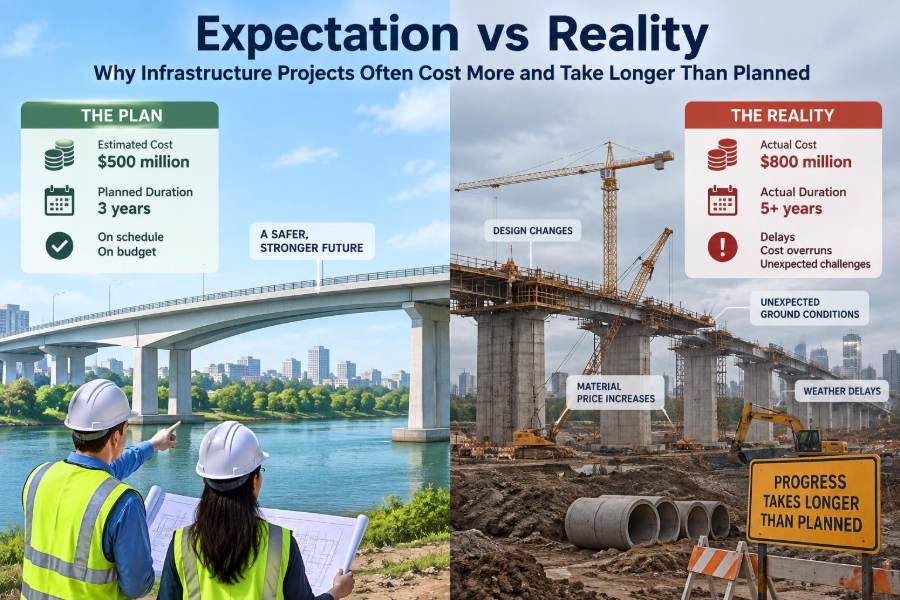

A new bridge, rail extension, flood barrier, or water-treatment plant is often announced with a clean rendering, a budget, and an opening date. For the public, the promise can seem straightforward: approve the project, build it, and start using it.
Then the completion date moves. Construction zones remain in place longer than expected. The reported cost rises, sometimes more than once. It is easy to conclude that someone simply “got the estimate wrong.”
Sometimes poor estimating or weak management is part of the story. But large infrastructure projects are also built in the most complicated places imaginable: beneath active streets, beside operating railways, across rivers, through uncertain ground, and within communities that must keep functioning while work continues.
Understanding the gap between expectation and reality matters for engineers, clients, policymakers, and residents. Better explanations do not excuse avoidable failures; they help distinguish unavoidable uncertainty from risks that should have been identified, priced, and managed earlier.
🏗️ The Basic Pattern: Optimism Meets Complexity
Cost overruns and schedule delays occur when actual delivery requires more money or time than the approved baseline. The baseline is the agreed estimate and programme at a particular point in project development, not merely an early public announcement.
That distinction matters. A concept-stage estimate may be based on limited surveys and broad assumptions. A construction-stage estimate should reflect a far more developed design, known site constraints, procurement strategy, and risk allocation.
Infrastructure combines many interconnected systems: structures, utilities, drainage, pavement, signalling, environmental controls, land access, and public safety. A change to one system can affect several others. Complexity is not automatically mismanagement, but it demands a realistic approach to uncertainty.
🗺️ Why Early Estimates Are Inherently Uncertain
Before design and investigation are complete, an estimate is an informed forecast rather than a final price. The team may not yet know the full ground profile, the exact utility layout, the condition of existing assets, or the eventual construction sequence.
Early numbers are still useful for comparing options and deciding whether to proceed. The mistake is treating a preliminary range as a fixed promise. As definition improves, a responsible estimate may rise because hidden scope and risk have become visible—not necessarily because the project has suddenly become worse.
A useful analogy is renovating an old building. Painting a room can be priced quickly; repairing a wall after discovering rot, asbestos, undocumented wiring, and a damaged foundation cannot be priced with the same confidence.
🔎 Scope Definition Sets the Starting Point
Scope is the complete description of what a project must deliver: physical works, performance requirements, approvals, land, temporary works, testing, commissioning, and handover. A vague scope creates a deceptively low initial estimate.
For example, a rail station project may be described as “two new platforms.” In practice, it may also need lifts, drainage changes, signalling modifications, fire systems, accessibility works, passenger circulation upgrades, track possessions, and interfaces with an operating railway.
Projects should state what is included, excluded, assumed, and still undecided. This does not remove uncertainty, but it prevents stakeholders from comparing a narrow early estimate with a fully developed finished asset.
🌍 Ground Conditions Can Rewrite a Construction Plan
Soil and rock are variable, even across short distances. Boreholes and laboratory tests provide evidence, but they sample only selected locations. Between those points may lie weak soils, boulders, contaminated material, groundwater pressure, voids, or old foundations.
Geotechnical uncertainty is especially consequential for tunnels, deep excavations, bridge foundations, retaining walls, and underground stations. If the ground behaves differently from assumptions, the contractor may need additional support, dewatering, slower excavation, redesigned foundations, or different equipment.
Good site investigation reduces risk, but it cannot turn the subsurface into a fully known condition. The practical aim is to investigate enough to make decisions intelligently and to assign remaining risk explicitly.
🔌 Hidden Utilities Create High-Impact Surprises
Water pipes, sewers, power cables, telecommunications ducts, gas mains, and abandoned services often occupy crowded corridors. Records can be incomplete, locations can differ from drawings, and a single live cable may constrain excavation or require a redesigned sequence.
Utility diversion is rarely just a digging task. It involves locating assets, confirming ownership, designing relocations, obtaining approvals, scheduling outages, protecting customers, and coordinating several organizations.
Early utility mapping, trial holes, and discussions with asset owners are therefore valuable. They may increase preconstruction effort, but they can prevent far more disruptive discoveries after the road has been opened.
🏛️ Existing Assets Are Less Predictable Than New Sites
Many modern projects modify infrastructure built decades ago. Drawings may be missing, dimensions may not match records, and previous repairs may have introduced materials or details that are not obvious until exposed.
A bridge rehabilitation, for instance, may reveal corrosion behind bearings, degraded concrete within a pier, or reinforcement placed differently from historic plans. The design team must then assess safety, develop repairs, and coordinate changes while preserving traffic or rail operations.
Refurbishment is not simply new construction at a smaller scale. Its uncertainty is often greater because the project begins with an asset that has a history rather than a blank site.
📐 Design Maturity Changes the Price
Cost estimates evolve with design maturity. At an early stage, quantities may be derived from approximate lengths, areas, and typical cross-sections. Later, detailed drawings reveal exact retaining-wall lengths, reinforcement complexity, drainage connections, temporary works, and finishes.
An estimate that increases during design is not automatically an overrun. It may be a scope and estimate development issue. The more concerning situation is when a project is committed to a budget before enough design work has been done to test whether that budget is credible.
| Project stage | What is usually known | Main uncertainty |
|---|---|---|
| Concept | Need, broad route or location, possible options | Scope, ground, utilities, approvals, quantities |
| Preliminary design | Preferred solution, key dimensions, initial surveys | Interfaces, constructability, detailed quantities |
| Detailed design | Drawings, specifications, construction methods | Market conditions, residual site risk, delivery performance |
| Construction | Actual work fronts and discovered conditions | Unforeseen events, changes, productivity, disruptions |
🧩 Interfaces Multiply Coordination Work
An interface is a point where systems, teams, contracts, or assets must work together. A new road may interface with drainage authorities, utility owners, adjacent developments, traffic systems, railway operations, environmental regulators, and local access routes.
Each interface has decisions, data requirements, approvals, and dates. If one party is late, another may lose a work window or need to resequence activities. Delays can then cascade even where individual tasks appear small.
Interface management should identify owners, information needed, decision deadlines, and consequences of delay. A programme that lists construction activities but ignores external dependencies is incomplete.
🛤️ Building While the Network Stays Open
Infrastructure is often delivered without closing the system it improves. Roads must carry traffic, railways must run trains, airports must serve flights, and water systems must maintain supply. These operational constraints reduce the contractor’s freedom to work.
Night shifts, weekend possessions, lane closures, outage windows, and strict safety controls can make a task take longer and cost more than the same task on an empty site. Access is not just a logistical detail; it is a production constraint.
Closing a route entirely may shorten construction, but it can create unacceptable disruption for users and businesses. The right choice depends on safety, network resilience, social impacts, and the value of faster delivery.
🚧 Temporary Works Are Real Engineering
Temporary works are structures and arrangements used to build the permanent asset: excavation support, scaffolds, falsework, traffic diversions, crane platforms, cofferdams, and temporary drainage. They are removed or altered, but their design and safety are fundamental.
Early estimates sometimes focus on the visible finished structure and understate the effort needed to create safe access and stable working conditions. A bridge span may be simple on a drawing while its erection over a live road requires elaborate lifting plans, protective measures, and traffic management.
Constructability reviews bring designers, construction specialists, and operators together to test whether a proposed solution can be built safely in the actual site environment.
📜 Permits and Approvals Follow Their Own Timelines
Planning permission, environmental consent, land access, heritage approvals, watercourse permissions, and traffic orders may each require studies, consultation, design information, and review periods. Their timing can be affected by concerns raised during consultation or requests for further evidence.
Approval pathways should not be treated as a single box to tick near the end of design. They are a schedule-critical workstream with dependencies of their own.
Early engagement can clarify expectations, but it does not guarantee approval. Responsible programmes allow for review, revision, and the possibility that conditions will change the design or construction method.
🌿 Environmental Requirements Shape Both Cost and Sequence
Environmental obligations may require habitat surveys, seasonal restrictions, sediment controls, noise limits, water-quality protection, waste management, or remediation of contaminated land. These measures are not optional add-ons when they protect ecosystems, workers, and communities.
Timing is often central. If a particular survey or ecological clearance can only be completed during a suitable season, missing that window can affect the next available construction period. Likewise, in-water work may be restricted to protect fish or other sensitive species.
The most effective approach is to integrate environmental planning with design and programme development. Leaving it until mobilization turns foreseeable requirements into apparent surprises.
🏘️ Land, Property, and Community Impacts Take Time
A route shown on a map is not automatically buildable. Land may need to be acquired, rights negotiated, access agreements secured, or existing tenants relocated. Property issues can become particularly complex where ownership is fragmented or legal rights are unclear.
Communities also need safe pedestrian routes, emergency access, clear communication, and practical mitigation for noise, dust, vibration, and business disruption. Ignoring these needs can lead to objections, redesign, and loss of trust.
Meaningful engagement is not merely a public-relations exercise. Local knowledge can reveal school travel patterns, flood behavior, access needs, or utility issues that formal records do not capture.
📈 Inflation and Market Conditions Move the Target
Infrastructure is exposed to changes in labor availability, fuel costs, material prices, equipment demand, financing conditions, and supplier capacity. A project estimated years before construction may enter a different market from the one assumed in its original budget.
Some contracts include mechanisms for adjusting prices under defined circumstances; others place more price risk on a contractor. Neither approach eliminates the underlying market change. It determines who carries the financial consequences and how transparently they appear.
Forecasts should distinguish between the base construction cost, inflation assumptions, and contingency for uncertain events. Combining them into one unexplained figure makes later changes harder to interpret.
👷 Labor, Skills, and Supply Chains Limit Delivery
A funded project still needs qualified people, specialist equipment, fabrication capacity, and materials delivered when required. Shortages of experienced crews, constrained factory slots, or delayed components can affect productivity and sequence.
Specialized items such as switchgear, rail systems, pumps, bearings, or custom steelwork may require long lead times. A late technical decision can therefore become a late construction activity even before work begins on site.
Procurement planning should identify long-lead items early and avoid releasing incomplete specifications that invite later changes. Buying early can reduce schedule risk, but it also creates storage, compatibility, and design-freeze risks that must be managed.
💼 Procurement Choices Allocate Risk, Not Eliminate It
Traditional delivery, design-build, construction management, alliance-style arrangements, and public-private models distribute responsibilities differently. The contract form influences when price is fixed, who develops design, and how changes are handled.
Transferring a poorly understood risk to a contractor does not make it disappear. Contractors may price the uncertainty, qualify their bid, dispute responsibility later, or face financial pressure if the risk is beyond what was reasonably foreseeable.
A fair allocation places each risk with the party best able to understand, control, or absorb it. This generally produces more useful pricing and fewer incentives to hide problems until they become claims.
📝 Changes Are Sometimes Necessary—and Sometimes Avoidable
Change is common because conditions evolve and stakeholders refine requirements. A safety improvement, a newly identified utility conflict, or a regulatory condition may justify modifying the work.
Other changes arise from late decisions, incomplete requirements, or insufficient design coordination. These are more avoidable and often expensive because they occur after procurement, mobilization, or installation has begun.
Strong change control asks several questions: What has changed? Why? What is the cost and schedule effect? Which alternatives were considered? Who has authority to approve it? Recording answers protects both governance and learning.
⏱️ Critical Paths Explain Why Small Delays Can Matter
A programme contains many activities, but only some sit on the critical path: the sequence that determines the earliest possible completion date. Delaying a noncritical activity may be absorbed by available float, while a short delay to a critical activity can move the final completion date.
Consider a hypothetical pumping station. If electrical equipment cannot be installed until the building is weather-tight, and commissioning cannot begin until that equipment is tested, a delay in roof completion may affect the whole handover sequence.
Programmes should be updated using actual progress and realistic remaining durations. A decorative schedule that is not connected to site conditions cannot provide reliable early warning.
🔄 Rework Consumes More Than Materials
Rework occurs when completed work must be corrected, removed, or rebuilt. It consumes labor and materials, but it also disrupts work fronts, inspections, deliveries, and follow-on trades.
Common triggers include conflicting drawings, unclear specifications, inaccurate setting out, late design revisions, and quality checks performed too late. The cost is often greater than the visible repair because the team must dismantle a sequence that was already underway.
Coordination reviews, model checks where appropriate, clear inspection points, and prompt resolution of technical queries reduce rework. They do not replace skilled supervision, which remains essential on site.
⚖️ Claims and Disputes Can Freeze Progress
When parties disagree about responsibility for delay, changed conditions, or additional cost, they may enter formal claim and dispute processes. These processes can be necessary to resolve legitimate contractual questions, but prolonged conflict consumes management attention and can slow decisions.
Disputes are less likely to be resolved efficiently when records are weak. Daily reports, photographs, programme updates, instructions, site meeting minutes, and clear notices create the factual basis for understanding what happened.
Early issue escalation and collaborative problem-solving can preserve progress. That does not mean ignoring contractual rights; it means separating technical recovery from the eventual allocation of cost whenever possible.
🧪 Testing and Commissioning Are Frequently Underestimated
Construction is not complete when the concrete is poured or the equipment is installed. Systems must be inspected, tested, integrated, demonstrated, documented, and accepted before an asset can operate safely.
Commissioning is especially significant for rail, energy, water, and digital-control systems. Individual components may work separately while the combined system still fails to meet performance requirements.
Handover planning should begin early. It needs acceptance criteria, test procedures, training, operations manuals, spare parts, asset data, and access to rectify defects. Compressing this phase to recover an earlier delay can create operational risk.
🧠 Optimism Bias Shapes Decisions Before Construction
Optimism bias is the tendency to expect a favorable outcome and underestimate difficulties. In projects, it can appear as assumptions that approvals will be smooth, ground conditions will be typical, productivity will be high, or stakeholder decisions will arrive on time.
This is not necessarily dishonesty. Teams can sincerely believe in an ambitious plan, particularly when a project has strong political, commercial, or social urgency. Yet sincere optimism can still produce an unreliable business case.
Independent review, reference to comparable work, and explicit challenge sessions help expose assumptions. The goal is not pessimism; it is an estimate and schedule that remain credible when ordinary complications occur.
🎯 Strategic Underestimation Is a Governance Problem
There is a more troubling possibility than ordinary optimism: an estimate may be presented too low because a more realistic number could make approval difficult. Once work has started, decision-makers may feel compelled to continue because stopping would waste previous investment.
This behavior cannot be corrected by adding a larger contingency alone. It requires transparent assumptions, independent cost assurance, staged approvals, and governance that rewards accurate forecasting rather than only securing initial authorization.
A healthy organization makes it safe to report bad news early. Suppressing emerging risks does not protect a project; it removes the chance to respond while options are still available.
🧮 Contingency Is Not a Slush Fund
Contingency is money set aside for uncertain events within a defined scope. It should be linked to identified risks, the maturity of design, and the confidence needed for the decision being made.
It is different from a management reserve for unforeseeable strategic issues, and different again from deliberate scope additions. Treating all three as one hidden pot makes reporting unclear and can mask whether the project is genuinely consuming risk allowance or expanding its obligations.
Too little contingency creates fragile budgets. Excessive, unexplained contingency can weaken accountability. Good practice is transparent risk-based allowance with regular review as risks are retired, materialize, or change.
📊 Risk Registers Must Drive Real Decisions
A risk register lists threats and opportunities, their likelihood, impact, owners, and planned responses. It becomes useful only when it changes behavior: commissioning another survey, protecting a decision date, procuring a long-lead component, or preparing an alternative construction method.
Risks should be specific enough to act on. “Bad weather” is vague; “river works may be interrupted by seasonal high flows, requiring a protected work area or revised sequence” creates a clearer management question.
Risk reviews need participation from design, construction, commercial, environmental, operational, and stakeholder teams. Major risks often sit between disciplines, where no single team sees the complete consequence.
🧱 Value Engineering Is Not Simply Cutting Cost
Value engineering examines whether a project can provide its required function more efficiently over its whole life. It may simplify a structural form, reduce maintenance needs, standardize components, or alter construction sequence to reduce disruption.
It becomes harmful when used as a label for removing necessary resilience, safety, accessibility, or durability. A lower initial cost can create higher operating cost, more frequent closures, or earlier replacement.
The key question is not “What can be deleted?” It is “What outcome must the asset deliver, and what is the most dependable way to deliver it?”
📣 Transparent Reporting Builds Better Choices
Public and organizational trust depends on reporting that distinguishes approved budget, current forecast, spent cost, contingency use, scope changes, and remaining risks. A single headline number rarely tells the full story.
Schedules need similar clarity. A revised completion date may result from changed scope, delayed authorization, discovered conditions, market constraints, or poor performance. These causes should not be blurred together.
Transparency can be uncomfortable, especially when forecasts worsen. But timely disclosure allows sponsors and communities to consider options: add resources, change scope, resequence work, accept delay, or reconsider the preferred solution.
🛠️ Practical Habits for Project Teams
Better outcomes come from disciplined routine rather than a single forecasting tool. Teams should keep assumptions visible, test them as new evidence arrives, and make decisions at the point where they can still influence cost and time.
- Investigate ground, utilities, existing assets, and access constraints early enough to affect the design.
- Define scope boundaries and operational requirements before asking the market for firm prices.
- Build programmes around approvals, possessions, interfaces, procurement, testing, and handover—not only physical construction.
- Use independent reviews to challenge major estimates, schedules, and risk allowances.
- Track changes promptly and assess their full downstream effects.
- Maintain records that explain actual progress, conditions, decisions, and disruptions.
These practices cost time and money upfront. Their value lies in avoiding late surprises, poorly priced risk, and decisions made under pressure.
👥 What Students and Early-Career Engineers Should Notice
Technical calculations matter, but infrastructure delivery also depends on communication, sequencing, contracts, surveying, safety, stakeholder needs, and operations. Engineers who understand these connections can identify risks before they become site crises.
When reviewing a drawing or attending a site meeting, ask practical questions: How will this be built? What must happen first? Who owns the adjacent asset? What information is still uncertain? How will the finished work be inspected and maintained?
These questions do not replace specialist expertise. They develop the systems thinking that distinguishes a design that works on paper from one that can be delivered responsibly.
🌉 The Core Principle: Forecast Honestly, Deliver Adaptively
Infrastructure projects often cost more and take longer because they are attempts to create long-life public assets amid incomplete information, changing conditions, multiple interfaces, and real-world constraints. Some uncertainty is unavoidable; avoidable surprises usually trace back to weak definition, delayed investigation, poor coordination, or unrealistic governance.
The answer is not to abandon ambition or to pad every estimate without explanation. It is to match confidence to evidence, expose uncertainty clearly, allocate risk sensibly, and update decisions when facts change.
A credible project is not one that promises certainty it cannot possess. It is one that prepares for uncertainty early enough to protect safety, value, performance, and public trust.
Better infrastructure delivery begins when budgets and schedules are treated as evidence-based forecasts—not wishes—and when teams manage the uncertainty behind them openly. 🌉📐🤝