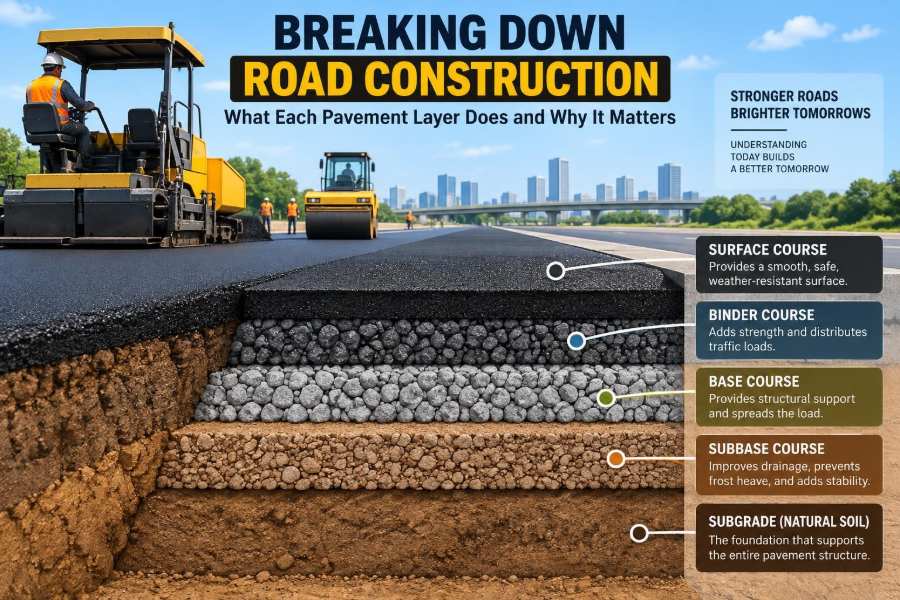

A freshly paved road can look deceptively simple: a dark, smooth surface with crisp lane markings. But the visible asphalt is only the top of a carefully designed system.
When a delivery truck passes, a bus stops repeatedly, or rainwater pools at the kerb, forces and moisture move through that system. Whether the road remains smooth or develops cracks, ruts, and potholes depends largely on what lies beneath the surface.
For civil engineering students, pavement layers turn soil mechanics, materials engineering, drainage, and construction quality into something tangible. For working professionals, understanding the role of each layer helps connect design drawings with site decisions and long-term maintenance.
A pavement is not simply a stack of materials. It is a load-spreading structure that must suit its traffic, climate, available materials, drainage conditions, and construction constraints.
🛣️ A Road Is a Structural System
Road pavement distributes wheel loads so that the natural ground does not deform excessively. A tyre applies a concentrated load near the surface; each underlying layer spreads that load over a larger area.
The principle resembles standing on snow. A narrow heel sinks much more readily than a wide snowshoe because the snowshoe spreads the same force over more area. Pavement layers perform that widening function for traffic loads.
📚 The Basic Pavement Vocabulary
In a typical flexible pavement, the layers from bottom to top are the subgrade, possible improvement or separation layers, sub-base, base course, and asphalt surfacing. Not every project contains every layer, and names can vary between agencies.
Flexible pavement is the common term for asphalt pavement because its bituminous layers deform slightly under load. By contrast, concrete slabs in rigid pavements carry loads differently and are discussed later as a useful comparison.
🌍 The Subgrade: The Ground That Supports Everything
The subgrade is the prepared natural soil, or engineered fill, directly beneath the pavement structure. It is not merely the bottom layer; it is the foundation on which every upper layer relies.
Its strength depends on soil type, density, moisture condition, and uniformity. A strong, well-compacted granular subgrade may need less structural support above it than a weak, wet clay subgrade.
Designers commonly use project-specific testing to estimate subgrade support. The exact test and design method depend on local standards, so a laboratory value should never be treated as permanent if site moisture or construction conditions change.
💧 Why Water Changes Subgrade Behaviour
Water is often more damaging than traffic alone. Fine-grained soils can lose apparent strength when saturated, while repeated loading may pump water and fines through weak zones.
Consider a road across clayey ground with an unsealed drainage outlet. During wet periods, the soil may soften beneath wheel paths; traffic then produces depressions that collect even more water. The distress is visible at the surface, but its cause is below.
🧱 Preparing the Formation Level
The exposed level on which pavement construction begins is often called the formation. Preparing it involves trimming to line and level, removing unsuitable pockets, controlling moisture, and compacting the soil to the specified requirement.
Uniformity matters as much as average strength. A road with mostly firm ground but isolated soft spots can settle unevenly, concentrating bending and strain in the layers above.
- Proof-rolling may reveal yielding areas under a heavy construction vehicle.
- Soft material may be excavated and replaced, or treated where appropriate.
- Standing water should be removed before placing granular layers.
🧪 Subgrade Stabilisation When Soil Is Weak
Where excavation and replacement are impractical, engineers may improve soil using lime, cement, or other binders. Lime is often useful for certain plastic clays, while cementitious treatment can improve a range of suitable soils.
Stabilisation is not a universal cure. Material testing, mixing control, moisture control, curing, and environmental considerations determine whether it performs as intended. Organic soils and highly variable fills may require a different solution.
🧵 Geotextiles and Geogrids: Small Materials, Specific Jobs
Geosynthetics can be placed between soil and aggregate layers. A geotextile may provide separation, preventing fine subgrade soil from mixing into the granular layer while allowing water to pass in a controlled way.
Geogrids can provide reinforcement by interlocking with aggregate and restraining lateral movement. Their benefit depends on correct selection, overlap, placement, and the surrounding material; simply adding a fabric does not compensate for poor drainage or inadequate thickness.
🪨 The Sub-Base: Support, Separation, and Drainage
The sub-base is generally a granular layer placed above the subgrade and below the base course. It provides a stable working platform for construction, adds load distribution, and can help manage water.
Its aggregate must have an appropriate grading: enough smaller particles to fill voids and develop stability, but not so many fines that drainage and frost performance are compromised. The desired balance varies with the pavement system and local specifications.
🌧️ Drainage Is a Design Requirement, Not an Extra
A pavement needs a route for water to leave. Surface crossfall directs rain toward drains or shoulders, while subsurface drainage may intercept water before it reaches sensitive layers.
Granular layers are sometimes assumed to drain automatically. In reality, a dense, well-graded aggregate can have limited permeability, and drainage paths can become blocked by fines. Drainage design must consider outlets, filter compatibility, slopes, and maintenance access.
❄️ Frost and Seasonal Movement
In cold regions, frost-susceptible soils can draw water upward and form ice lenses, causing ground heave. When thaw arrives, the weakened, water-rich soil may temporarily have far less bearing capacity.
Appropriate non-frost-susceptible materials, drainage, insulation in selected cases, and sufficient pavement thickness can reduce this risk. The correct approach depends on local climate and ground conditions rather than a single universal detail.
🏗️ The Base Course: The Main Load-Spreading Layer
The base course is usually the strongest unbound granular layer in a flexible pavement. It lies directly under asphalt layers and is a major contributor to structural capacity.
Good base aggregate needs particle strength, durable shape, suitable grading, cleanliness, and compaction. Under traffic, aggregate particles interlock; this interlock helps resist shear movement and prevents the layer from behaving like loose gravel.
⚙️ Aggregate Gradation and Particle Interlock
Gradation describes the distribution of particle sizes in aggregate. A well-designed blend can create a dense skeleton with enough fine material to fill part of the void space.
Too many fines can retain water and reduce drainage. Too few fines may make compaction difficult and leave a layer prone to movement. Material source, crushing method, and moisture condition all influence site performance.
🚜 Compaction: Where Design Meets Reality
Even excellent aggregate cannot perform properly if it is placed loose or compacted unevenly. Compaction reduces air voids, increases contact between particles, and improves stiffness and resistance to deformation.
Roller type, layer thickness, number of passes, vibration settings, and moisture content must suit the material. A roller may densify the top while leaving the bottom loose if the lift is too thick.
📏 Lift Thickness and Construction Control
A lift is one placed and compacted layer of material. Limiting loose lift thickness allows compaction energy to reach the full depth and makes quality more consistent.
Field density testing, level checks, visual inspection, and proof-rolling each reveal different issues. Passing one test does not automatically prove every requirement has been met; good quality control combines evidence.
🛢️ Prime Coat and Tack Coat Are Not the Same
A prime coat is sometimes applied to a prepared granular base before the first asphalt layer, depending on the pavement system and specification. Its purpose can include binding loose surface particles and preparing the base.
A tack coat is an adhesive bituminous application between asphalt layers or between asphalt and an existing surface. It promotes bonding so layers act together rather than slipping under braking or turning traffic.
🔗 Why Interlayer Bonding Matters
Without effective bond, an asphalt overlay may behave as separate thin sheets rather than one composite structure. This can contribute to slippage cracking, delamination, and reduced load transfer.
Bond is affected by surface cleanliness, application rate, temperature, curing or breaking characteristics, and construction traffic. Dust, moisture, and excess tack can all create problems, so the application must follow the product and project requirements.
⬛ Asphalt Binder Course: Structural Asphalt
The binder course is an asphalt layer below the final wearing course. It contributes substantially to pavement strength and is commonly designed with aggregate and bituminous binder suited to structural load carrying.
Asphalt is a composite: mineral aggregate forms the stone skeleton, and bitumen binds particles while providing flexibility and water resistance. The mix must resist permanent deformation in heat while avoiding excessive brittleness in cooler conditions.
🚚 Load Repetition and Fatigue Cracking
Road damage is strongly influenced by repeated axle loads, not just a single heavy vehicle. Repeated bending can initiate fatigue cracks, often from the bottom of asphalt layers where tensile strain is greatest.
Once cracks connect to the surface, water can enter the structure. This is why timely crack sealing and drainage maintenance can be valuable: they help protect supporting layers before distress becomes more extensive.
🛞 The Wearing Course: The Road Users See
The wearing course is the uppermost asphalt layer in many roads. It provides a smooth, durable running surface and directly affects skid resistance, spray, noise, ride quality, and waterproofing.
It must survive tyre abrasion, weathering, fuel spills in some locations, and localised stresses from braking and turning. A smooth appearance alone is not enough; surface texture and mixture durability are also important.
🚦 Surface Texture, Friction, and Water
Macrotexture refers to the larger texture between aggregate particles, while microtexture relates to the fine roughness of aggregate surfaces. Together they help tyres develop friction, particularly on wet roads.
Surface drainage is equally important. Crossfall, longitudinal grade, kerb arrangement, and drainage inlet placement influence whether water leaves the carriageway or creates ponding in wheel paths.
🔊 Noise, Comfort, and the Limits of Smoothness
Surface choice involves trade-offs. Some open or porous asphalt surfaces can reduce spray and road noise, but they require reliable drainage and can clog if not maintained. Dense surfaces may be more robust in other environments.
Ride quality matters to users and vehicles, but a very smooth finished surface cannot compensate for insufficient structural support. If the layers below continue to move, surface irregularities will return.
🧱 Shoulders, Kerbs, and Edge Support
Pavement edges are vulnerable because they receive less lateral confinement than the middle of the lane. Heavy vehicles travelling near an unsupported edge can cause cracking and edge breakup.
Paved shoulders, properly compacted verge support, kerbs, and sound drainage details can improve edge performance. However, kerbs must not trap water within the pavement; outlets and subsoil drainage details still matter.
🔍 A Quick Layer-by-Layer Reference
| Element | Primary role | Common failure if poorly executed |
|---|---|---|
| Subgrade | Foundation support | Settlement, pumping, widespread deformation |
| Separation or reinforcement layer | Control mixing or improve stability | Aggregate contamination, local rutting |
| Sub-base | Working platform, support, moisture management | Loss of support, drainage problems |
| Base course | Major load distribution | Rutting, cracking, weak wheel paths |
| Binder course | Structural asphalt capacity | Fatigue damage, deformation |
| Wearing course | Friction, smoothness, weather protection | Ravelling, poor skid resistance, water entry |
⚖️ Pavement Thickness Is Not Chosen by Habit
Layer thickness depends on anticipated traffic loading, subgrade support, material properties, drainage, reliability requirements, climate, and the adopted design procedure. A road serving occasional cars has a very different demand from an industrial access road carrying frequent heavy axles.
Using a familiar thickness from another project can be risky when ground conditions or traffic differ. Design must also account for realistic construction tolerances and future maintenance strategy.
🏭 Heavy Vehicles Create Concentrated Demands
At intersections, bus stops, freight yards, and climbing lanes, traffic moves slowly, brakes, turns, or queues. These actions increase shear stresses and can make rutting more likely than on a freely flowing lane.
Engineers may select stronger mixes, thicker asphalt, stabilised layers, or even concrete in highly stressed zones. The appropriate response is site-specific; a material that works on a rural through-lane may not suit a container terminal entrance.
🕳️ How Potholes Actually Develop
A pothole is usually the visible end of a chain of events, not an isolated surface defect. Water enters through cracks, traffic weakens the material, aggregate loosens, and repeated tyre impacts remove pieces of pavement.
A superficial patch can restore safety temporarily, but lasting repair requires removing failed material, addressing trapped moisture or weak support where necessary, creating sound edges, and compacting the replacement correctly.
📉 Rutting Has More Than One Cause
Rutting is a longitudinal depression in a wheel path. It can result from asphalt deformation near the surface, densification or shear movement in granular layers, or weakness in the subgrade.
The repair must match the mechanism. Milling and replacing surface asphalt may be appropriate for a surface mix problem, but it will not solve rutting driven by saturated subgrade below.
🩺 Maintenance Protects the Whole Structure
Preventive maintenance seeks to keep water out and preserve surface function before major structural damage develops. Typical actions include crack sealing, drainage cleaning, local repairs, surface treatments, and timely overlays.
Maintenance decisions should follow condition assessment rather than appearance alone. Visual surveys, roughness measurements, skid assessment, coring, deflection testing, and drainage inspections can each contribute to a clearer diagnosis.
🧭 Flexible and Rigid Pavements Compared
Flexible asphalt pavements spread load gradually through several layers. Rigid concrete pavements use a comparatively stiff slab that distributes load over a wider area, often allowing a different supporting-layer arrangement.
Neither is automatically superior. Concrete can be attractive in severe loading environments, while asphalt can be placed and repaired efficiently in many situations. Initial cost, life-cycle maintenance, local expertise, materials, joints, climate, and traffic management all shape the choice.
♻️ Reclaimed and Lower-Impact Materials
Reclaimed asphalt pavement, recycled aggregates, industrial by-products where permitted, and improved mix technologies can reduce demand for virgin materials. Their use requires careful processing, testing, and specification control.
Sustainability is not achieved simply by calling a material recycled. A lower-impact pavement must still meet structural, durability, drainage, and safety requirements over its intended service life.
🦺 Site Safety and Sequencing Affect Quality
Traffic control, safe plant movement, and disciplined sequencing protect people and the pavement work. For example, hauling vehicles turning on an unprotected tack coat or wet granular layer can damage a prepared surface before the next layer is placed.
Weather windows matter too. Asphalt temperature, rain risk, wind, and haul time influence compaction and bonding. Construction planning is therefore part of pavement performance, not merely site logistics.
🧠 Common Mistakes to Avoid
- Treating drainage as an afterthought: water can undermine otherwise adequate thickness.
- Building over soft spots: local defects often reflect through the completed road.
- Using excessive lift thickness: lower portions may remain under-compacted.
- Neglecting layer cleanliness: contamination reduces bonding and material quality.
- Repairing symptoms only: surface distress may originate in deeper layers.
- Assuming specifications replace judgement: field conditions still require observation and response.
🎓 Reading a Pavement Section Drawing
When reviewing a drawing, trace the system from the finished road level downward. Identify layer material, compacted thickness, crossfall, interfaces, edge details, drainage features, and any notes about treatment or geosynthetics.
Then ask practical questions: Where does water go? Is there a change in thickness at a driveway or junction? What happens where the pavement meets a culvert trench? These transitions often deserve more attention than a uniform mid-block section.
🌉 The Core Principle Behind Every Layer
Every pavement layer has a job, but the layers succeed only when they work together. Strong asphalt over wet, weak soil will eventually show distress; excellent subgrade preparation can still be compromised by poor interlayer bond or blocked drainage.
Durable roads are built by managing loads, moisture, materials, and construction quality as one connected system. That principle explains why a road’s long-term performance is decided as much below the surface as above it.
A reliable pavement is not defined by its blacktop alone. It is the result of a sound foundation, well-compacted supporting layers, appropriate asphalt, controlled water, and maintenance that responds to the real cause of damage—not merely what can be seen from the road. 🛣️💧🏗️