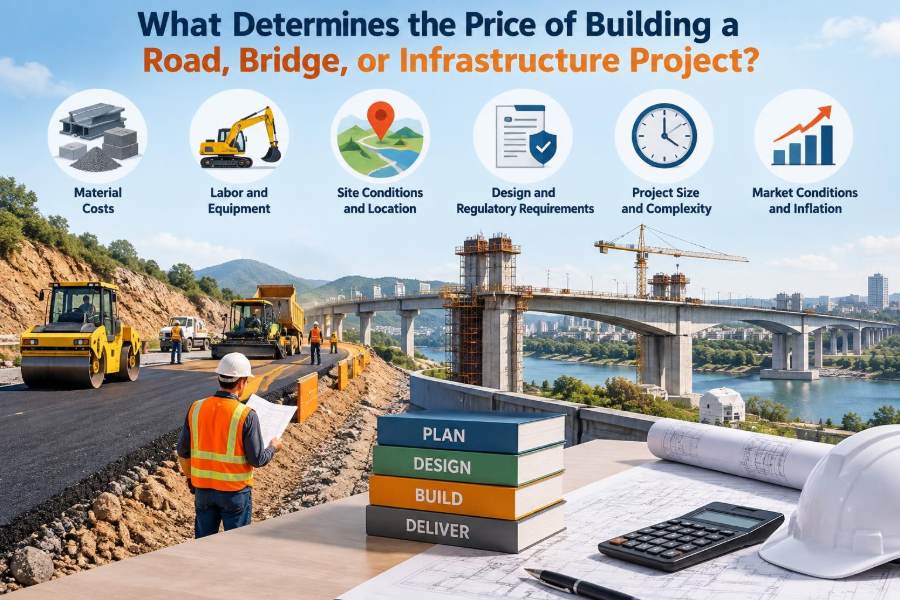

A new road may look simple from a passing car: a smooth surface, painted lines, drainage grates, and perhaps a bridge over a creek. Yet the price behind that view can vary enormously, even between projects of similar length.
Consider two hypothetical two-lane roads. One crosses open, firm ground beside an existing utility corridor. The other enters a dense town, passes through soft soil, crosses a railway, and must remain open to traffic during construction. Their maps may show the same distance, but their engineering problems are entirely different.
This is why a single “cost per kilometre” or “cost per bridge” figure is rarely enough to explain infrastructure pricing. It can be useful for early comparisons, but it cannot replace a project-specific estimate.
For students, understanding these cost drivers connects design decisions to real constraints. For professionals and communities, it helps explain why a change that looks small on a drawing can reshape a budget, schedule, and risk profile.
🧭 A project price is built, not discovered
The cost of infrastructure is the combined result of scope, site conditions, design choices, delivery method, timing, and risk. A road is not merely asphalt; it may include earthworks, drainage, lighting, signs, retaining walls, utility adjustments, landscaping, traffic management, and land acquisition.
Likewise, a bridge is a system of foundations, supports, deck, bearings, barriers, approaches, drainage, and inspection access. The visible superstructure is only part of what must be designed and paid for.
📏 Scope defines the starting point
The first cost question is: what exactly is being delivered? A rural access road, an urban arterial, and a motorway lane addition are all “roads,” but they serve different speeds, traffic volumes, vehicle types, safety requirements, and operational needs.
Scope should state measurable outputs: route length, number and width of lanes, junctions, structures, drainage standard, pavement design life, active-travel facilities, and required relocations. An incomplete scope creates estimates that appear precise but are built on missing work.
🗺️ Location changes nearly everything
Location affects material haul distances, access for equipment, labour availability, weather exposure, local permitting, and the cost of working around existing development. A remote site may have inexpensive land but costly logistics. A central urban site may have excellent suppliers but severe access restrictions.
Local conditions also influence the practical construction window. Mountain weather, monsoon seasons, freezing conditions, or flood periods can limit when certain operations are feasible.
🪨 Ground conditions drive hidden costs
Before construction begins, engineers investigate the ground through mapping, boreholes, trial pits, geophysical surveys, and laboratory testing. The aim is not to eliminate uncertainty completely; it is to understand the ground well enough to design safely and price risk sensibly.
Rock excavation can require specialized breaking or controlled blasting. Soft clay may need removal, reinforcement, drainage, staged loading, or deep foundations. Contaminated material can require testing, handling controls, and disposal at appropriate facilities.
A small difference in soil profile can therefore change both the design and the construction sequence.
💧 Water is often the deciding constraint
Water affects infrastructure above and below ground. High groundwater can complicate excavations. Rivers can scour bridge foundations, while intense rainfall can overload drainage if runoff is underestimated. Coastal projects may face tides, waves, corrosion, and saline groundwater.
Drainage is often underestimated by non-specialists because much of it is buried. Culverts, channels, pipes, manholes, outfalls, detention features, and erosion protection may occupy a meaningful share of a road project’s work.
🌍 Earthworks balance cut, fill, and hauling
Earthworks involve cutting high ground, placing fill in low areas, shaping slopes, and preparing the formation on which pavement is built. The cheapest outcome is not always the route with the shortest length; it may be the route that minimizes difficult excavation and long-distance hauling.
Engineers seek an efficient earthwork balance, where suitable excavated material can be reused as fill. But material quality matters. Organic soils, weak clay, or unsuitable rock cannot automatically be used in embankments.
🛣️ Pavement is a layered structural system
Road pavement is designed for anticipated traffic loading, climate, drainage, subgrade strength, and intended service life. Heavy trucks impose far more damaging loads than ordinary cars, so a freight route may need a substantially stronger pavement than a lightly used local street.
Typical layers can include improved subgrade, granular sub-base, base course, and an asphalt or concrete surface. Thickness, material specification, and quality control all affect cost, but reducing them without sound engineering can transfer expense into early maintenance.
🏗️ Bridge type follows the crossing problem
A bridge’s price depends heavily on span arrangement and structural form. A short crossing over a drainage channel may use precast concrete units. A long river crossing, valley viaduct, or major navigation route demands a different solution.
Possible forms include slab bridges, beam bridges, box girders, arches, trusses, cable-stayed bridges, and suspension bridges. None is universally cheapest. The appropriate choice depends on span, clearance, foundation conditions, construction access, aesthetics, maintenance, and disruption below.
🔩 Foundations carry uncertainty into cost
Bridge foundations transfer loads safely into the ground. Where strong material lies near the surface, shallow foundations may work. Where weak soils, scour, or deep competent strata are present, piles, drilled shafts, or other deep systems may be necessary.
Foundation construction is sensitive to actual site conditions. Obstructions, variable rock levels, unexpected groundwater, or difficult drilling can affect productivity. Good investigation reduces surprises, but contingency remains necessary because the ground cannot be inspected everywhere in advance.
🚧 Existing utilities can dominate urban work
Water mains, sewers, power cables, telecommunications lines, gas pipes, and district-energy systems often occupy the same corridors needed for roads. Their locations may be incomplete on records, and their owners may require approvals, shutdown plans, supervision, or protective measures.
Utility relocation is not just a physical task. It requires coordination among asset owners, designers, contractors, and affected customers. Late discovery can force redesign, delay excavation, and disrupt a carefully planned sequence.
🚦 Keeping traffic moving has a price
Many projects are built while the existing road, rail line, waterway, or pedestrian route remains in use. Temporary lanes, barriers, signs, signals, detours, work-zone lighting, and traffic-control staff add direct cost.
Staging can also reduce efficiency. A contractor may need to build half a structure, shift traffic, then build the other half rather than working across the full site at once. The public benefit is continuity, but it must be recognized in the project budget.
🚆 Interfaces with rail and waterways raise complexity
Crossing a railway or working beside one often requires tightly controlled access periods, safety protection, and approval of detailed construction plans. Railway possessions—periods when normal operations are restricted—can be limited and expensive to miss.
Waterway work can require navigation clearance, environmental controls, flood planning, and special installation methods. A design that reduces interference with rail or river operations may cost more initially but avoid broader disruption risks.
🏙️ Urban constraints are more than tight space
In built-up areas, crews may work close to homes, businesses, hospitals, schools, heritage assets, and underground services. Noise, dust, vibration, access, deliveries, and emergency routes must be managed alongside the physical construction.
Limited laydown space means materials may arrive in smaller, more frequent deliveries instead of being stored on site. That affects logistics, productivity, and the ability to recover quickly from delays.
🌳 Environmental commitments shape design and method
Environmental requirements may address protected habitats, water quality, tree retention, sediment control, noise, air quality, and waste handling. These are not simply additions at the end of design; they can determine alignment, drainage strategy, work timing, and construction methods.
For example, avoiding in-channel work during sensitive periods may constrain the programme. It can be the right mitigation, but the estimate should include the resulting scheduling and access implications.
🏘️ Land acquisition and rights are separate cost streams
A project may require permanent land, temporary construction access, easements, or rights to relocate utilities. The cost is shaped by property type, local process, valuation, negotiations, and legal requirements.
Land issues can also influence alignment. A route that looks geometrically efficient may cross many parcels or affect critical businesses, while a slightly longer route may reduce acquisition complexity. These are planning trade-offs, not merely line items.
📐 Standards establish minimum performance
Design standards set expectations for safety, geometry, loads, materials, accessibility, drainage, barriers, seismic performance where relevant, and many other features. They help provide consistency, but applying them requires engineering judgment for the project context.
Higher design speeds can require gentler curves, longer sight distances, wider clear zones, and more substantial junction layouts. A change in design criteria can therefore affect land, earthworks, structures, and drainage simultaneously.
♿ Accessibility and complete streets add valuable scope
Footways, crossings, ramps, tactile paving, cycle tracks, bus stops, lighting, and public-realm improvements can expand a project beyond vehicle movement. These features should not be treated as cosmetic extras; they affect how safely and independently people can use the corridor.
They do, however, need physical space and coordination. Drainage inlets, utility covers, kerb lines, tree pits, parking, and loading activity all need to work together in a constrained urban cross-section.
🧱 Materials respond to market and specification
Concrete, reinforcing steel, structural steel, asphalt binders, aggregates, pipes, electrical equipment, and bearings have different supply chains and lead times. Prices can change between early planning and procurement, particularly when energy, transport, or demand conditions shift.
Specification matters as much as quantity. Corrosion-resistant reinforcement, high-performance concrete, specialized waterproofing, or durable surfacing may cost more upfront while being justified by exposure and expected maintenance needs.
👷 Labour, plant, and productivity set construction cost
Construction estimates combine labour hours, equipment time, materials, subcontract work, overheads, and expected productivity. Productivity is shaped by working room, shift patterns, weather, access, repetitive work, inspection hold points, and crew experience.
A tower crane, piling rig, asphalt paver, or large lifting operation may be essential for a particular method. Plant selection affects not only daily cost but also programme duration and site safety planning.
⏱️ Schedule has a direct monetary effect
Time costs money through site supervision, traffic management, plant hire, temporary works, insurance, security, and financing arrangements where applicable. Delays can also push work into less favourable weather or create conflicts with seasonal restrictions.
Acceleration is possible in some cases through additional shifts, prefabrication, or parallel work fronts. It is rarely free. Faster delivery must be weighed against congestion, safety, quality-control capacity, and available labour.
🏭 Prefabrication can trade site risk for factory planning
Precast beams, modular bridge elements, prefabricated drainage structures, and factory-made reinforcement cages can shorten critical site activities. This can be especially useful where road closures or rail possessions are limited.
However, prefabrication requires transport routes, lifting capacity, accurate interfaces, early design decisions, and reliable manufacturing slots. A module that is efficient in a factory may be difficult to deliver through narrow streets or beneath low clearances.
🧰 Temporary works are real engineering
Temporary works support construction until the permanent structure can carry itself. Examples include excavation shoring, falsework, scaffolding, cofferdams, temporary bridges, crane platforms, and dewatering systems.
They are sometimes overlooked in early estimates because they do not remain after opening day. Yet they can be essential to safety and constructability, particularly for deep excavations, river works, or bridge construction over live traffic.
🛡️ Risk allowances should be visible and reasoned
An estimate should distinguish between defined work and uncertainty. Contingency is an allowance for identified risks or incomplete definition; it is not a vague reserve for poor planning.
Typical risks include unknown utilities, difficult ground, environmental approvals, weather disruption, supplier lead times, third-party interfaces, and design development. As information improves, some allowances should reduce while newly identified risks may require attention.
📊 Estimate maturity matters as much as the estimate total
Early concept estimates rely on broad quantities, comparable projects, and assumptions. Later estimates use surveys, geotechnical data, drawings, construction methods, quotations, and more detailed quantities. These are different levels of confidence, not competing answers.
| Estimate stage | Typical basis | Main limitation |
|---|---|---|
| Early planning | Comparable schemes and high-level scope | Many site and design details are unknown |
| Developed design | Measured quantities and preliminary methods | Some interfaces and market inputs may remain uncertain |
| Pre-construction | Detailed documents and supplier or contractor pricing | Actual conditions and future market movement can still differ |
Presenting an early estimate as a fixed promise is a common communication failure. A useful estimate explains its basis, exclusions, assumptions, and uncertainty range in terms appropriate to the decision being made.
🤝 Procurement allocates responsibility and opportunity
Under different delivery models, the owner, designer, and contractor take on different responsibilities for design, construction, pricing, and risk. Traditional design-bid-build, design-build, construction management, and collaborative arrangements can produce different cost profiles.
A low bid is not automatically the lowest whole-project cost. If information is incomplete or risks are transferred unrealistically, claims, change orders, schedule impacts, or quality compromises may follow. Clear scope and fair risk allocation support better outcomes.
🔄 Changes become expensive when they arrive late
Early design changes usually involve analysis and drawings. Late changes may require demolition, remobilization, new permits, altered procurement, and disruption to completed work. The same decision therefore costs far more after construction has begun.
Value engineering works best when it examines function: can the project meet the required performance with less material, simpler staging, safer construction, or lower maintenance? It should not mean removing necessary resilience or safety features solely to reduce the initial figure.
🔍 Quality assurance prevents costly rework
Testing, inspection, surveys, material certificates, trial sections, and documented hold points help verify that work meets specification. They consume time and money, but they reduce the chance that hidden defects become expensive repairs later.
Examples include checking compaction in embankments, concrete strength and curing, reinforcement placement, weld quality, asphalt density, and drainage gradients. Good quality management is planned into production rather than added after a problem appears.
🧮 Whole-life cost changes the “cheapest” answer
Initial construction cost is only one part of public value. Assets also require inspections, cleaning, renewal, repairs, traffic management during maintenance, and eventual rehabilitation or replacement.
A slightly higher-capital-cost option can be justified if it improves durability, reduces access difficulty, or avoids repeated disruption. Conversely, highly specialized components may carry future maintenance challenges if replacements are difficult to source. Whole-life analysis should consider both expected cost and operational consequences.
🌦️ Resilience requires choices under uncertainty
Infrastructure is exposed to floods, heat, freeze-thaw cycles, landslides, earthquakes in relevant regions, vessel impact, and changing traffic patterns. Designing for every imaginable event would be impractical, but ignoring credible hazards can create unacceptable future costs.
Resilience decisions involve uncertainty and policy choices. Raising a road, enlarging drainage, protecting bridge piers, or selecting more durable materials may increase initial cost while reducing vulnerability to disruptive failures.
📝 A practical way to question a project budget
When reviewing a proposed cost, ask what is included before comparing totals. Useful questions include:
- What are the stated quantities, performance requirements, and project boundaries?
- What ground, utility, environmental, and land information supports the estimate?
- How will traffic, pedestrians, rail, or waterways be maintained during construction?
- What assumptions have been made about materials, labour, access, and schedule?
- Which risks are included in contingency, and who owns them?
- Does the comparison consider maintenance and renewal, not only opening-day cost?
These questions do not require a reader to be an estimator. They help reveal whether two apparently similar prices are actually pricing the same problem.
🎯 The core principle: cost follows conditions and decisions
Roads, bridges, and other civil infrastructure are priced through a chain of decisions: where to build, what performance is needed, what the site allows, how construction will proceed, and how uncertainty will be managed. Length or area alone cannot capture that chain.
The strongest budgets emerge from early investigation, clear scope, constructable design, realistic scheduling, explicit risks, and a whole-life view. Cost control is not simply about cutting items; it is about making informed choices before uncertainty becomes expensive.
The price of infrastructure reflects the full challenge of creating a safe, durable, buildable asset in a real place—not just the concrete, steel, or asphalt visible at the end. 🌉🛣️📐