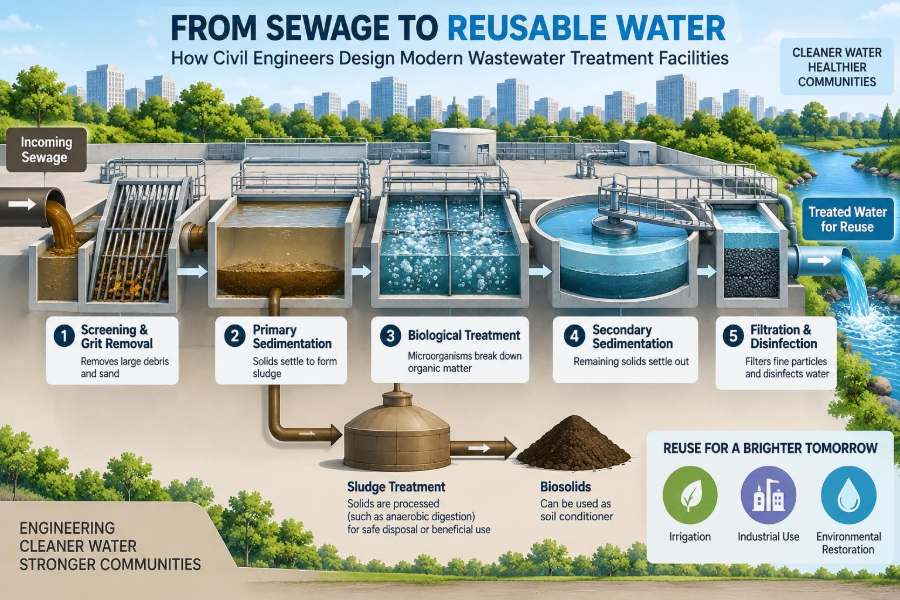

When a toilet flushes, a shower drains, or a restaurant dishwasher finishes a cycle, the water disappears from view almost immediately. Yet it does not disappear from the urban system. It enters a network that must safely carry a changing, contaminated flow away from homes, workplaces, hospitals, and industries.
At a wastewater treatment facility, that ordinary-looking water becomes an engineering problem with public-health, environmental, energy, and resource-recovery dimensions. The plant must work during dry weather, morning peaks, storms, equipment failures, and gradual changes in a community’s population.
The objective is no longer simply to make wastewater “cleaner.” Modern facilities are designed to remove specific contaminants, protect receiving waters, recover useful materials where practical, and sometimes produce water suitable for reuse.
Civil engineers connect all of these tasks: hydraulics, structures, geotechnical design, process engineering, construction, operations, and long-term planning. Following the treatment train from inlet to outlet shows why a wastewater plant is one of the most carefully coordinated pieces of infrastructure in a city.
🚽 What Wastewater Actually Contains
Municipal wastewater is mostly water, but the small fraction of dissolved and suspended material determines the treatment challenge. It includes human waste, food residue, soap, oils, paper fibers, grit, microorganisms, nutrients, and chemicals washed from domestic and commercial activities.
Not all incoming flow has the same strength. Industrial discharges can contain high organic loads, salts, metals, or unusual chemicals, while a storm can dilute wastewater but sharply increase its volume. Engineers therefore design for both water quality and flow variability.
🏙️ Why Treatment Facilities Matter to Cities
Untreated wastewater can reduce dissolved oxygen in rivers and lakes as microorganisms consume organic material. Low oxygen stresses aquatic life, while pathogens can create direct public-health risks where people contact contaminated water.
Nitrogen and phosphorus can also stimulate excessive algae growth in sensitive waters. Treatment requirements are therefore often shaped by the capacity and condition of the receiving river, lake, estuary, or coastal zone—not only by the size of the city.
🗺️ Starting with the Service Area
Plant design begins upstream of the site. Engineers identify the population served, land uses, existing sewer network, industrial contributors, seasonal visitors, planned development, and the drainage area connected to the system.
A facility sized only for current demand may become overloaded long before its structures reach the end of their physical life. Conversely, major equipment installed far ahead of need can impose unnecessary capital and operating costs. A common solution is phased expansion: reserve land and hydraulic routes for future units while building treatment capacity in stages.
📈 Estimating Flow and Pollutant Loads
Flow is commonly expressed as a daily average, but averages do not operate pumps or prevent flooding. Engineers also examine peak hourly flow, minimum flow, wet-weather flow, and the rate at which flow changes.
They estimate pollutant loads such as biochemical oxygen demand, suspended solids, nitrogen, and phosphorus. A treatment process needs enough volume, oxygen transfer, chemical supply, and solids-handling capacity to manage the mass of contaminant entering it, not merely the number of liters passing through.
🌧️ Designing for Rain and Infiltration
In separate sewer systems, sanitary sewage and stormwater are intended to travel in different pipes. In reality, groundwater can enter sanitary sewers through cracks and joints, while illegal connections and damaged manholes can admit rainfall.
This inflow and infiltration can overwhelm a plant hydraulically even when pollutant concentrations are low. Engineers may address it through sewer rehabilitation, storage, flow equalization, or treatment bypass arrangements permitted by local regulations. Expanding the plant alone may not be the most effective solution.
📍 Choosing a Suitable Site
A treatment plant needs more than a large empty parcel. Site selection considers access roads, sewer elevations, flood exposure, soil conditions, available power, room for expansion, setback requirements, nearby sensitive receptors, and a practical route for treated-water discharge or reuse distribution.
Topography strongly affects energy use. If wastewater can arrive largely by gravity, pumping demand is lower. However, a low-lying site may face flood risk, high groundwater, or difficult construction conditions, so the “lowest” site is not automatically the best one.
🧭 The Treatment Train Concept
Most facilities use a sequence of physical, biological, and chemical processes. Each step protects or improves the performance of the next, much like sorting, washing, and filtering ingredients before preparing food.
| Stage | Main purpose | Typical examples |
|---|---|---|
| Preliminary treatment | Protect equipment from large debris and abrasive material | Screens, grinders, grit chambers |
| Primary treatment | Settle readily removable solids | Primary clarifiers |
| Secondary treatment | Remove dissolved and fine organic pollution biologically | Aeration basins, biofilters, clarifiers |
| Advanced treatment | Target nutrients, particles, pathogens, or trace concerns | Filtration, nutrient removal, disinfection |
| Solids treatment | Stabilize and reduce sludge volume | Digestion, dewatering, drying |
The exact arrangement depends on influent characteristics, permit limits, available land, climate, operator capacity, and the intended use of treated water.
🧱 Headworks: The Plant’s First Defense
The headworks receives raw wastewater and removes materials that could clog pumps, wrap around rotating equipment, or accumulate in tanks. Coarse screens capture items such as wipes, rags, and plastics; finer screens remove smaller debris where needed.
Screenings must be washed, compacted, and safely disposed of. Designing for access, odor control, washdown, and maintenance is essential. A screen that performs well on paper but cannot be cleared safely during a blockage is not a resilient design.
🏖️ Removing Grit Before It Causes Damage
Grit includes sand, gravel, eggshell fragments, and other dense mineral particles. Unlike organic solids, it does not break down in biological tanks. It settles in channels and basins, erodes pumps, and reduces usable volume.
Grit chambers slow or control flow so that heavy particles settle while lighter organic matter continues onward. Their performance is sensitive to hydraulic conditions, which is why channel geometry and flow control deserve as much attention as the grit-removal equipment itself.
🌀 Pumping and Hydraulic Profile
Wastewater plants are often designed around a hydraulic profile: a drawing that tracks the water level needed at each stage. It reveals whether flow can move by gravity and where pumps must lift it.
Every screen, pipe, valve, tank, and filter causes headloss. If these losses are underestimated, upstream levels can rise and cause flooding. If elevations are set too conservatively, unnecessary pumping energy can burden the plant for decades.
🫧 Primary Clarification
In a primary clarifier, wastewater moves slowly enough for settleable solids to sink as primary sludge while fats, oils, grease, and floating material are skimmed from the surface. This reduces the solids and organic load reaching later processes.
Primary treatment is not a substitute for biological treatment, because much pollution remains dissolved or finely suspended. Still, it can reduce downstream equipment size and produces a concentrated solids stream that may support energy recovery.
🦠 Biological Treatment and the Activated Sludge Process
Activated sludge is among the most widely used secondary-treatment systems. In aeration basins, communities of microorganisms consume biodegradable organic matter. Air or oxygen is supplied both to support these organisms and to keep solids mixed.
The mixed liquid then enters a secondary clarifier. Biological solids settle, clarified water leaves the top, and a portion of settled biomass returns to the aeration basin. This return activated sludge maintains the microorganism population needed for treatment.
💨 Aeration: A Major Energy Decision
Aeration is commonly one of the largest electricity demands at a wastewater plant. Too little oxygen can impair treatment; too much wastes energy and may disrupt process goals such as nitrogen removal.
Engineers select blowers, diffusers, mixing systems, and control instrumentation based on expected loads and operating ranges. Dissolved-oxygen sensors and automated controls can adjust air delivery, but instruments require calibration and maintenance. Automation improves decisions only when the underlying measurements are reliable.
🧬 Nitrogen Removal Through Nitrification and Denitrification
Nitrogen can reach wastewater primarily as ammonia. In an aerobic zone, specialized microorganisms convert ammonia to nitrate through nitrification. Because ammonia can harm aquatic organisms, this conversion may be a key permit requirement.
In an anoxic zone—one with no dissolved oxygen but with nitrate available—other microorganisms convert nitrate to nitrogen gas, which escapes harmlessly to the atmosphere. Successful denitrification requires careful recirculation of nitrate-rich water and a suitable carbon source.
🌿 Phosphorus Control
Phosphorus is another nutrient that may need removal before discharge to sensitive waters. Plants can remove it biologically by encouraging particular microorganisms to store phosphorus, or chemically by adding coagulants that form settleable phosphorus-containing solids.
Biological phosphorus removal can reduce chemical consumption but is sensitive to influent conditions and process operation. Chemical removal is often dependable and flexible, yet it increases solids production and requires storage and handling systems. Many facilities use a combination when conditions warrant it.
🔍 Secondary Clarifiers and Solids Separation
Secondary clarifiers separate treated water from the biological solids created in aeration. Their apparent simplicity hides a demanding hydraulic and biological balance: poor settling can allow solids to escape with the effluent, undermining downstream disinfection or filtration.
Operators watch sludge blanket depth, settling behavior, return rates, and hydraulic loading. Civil engineers provide the tank geometry, inlet and outlet arrangements, and redundancy that allow this process to remain stable under changing flows.
🧪 Tertiary Filtration for Polishing
Where effluent limits are strict or water is intended for reuse, treatment may continue through tertiary filtration. Filters capture fine particles that remain after clarification, often using granular media, cloth disks, or membranes.
Filtration is particularly useful because particles can shield microorganisms from disinfectants. It is not universally necessary, however. Its value depends on required effluent quality, variability in secondary treatment, footprint, energy use, and maintenance capacity.
☀️ Disinfection Without Creating New Problems
Disinfection reduces pathogens before discharge or reuse. Common options include ultraviolet light, chlorine-based systems, and ozone in selected applications. The best choice depends on water quality, required pathogen reduction, contact time, operator skills, safety systems, and receiving-water conditions.
Chlorine can provide a residual disinfectant but may require dechlorination before discharge to avoid harming aquatic life. Ultraviolet systems avoid a chemical residual but depend on lamp condition, clean sleeves, and sufficiently low turbidity. No disinfection method can compensate for fundamentally poor upstream treatment.
♻️ Matching Reclaimed Water to Its Intended Use
Reusable water is not one universal product. Water suitable for landscape irrigation may have different treatment, monitoring, storage, and distribution requirements than water proposed for industrial cooling, toilet flushing, aquifer recharge, or indirect potable reuse.
Engineers apply a fit-for-purpose approach: define the end use first, then specify treatment barriers and monitoring appropriate to the risk. Reuse systems also need dedicated pipes, cross-connection controls, storage, and clear operational responsibilities.
🧱 Sludge Is a Resource and a Responsibility
Solids removed from wastewater are called sludge, or biosolids after appropriate treatment and stabilization. Although they represent a smaller volume than incoming water, handling them can account for a large share of plant complexity and cost.
Thickening concentrates solids before further treatment. Stabilization reduces odors and pathogen risks, while dewatering removes water so material can be transported or beneficially used where regulations and local conditions allow. Disposal routes must be planned from the beginning, not treated as an afterthought.
🔥 Anaerobic Digestion and Biogas
Anaerobic digesters use microorganisms in oxygen-free conditions to stabilize organic sludge. One product is biogas, containing methane and carbon dioxide, which may be used for heating, electricity generation, or upgraded for other uses when the project economics and systems support it.
Digesters are not automatically suitable for every plant. They require capital, trained operators, gas safety systems, and enough biodegradable solids to justify their complexity. Smaller facilities may choose other solids-management strategies.
⚡ Designing for Energy, Not Just Compliance
A treatment plant must meet discharge requirements every day, but its lifetime environmental performance also depends on electricity and chemical demand. Pumping, aeration, solids processing, heating, and advanced treatment can all be significant loads.
Useful design measures include minimizing unnecessary lift, selecting efficient equipment across its expected operating range, recovering biogas where viable, and providing controls that respond to actual conditions. Energy optimization must never compromise treatment reliability or worker safety.
👃 Odor Control and Community Compatibility
Odors often originate near headworks, primary treatment, solids handling, and any stagnant or anaerobic zones. Hydrogen sulfide and other compounds can create nuisance conditions and may contribute to corrosion.
Good odor control starts with process layout: cover high-odor areas, keep wastewater moving, provide ventilation, and treat captured air when necessary. Locating odor sources and access points thoughtfully can reduce both neighbor impacts and maintenance difficulties.
🛡️ Redundancy, Resilience, and Safe Failure
Wastewater never stops arriving because a pump, blower, screen, or power feeder fails. Critical equipment is therefore often installed with standby capacity, bypass routes, isolation gates, and the ability to take a unit out of service for maintenance.
Resilience also includes flood protection, backup power, spare-parts planning, cybersecurity for control systems, and emergency operating procedures. Designing for failure does not mean accepting poor performance; it means preventing one failure from becoming a public-health or environmental incident.
📟 Instrumentation and Operator Control
Modern plants use flow meters, level sensors, dissolved-oxygen probes, pH measurement, turbidity monitoring, and automated control systems. These tools show operators what is happening inside processes that cannot be judged reliably by appearance alone.
However, a sensor can drift, foul, or fail. Sound design includes sample points, manual verification methods, alarm priorities, and clear control logic. Operators need information that supports action, rather than a control room filled with unmanageable alarms.
👷 Designing for the People Who Operate the Plant
A facility may be technically sophisticated yet difficult to operate. Engineers should consider safe walkways, lifting access, fall protection, chemical delivery routes, confined-space risks, lighting, drainage, noise, and the physical effort required for routine tasks.
Early input from operators can reveal practical issues that drawings miss: whether a valve can be reached, whether a screen can be cleaned safely, or whether a sample point can be used during rain. Operability is a design criterion, not a final checklist item.
🏗️ Construction Sequencing at Existing Facilities
Many projects expand or upgrade plants that must remain in service. Construction sequencing then becomes part of the treatment design. Taking a tank or pipe out of operation can reduce capacity precisely when wet weather arrives.
Temporary pumping, bypass piping, phased tie-ins, and carefully scheduled shutdowns may be required. Contractors, designers, and plant staff need clear coordination because an apparently minor connection can alter flows throughout the facility.
⚠️ Common Design Mistakes to Avoid
Several recurring mistakes arise when a plant is treated as a collection of individual machines rather than an integrated system.
- Designing to average flow: peak conditions, maintenance outages, and storms drive many real operational problems.
- Ignoring hydraulics: insufficient elevation or overlooked headloss can create upstream flooding and excessive pumping.
- Underestimating solids handling: poorly planned sludge processing can constrain the whole plant.
- Overcomplicating controls: systems that cannot be maintained or understood will not deliver their intended benefit.
- Leaving no room to grow: future expansion becomes far more costly when land, pipe corridors, and electrical capacity were not reserved.
📐 A Hypothetical Upgrade Example
Imagine a growing town whose existing plant meets normal dry-weather requirements but struggles during rain. Monitoring shows that groundwater infiltration is driving large wet-weather flows, while nutrient limits are expected to tighten in the future.
A sound solution might combine sewer rehabilitation with new equalization storage, rather than sizing every downstream process for the largest short-term peak. The town could add biological nutrient-removal basins in a future phase, reserve electrical capacity, and install tertiary filtration only if reuse or discharge requirements justify it.
This is a hypothetical example, but it illustrates a central practice: define the actual constraint before selecting equipment. The largest structure is not necessarily the best engineering answer.
🌍 The Core Principle: Treat Water as a Managed Cycle
Modern wastewater facilities protect health and waterways by combining multiple barriers: collection, screening, settling, biological conversion, solids separation, polishing, disinfection, and responsible residuals management. Each barrier addresses a different part of the problem.
The most durable designs balance treatment performance with hydraulics, energy, maintenance, safety, community impacts, and future uncertainty. They also recognize that reusable water and recovered resources are possible only when the entire system—from sewer to final use—is planned as one connected cycle.
Effective wastewater engineering turns a necessary public service into a reliable system for protecting water, recovering value, and supporting resilient communities. 🌊♻️🏗️