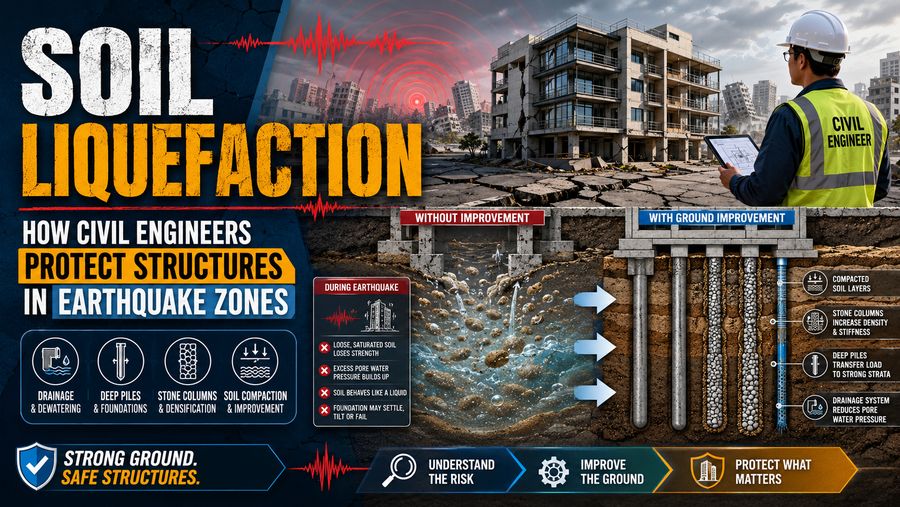

Earthquakes can damage buildings in more ways than simply shaking them. In certain ground conditions, strong seismic motion can cause water-saturated soil to temporarily lose much of its strength and behave almost like a liquid. This phenomenon is known as soil liquefaction, and it can seriously affect buildings, bridges, roads, pipelines, ports, and other infrastructure. 🌊🏗️
Liquefaction is especially dangerous because a structure may be well designed to resist earthquake forces but still suffer severe damage if the ground beneath it loses bearing capacity, settles unevenly, or moves sideways.
Civil engineers address this risk by combining geotechnical investigation, earthquake engineering, foundation design, ground improvement, drainage, structural detailing, and long-term planning.
Understanding where liquefaction might occur—and how to reduce its effects—is therefore an important part of designing resilient infrastructure in earthquake-prone areas. 🌎⚙️
🧱 What Is Soil Liquefaction?
Soil liquefaction occurs when certain loose, saturated soils lose strength and stiffness during strong shaking.
The phenomenon is most commonly associated with:
- Loose sand
- Silty sand
- Some low-plasticity silts
- Saturated granular soils
- Recently deposited sediments
- Artificially filled land
Under normal conditions, soil particles support loads by pressing against one another.
During an earthquake, repeated shaking can cause loose particles to rearrange into a denser configuration. If the spaces between the particles are filled with water and that water cannot escape quickly, pore-water pressure increases.
As pore pressure rises, the effective stress holding the soil grains together decreases.
If effective stress becomes very small, the soil may temporarily lose much of its ability to resist shear forces.
That is liquefaction. ⚠️
💧 Why Does Water Matter?
Water plays a central role in liquefaction.
Consider loose sand below the groundwater table.
The soil skeleton carries part of the load, while water occupies the pores between particles.
During rapid earthquake shaking, the soil tries to contract, but groundwater does not have enough time to drain away.
This causes pore-water pressure to build.
In simplified geotechnical terms:
Effective Stress = Total Stress − Pore-Water Pressure
If pore-water pressure increases significantly, effective stress falls.
Because soil strength depends strongly on effective stress, the soil can become dramatically weaker.
This is why saturated loose soils generally present much greater liquefaction risk than dense, dry soils. 💧📉
🌎 Where Is Liquefaction Most Likely to Occur?
Liquefaction does not occur everywhere during an earthquake.
Several conditions typically need to exist together.
🏖️ Loose Granular Soil
Loose sands and silty sands are particularly susceptible.
Dense soils generally resist liquefaction better because their particles are already tightly packed.
💦 High Groundwater
Soils below or near the groundwater table are more vulnerable.
🌋 Strong Earthquake Shaking
The earthquake must create sufficient cyclic stress in the ground.
Larger earthquakes, longer shaking durations, and stronger local ground motion generally increase the potential for liquefaction.
🏞️ Young Geological Deposits
Young river deposits, beaches, reclaimed land, floodplains, and loose artificial fills can be especially vulnerable.
Ports, coastal cities, and river valleys therefore often require careful liquefaction assessment.
🔍 How Do Civil Engineers Identify Liquefaction Risk?
Before designing foundations, geotechnical engineers investigate the site.
A typical assessment may include:
- Geological mapping
- Boreholes
- Soil sampling
- Groundwater measurements
- Laboratory testing
- In-situ penetration tests
- Seismic hazard information
The objective is to understand both the soil and the earthquake hazard.
🧪 Standard Penetration Test
The Standard Penetration Test, or SPT, is widely used in geotechnical investigation.
During the test, engineers measure how many hammer blows are required to drive a sampler into the soil.
Loose soils generally have lower resistance than dense soils.
Corrected SPT values can be used in empirical liquefaction evaluation methods.
📏 Cone Penetration Test
The Cone Penetration Test, or CPT, pushes an instrumented cone continuously into the ground.
It measures parameters such as:
- Tip resistance
- Sleeve friction
- Sometimes pore-water pressure
CPT data provides a detailed continuous profile and is particularly valuable for identifying thin soil layers that may be susceptible to liquefaction.
🌊 Shear-Wave Velocity Testing
Engineers may also measure shear-wave velocity.
Seismic waves travel differently through loose and dense soils.
Shear-wave velocity data can therefore contribute to liquefaction assessments and broader site-response studies.
⚖️ Cyclic Stress and Cyclic Resistance
Many liquefaction evaluations compare two important quantities:
🌍 Cyclic Stress Ratio
This represents the earthquake-induced cyclic loading imposed on the soil.
🧱 Cyclic Resistance Ratio
This represents the soil’s ability to resist liquefaction.
If earthquake demand exceeds soil resistance, liquefaction becomes more likely.
Engineers apply correction factors for variables such as:
- Earthquake magnitude
- Soil density
- Overburden pressure
- Soil composition
- Groundwater conditions
Modern liquefaction analysis can range from relatively simple empirical methods to sophisticated numerical simulations.
🏗️ What Damage Can Liquefaction Cause?
Liquefaction itself is only part of the problem.
The resulting ground deformation can create several types of damage.
📉 Settlement
After liquefaction, soil particles may rearrange into a denser state.
This can cause the ground surface to settle.
If settlement is uneven, buildings may tilt or crack.
↔️ Lateral Spreading
On sloping ground or near riverbanks, liquefied soil may move sideways.
This is called lateral spreading.
Even moderate horizontal movement can damage:
- Bridge foundations
- Pipelines
- Roads
- Retaining walls
- Port facilities
🏢 Bearing Capacity Failure
Shallow foundations rely on soil strength.
If that strength suddenly decreases, foundations may sink, rotate, or tilt.
🚰 Buried Utility Damage
Pipelines, sewers, and underground tanks can move when surrounding soil liquefies.
Some buried structures may float upward because liquefied soil provides reduced resistance to buoyancy.
🌊 Sand Boils
High pore pressure can force water and sand toward the ground surface.
This produces features known as sand boils or sand blows.
They are often visible evidence that liquefaction occurred during an earthquake.
🛠️ How Do Engineers Reduce Liquefaction Risk?
Civil engineers can address liquefaction using several strategies.
The best solution depends on factors such as:
- Building importance
- Soil depth
- Site geometry
- Groundwater level
- Construction cost
- Nearby structures
- Environmental constraints
No single method is suitable for every project.
🪨 1. Soil Densification
Loose soil is generally more susceptible to liquefaction than dense soil.
One effective strategy is therefore to make the soil denser before construction.
🔨 Vibrocompaction
Vibrocompaction uses vibrating equipment inserted into loose granular soil.
The vibration causes particles to rearrange into a denser configuration.
This reduces the soil’s tendency to contract during future earthquake shaking.
Vibrocompaction is commonly suitable for relatively clean sands.
💥 Dynamic Compaction
Dynamic compaction uses very heavy weights repeatedly dropped from significant heights.
The resulting impact energy densifies deeper soil layers.
This method may be effective over large undeveloped sites.
However, it can generate substantial vibration and is therefore not always appropriate near existing buildings.
🪨 2. Stone Columns
Stone columns are constructed by installing vertical columns of compacted gravel or crushed stone into weak soil.
They can improve liquefaction resistance in several ways:
- Increasing ground density
- Providing reinforcement
- Improving drainage
- Increasing soil stiffness
Stone columns can also reduce settlement and improve bearing capacity.
They are widely used beneath buildings, storage facilities, embankments, and transportation infrastructure.
🏗️ 3. Deep Soil Mixing
Deep soil mixing improves weak ground by mechanically blending soil with cementitious binders.
The resulting soil-cement columns or panels are much stronger and stiffer than the original soil.
This method can:
- Increase shear strength
- Reduce settlement
- Limit lateral deformation
- Reduce liquefaction-related movement
Deep soil mixing is particularly useful where traditional densification methods are unsuitable.
💉 4. Grouting
Engineers can inject materials into the ground to improve its properties.
Different grouting techniques serve different purposes.
🧱 Compaction Grouting
A stiff grout is injected under pressure.
Instead of penetrating the soil pores, it forms a bulb that pushes surrounding soil outward and densifies it.
🧪 Permeation Grouting
Low-viscosity grout enters the voids between soil particles and hardens.
This can strengthen soil without significantly disturbing its structure.
⚙️ Jet Grouting
High-energy jets mix soil with cement slurry to form strong soil-cement columns.
Jet grouting can be useful near existing structures because treatment can be highly localized.
💧 5. Improving Drainage
Because liquefaction depends heavily on excess pore-water pressure, engineers may improve drainage so that water pressure can dissipate more rapidly.
Techniques can include:
- Gravel drains
- Vertical drains
- Drainage columns
- Permeable stone columns
The basic idea is simple:
Faster drainage → Lower excess pore pressure → Lower liquefaction potential
However, drainage systems must be carefully designed because earthquake shaking occurs rapidly.
🌊 6. Lowering the Groundwater Table
In some projects, engineers may lower groundwater levels.
If soil becomes less saturated, liquefaction potential can decrease.
Possible methods include:
- Permanent drainage systems
- Pumping
- Subsurface drains
However, lowering groundwater can create other problems.
For example, it may cause settlement of nearby ground or affect wells and ecosystems.
Therefore, groundwater control requires careful environmental and geotechnical evaluation.
🏢 7. Using Deep Foundations
Sometimes it is not economical to improve all liquefiable soil.
Instead, engineers may transfer structural loads through weak layers into stronger soil or rock below.
This can be done using:
- Driven piles
- Drilled shafts
- Micropiles
- Caissons
Deep foundations can help support a structure even if shallow soils lose strength.
However, piles themselves must be designed for earthquake-related effects.
They may experience:
- Lateral soil movement
- Bending
- Downdrag
- Loss of lateral support
- Forces from lateral spreading
So simply installing piles does not automatically eliminate liquefaction risk.
🧱 8. Designing Stronger Foundations
When ground improvement is limited, foundation systems can sometimes be designed to tolerate some settlement.
Engineers may use:
- Thick raft foundations
- Mat foundations
- Tied footings
- Rigid foundation systems
A stiff raft can help distribute loads and reduce differential settlement.
The design objective may shift from preventing all ground movement to ensuring the structure can safely tolerate expected movement.
↔️ 9. Addressing Lateral Spreading
Lateral spreading is often more difficult to manage than simple vertical settlement.
Engineers may use:
- Ground improvement near slopes
- Structural retaining systems
- Sheet-pile walls
- Soil-cement walls
- Reinforced embankments
- Deep foundations
- Stabilized waterfront structures
Critical infrastructure such as bridges and pipelines requires special attention where liquefiable soils are located near rivers or coastlines.
🌉 10. Designing Bridges for Liquefaction
Bridge foundations can be particularly vulnerable.
Liquefaction may reduce support around piles or cause riverbanks to move laterally.
Engineers consider:
- Foundation depth
- Pile ductility
- Lateral spreading loads
- Abutment movement
- Bearing displacement
- Approach settlement
Modern seismic bridge design often requires geotechnical and structural engineers to work closely together.
🚰 11. Protecting Pipelines and Utilities
Buried infrastructure can experience large deformation when surrounding soil liquefies.
Engineers may use:
- Flexible joints
- Ductile pipeline materials
- Special anchoring
- Deeper burial
- Ground improvement
- Alternative alignments
Flexibility can sometimes be more valuable than extreme rigidity.
A pipeline designed to deform without rupturing may perform better during earthquake-induced ground movement.
🧰 12. Retrofitting Existing Buildings
Many buildings in earthquake-prone cities were constructed before modern liquefaction standards existed.
Retrofitting options may include:
- Underpinning
- Micropiles
- Compaction grouting
- Jet grouting
- Drainage improvements
- Foundation strengthening
Retrofitting can be more difficult than designing a new building because engineers must work around an existing structure.
Access limitations and vibration restrictions often influence the selected technique.
🗺️ Liquefaction Hazard Mapping
Cities can reduce risk before individual projects even begin.
Government agencies and engineers may develop liquefaction susceptibility maps.
These maps identify areas where soil conditions and groundwater make liquefaction more likely.
Urban planners can use this information to guide:
- Land development
- Emergency planning
- Infrastructure investment
- Building-code requirements
- Critical facility placement
Hospitals, emergency centers, bridges, and lifeline infrastructure deserve particular attention.
📐 Performance-Based Earthquake Engineering
Modern earthquake engineering increasingly uses performance-based design.
Instead of merely asking whether a building meets minimum code requirements, engineers ask how it is expected to perform under different earthquake levels.
For liquefaction, this may include estimating:
- Expected settlement
- Probability of triggering liquefaction
- Lateral displacement
- Foundation response
- Structural damage
A critical facility may require much stricter performance objectives than a small, ordinary structure.
🖥️ Numerical Modeling and Computer Simulation
Advanced projects may use computer models to simulate soil behavior during earthquakes.
Engineers can model:
- Earthquake ground motion
- Pore-pressure generation
- Soil-structure interaction
- Settlement
- Lateral spreading
- Foundation performance
These simulations are especially useful for complex projects such as:
- Dams
- Ports
- High-rise buildings
- Bridges
- Nuclear facilities
- Major transportation projects
However, numerical models depend heavily on accurate soil parameters and experienced interpretation.
🧪 Importance of Laboratory Testing
Laboratory tests can provide detailed information about how soil behaves under cyclic loading.
Common tests may include:
- Cyclic triaxial testing
- Cyclic simple shear testing
- Resonant-column testing
These tests can help engineers understand how specific soil samples respond to repeated loading similar to earthquake shaking.
For major projects, laboratory results can supplement field data.
🏙️ Liquefaction in Reclaimed Land
Land reclamation creates valuable space in coastal cities, but reclaimed ground can be vulnerable if loose fill is placed below the groundwater table.
Major ports, airports, and waterfront developments therefore often require intensive ground improvement.
Possible strategies include:
- Vibrocompaction
- Dynamic compaction
- Stone columns
- Deep mixing
- Preloading
Correctly treating reclaimed land before construction can greatly reduce future earthquake damage.
⚠️ Can Liquefaction Be Completely Prevented?
Not always.
In some projects, completely eliminating liquefaction is technically difficult or economically impractical.
Engineers may instead focus on controlling the consequences.
For example, a design may allow limited liquefaction but ensure that:
- Settlement remains acceptable
- Foundations remain stable
- Pipelines do not rupture
- Bridges remain usable
- Buildings do not collapse
Earthquake engineering is therefore often about risk reduction and controlled performance, not creating a structure that experiences zero movement.
📋 Building Codes and Standards
Earthquake-prone regions typically include geotechnical seismic requirements in building codes.
Depending on location, engineers may be required to evaluate:
- Site soil classification
- Liquefaction potential
- Ground settlement
- Lateral spreading
- Foundation performance
Requirements differ between countries and jurisdictions.
Professional engineers must therefore apply the standards, hazard data, and accepted design practices relevant to the specific project location.
🌟 Benefits of Proper Liquefaction Mitigation
Effective liquefaction design can help:
- 🏢 Reduce building damage
- 🌉 Protect bridges
- 🚰 Prevent utility failures
- 🏥 Keep critical facilities operational
- 🚧 Reduce road and railway disruption
- 💰 Lower earthquake recovery costs
- 🛡️ Improve public safety
The benefits extend beyond individual buildings.
When water lines, roads, bridges, electricity networks, and hospitals remain operational after an earthquake, entire communities can recover more quickly.
❓ Frequently Asked Questions
What type of soil is most likely to liquefy?
Loose, saturated granular soils—particularly sands and some silty sands—are commonly associated with liquefaction.
Can clay liquefy?
Traditional liquefaction is primarily associated with granular soils. However, some fine-grained soils can experience cyclic softening or other earthquake-related strength loss. Their behavior must be evaluated using appropriate geotechnical methods.
Does liquefaction happen during every earthquake?
No. Liquefaction requires suitable soil, sufficient saturation, and strong enough cyclic shaking.
Can a building survive liquefaction?
Yes, depending on the severity of the ground deformation and the foundation and structural design. Ground improvement or deep foundations can significantly improve performance.
Are piles enough to solve liquefaction problems?
Not always. Piles may bypass weak soil, but they can still be damaged by lateral spreading, bending, loss of soil support, or settlement. They must be designed specifically for liquefaction-related effects.
How can engineers tell whether liquefaction might occur?
Engineers use geological information, groundwater data, field tests such as SPT and CPT, laboratory testing, and earthquake hazard analysis.
Can liquefaction risk be reduced after a building is already constructed?
Yes. Techniques such as underpinning, grouting, micropiles, and localized ground improvement can sometimes reduce risk, although retrofitting is often more complex and expensive than treatment before construction.
🎯 Conclusion
Soil liquefaction is one of the most challenging geotechnical hazards associated with earthquakes. 🌍⚠️ When loose, water-saturated soil experiences strong cyclic shaking, rising pore-water pressure can dramatically reduce its strength and stiffness.
The resulting damage may include settlement, tilting buildings, lateral ground movement, broken pipelines, damaged bridges, and foundation failure.
Civil engineers address these risks through a combination of site investigation, liquefaction analysis, ground improvement, drainage, deep foundations, resilient structural design, and hazard planning.
Methods such as vibrocompaction, stone columns, deep soil mixing, grouting, groundwater management, and pile foundations can substantially improve performance when properly designed.
The most important lesson is that earthquake-resistant engineering does not stop at the building itself.
A structure can only perform as well as the ground supporting it.
By understanding the interaction between soil, groundwater, foundations, and earthquake shaking, civil and geotechnical engineers can design infrastructure that is far more capable of surviving severe seismic events. 🏗️🌎🛡️