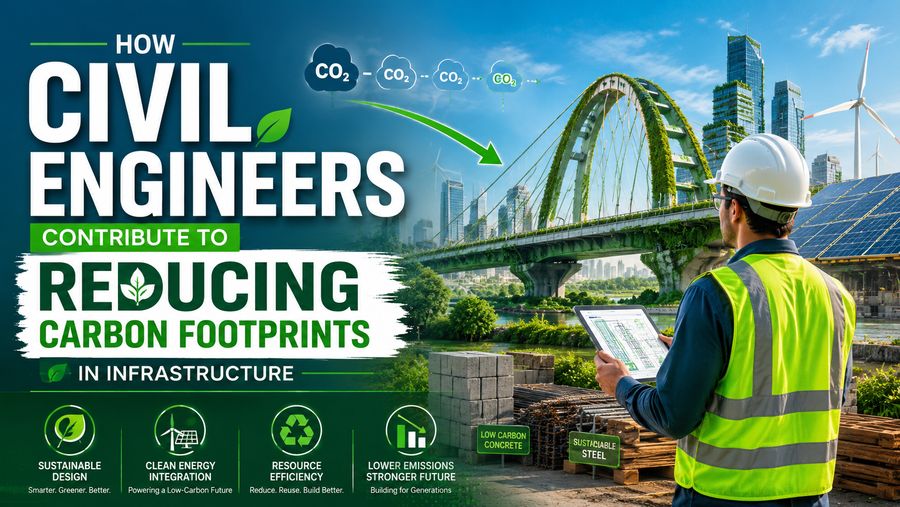

Infrastructure is essential to modern life. Roads, bridges, buildings, airports, railways, dams, water systems, and energy networks support economic growth and everyday activities. However, constructing and maintaining this infrastructure also consumes large quantities of energy and raw materials, which can contribute significantly to greenhouse gas emissions. 🏗️🌱
This is where civil engineers play a critical role in reducing carbon footprints.
Civil engineers influence nearly every stage of an infrastructure project, from initial planning and material selection to construction, operation, maintenance, and eventual demolition or reuse. By making smarter design decisions, selecting lower-carbon materials, improving energy efficiency, and considering the entire life cycle of a project, engineers can substantially reduce environmental impacts.
As governments and industries work toward climate goals, low-carbon infrastructure is becoming an increasingly important priority. Civil engineering is therefore no longer focused only on strength, durability, safety, and cost—it must also consider sustainability and carbon performance. 🌿
🌱 What Is a Carbon Footprint in Infrastructure?
A carbon footprint refers to the total amount of greenhouse gas emissions associated with an activity, product, building, or infrastructure project.
These emissions are commonly expressed as carbon dioxide equivalent, or CO₂e, which allows different greenhouse gases to be compared using a common measurement.
Infrastructure generates carbon emissions from several sources, including:
- Manufacturing construction materials
- Transporting materials to construction sites
- Operating heavy machinery
- Producing electricity used during construction
- Heating and cooling buildings
- Maintaining infrastructure
- Replacing damaged components
- Demolition and waste processing
Civil engineers can reduce many of these emissions through better planning and design.
🏗️ Embodied Carbon vs. Operational Carbon
When discussing infrastructure emissions, two important concepts are embodied carbon and operational carbon.
🧱 Embodied Carbon
Embodied carbon includes emissions associated with producing, transporting, constructing, maintaining, and eventually disposing of materials.
For example, producing cement requires large amounts of energy and releases carbon dioxide during the chemical manufacturing process.
Similarly, producing steel, glass, asphalt, and other materials also generates emissions.
⚡ Operational Carbon
Operational carbon refers to emissions generated while infrastructure is being used.
Examples include:
- Electricity consumed by buildings
- Fuel used by transportation systems
- Energy required for water pumping
- Heating and cooling
- Lighting
- Ventilation
Civil engineers increasingly consider both types when designing sustainable infrastructure.
🧱 1. Using Low-Carbon Construction Materials
Material selection is one of the most powerful ways civil engineers can reduce emissions.
Traditional materials such as cement and steel are highly useful but energy-intensive to produce.
Engineers can reduce carbon footprints by selecting lower-carbon alternatives where appropriate.
🌿 Low-Carbon Concrete
Concrete is one of the most widely used construction materials in the world.
Its primary binding material, cement, is responsible for a significant portion of concrete’s carbon emissions.
Engineers can reduce these emissions by using supplementary cementitious materials or alternative binders.
Examples may include:
- Fly ash
- Ground granulated blast-furnace slag
- Calcined clay
- Silica fume
- Recycled concrete materials
- Limestone-based blends
Reducing the amount of traditional cement in concrete mixtures can lower embodied carbon while still meeting structural requirements.
♻️ Recycled Materials
Recycling existing construction materials can reduce the need for virgin raw materials.
Civil engineers may incorporate:
- Recycled aggregates
- Reclaimed asphalt
- Recycled steel
- Reused structural components
- Recycled plastics in certain applications
Using recycled materials can reduce both waste and the energy required for raw material extraction.
📐 2. Designing Structures That Use Less Material
A sustainable structure does not necessarily require exotic materials.
Sometimes, the greatest carbon reduction comes from simply using less material more efficiently.
Civil engineers use structural analysis, optimization software, and advanced modeling to design components that provide the required strength without unnecessary mass.
For example, engineers may optimize:
- Beam dimensions
- Column sizes
- Foundation thickness
- Reinforcement quantities
- Bridge deck geometry
- Structural framing systems
Reducing material use can lower:
- Construction costs
- Transportation requirements
- Embodied carbon
- Waste generation
The objective is not to weaken the structure but to avoid unnecessary overdesign while maintaining required safety factors. ⚙️
🏢 3. Improving Building Energy Efficiency
Civil and structural engineers often work closely with architects and mechanical engineers to improve building performance.
Energy-efficient infrastructure can dramatically reduce operational emissions throughout its lifetime.
Important strategies include:
- Better insulation
- Efficient building orientation
- Natural ventilation
- Daylighting
- High-performance windows
- Energy-efficient building envelopes
- Passive cooling systems
- Green roofs
A building designed to remain comfortable using less heating and cooling can save energy for decades. 🌞🏢
Even small reductions in annual energy demand can produce substantial long-term carbon savings.
🚆 4. Designing Sustainable Transportation Systems
Transportation infrastructure has an enormous influence on carbon emissions.
Civil engineers design:
- Roads
- Railways
- Bus systems
- Pedestrian paths
- Bicycle networks
- Transit stations
- Bridges
- Interchanges
Engineering decisions can encourage lower-carbon transportation.
For example, cities designed around reliable public transport may reduce dependence on private cars.
Similarly, safe pedestrian and cycling infrastructure can encourage people to walk or cycle instead of driving short distances.
🚲 Supporting Active Transportation
Engineers can create:
- Dedicated cycle lanes
- Safe sidewalks
- Pedestrian bridges
- Traffic-calmed streets
- Accessible crossings
These systems make low-emission transportation safer and more practical.
🚇 Supporting Public Transit
Railways, metro systems, and bus rapid transit can move large numbers of passengers efficiently.
Well-designed transit systems can help reduce congestion, fuel consumption, and transport-related emissions.
🛣️ 5. Building Lower-Carbon Roads
Road construction traditionally requires large quantities of asphalt, aggregates, fuel, and heavy machinery.
Engineers can reduce the environmental impact through improved materials and construction methods.
Possible approaches include:
- Reclaimed asphalt pavement
- Warm-mix asphalt
- Recycled aggregates
- Optimized pavement thickness
- Longer-lasting pavement designs
- Better maintenance scheduling
Extending pavement life can significantly reduce emissions because roads require fewer major repairs and reconstructions.
🌡️ Warm-Mix Asphalt
Traditional hot-mix asphalt requires high production temperatures.
Warm-mix technologies can reduce manufacturing temperatures, which may decrease fuel consumption and associated emissions.
🚧 6. Reducing Emissions During Construction
Even an environmentally friendly design can generate unnecessary emissions if construction is poorly managed.
Civil engineers and construction managers can optimize construction activities to reduce fuel use and waste.
Strategies include:
- Efficient construction scheduling
- Minimizing equipment idle time
- Using energy-efficient machinery
- Electrifying equipment where practical
- Reducing unnecessary material transport
- Consolidating deliveries
- Reusing excavated materials onsite
Heavy construction equipment can consume large quantities of diesel fuel.
Reducing idle time alone can improve efficiency and lower emissions. 🚜
📍 7. Sourcing Materials Locally
Transporting heavy materials over long distances requires substantial energy.
Sand, gravel, concrete components, steel, and other construction materials can be extremely heavy.
Engineers can reduce transportation emissions by choosing suitable materials available closer to the project site.
Local sourcing can also support regional economies.
However, engineers must consider overall environmental performance rather than assuming that the nearest material is always the most sustainable.
A slightly more distant material with significantly lower manufacturing emissions may sometimes provide a better overall result.
🔄 8. Applying Life-Cycle Assessment
One of the most important sustainability tools available to engineers is life-cycle assessment, commonly called LCA.
Life-cycle assessment examines environmental impacts across the entire lifespan of a project.
This can include:
Raw materials → Manufacturing → Transportation → Construction → Operation → Maintenance → End of life
Instead of considering only initial construction emissions, engineers evaluate long-term performance.
For example, a material with slightly higher initial emissions might last twice as long and require far less maintenance.
Over the complete life cycle, it could therefore have a lower total carbon footprint.
🏗️ 9. Designing Infrastructure for Longer Service Life
Durability is closely connected to sustainability.
Infrastructure that needs frequent repair or replacement consumes additional materials, energy, labor, and fuel.
Civil engineers can extend service life through:
- Proper drainage
- Corrosion-resistant reinforcement
- Durable concrete mixtures
- Protective coatings
- Improved waterproofing
- Climate-appropriate materials
- Preventive maintenance programs
A bridge designed to remain functional for many decades can have a lower lifetime carbon footprint than one requiring major rehabilitation frequently.
🔧 10. Prioritizing Maintenance Over Replacement
In many cases, the lowest-carbon structure is the one that already exists.
Demolishing infrastructure and rebuilding it can require enormous quantities of new materials.
Civil engineers can evaluate whether existing structures can be repaired, reinforced, upgraded, or repurposed.
Potential approaches include:
- Structural strengthening
- Bridge rehabilitation
- Building retrofits
- Foundation upgrades
- Pavement resurfacing
- Adaptive reuse
Extending the useful life of existing infrastructure can reduce both construction waste and embodied carbon. ♻️
🏚️ 11. Adaptive Reuse of Existing Buildings
Adaptive reuse involves converting an existing structure for a new purpose.
For example:
- A warehouse may become apartments.
- An industrial building may become offices.
- An old school may become a community center.
- A railway structure may become a pedestrian route.
Reusing foundations, columns, walls, and structural frames avoids emissions associated with manufacturing and installing replacement materials.
Civil engineers play an important role in determining whether existing structures can safely support new uses.
💧 12. Designing Energy-Efficient Water Infrastructure
Water treatment and distribution systems can consume significant amounts of electricity.
Energy is required to:
- Pump drinking water
- Treat wastewater
- Operate filtration systems
- Move water across elevation changes
- Maintain pressure networks
Civil and environmental engineers can improve efficiency by designing optimized pumping systems and pipe networks.
Possible strategies include:
- Efficient pumps
- Variable-speed drives
- Gravity-based distribution
- Leak reduction
- Pressure optimization
- Energy recovery technologies
Reducing water loss also reduces energy waste because less water needs to be treated and pumped.
🌧️ 13. Sustainable Stormwater Management
Traditional urban drainage systems often rely heavily on concrete channels and underground pipes.
Modern civil engineers increasingly incorporate green infrastructure.
Examples include:
- Rain gardens
- Bioswales
- Permeable pavements
- Green roofs
- Retention ponds
- Constructed wetlands
These systems can manage stormwater while also supporting vegetation and reducing urban heat.
Permeable surfaces allow rainwater to enter the ground rather than immediately flowing into drainage networks.
This can reduce the need for large energy- and material-intensive drainage infrastructure.
🌳 14. Incorporating Nature-Based Solutions
Nature-based infrastructure uses natural processes to address engineering challenges.
Examples include:
- Restoring wetlands for flood protection
- Planting vegetation to stabilize slopes
- Using mangroves for coastal protection
- Creating urban forests
- Restoring river floodplains
Traditional engineering solutions such as concrete seawalls are sometimes necessary, but nature-based approaches can provide additional environmental benefits.
Trees and vegetation also absorb carbon dioxide as they grow. 🌳
Hybrid solutions combining traditional engineering and natural systems can often provide strong resilience while reducing environmental impacts.
🌡️ 15. Designing for Climate Resilience
Low-carbon infrastructure must also be resilient.
Climate-related risks can include:
- Extreme heat
- Flooding
- Sea-level rise
- Stronger storms
- Drought
- Wildfires
Infrastructure that fails prematurely because it was not designed for changing conditions may need early reconstruction.
That can significantly increase lifetime emissions.
Civil engineers therefore consider future climate conditions when designing infrastructure expected to last for decades.
Resilient design can reduce both economic losses and carbon emissions associated with rebuilding.
🖥️ 16. Using Digital Engineering and Building Information Modeling
Digital technologies are helping engineers design more efficiently.
Building Information Modeling, or BIM, allows project teams to create detailed digital models of infrastructure.
These models can help engineers:
- Calculate material quantities
- Detect design conflicts
- Reduce construction errors
- Optimize structural systems
- Coordinate project teams
- Plan maintenance
Reducing construction mistakes can prevent unnecessary demolition and material waste.
Digital twins and sensor systems can also help monitor infrastructure performance over time. 💻📊
🤖 17. Using Artificial Intelligence for Optimization
Artificial intelligence is increasingly being used in engineering design.
AI-based tools can analyze large numbers of possible designs and identify options that use fewer materials or produce lower emissions.
Potential applications include:
- Structural optimization
- Traffic management
- Energy modeling
- Construction scheduling
- Predictive maintenance
- Material selection
Predictive maintenance is particularly useful because sensors and algorithms can identify potential problems before major failures occur.
Early repairs are often far less carbon-intensive than complete replacement.
☀️ 18. Integrating Renewable Energy Into Infrastructure
Civil engineers can help incorporate renewable energy systems into buildings and infrastructure projects.
Examples include:
- Rooftop solar panels
- Solar car parks
- Small renewable energy systems
- Solar-powered street lighting
- Renewable-powered pumping stations
Engineers also design the structures and foundations needed to support larger renewable-energy facilities.
Low-carbon infrastructure therefore includes not only reducing energy consumption but also supporting cleaner energy generation. ☀️⚡
🌆 19. Building Compact and Sustainable Cities
Urban planning has a major impact on infrastructure-related emissions.
Low-density development can require:
- Longer roads
- Longer utility networks
- More car travel
- More land consumption
Compact, well-connected cities can often provide infrastructure more efficiently.
Civil engineers work alongside urban planners to design communities where housing, transportation, utilities, and public spaces work together.
Well-planned cities can reduce travel distances and improve access to public transportation, cycling, and walking.
📊 20. Measuring Carbon During Project Design
Reducing carbon effectively requires measuring it.
Engineers increasingly use carbon-accounting methods to estimate emissions associated with different design options.
For example, an engineer may compare:
Design A: Conventional concrete structure
Design B: Lower-cement concrete with optimized structural dimensions
Design C: Hybrid structure using recycled steel
Carbon calculations allow project teams to compare options based not only on cost and engineering performance but also on environmental impact.
This makes carbon reduction a measurable engineering objective.
👷 The Civil Engineer’s Role Throughout a Project
Civil engineers can influence carbon emissions during nearly every project stage.
📝 Planning
Engineers can evaluate whether new construction is actually necessary or whether existing infrastructure can be upgraded.
📐 Design
Engineers optimize structures and select lower-impact materials.
🚧 Construction
They help reduce waste, transportation, and machinery emissions.
🔧 Operation
Engineers improve energy and resource efficiency.
🛠️ Maintenance
They extend infrastructure life through preventive maintenance.
♻️ End of Life
Engineers can design structures so that materials are easier to reuse, recycle, or recover.
This whole-life approach is essential for truly sustainable infrastructure.
⚠️ Challenges in Low-Carbon Civil Engineering
Reducing emissions is not always simple.
Engineers must balance sustainability against other important requirements.
Common challenges include:
- Construction costs
- Building codes
- Material availability
- Safety requirements
- Contractor experience
- Supply-chain limitations
- Client expectations
- Project schedules
Some low-carbon materials may also have limited long-term performance data in particular environments.
Engineers therefore need to ensure that sustainability improvements do not compromise safety or durability.
🌟 Benefits of Low-Carbon Infrastructure
Reducing infrastructure carbon footprints can provide benefits beyond climate protection.
These may include:
- 🌍 Lower greenhouse gas emissions
- 💰 Reduced long-term energy costs
- ♻️ Less material waste
- 🏗️ More efficient construction
- 🌳 Improved urban environments
- 🚶 Healthier transportation options
- 💧 Better resource management
- 🔧 Longer-lasting infrastructure
- 🌡️ Greater climate resilience
Sustainable engineering can therefore provide environmental, economic, and social advantages simultaneously.
❓ Frequently Asked Questions
How do civil engineers reduce carbon emissions?
Civil engineers can reduce emissions by optimizing designs, selecting lower-carbon materials, extending infrastructure life, improving transportation systems, reducing construction waste, and incorporating renewable energy and energy-efficient technologies.
Why does concrete have a large carbon footprint?
Much of concrete’s carbon footprint comes from cement production, which requires high temperatures and releases carbon dioxide during manufacturing. Engineers can reduce this impact by optimizing concrete use and incorporating lower-carbon cementitious materials when suitable.
What is embodied carbon?
Embodied carbon refers to greenhouse gas emissions associated with producing, transporting, constructing, maintaining, and disposing of construction materials and infrastructure.
What is life-cycle carbon?
Life-cycle carbon considers emissions across the entire life of an infrastructure project, including construction, operation, maintenance, and eventual demolition or reuse.
Can existing infrastructure be more sustainable than new construction?
Yes. Repairing, retrofitting, strengthening, or repurposing existing infrastructure can often avoid large quantities of new material and reduce embodied carbon compared with complete demolition and reconstruction.
Is sustainable infrastructure more expensive?
Not necessarily. Some sustainable technologies have higher initial costs, but they may reduce energy, maintenance, and replacement costs over the project’s lifetime. Material optimization can sometimes reduce both carbon emissions and construction costs.
🎯 Conclusion
Civil engineers have enormous influence over the environmental impact of the built world. 🌍🏗️ Every decision involving materials, structural systems, transportation networks, water infrastructure, construction methods, maintenance, and urban development can affect the amount of carbon associated with infrastructure.
Reducing carbon footprints does not depend on a single technology. Instead, it requires a combination of smarter design, efficient material use, low-carbon construction methods, longer-lasting structures, better transportation systems, renewable energy, digital engineering, and life-cycle thinking.
Perhaps one of the most important changes in modern civil engineering is the shift from asking only:
“Can we build it safely and affordably?”
to also asking:
“Can we achieve the same purpose with less carbon and fewer resources?” 🌱
As infrastructure continues to expand around the world, civil engineers will be central to determining whether future cities and transportation networks become more carbon-intensive or more sustainable.
By designing infrastructure that uses fewer resources, lasts longer, consumes less energy, and adapts to changing environmental conditions, civil engineers can help build communities that are both functional and environmentally responsible. 🌿🏙️