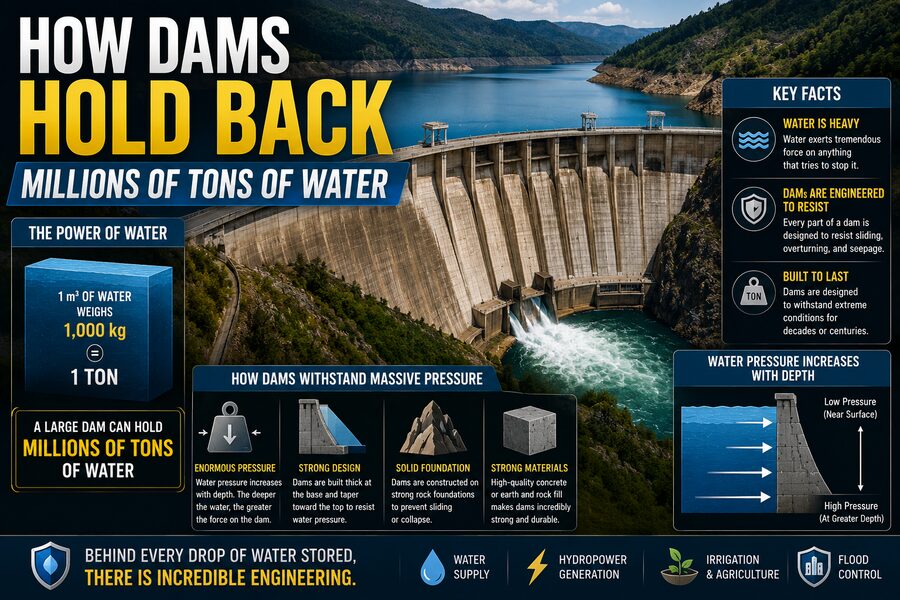

A large dam can hold back an enormous reservoir containing millions or even billions of tonnes of water. From a distance, the structure may look almost impossibly small compared with the lake pressing against it. Yet properly designed dams can remain stable for decades while resisting immense forces every second of every day. 🏗️💧
How is that possible?
The answer lies in a combination of hydrostatic pressure, structural geometry, gravity, rock mechanics, reinforced concrete, drainage systems, spillways, and careful monitoring.
Engineers do not simply build an extremely thick wall and hope it survives. They calculate where the water forces act, how those forces travel through the dam, how the foundation responds, what happens during floods and earthquakes, and how to prevent water from weakening the structure from within.
Different types of dams solve the same fundamental problem in different ways.
Understanding how they work reveals some of the most impressive applications of civil and structural engineering. 🌍⚙️
💧 Water Pressure Increases With Depth
The first important principle is hydrostatic pressure.
Water in a reservoir pushes against the upstream face of a dam.
The pressure is approximately described by:
P = ρgh
where:
P = pressure
ρ = density of water
g = gravitational acceleration
h = depth below the water surface
This equation tells us something extremely important:
Water pressure increases with depth.
Near the surface, the pressure created by the reservoir is relatively small.
Near the bottom of a deep dam, it is much greater.
That is why dams are usually much thicker near their bases than near their tops. 📐
The lower part of the structure must resist the greatest pressure.
🔺 Why the Water Force Has a Triangular Distribution
Because hydrostatic pressure increases linearly with depth, engineers often represent the pressure acting on a vertical dam face as a triangle.
At the reservoir surface:
Pressure ≈ 0 gauge pressure
At the bottom:
Pressure = maximum
This triangular pressure distribution produces a large horizontal force against the dam.
For a simplified vertical surface of height H, the resultant hydrostatic force per unit width is:
F = ½ρgH²
Notice that height is squared.
This means increasing reservoir depth dramatically increases the total force.
If the water depth doubles, the hydrostatic force per unit width becomes roughly four times greater. 🤯
This is one reason very tall dams require extremely careful structural engineering.
🧱 Gravity Dams Use Their Own Weight
One of the simplest concepts is the gravity dam.
A gravity dam is usually a massive concrete structure designed so that its own weight resists the pressure of the reservoir.
The water pushes horizontally.
Gravity pulls the dam downward.
The dam’s shape and weight keep the structure stable.
A typical gravity dam has:
- A relatively narrow crest
- A very thick base
- A large mass of concrete
Its cross-section may look somewhat triangular.
The main idea is:
Water tries to push the dam downstream → the enormous weight of the dam resists that movement.
Gravity dams can contain millions of cubic meters of concrete. 🧱🏗️
Their mass is not wasteful—it is part of the structural system.
⚖️ Engineers Must Prevent Sliding
One possible failure mode is sliding.
The reservoir pushes the dam horizontally toward the downstream side.
The dam resists this through mechanisms including:
- Friction against the foundation
- Shear resistance at the concrete-rock interface
- Structural features such as shear keys
- The dam’s own weight
Engineers calculate whether the resisting forces are safely greater than the forces trying to move the structure.
The foundation rock must therefore be strong and stable.
Building a massive dam on weak or highly fractured rock could be dangerous even if the concrete itself were extremely strong.
🔄 Engineers Must Also Prevent Overturning
Water pressure does not simply push the dam sideways.
It also creates an overturning moment.
Imagine pushing near the top of a heavy cabinet.
If the force is large enough, the cabinet could begin rotating about its bottom edge.
A dam faces a similar mechanical problem.
The reservoir force tends to rotate the structure downstream.
The dam’s weight creates a stabilizing moment in the opposite direction.
Engineers carefully design the cross-section so the combined forces remain within safe limits.
The resultant force must pass through an acceptable region of the foundation to prevent excessive tensile stress or instability.
🏹 Arch Dams Use Geometry Instead of Only Mass
Not every dam relies mainly on weight.
An arch dam curves upstream toward the reservoir.
When water pushes against it, the curved shape transfers much of the force sideways into the canyon walls.
This is similar to the way an architectural arch transfers loads into its supports. 🏹
Instead of resisting all the water pressure through massive concrete weight, the dam uses compression and geometry.
Arch dams can therefore be much thinner than gravity dams.
However, they require extremely strong rock abutments on both sides of the valley.
If the canyon walls cannot safely carry the transferred loads, an arch dam may not be suitable.
⛰️ Why Narrow Canyons Are Ideal for Arch Dams
Arch dams are especially effective in narrow, steep-sided valleys.
The shorter span allows the curved structure to transfer forces efficiently into the surrounding rock.
The canyon walls effectively become part of the structural system.
Engineers analyze:
- Rock strength
- Joint orientation
- Faults
- Weathering
- Underground water
A beautiful geometric dam is useless if its abutments are weak.
For an arch dam, the geology is just as important as the concrete. 🪨
🪨 Embankment Dams Work Differently
Many of the world’s largest dams by volume are not giant concrete walls.
They are embankment dams constructed from compacted earth or rock.
Two major categories are:
- Earthfill dams
- Rockfill dams
These structures are extremely wide at the base.
Their huge mass and gentle slopes provide stability.
But soil and rock are not necessarily watertight.
Therefore, embankment dams usually include an impermeable or low-permeability barrier.
This may be:
- A clay core
- An asphaltic core
- A concrete face
- Another engineered sealing system
The surrounding fill supports the structure while the core limits water flow. 🌍
💦 Seepage Is Expected—and Must Be Controlled
Water naturally tries to move through and beneath dams.
This process is called seepage.
The objective is not always to eliminate every drop of seepage.
Instead, engineers control it so that it does not create dangerous pressures or carry away soil.
Controlled seepage is generally manageable.
Uncontrolled seepage can become extremely dangerous.
Water can travel through:
- Foundation cracks
- Construction joints
- Porous soil
- Fractured rock
- Dam materials
Engineers therefore design drainage and filtration systems to control where the water goes.
🧨 Why Piping Can Be Dangerous
One of the most serious risks for embankment dams is a phenomenon called internal erosion or piping.
If seepage begins carrying fine soil particles out of the dam or foundation, a small internal channel can gradually form.
More water flows through the channel.
More soil is removed.
The passage becomes larger.
This can create a dangerous feedback process:
Seepage → soil erosion → larger passage → more seepage → more erosion
Engineers use carefully graded filters and drainage zones to stop soil particles from migrating while allowing water to escape safely. 🛡️
🚰 Drainage Systems Reduce Internal Pressure
Water beneath a concrete dam can create uplift pressure.
This pressure pushes upward against the base of the dam.
That is undesirable because the dam depends partly on its weight for stability.
If uplift becomes too large, the effective downward force is reduced.
To control this, engineers may install:
- Drainage galleries
- Foundation drains
- Relief holes
These systems provide pathways for water to escape and reduce internal pressure.
Some large concrete dams even contain internal tunnels where engineers can inspect drains and instruments. 🔦
🧱 Foundations Are a Critical Part of the Dam
A dam does not end where the visible concrete or earth meets the ground.
The foundation is part of the structural system.
Engineers investigate the site using:
- Geological mapping
- Core drilling
- Rock testing
- Groundwater measurements
- Geophysical surveys
They search for:
- Weak layers
- Faults
- Cavities
- Fractures
- Permeable zones
If necessary, foundation rock can be treated before construction.
For example, engineers may inject cement-based grout into cracks.
This process helps reduce seepage and improve foundation conditions.
💉 Grout Curtains Help Control Underground Water
A common feature beneath some dams is a grout curtain.
Engineers drill holes into the foundation and inject grout into fractures.
Once hardened, the grout reduces the permeability of the rock.
This creates an underground barrier that makes it more difficult for reservoir water to flow beneath the dam.
A grout curtain is not necessarily perfectly impermeable.
Its purpose is to reduce seepage to manageable levels.
Combined with drainage systems, it helps control water pressure beneath the structure. 💧
🌊 Spillways Protect Dams During Floods
One of the most important parts of any dam is often not the dam wall itself.
It is the spillway.
A reservoir cannot be allowed to rise indefinitely.
During heavy rainfall or snowmelt, huge amounts of water may enter the reservoir.
If water rises too high, it must be safely released.
A spillway provides a controlled route around or through the dam.
Without sufficient spillway capacity, water could flow over parts of the structure that were never designed for uncontrolled overflow.
For embankment dams especially, overtopping can cause rapid erosion and potentially catastrophic failure.
🌧️ Engineers Design for Extreme Flood Events
Ordinary river flows are not the only concern.
Engineers must consider rare but severe floods.
Hydrologists estimate extreme inflows based on:
- Historical rainfall
- Watershed size
- Storm patterns
- Snowmelt
- River behavior
- Statistical models
For very high-consequence dams, engineers may analyze exceptionally severe design floods.
The spillway must be able to discharge huge quantities of water without allowing the reservoir to reach dangerous levels.
Some spillways can release thousands or tens of thousands of cubic meters of water every second. 🌊⚡
🌀 Why Spillways Need Energy Dissipation
Water leaving a high reservoir can accelerate dramatically.
If that high-speed flow is allowed to hit the riverbed directly, it can cause severe erosion.
Engineers therefore use energy dissipation structures.
Examples include:
- Stilling basins
- Flip buckets
- Stepped spillways
- Baffle blocks
A stilling basin may deliberately create a hydraulic jump.
In a hydraulic jump, fast shallow water suddenly becomes slower and deeper.
Large amounts of kinetic energy are transformed into turbulence and heat.
This protects downstream foundations and riverbeds from destructive erosion. 🌪️
⚡ Hydroelectric Dams Use Water Pressure Productively
Some dams also generate electricity.
Water from the reservoir enters large pipes called penstocks.
The water flows downward under pressure toward turbines.
The moving water rotates the turbine.
The turbine drives an electrical generator.
The energy conversion is approximately:
Gravitational potential energy → kinetic energy → mechanical rotation → electrical energy
The height difference between the reservoir and turbine is called head.
Greater head generally means more available energy per unit mass of water.
This allows the same reservoir that creates enormous structural loads to also become an energy source. ⚡🏞️
🧮 Engineers Calculate Many Different Loads
Hydrostatic pressure is only one force acting on a dam.
Engineers may also need to consider:
- Dam self-weight
- Sediment pressure
- Ice loads
- Earthquake forces
- Wind
- Temperature changes
- Uplift
- Wave action
A dam must remain safe under many combinations of conditions.
For example, a reservoir may be nearly full when an earthquake occurs.
The structure must be designed with such combined scenarios in mind.
🌎 Earthquakes Create Special Challenges
During an earthquake, the ground moves.
A dam and its reservoir respond dynamically.
The water itself can create additional forces as it moves relative to the structure.
Engineers analyze earthquake effects using structural dynamics and geotechnical engineering.
Different dam types behave differently.
Concrete dams must resist dynamic stresses.
Embankment dams must avoid excessive deformation, cracking, or liquefaction of susceptible materials.
Modern high-hazard dams in seismic regions are subjected to extensive earthquake analysis. 🌎
🌡️ Temperature Can Move Massive Concrete Structures
Concrete expands when heated and contracts when cooled.
For an enormous dam, even tiny strain can create substantial movement and stress.
Temperature differences may develop because:
- The reservoir water is cold.
- The downstream face is heated by sunlight.
- Seasonal temperatures change.
- Concrete generates heat while curing.
Engineers account for thermal effects in the design.
Large concrete pours may also require cooling systems during construction to prevent excessive thermal cracking.
🧱 Concrete Dams Are Built in Sections
A huge concrete dam is generally not poured as one giant block.
Instead, it is constructed in sections or blocks.
This helps engineers control:
- Heat from cement hydration
- Shrinkage
- Construction sequencing
- Cracking
Joints between blocks are carefully designed and sealed.
In some major projects, cooling pipes may be embedded within the concrete so chilled water can remove heat during curing. ❄️
📡 Dams Are Continuously Monitored
A large dam is not simply completed and forgotten.
Engineers monitor it throughout its operating life.
Instruments may measure:
- Water pressure
- Seepage flow
- Structural movement
- Foundation pressure
- Crack width
- Temperature
- Settlement
Modern dams may use automated sensors that continuously send measurements to monitoring systems.
Engineers compare current readings with historical patterns and expected behavior.
A gradual change in seepage or movement can provide an early warning that further investigation is needed. 📊
📐 Tiny Movements Can Be Normal
It may sound alarming to learn that a dam moves.
But some movement is expected.
Reservoir level changes alter the forces acting on the structure.
Temperature changes can also produce expansion and contraction.
A large concrete dam might move slightly upstream and downstream depending on reservoir level and seasonal temperature.
The key question is not:
“Did the dam move?”
It is:
“Is the movement consistent with the expected structural behavior?”
Monitoring allows engineers to answer that question.
🛡️ Redundancy and Safety Factors Matter
Dam engineering contains uncertainty.
Rock properties vary.
Flood estimates have uncertainty.
Construction materials are not perfectly uniform.
Engineers therefore use safety margins and conservative assumptions.
They also rely on multiple protective systems.
For example:
Stable structure + drainage + spillway + monitoring + emergency planning
If one element experiences a problem, others can help reduce the risk of failure.
This is similar to the defense-in-depth philosophy used in many other safety-critical engineering systems.
🏘️ Why Dam Failure Consequences Matter
A dam’s safety classification often depends partly on what is located downstream.
A relatively small dam above an unpopulated area may present very different consequences from a larger dam located upstream of a city.
Engineers and regulators may therefore consider:
- Downstream population
- Infrastructure
- Environmental impacts
- Economic consequences
Higher-consequence dams generally require more stringent design, inspection, and emergency planning.
🗺️ Emergency Action Plans
Even carefully engineered structures cannot be treated as risk-free.
Many major dams have Emergency Action Plans.
These plans identify:
- Potential failure scenarios
- Flood inundation areas
- Warning procedures
- Communication responsibilities
- Evacuation coordination
The objective is to ensure that communities and authorities know what to do if unusual conditions occur.
Emergency planning does not replace safe engineering.
It provides an additional layer of protection. 🚨
🏗️ Why Different Sites Need Different Dam Types
There is no single best dam design.
Engineers choose based on conditions such as:
- Valley shape
- Foundation geology
- Available construction materials
- Dam height
- Reservoir size
- Earthquake risk
- Climate
- Construction cost
A narrow rocky canyon may suit an arch dam.
A broad valley may favor an embankment dam.
A site with strong foundations and suitable construction access may support a concrete gravity dam.
The engineering design must fit the landscape rather than forcing the landscape to fit one preferred structure.
📊 Gravity, Arch, and Embankment Dams at a Glance
🧱 Gravity Dam
Uses enormous weight to resist reservoir pressure.
Best known for:
- Massive concrete sections
- Strong foundations
- Excellent stability through weight
🏹 Arch Dam
Uses a curved shape to transfer water loads into canyon walls.
Best known for:
- Thin concrete sections
- Efficient structural action
- Requirement for strong rock abutments
🪨 Embankment Dam
Uses large volumes of compacted earth or rock.
Best known for:
- Very wide base
- Flexible construction
- Internal cores and filters for seepage control
Different designs solve the same problem through different structural principles.
🤯 How Can a Dam Resist So Much Water?
The important insight is that engineers do not think of the reservoir simply as “millions of tonnes of water sitting behind a wall.”
They calculate exactly how pressure varies with depth and how that pressure transfers through the structure.
A gravity dam sends forces into its massive body and foundation.
An arch dam sends them sideways into canyon walls.
An embankment dam distributes them through an enormous mass of compacted material.
The structure and terrain work together.
This is why geometry matters just as much as material strength. 📐
🌟 Final Thoughts
Dams hold back enormous reservoirs because engineers carefully control how water forces move through the structure and into the Earth beneath it.
The process begins with a simple physical fact:
Water pressure increases with depth. 💧
From there, the engineering becomes remarkably sophisticated.
Massive gravity dams resist pressure through their own weight.
Curved arch dams redirect forces into strong canyon walls.
Embankment dams rely on huge quantities of compacted soil and rock while internal barriers control seepage.
Foundations transfer loads into the ground.
Drainage systems reduce unwanted water pressure.
Filters prevent internal erosion.
Spillways safely release floodwater.
Energy-dissipation structures control high-speed flows.
Sensors continuously monitor the dam’s behavior. 📡🏗️
No single feature keeps a dam safe.
The safety comes from the entire engineered system working together.
A reservoir may contain an almost unimaginable mass of water, but engineers do not attempt to fight that water with brute strength alone.
They use physics, geometry, geology, materials science, hydraulics, and structural design to guide the forces along safe paths.
That is what makes a well-designed dam so remarkable.
It is not merely a wall blocking a river.
It is a carefully engineered structure that redirects one of nature’s most powerful forces into the ground—while often controlling floods, storing water, supporting irrigation, and generating electricity at the same time. 🌊⚡🌍