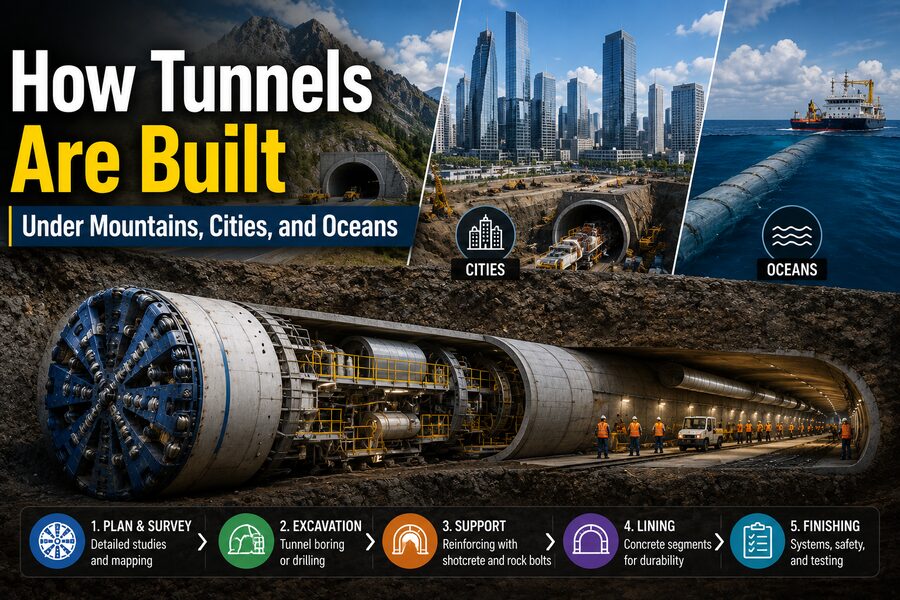

Tunnels are among the most impressive achievements in civil engineering. They allow roads, railways, utility lines, water systems, and pedestrian routes to pass through places where building on the surface would be difficult, expensive, or disruptive.
A tunnel may cut through a mountain, run beneath a crowded city, or even pass under the seabed between countries. Although these projects may look similar from the outside, the engineering methods used to build them can be very different.
Engineers must understand rock strength, soil conditions, groundwater pressure, nearby buildings, excavation methods, ventilation, structural support, and construction safety before tunneling begins.
Some tunnels are blasted through solid rock. Others are excavated using enormous tunnel boring machines. Shallow urban tunnels may be built from the surface using cut-and-cover construction, while underwater tunnels can sometimes be assembled from prefabricated sections and lowered into trenches on the seabed.
The common goal is simple: remove material while preventing the surrounding ground from collapsing or flooding into the excavation.
Achieving that safely can require years of geological investigation and careful monitoring. 🏗️🔍
🧭 Why Build a Tunnel?
Engineers choose tunnels when surface routes are impractical or undesirable.
A tunnel can:
- ⛰️ Shorten routes through mountains
- 🚇 Carry metro lines beneath crowded cities
- 🌊 Cross underneath rivers or ocean channels
- 🚰 Transport water
- ⚡ Carry electrical and communication cables
- 🚗 Reduce traffic at the surface
- 🌱 Protect landscapes from major surface disruption
Building a tunnel is usually expensive, so planners compare it with alternatives such as bridges, surface roads, or longer routes around obstacles.
If the benefits are large enough, tunneling may become the preferred solution.
🪨 The First Step: Understanding the Ground
Before engineers decide how to excavate, they need to know what lies underground.
Geologists and geotechnical engineers investigate the route using techniques such as:
- Boreholes
- Rock cores
- Soil samples
- Seismic surveys
- Groundwater measurements
- Laboratory testing
These studies help answer critical questions.
Is the tunnel passing through strong granite or weak clay?
Are there underground faults?
How much groundwater is present?
Could the soil settle after excavation?
Are there old foundations or buried utilities nearby?
A tunnel design that works perfectly in strong rock may be completely unsuitable in soft, water-saturated soil.
🧪 Rock and Soil Behave Very Differently
Tunnels through mountains often encounter rock.
Solid rock can sometimes support itself temporarily after excavation, but fractured or weak rock may require immediate reinforcement.
Urban tunnels frequently pass through soils such as:
- Sand
- Gravel
- Clay
- Silt
Loose soil behaves very differently from rock.
If it is unsupported, it can flow or collapse into the excavation.
Groundwater adds another difficulty because water pressure can push soil into the tunnel.
For this reason, tunneling methods are selected based heavily on geology.
⛰️ Building Tunnels Through Mountains
Mountain tunnels often involve long sections of relatively deep excavation.
Two major methods are commonly used:
- Drill-and-blast excavation
- Tunnel boring machines
The best method depends on tunnel length, rock type, diameter, schedule, and cost.
💥 Drill-and-Blast Tunneling
Drill-and-blast is a traditional method for excavating rock.
The basic cycle is:
- Drill holes into the rock face.
- Place explosives inside selected holes.
- Detonate the explosives.
- Ventilate smoke and gases.
- Remove broken rock.
- Install structural support.
- Repeat.
Engineers carefully design the position, depth, and timing of the explosive charges.
The goal is not simply to destroy rock randomly.
The blast must break the correct amount of material while limiting damage to the surrounding rock.
After each blast, excavators and loaders remove the broken material, known as muck.
The process advances the tunnel step by step.
🛡️ Supporting the Rock After Excavation
Removing material changes the stresses inside the mountain.
The surrounding rock begins redistributing loads around the new opening.
Engineers must determine whether the tunnel can support itself or needs reinforcement.
Common support methods include:
- Rock bolts
- Steel ribs
- Wire mesh
- Shotcrete
- Concrete lining
Rock bolts are long steel rods installed into drilled holes in the surrounding rock.
They help tie fractured rock together.
Shotcrete is concrete sprayed directly onto the tunnel surface.
It can quickly create a protective structural layer.
🧱 The New Austrian Tunnelling Method
One influential tunneling approach is the New Austrian Tunnelling Method, often called NATM.
The basic philosophy is to allow the surrounding rock or soil to participate in supporting itself while using flexible reinforcement and continuous monitoring.
Engineers may:
- Excavate a short section
- Apply shotcrete
- Install rock bolts
- Measure deformation
- Adjust support as necessary
Instead of assuming underground conditions are perfectly known beforehand, the method uses actual observed ground behavior during construction.
This makes monitoring extremely important.
🌀 Tunnel Boring Machines
For long tunnels, engineers may use a Tunnel Boring Machine, or TBM.
A TBM is a gigantic machine that excavates a circular tunnel continuously.
At the front is a rotating cutterhead fitted with cutting tools.
As the cutterhead rotates, it breaks rock or soil.
The excavated material is transported backward through the machine using conveyors or other systems.
Behind the cutterhead, equipment may install the tunnel lining.
Some TBMs can be hundreds of meters long when all their backup equipment is included. 🚇⚙️
🪨 Hard-Rock TBMs
Hard-rock TBMs use cutting discs pressed against the rock face with enormous force.
As the cutterhead rotates, the discs create cracks in the rock.
Pieces break away and fall into collection openings.
The machine then advances forward using hydraulic systems.
Hard-rock TBMs are particularly effective for long tunnels through relatively predictable geology.
Their advantage is continuous excavation.
However, they require major investment and are less flexible if geological conditions change unexpectedly.
🏙️ Why Tunneling Under Cities Is Difficult
Urban tunneling is especially challenging because engineers must excavate without damaging what already exists above.
A city tunnel might pass under:
- Apartment buildings
- Historic structures
- Roads
- Railways
- Water pipes
- Sewers
- Electrical cables
- Existing metro tunnels
Even a few centimeters of unexpected ground movement can sometimes damage sensitive structures.
Engineers therefore focus intensely on controlling settlement.
📉 What Is Ground Settlement?
When soil is removed underground, the surrounding ground can move slightly toward the empty space.
If too much movement reaches the surface, buildings or roads may settle.
Uneven settlement is particularly dangerous because different parts of a building can move by different amounts.
This can produce:
- Cracks
- Distorted doors and windows
- Utility damage
- Structural stress
Urban tunneling methods are therefore designed to support the excavation face and limit ground loss.
🛡️ Earth Pressure Balance TBMs
An Earth Pressure Balance, or EPB, machine is often used in soft ground.
The front of the TBM is enclosed.
Excavated soil is kept inside a pressurized chamber behind the cutterhead.
That pressure helps balance the pressure of the surrounding ground.
A controlled screw conveyor removes excavated soil while maintaining the required chamber pressure.
The objective is to prevent the soil ahead of the machine from collapsing into the tunnel.
EPB machines are widely used for metro and urban transport tunnels.
💧 Slurry Shield TBMs
Where soil is loose and groundwater pressure is high, engineers may use a slurry shield TBM.
At the tunnel face, a pressurized mixture called slurry helps support the surrounding ground and resist water pressure.
Excavated soil mixes with the slurry and is pumped to the surface.
At a separation plant, the soil is removed and the slurry can often be reused.
Slurry shield machines are useful in conditions such as water-bearing sand and gravel.
🧩 Segmental Concrete Linings
Many modern TBM tunnels are lined with precast concrete segments.
Behind the cutterhead, mechanical equipment installs curved concrete pieces to form a complete ring.
These segments are manufactured precisely in factories.
Bolts or other connection systems hold them together.
Gaskets between segments help keep groundwater out.
As the TBM advances, it builds ring after ring behind itself.
This means excavation and structural lining can proceed almost continuously.
🏗️ Cut-and-Cover Construction
Not every urban tunnel is bored deep underground.
For relatively shallow tunnels, engineers may use cut-and-cover construction.
The basic process is:
- Excavate a trench from the surface.
- Build the tunnel structure inside it.
- Cover the tunnel.
- Restore the road or ground above.
This method can be simpler and less expensive than deep tunneling.
However, it causes major surface disruption during construction.
Roads may need to be closed or temporarily relocated.
Utilities may also have to be moved.
🏢 Top-Down Construction
A variation of cut-and-cover is called top-down construction.
Engineers first construct retaining walls and a roof slab.
The surface above may then be reopened relatively early.
Excavation continues underneath the completed roof.
This is useful in crowded cities where long-term road closure would be highly disruptive.
🌊 How Are Tunnels Built Under Water?
Underwater tunnels can be built in several ways.
A tunnel does not normally involve workers excavating directly through open seawater.
Instead, engineers either bore deep beneath the seabed or construct sealed tunnel sections that are placed into a prepared trench.
Two important methods are:
- Bored tunnels
- Immersed tube tunnels
🌊 Bored Tunnels Beneath the Seabed
A tunnel boring machine can excavate through soil or rock beneath a river or ocean floor.
The machine remains surrounded by geological material rather than open water.
However, groundwater pressure can be extremely high.
The tunnel lining and excavation system must therefore resist water entering through joints or the tunnel face.
Engineers carefully choose the tunnel depth so that enough rock or soil remains above the tunnel to provide stability.
🚢 Immersed Tube Tunnels
An immersed tube tunnel is built differently.
Large tunnel sections are manufactured in a dry dock or construction basin.
Each section may be hundreds of meters long.
The ends are temporarily sealed.
The sections are then floated to the tunnel location.
Meanwhile, engineers excavate a trench in the seabed.
The tunnel section is carefully lowered into the trench and connected to the previous section.
After joining, water is pumped out of the connection.
The tunnel is then covered with protective material.
Section by section, the crossing is assembled underwater. 🌊🏗️
💧 Keeping Water Out
Waterproofing is essential in underground construction.
Engineers use systems such as:
- Waterproof membranes
- Rubber gaskets
- Concrete linings
- Grouting
- Drainage systems
Grouting involves injecting materials into cracks or gaps in the ground.
The grout hardens and can reduce water flow or strengthen weak soil and rock.
In some projects, extensive grouting is performed ahead of excavation.
❄️ Ground Freezing
For particularly difficult water-bearing ground, engineers can temporarily freeze the soil.
Pipes are installed around the planned excavation.
Cold fluid circulates through the pipes.
Groundwater freezes, turning loose wet soil into a stronger frozen mass.
Workers can then excavate within this temporary frozen structure.
Once permanent tunnel support is installed, the refrigeration system is turned off and the ground gradually thaws.
Ground freezing is useful for shafts, cross-passages, and difficult underground connections.
🚧 How Tunnels Are Started
Tunnel boring machines cannot simply appear underground.
Engineers usually construct large vertical shafts or open launch areas.
A launch shaft allows the TBM to be assembled and begin excavation.
At the far end, a reception shaft may allow the machine to be removed.
These shafts can themselves be major engineering projects, sometimes extending dozens of meters underground.
They may later become:
- Stations
- Ventilation shafts
- Emergency exits
- Utility access points
📡 Surveying Keeps the Tunnel on Course
A tunnel may be excavated from opposite ends simultaneously.
The two sections must eventually meet with extraordinary precision.
Surveyors use:
- Laser instruments
- Total stations
- Gyroscopic measurements
- Satellite positioning at the surface
Underground, satellite signals generally cannot reach the tunnel directly.
Engineers therefore transfer coordinates down shafts and through underground survey networks.
Modern tunnel guidance systems can keep TBMs on carefully designed three-dimensional routes.
🧭 Curved Tunnels Require Constant Guidance
Tunnels are not always straight.
Metro systems may need to curve around foundations or align with stations.
TBMs can steer gradually by changing the direction of hydraulic thrust cylinders.
Sensors continuously measure:
- Position
- Pitch
- Roll
- Heading
Operators make small corrections as the machine advances.
Even tiny guidance errors can become significant over several kilometers.
🏢 Protecting Buildings Above
Before urban tunneling begins, engineers may survey nearby buildings.
Crack gauges, settlement markers, tilt sensors, and other instruments can be installed.
During excavation, engineers continuously monitor movement.
If settlement begins approaching predefined limits, construction can be modified.
Possible responses include:
- Reducing excavation speed
- Adjusting TBM pressure
- Injecting grout
- Changing support measures
This process is known as observational construction or monitoring-based control.
🧪 Compensation Grouting
In some urban projects, engineers actively counter settlement using compensation grouting.
Small pipes are installed beneath sensitive buildings.
If monitoring detects ground movement, grout can be injected into the soil.
The injected material fills voids and can create slight controlled uplift.
This helps compensate for settlement caused by tunneling.
🌬️ Ventilation During Construction
Tunnels are confined spaces.
Construction equipment can produce:
- Dust
- Heat
- Diesel exhaust
- Blasting gases
Ventilation systems supply fresh air and remove contaminated air.
Large temporary ducts may run throughout the excavation.
Air quality is continuously monitored for worker safety.
After construction, road and rail tunnels usually receive permanent ventilation systems as well.
🔥 Fire Safety in Finished Tunnels
A completed tunnel must also protect its users during emergencies.
Depending on the tunnel, safety systems may include:
- Emergency exits
- Cross-passages
- Fire-resistant linings
- Smoke-control ventilation
- Emergency lighting
- Communication equipment
- Fire detection systems
Twin-bore tunnels often contain cross-passages allowing people to move from one tunnel to another during an emergency.
🚇 Railway and Metro Tunnel Construction
A railway tunnel requires more than excavation.
After the structural shell is completed, engineers must install:
- Track
- Power systems
- Signaling
- Lighting
- Communications
- Drainage
- Ventilation
Metro tunnels also need stations.
Stations can be much larger than the running tunnels connecting them.
In dense cities, constructing underground stations may be one of the most difficult parts of the entire project.
🚗 Road Tunnels
Road tunnels require substantial mechanical and safety infrastructure.
Vehicle engines can produce pollutants, so ventilation is particularly important.
Long road tunnels may use large fans to move air.
Engineers must also manage:
- Traffic control
- Fire protection
- Drainage
- Emergency access
- Lighting
The finished tunnel is essentially an underground transportation facility, not merely a hole through the ground.
💦 Drainage Systems
Groundwater can continue pressing against tunnel linings for decades.
Drainage systems collect leakage and surface water.
Pumps may be required if water cannot flow naturally downhill to an outlet.
Underwater tunnels need especially reliable pumping systems because the tunnel may lie below sea level.
Backup power is commonly provided for critical pumping equipment.
🧱 Tunnel Linings Must Resist Long-Term Loads
A finished tunnel lining may be made from:
- Reinforced concrete
- Precast concrete segments
- Sprayed concrete
- Steel components
The lining must resist surrounding soil or rock pressure.
In deep tunnels, the surrounding geological stress can be enormous.
Underwater tunnels must also resist external water pressure.
Engineers design these linings for long-term durability, often with intended service lives measured in many decades.
🌡️ Temperature and Air Pressure Challenges
Very deep tunnels can become surprisingly hot.
Rock temperature generally increases with depth.
Long mountain tunnels may therefore require significant ventilation and cooling during construction.
High-altitude tunnel projects can create additional challenges for workers and machinery.
Air pressure itself can also become important.
Some pressurized TBM maintenance tasks near the cutterhead may require workers to enter environments with pressure higher than normal atmospheric pressure.
Special procedures are needed to prevent decompression injuries.
🔧 Maintaining the TBM Cutterhead
The front of a TBM experiences extreme wear.
Cutter discs or cutting tools may need replacement.
In strong stable rock, workers may sometimes access the cutterhead relatively easily after the machine stops.
In soft ground under high water pressure, access can be much more difficult.
Some maintenance tasks may require a pressurized environment similar in principle to compressed-air work.
This makes TBM maintenance a significant part of tunnel planning.
🚚 Removing Excavated Material
A long tunnel produces enormous quantities of excavated rock and soil.
Engineers call this material muck.
It may be removed using:
- Conveyor belts
- Trains
- Trucks
- Slurry pipelines
On major projects, logistics can be almost as challenging as excavation.
Thousands or millions of cubic meters of material may need to be transported and disposed of or reused.
Some excavated rock can be crushed and reused as construction aggregate.
🌍 Environmental Considerations
Tunnel projects can reduce surface disruption compared with highways or bridges, but they still have environmental impacts.
Engineers assess:
- Groundwater changes
- Excavated material disposal
- Construction noise
- Energy consumption
- Effects on ecosystems
- Carbon emissions
Underwater projects must also consider marine environments.
Construction methods are often modified to reduce impacts on sensitive habitats.
⚠️ What Happens When Engineers Encounter Unexpected Ground?
No geological survey can reveal every underground condition.
Tunnel crews may discover:
- Unknown faults
- Cavities
- Weak rock
- Excess groundwater
- Unrecorded foundations
When conditions change, the construction method may need to change too.
Engineers might:
- Add stronger support
- Reduce excavation length
- Inject grout
- Lower groundwater
- Modify TBM operating pressure
- Change the tunnel alignment in extreme situations
Flexibility is essential in underground engineering.
🤖 Automation and Modern Tunnel Construction
Modern tunneling increasingly uses automation and digital monitoring.
TBMs can record information such as:
- Cutterhead torque
- Thrust force
- Excavation pressure
- Advance rate
- Ground movement
Engineers analyze these data to understand changing geological conditions.
Three-dimensional digital models can also combine geology, construction progress, and monitoring information.
This helps teams detect problems earlier.
📊 Why Tunnel Projects Take So Long
A tunnel might require years before excavation even starts.
Major phases include:
- Route planning
- Geological investigation
- Environmental studies
- Engineering design
- Approvals
- Shaft and access construction
- Excavation
- Structural lining
- Mechanical and electrical installation
- Testing and commissioning
The excavation itself may be only one part of the project.
🧠 Choosing the Right Tunneling Method
There is no single “best” tunnel construction method.
Engineers choose based on:
- Geology
- Tunnel length
- Diameter
- Depth
- Groundwater
- Surface buildings
- Construction schedule
- Cost
A short mountain tunnel may favor drill-and-blast.
A long railway tunnel through consistent rock may justify a hard-rock TBM.
A metro tunnel through soft urban soil may use an EPB machine.
A shallow urban tunnel may use cut-and-cover.
A wide underwater crossing may use immersed tubes.
Each method solves a different engineering problem.
🌟 Final Thoughts
Building a tunnel is fundamentally an exercise in controlling the ground.
Engineers remove material from a place where rock, soil, and groundwater have often remained undisturbed for thousands or millions of years. The moment excavation begins, those natural stresses start changing.
The challenge is to create a stable underground opening while keeping the surrounding ground where it belongs.
Under mountains, engineers may blast through hard rock or use enormous tunnel boring machines. ⛰️
Under cities, they carefully manage soil pressure and settlement so streets, utilities, and buildings remain safe. 🏙️
Under oceans and rivers, they must overcome groundwater pressure using sealed TBMs or prefabricated immersed tunnel sections. 🌊
Throughout the project, surveyors guide the excavation, geologists study changing ground conditions, structural engineers design supports, and monitoring systems continuously check movement.
What eventually appears as a smooth underground roadway or railway is therefore the result of an extraordinary combination of geology, structural engineering, machinery, surveying, hydraulics, construction management, and safety planning.
The most impressive part may be what users never notice.
When a train passes beneath a city, a car drives through a mountain, or commuters travel beneath the sea, the surrounding ground and water remain largely invisible—held safely outside the tunnel by engineering systems designed long before the first excavation machine ever began to move. 🚇🏗️🌍