
A small crack in a parking structure may look harmless after a wet winter. Yet that opening can admit water, oxygen, and chlorides, starting corrosion in reinforcing steel long before a visible defect becomes a safety concern.
Repair crews then face a familiar cycle: inspect, close lanes, remove damaged concrete, protect exposed steel, patch the area, and return later when another weakness appears. The disruption can be as costly to users as the repair itself.
At the same time, every new bridge deck, retaining wall, tunnel lining, and housing slab demands materials with a substantial environmental footprint. Ordinary concrete is indispensable, but the cement used to bind it is carbon-intensive to produce.
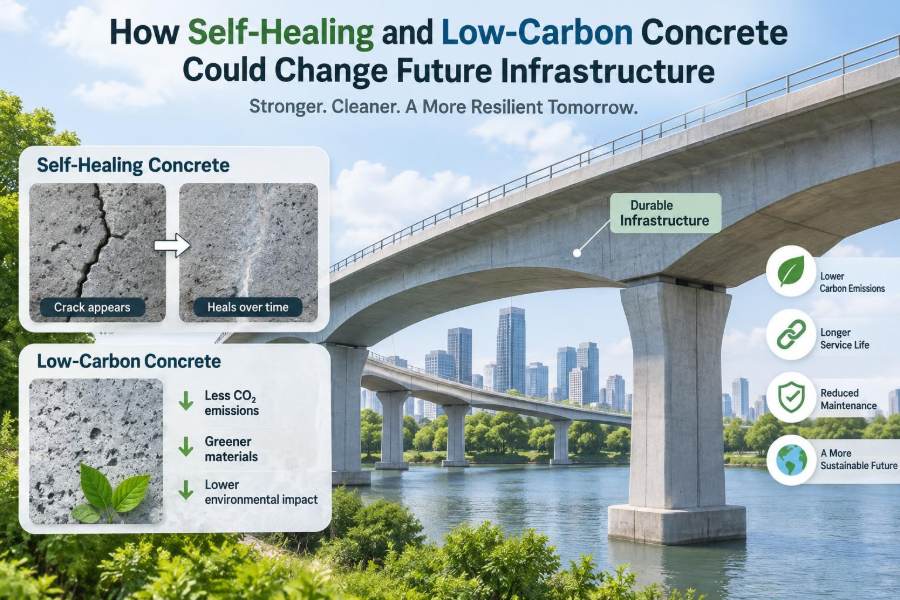
Self-healing and low-carbon concrete address different parts of this problem. One aims to make structures more durable and easier to maintain; the other aims to reduce emissions from construction materials. Their greatest potential may emerge when engineers design them together rather than treating them as separate innovations.
🏗️ Why Concrete Remains the Infrastructure Material of Choice
Concrete is used at extraordinary scale because its ingredients are widely available, it can be cast into nearly any shape, it performs well in compression, and it can protect embedded reinforcement. From foundations to water-treatment tanks, it provides structural mass, fire resistance, and long service potential.
Its weakness is not that it is inherently poor material. Rather, concrete infrastructure operates in demanding conditions: repeated loading, thermal movement, freezing and thawing, abrasion, seawater exposure, de-icing salts, and imperfect drainage all create pathways for deterioration.
🧱 The Carbon Challenge Hidden in Cement
Portland cement is the reactive powder that allows conventional concrete to harden. Its production requires heating limestone and other raw materials in a kiln, which consumes energy and releases carbon dioxide both from fuel use and from the chemical conversion of limestone.
Concrete’s total footprint depends on much more than cement alone. Aggregate transport, mixing, placement methods, reinforcement, repair frequency, and service life also matter. Still, reducing the amount of high-clinker cement in a durable mix is one of the most direct levers available to designers.
🔍 Why Cracks Form in Concrete
Concrete cracks for many reasons, and a crack is not automatically a structural failure. Early-age shrinkage can occur as water leaves the material. Temperature changes create movement, while restrained movement creates tensile stress that concrete may not withstand.
Later in life, cracks may result from settlement, overloading, corrosion expansion, alkali-silica reaction, freeze-thaw damage, or foundation movement. The first engineering task is therefore diagnosis: a material designed to heal a fine shrinkage crack cannot solve an active structural movement problem.
💧 When a Hairline Crack Becomes a Durability Problem
Fine cracks can close or partially seal naturally under favorable conditions, especially when moisture supports continued hydration or mineral deposition. This phenomenon, often called autogenous healing, is useful but limited by crack width, available unhydrated binder, exposure conditions, and time.
The key concern is permeability. A narrow crack can become a preferential route for water and dissolved salts. In reinforced concrete, chlorides reaching steel can destabilize its protective environment and initiate corrosion; the expanding corrosion products can then widen the surrounding concrete.
🩹 What Engineers Mean by Self-Healing Concrete
Self-healing concrete describes concrete systems designed to autonomously seal or repair damage after cracking. In most current approaches, the goal is not to restore a heavily fractured member to its original structural capacity.
More commonly, the target is to seal small cracks, reduce water ingress, slow reinforcement corrosion, or recover some impermeability. It is best understood as a durability strategy that complements sound structural design, detailing, curing, drainage, and inspection.
⚗️ Autogenous Healing: Concrete’s Built-In Ability
Conventional concrete already has modest self-sealing potential. Water entering a narrow crack may react with remaining cement particles, while calcium-bearing compounds can form crystalline deposits that partly fill the opening.
This is most useful when cracks are small and exposure remains wet enough for reactions to proceed. Engineers should not rely on it blindly: dry conditions, repeated movement, wide openings, and aggressive chemical exposure can all prevent meaningful healing.
🧪 Crystalline Additives and Mineral Growth
Some proprietary systems add reactive compounds intended to form insoluble crystals when water enters pores or cracks. The resulting mineral growth can obstruct water pathways, potentially improving watertightness in elements such as basements, tunnels, reservoirs, and retaining walls.
Performance depends on the particular product, mix design, crack characteristics, and service environment. Project teams should ask for test evidence relevant to the actual exposure and should distinguish a reduction in leakage from verified restoration of structural performance.
🦠 Bacteria-Based Healing Systems
Bacteria-based concrete commonly uses dormant spores together with a nutrient source. When water enters a crack, suitable conditions may activate the bacteria, which can contribute to the formation of calcium carbonate, a mineral that helps fill the crack.
The concept is appealing because the healing agent can remain inactive until moisture is present. However, bacterial viability, nutrient availability, encapsulation, cost, mixing damage, and long-term field behavior must all be considered. It is a developing technology, not a universal replacement for repair design.
🧫 Capsules, Vascular Networks, and Healing Agents
Another approach embeds small capsules containing a healing agent. Cracking ruptures selected capsules, releasing material that reacts or hardens in the damaged zone. This resembles a scratch-repair coating, but the concrete environment makes delivery and compatibility much harder.
Researchers have also explored hollow channels or vascular networks that carry repair agents. These systems may offer repeatable delivery in principle, but channels can affect strength, construction practicality, and durability. For now, their use is more specialized than mainstream structural concrete practice.
📏 Crack Width Is the Critical Design Question
A healing claim without a crack-width range is incomplete. Very fine, stable cracks are fundamentally different from cracks that open and close under traffic, temperature cycles, or settlement.
Designers should define what the system must achieve:
- seal a small crack against water penetration;
- reduce permeability in a submerged or buried element;
- protect reinforcement from chloride ingress;
- or restore a specified mechanical property.
These are related but not identical outcomes. Clear acceptance criteria prevent a laboratory demonstration from being mistaken for a project-ready durability solution.
🛣️ Where Self-Healing Concrete Fits Best
Early applications are most plausible where leakage control and reduced intervention have high value. Underground structures, marine-adjacent components, water-retaining structures, difficult-to-access façade elements, and remote assets can be strong candidates if the expected crack behavior matches the healing mechanism.
A bridge deck with repeated, wide fatigue cracking is a more demanding case than a stable basement wall crack. Location, loading, exposure, access for repair, and consequences of failure should guide selection.
🚫 What Self-Healing Concrete Cannot Fix
Self-healing concrete should never be used to excuse inadequate reinforcement, poor joints, weak foundations, insufficient cover, or a lack of movement accommodation. It cannot correct an ongoing structural mechanism that continues to create large displacement.
It also does not eliminate inspection. A sealed surface may conceal continuing distress elsewhere, so asset owners still need monitoring, drainage maintenance, and periodic condition assessment.
🌾 What Makes Concrete Low Carbon
Low-carbon concrete is concrete designed to reduce life-cycle greenhouse-gas emissions while meeting required fresh, mechanical, and durability performance. It is not defined by a single ingredient or universal mix recipe.
The most common route is lowering clinker content by replacing part of the cement with supplementary cementitious materials, or SCMs. Other routes include optimized binder content, efficient aggregate selection, renewable energy in production, carbon mineralization, and designs that avoid unnecessary material.
♻️ Supplementary Cementitious Materials
SCMs are finely divided materials that can contribute to binding reactions or improve the concrete microstructure. Common examples include ground granulated blast-furnace slag, fly ash, calcined clay, natural pozzolans, and limestone used in blended cements.
Availability varies widely by region. Some materials are industrial by-products with changing supply, while others are purpose-made. Engineers should avoid assuming that a material’s low embodied carbon automatically makes it suitable; chemical composition, fineness, consistency, and local quality control are essential.
🔥 Calcined Clay and Blended Binders
Calcined clay is produced by heating suitable clays at temperatures generally lower than those used for clinker production. When combined appropriately with limestone and cementitious binder systems, it can reduce clinker demand while contributing to strength and durability.
Its practical promise is tied to resource availability: clays are widespread, but not every deposit is suitable, and processing capacity must be developed. Mix behavior can also differ from conventional concrete, particularly in water demand and early-age workability.
🪨 Limestone Fillers and Smarter Binder Use
Limestone powder can be used in blended cement systems and concrete mixes to improve particle packing and reduce the amount of clinker required for a given volume of binder. The benefit comes from using each ingredient for a clear function, not from simply diluting cement without performance checks.
Well-graded particles can reduce voids and improve workability. But replacing cement beyond what the binder system can support may slow strength development or weaken resistance to a severe exposure condition.
🌊 Carbon Curing and Mineralized CO₂
Some technologies introduce captured carbon dioxide into fresh concrete or use it to carbonate suitable materials before they are added to concrete. The CO₂ can become mineralized as stable carbonate compounds, rather than remaining as a gas.
These approaches can be useful within controlled production processes, particularly precast manufacturing. Their benefit should be evaluated in a full material and process context: the source of CO₂, the amount mineralized, the effect on performance, and the emissions avoided elsewhere all affect the outcome.
⚖️ Lower Cement Content Does Not Always Mean Lower Risk
Reducing cement indiscriminately can produce a mix that is harder to place, slower to gain early strength, or more vulnerable to inadequate curing. A low-carbon design that requires premature repair is not a successful durability outcome.
The better question is: what is the lowest-impact mix that reliably meets the project’s required strength, placement window, exposure class, curing conditions, and design life? That question shifts attention from a single material quantity to whole-life performance.
⏳ Strength Development and Construction Scheduling
Many blended binders gain strength differently from high-clinker cement. Some mixes may develop strength more slowly at early ages but continue improving over longer periods, especially when curing is favorable.
This affects formwork removal, prestressing, lifting of precast elements, opening to traffic, and winter construction. Contractors need realistic maturity-based planning and project-specific trial batches, rather than assuming that a conventional schedule will transfer unchanged.
💦 Curing Is a Carbon and Durability Decision
Good curing keeps moisture and temperature conditions favorable for hydration. It can reduce early cracking, improve surface quality, and help low-clinker binder systems reach intended performance.
Skipping curing to save time or labor is a false economy. If the surface becomes porous or cracks early, the carbon saved through binder reduction may be offset by repairs, coatings, or shortened service life.
🧊 Exposure Conditions Still Govern Mix Selection
A concrete mix must fit the environment it will face. Chloride exposure, sulfate-bearing soils, freeze-thaw cycles, abrasion, chemical contact, and thermal loading each influence binder choice, air entrainment, water-binder ratio, cover depth, and curing requirements.
For example, an exterior pavement in a freezing climate requires careful air-void system control, while a marine structure prioritizes limiting chloride transport. “Green concrete” is not a single exposure class.
🔗 Why Healing and Low Carbon Work Better Together
Low-carbon binders can reduce upfront emissions, while self-healing strategies can reduce the chance that small cracks trigger disproportionate maintenance. Together, they point toward a service-life approach: use less high-emission material, then preserve the resulting structure effectively.
There can also be trade-offs. A novel healing additive may change workability or binder demand. A blended binder may alter crack formation and healing chemistry. These interactions need testing as a complete system, not as separate product claims.
📊 Comparing the Main Approaches
| Approach | Primary purpose | Most relevant question |
|---|---|---|
| SCM or blended binder | Reduce clinker-related emissions | Does it meet strength and exposure requirements? |
| Optimized mix design | Use materials efficiently | Can binder content fall without compromising placement or durability? |
| Autogenous healing | Seal very fine, stable cracks | Will moisture and crack width support healing? |
| Engineered healing additive | Improve crack sealing or watertightness | What performance is validated under service conditions? |
| Carbon curing or mineralization | Store CO₂ in mineral form or improve process efficiency | What is the verified system-level carbon benefit? |
🧾 Life-Cycle Thinking Changes the Decision
Initial embodied carbon matters, but infrastructure should be judged over a realistic service life. A slightly higher-impact material may sometimes be justified if it substantially improves durability in a harsh environment; conversely, an overdesigned high-cement mix may carry emissions that provide little additional value.
Life-cycle assessment can help compare alternatives, but its results depend on boundaries and assumptions. Transport distances, electricity sources, replacement scenarios, allocation methods, and expected maintenance all influence the answer, so comparisons should be transparent.
🧰 Practical Mix Design Workflow
Successful implementation starts before the concrete supplier receives a specification. The structural engineer, materials specialist, contractor, owner, and producer need aligned performance targets.
- Identify structural loads, exposure conditions, required service life, and constructability constraints.
- Set measurable requirements for strength, permeability-related performance, shrinkage, finishability, and early-age milestones.
- Screen locally available binder options and their quality consistency.
- Run laboratory trials, then production-scale trials where placement methods matter.
- Specify curing, testing, acceptance criteria, and contingency actions clearly.
This process is more reliable than prescribing a fashionable ingredient without defining what the concrete must accomplish.
🧪 Testing Beyond Compressive Strength
Compressive strength is necessary, but it is not a complete durability assessment. Depending on the structure, teams may evaluate shrinkage, chloride transport indicators, water penetration, freeze-thaw resistance, sulfate resistance, restrained cracking behavior, and curing sensitivity.
For self-healing systems, testing should include controlled crack creation, defined crack widths, exposure cycles, and a relevant measure of healing such as reduced flow or permeability. A visually closed crack alone may not demonstrate restored protection.
👷 Construction Quality Still Determines Performance
A sophisticated concrete mixture can fail in practice through excess added water, poor consolidation, misplaced reinforcement, inadequate cover, cold joints, premature drying, or insufficient curing. These are not minor workmanship details; they shape permeability and crack development.
Field teams need clear communication on what makes the mix different. A lower-carbon mixture with different setting behavior may require adjusted finishing timing. A healing additive may require mixing procedures that protect capsules or maintain uniform distribution.
⚠️ Common Specification Mistakes
Several mistakes repeatedly weaken otherwise promising projects:
- setting a maximum cement replacement percentage without defining durability performance;
- assuming all SCMs behave alike or remain equally available;
- requiring self-healing without defining crack size, exposure, and performance metric;
- using laboratory results from one mix as proof for a different local material system;
- reducing curing requirements because a mix is labelled sustainable;
- treating embodied-carbon targets as more important than safety, code compliance, or serviceability.
Performance-based specifications can reduce these risks when they remain precise, testable, and appropriate for local regulations.
🧭 Codes, Standards, and Approval Pathways
Concrete codes and project specifications are evolving, but acceptance of innovative materials is not uniform. Established blended cements may fit existing standards more readily than newer self-healing systems or unconventional binders.
Engineers should check applicable material standards, structural codes, owner requirements, and approval procedures early. Where a solution falls outside prescriptive rules, additional testing, third-party review, mock-ups, or project-specific approvals may be needed.
🏙️ Implications for Cities and Asset Owners
For asset owners, the attractive outcome is not merely a novel concrete label. It is fewer disruptive interventions, better reliability of water-excluding structures, and maintenance plans based on condition rather than repeated emergency repairs.
City-scale benefits depend on procurement. Owners can request environmental product information, life-cycle comparisons, durability targets, and repair-access considerations. They should also avoid selecting solely by initial bid price when future traffic disruption or service outages carry major consequences.
🎓 Skills Civil Engineers Need to Build
Future practitioners will need fluency across materials science, structural behavior, construction operations, and carbon assessment. They do not need to become chemists, but they should understand why binder chemistry, curing, moisture transport, and crack control affect project outcomes.
Useful habits include reading test reports critically, asking what was measured and under which conditions, and separating a material’s potential from its demonstrated suitability for a particular asset. Collaboration with suppliers and researchers is valuable when it remains evidence-led.
🔮 What the Next Stage May Look Like
Progress is likely to come through incremental combinations rather than one miraculous mix. More optimized blended binders, better digital material tracking, sensors that identify moisture or cracking, durable repair systems, and specifications based on verified performance can reinforce one another.
Regional solutions will matter. A low-carbon binder that works well near one source of clay, slag, or renewable electricity may not be the best choice elsewhere. Local resources and local exposure conditions should shape the engineering decision.
✅ The Core Principle: Design for the Whole Service Life
Self-healing and low-carbon concrete are most valuable when they support the same objective: infrastructure that uses resources carefully and remains dependable for as long as intended. Neither technology removes the need for conservative structural design, careful detailing, robust drainage, quality control, and inspection.
The practical priority is to match material behavior to actual risk. Use low-carbon binder systems that can meet the required exposure performance, and consider self-healing features where small, stable cracks and difficult repair access make sealing especially valuable.
The future of concrete is not simply less cement or smarter cracks; it is better engineering decisions across design, construction, operation, and renewal. When that whole-life view guides projects, innovation becomes a tool for durable, lower-impact infrastructure rather than a label on a mix ticket. 🌱🏗️💧