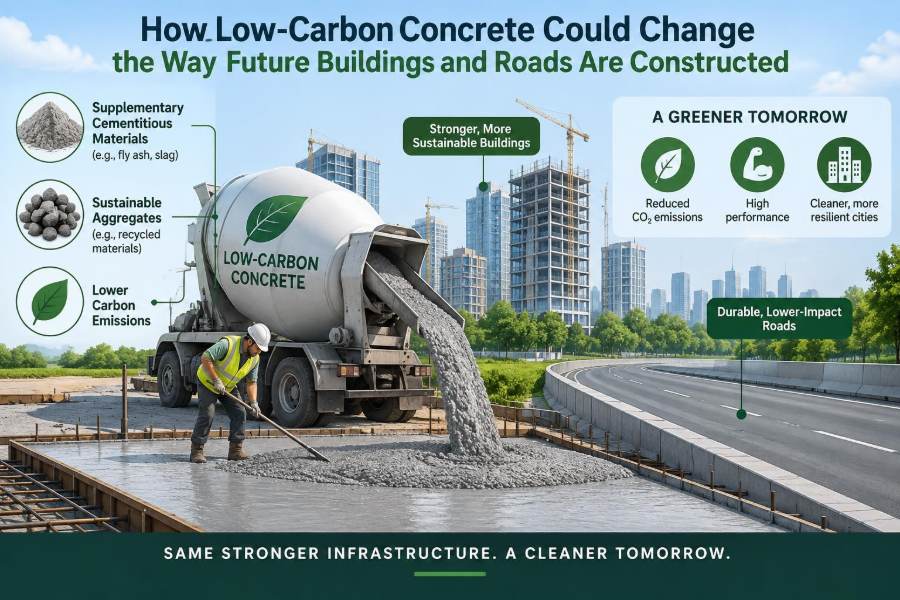

A new bridge opens, an apartment block rises, or a road is resurfaced, and most people notice the finished surface: smooth pavement, clean façades, strong columns. Few stop to consider the enormous volume of concrete that made it possible.
Concrete is so familiar that it can seem like a neutral background material. Yet its main binding ingredient, cement, carries a substantial environmental footprint, while concrete production also consumes aggregate, water, energy, and transport capacity.
That creates a practical challenge for civil engineers. Communities still need housing, hospitals, flood defences, railways, ports, and reliable roads. The question is not whether to stop building, but how to deliver the same safety, service life, and functionality with fewer emissions.
Low-carbon concrete is one of the most important answers. It is not one magic mix or a single new product; it is a changing set of materials, design choices, construction methods, and verification practices that can reshape how infrastructure is conceived and delivered.
🧱 Why Concrete Has Such a Large Carbon Footprint
Concrete itself is a composite material made from a binder, water, fine aggregate such as sand, and coarse aggregate such as gravel or crushed stone. In most conventional concrete, the binder is Portland cement.
Cement manufacture is carbon-intensive for two main reasons. Kilns need very high temperatures, traditionally supplied largely by fossil fuels, and limestone releases carbon dioxide when it is chemically converted into lime during clinker production. Clinker is the hard, reactive material ground to make most cement.
Because concrete is used in very large quantities, even modest reductions in the emissions of each cubic metre can matter across a city-scale project.
🌍 What “Low-Carbon Concrete” Actually Means
Low-carbon concrete is concrete designed to have a lower greenhouse-gas footprint than a suitable conventional reference mix while meeting the required engineering performance. The reference matters: a lightly loaded floor slab and a marine bridge pier do not have the same requirements.
The term can refer to lower-clinker cement, supplementary cementitious materials, alternative binders, recycled constituents, optimized mix proportions, carbon mineralization, or combinations of these approaches. It does not automatically mean “zero carbon,” nor does it mean lower quality.
A credible claim should specify the functional basis: for example, carbon impact per cubic metre, per unit of compressive strength, or over the intended service life of an element.
🔥 The Central Role of Clinker Reduction
For many projects, the most direct route to lower embodied carbon is to reduce the amount of clinker in the binder. This is often described as lowering the clinker factor.
A cement with less clinker can still perform well when the replacement materials are compatible with the application, curing conditions, exposure class, and construction programme. The practical constraint is that reducing clinker changes hydration—the chemical process by which cement and water create the hardened binding matrix.
Engineers therefore cannot specify a percentage replacement in isolation. They must consider what the concrete must do, when it must do it, and the environment it will experience.
♻️ Supplementary Cementitious Materials
Supplementary cementitious materials, often shortened to SCMs, are finely divided materials that partially replace Portland cement or contribute to binding reactions. Their use has long been established in many regions, but availability and specifications vary significantly.
Common SCM families
- Ground granulated blast-furnace slag: a processed by-product from iron production that can contribute to later-age strength and durability.
- Fly ash: material historically collected from coal combustion; supplies are becoming less predictable as coal-fired generation declines.
- Calcined clay: clay heated to create reactive phases, offering a potential alternative where suitable clay resources and processing capacity exist.
- Natural pozzolans: volcanic or sedimentary materials that react with lime in cementitious systems.
- Limestone powder: a widely available filler that can support cement efficiency when used in appropriate blended systems.
No SCM is universally interchangeable. Its chemistry, fineness, moisture condition, and consistency all influence the concrete mix.
⏱️ Why Early Strength Can Become a Project Constraint
Some lower-clinker mixes gain strength more slowly than conventional high-cement mixes, especially in cold weather. That may be acceptable for a mass foundation, but it can disrupt a precast factory or a fast-moving floor-cycle programme where forms must be reused quickly.
This does not make the material unsuitable. It changes the engineering response: adjust the mix, improve curing temperature, revise the sequence, use compatible admixtures, or reserve a higher early-strength mix for the elements that truly need it.
Low carbon should be designed into the programme, not added after the programme has fixed every decision.
🧪 Alternative Binders Beyond Blended Cement
Some systems aim to go beyond conventional Portland-cement blends. These include alkali-activated materials, calcium sulfoaluminate-based cements, and other novel or regionally developed binders.
They may offer significant carbon reductions under appropriate conditions, but adoption requires careful assessment. Long-term durability, supply reliability, standards compliance, handling requirements, reinforcement compatibility, and contractor familiarity can all affect whether a system is suitable.
For a pilot application, low-risk nonstructural elements may be a sensible starting point. For critical infrastructure, evidence, testing, and approval processes need to match the consequence of failure.
💧 Mix Design Is About Efficiency, Not Just Substitution
A lower-carbon binder helps, but the complete mix matters. Designers can often reduce cementitious content by improving aggregate grading, controlling water demand, and using suitable water-reducing admixtures.
Good particle packing lets smaller particles fill spaces between larger particles, reducing unnecessary paste volume. Since paste usually has a higher carbon footprint than aggregate, a well-proportioned mix can lower emissions without simply diluting performance.
However, reducing paste too aggressively can harm workability, pumpability, finishability, or cohesion. The aim is an efficient mix that crews can place and compact reliably on site.
📏 Strength Alone Is Not Enough
Compressive strength is essential, but it is not a complete measure of concrete quality. A durable structure must also resist the specific deterioration mechanisms expected in service.
Depending on the project, engineers may need to consider permeability, chloride ingress, carbonation, sulfate exposure, freeze-thaw resistance, abrasion, shrinkage, creep, and heat generation. A concrete that reaches its specified strength can still be a poor choice if it is vulnerable to the actual exposure conditions.
Performance-based specifications are valuable because they focus on required outcomes rather than demanding one familiar recipe.
🌊 Durability Can Reduce Whole-Life Carbon
A road deck or coastal wall with a longer, reliable service life can avoid major future repair, traffic disruption, material consumption, and replacement emissions. This is why a lower-emission mix at the batching plant is not necessarily the lowest-carbon solution over the asset’s lifetime.
For example, blends containing certain SCMs may refine pore structure and improve resistance to chloride penetration when properly designed and cured. That can be particularly useful where de-icing salts or seawater exposure threaten reinforcement corrosion.
There is no automatic durability bonus, though. The result depends on the full mix, cover depth, workmanship, curing, cracking control, and exposure environment.
🏢 Structural Design Can Avoid Unnecessary Concrete
Material substitution is only one lever. Engineers can also reduce carbon by using less concrete while maintaining safety and serviceability.
This may involve efficient spans, optimized slab thicknesses, voided or ribbed systems, high-strength concrete where it genuinely reduces volume, and structural layouts that avoid oversized transfer elements. Foundations can also be optimized using better ground investigation and realistic load assessment.
“Use less” must never become “provide less resilience.” Robustness, fire performance, vibration, deflection, constructability, and future adaptation remain essential design checks.
🛣️ Roads Need a Different Low-Carbon Strategy
Concrete roads, pavements, curbs, barriers, drainage channels, and bridges each have different performance demands. Pavement concrete must withstand repeated axle loads, temperature changes, joint movement, abrasion, and sometimes freeze-thaw cycling.
For roads, carbon reduction can come from durable pavement design, locally sourced aggregates, optimized slab geometry, recycled materials where technically appropriate, and construction planning that limits waste and rework. Rehabilitation decisions also matter: preserving a serviceable base or structure may have a lower impact than full reconstruction.
Traffic management is part of the wider picture. A technically sound repair that causes excessive repeat closures can create operational and social costs that should not be ignored.
🏗️ Precast Construction Offers Useful Control
Precast plants operate in more controlled conditions than most construction sites. They can measure materials accurately, reuse moulds, manage curing conditions, and capture data across repeated production cycles.
Those advantages can make precast elements a strong setting for lower-carbon mix development. However, transport distance, lifting requirements, connection design, and the carbon of additional reinforcement or steelwork must still be considered.
Factory production is not automatically better; it is most effective when the structural system, logistics, and repeatability support it.
🌡️ Curing Determines Whether the Mix Delivers
Curing keeps concrete at suitable moisture and temperature conditions while it develops strength and durability. It is especially important for mixes with slower early hydration or higher proportions of certain SCMs.
If fresh concrete dries too quickly, surface cracking and poor near-surface quality can result. A project can specify an excellent low-carbon mix and still lose its durability advantage through rushed or inadequate curing.
Site teams need clear, practical curing instructions: when to begin, what method to use, how long it must continue, and how weather conditions change the plan.
🧊 Cold Weather and Hot Weather Need Different Responses
In cold weather, hydration slows and early-age strength development can be delayed. In hot, dry, or windy conditions, evaporation rises, increasing the risk of plastic shrinkage cracking before the concrete has hardened.
Lower-carbon concrete may be more sensitive to these conditions depending on its binder system. Planning may include protected storage, temperature-controlled materials, windbreaks, evaporation control, insulated formwork, adjusted placement times, or revised curing regimes.
Weather planning is not a minor site detail. It connects material performance directly to programme certainty and repair risk.
📋 Performance Specifications Open More Options
Prescriptive specifications tell suppliers exactly what ingredients or proportions to use. They can be simple to administer, but they may lock projects into higher-clinker mixes even when alternative solutions can meet the required performance.
Performance specifications set criteria such as strength, exposure resistance, workability retention, shrinkage limits, or service-life indicators, then allow the producer to develop a compliant mix. This can encourage innovation and local optimization.
They also demand stronger quality assurance. Clear test methods, acceptance criteria, responsibilities, and treatment of nonconforming results are essential.
🧾 Environmental Product Declarations Need Careful Reading
An Environmental Product Declaration, or EPD, reports environmental information for a product using a defined assessment method. It can help compare cements, concrete mixes, aggregates, and construction products.
But comparisons are only meaningful when the declared unit, system boundary, location, electricity assumptions, transport, and data quality are sufficiently aligned. One declaration may cover production to the factory gate, while another may include different stages.
An EPD is useful evidence, not a shortcut around engineering judgment or whole-project analysis.
🔍 Whole-Life Carbon Changes the Decision
Whole-life carbon considers emissions associated with materials, transport, construction, maintenance, repair, replacement, and end-of-life treatment. For long-lived assets, these stages can influence the best choice.
A bridge component requiring unusually frequent repair may have a poor whole-life outcome even if its initial concrete mix has low embodied carbon. Conversely, a moderately higher-impact material may be justified when it substantially improves durability in a severe environment.
The right functional unit should reflect the asset’s purpose: supporting a floor over a design life, carrying traffic, retaining soil, or protecting a shoreline.
🚚 Transport and Local Supply Still Matter
Concrete is heavy, time-sensitive, and usually supplied locally. Hauling ready-mix over long distances can add emissions and reduce workable time, while remote sourcing of specialized binders may undermine some of their benefit.
Local materials are not automatically lower carbon, because extraction methods and processing vary. Still, early supply-chain mapping helps a design team understand realistic options rather than specifying products that are difficult to obtain consistently.
Projects should ask what is available within the expected supply radius, in what volume, and with what quality controls.
🔄 Recycled Aggregate Has Limits as Well as Benefits
Recycled concrete aggregate can reduce demand for virgin aggregate and divert demolition material from disposal. It is often particularly practical in subbases, drainage layers, and selected concrete applications.
Its properties can differ from virgin aggregate because particles may carry old mortar. This can increase water absorption, affect density, and introduce variability. Processing, grading, contamination control, and appropriate replacement levels are therefore important.
Using recycled aggregate responsibly means matching it to the application, rather than assuming every demolished slab can become high-performance structural concrete.
🫧 Carbon Mineralization Is Promising but Not a Complete Answer
Some processes introduce captured carbon dioxide into fresh concrete or cured concrete products, where it can react to form stable carbonate minerals. This may store a limited amount of carbon while sometimes improving particular material properties.
Concrete also undergoes slow natural carbonation during service, especially where surfaces are exposed to air. That uptake should be assessed carefully because carbonation can also reduce the alkalinity that protects embedded steel if it progresses to reinforcement depth.
Carbon mineralization can be part of a wider strategy, but it does not remove the need to reduce clinker and use materials efficiently.
⚠️ Carbon Claims Must Not Outrun Evidence
Terms such as “carbon neutral,” “net zero,” and “green concrete” can conceal important assumptions. A claim may depend on offsets, future carbonation, a narrow life-cycle boundary, or comparisons with an unusually carbon-intensive baseline.
Procurement teams should ask for transparent calculations, stated boundaries, mix-specific information, and confirmation that performance requirements have been met. The most useful claims are specific enough to be checked.
- What is being compared?
- Which life-cycle stages are included?
- Is the result based on a verified product declaration or project calculation?
- Does the concrete meet the required exposure and service-life criteria?
👷 Contractors Need a Seat at the Design Table
A mix that looks excellent on paper can fail operationally if it is difficult to pump, finish, place through congested reinforcement, or maintain within a realistic delivery window. Contractors and concrete suppliers understand these constraints early.
Early collaboration can identify trial pours, batching tolerances, admixture compatibility, backup mix options, curing resources, and realistic strength-testing ages. It can also prevent late substitutions that erase the intended carbon savings.
Low-carbon construction works best as a team process rather than a requirement passed down at tender stage.
🧪 Trial Batches Are an Engineering Tool, Not a Sign of Failure
Trial batching allows a team to test fresh properties, strength development, finishability, air content, temperature behaviour, and other relevant performance indicators before full production. It is particularly valuable when materials, weather, or placement methods differ from familiar practice.
A meaningful trial should resemble the actual work as closely as possible. Testing a small laboratory batch cannot fully represent a long pumped placement, a heavily reinforced wall, or an exposed pavement pour.
Documenting what worked—and what did not—creates confidence for future projects.
📊 Carbon Budgets Can Guide Better Choices
Projects increasingly use carbon budgets alongside cost and schedule targets. A budget gives design teams a reason to compare options before decisions become expensive to change.
Concrete should be assessed by element and volume, not only as a single project total. A large foundation mat, retaining wall, or podium slab may offer a high-impact opportunity, while a small architectural feature may not justify complex procurement effort.
Tracking should be proportionate. The goal is actionable information, not a spreadsheet that nobody uses.
💰 Cost Is More Complicated Than Material Price
A lower-carbon mix may cost more, less, or about the same at purchase, depending on regional supply, demand, specifications, and production constraints. Focusing only on price per cubic metre can miss effects on placement rate, curing, formwork turnover, durability, and future maintenance.
Conversely, environmental ambition should not be used to dismiss cost control. The best solutions often combine efficient structural design, locally viable binders, reliable operations, and durable detailing.
Value engineering should ask, “How can this element deliver its function with less whole-life impact?” rather than simply, “What is the cheapest mix today?”
🏛️ Codes, Standards, and Approvals Shape Adoption
Concrete standards and building codes exist to protect public safety and establish dependable practice. They can also make change slow, particularly for structural or safety-critical applications.
Many current frameworks already allow a range of blended cements and performance-based approaches, but local regulations, client requirements, and approval authorities may be more restrictive. Engineers must work within applicable rules and avoid treating sustainability goals as permission to bypass them.
Better guidance, shared test data, and well-documented demonstration projects can gradually expand confidence in suitable solutions.
🎓 Skills for the Next Generation of Engineers
Future civil engineers will need more than the ability to select a standard strength class. They will need to understand binder chemistry, durability design, life-cycle assessment, supply chains, specifications, construction sequencing, and uncertainty in environmental data.
For students, a useful habit is to ask two questions about every material choice: what performance does this element need, and what resources are required to achieve it? For professionals, continuing education and supplier engagement can turn unfamiliar options into practical ones.
The discipline remains grounded in fundamentals: safe loads, sound detailing, good drainage, quality construction, and durable maintenance plans.
🧭 A Practical Path for Project Teams
Teams do not need to wait for a perfect universal material. A structured process can reduce carbon on ordinary projects now while creating space for more ambitious innovation.
- Set a project carbon objective early, alongside safety, cost, and programme goals.
- Identify concrete elements with the largest volumes or highest cement contents.
- Review local binder, aggregate, and ready-mix supply options.
- Define performance and exposure requirements clearly.
- Compare feasible mixes using consistent carbon boundaries.
- Run representative trials and plan curing before construction begins.
- Record actual materials and lessons learned for the next project.
🏙️ How This Could Change Future Construction
Low-carbon concrete can shift construction away from a simple “specify strength and pour” model. Future projects are likely to treat concrete as a performance system whose carbon, durability, buildability, and service life must be considered together.
That may mean more blended binders, better use of local materials, leaner structural forms, digital material records, and closer coordination between designers, producers, contractors, and asset owners. Buildings and roads may not look radically different from the outside, but the decisions behind them can be.
The core principle is simple: build only what is needed, use the lowest-impact materials that reliably meet the job, and protect the asset long enough for that choice to matter.
Low-carbon concrete is not a single product waiting to solve construction’s challenges. It is a disciplined engineering approach—one that combines material innovation with durable design, careful delivery, and honest measurement—to make the structures society depends on more resource-conscious over their full lives. 🏗️🌍🔧