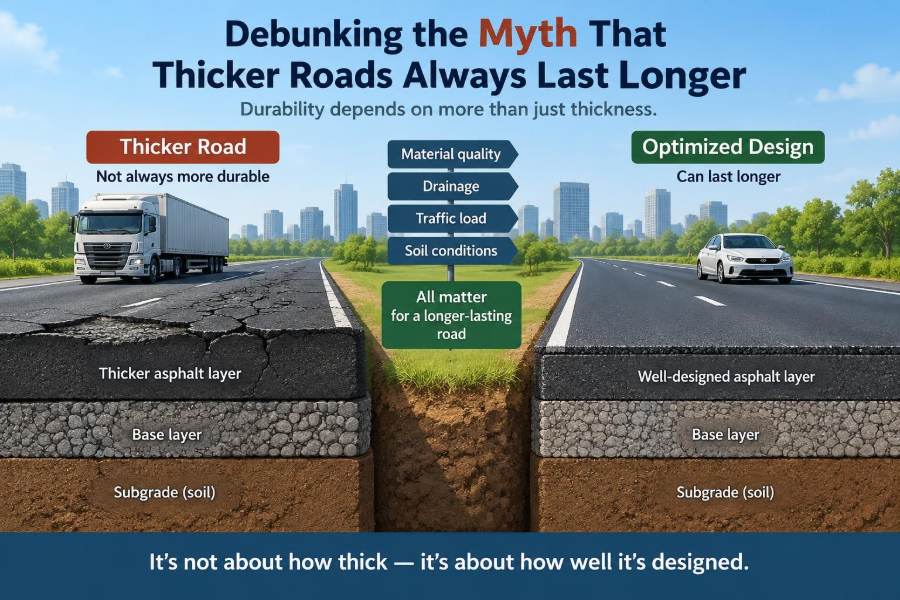

A newly resurfaced road can look indestructible: dark, smooth asphalt, crisp lane markings, and a pavement layer that seems much thicker than the old one. It is tempting to assume that more asphalt automatically means more years of trouble-free service.
Then a surprising thing happens. A thinner road on one corridor performs well for years, while a much thicker road nearby develops wheel-path ruts, edge cracking, or potholes. The visible surface has not told the whole story.
For students, this is a useful correction to a simple intuition. For practitioners, it is a daily design and maintenance reality: pavement performance depends on the entire system, not just the thickness visible at the surface.
Thickness matters, sometimes decisively. But specifying extra thickness without understanding loads, materials, water, construction quality, and the supporting ground can spend money in the wrong place—or even preserve the conditions that cause early failure.
🛣️ The Simple Claim Behind the Myth
The myth usually takes this form: if one pavement is thicker than another, it must last longer. It sounds reasonable because thickness can reduce stress reaching lower layers and provide more material to wear away.
Yet pavement is not a solid slab resting on a perfectly rigid foundation. It is a layered structure that flexes under traffic, drains or retains water, expands and contracts with temperature, and relies on support from the material beneath it.
A thicker pavement is not automatically a better pavement; it is a design choice whose value depends on the failure mechanism being controlled.
🏗️ Pavement Works as a Layered System
A typical flexible pavement includes an asphalt surface, one or more base layers, a subbase where needed, and the subgrade: the prepared natural soil or fill beneath the road. Each layer has a different job.
The surface provides smoothness, skid resistance, waterproofing to a limited degree, and resistance to traffic wear. The base and subbase spread loads, provide support, and may assist drainage. The subgrade supplies the foundation for everything above.
If a weak layer remains untreated, adding material above it may reduce some stresses, but it cannot make the weakness disappear.
⚙️ What Pavement Thickness Actually Does
Increasing thickness generally spreads wheel loads over a wider area before they reach lower layers. This can reduce compressive strain in the subgrade and tensile strain near the bottom of asphalt layers, both of which are associated with common forms of distress.
Thickness can also provide structural capacity for repeated heavy loading. A road serving buses, freight vehicles, and construction traffic usually needs a different structure from a low-volume residential street.
But the benefit is not unlimited. Once another factor becomes controlling—such as trapped water, poor bonding, or weak soil—extra surface thickness may offer a smaller return than correcting that factor.
🚚 Traffic Loads Are Repetitive, Not One-Time Events
Pavements rarely fail because of one ordinary vehicle pass. They deteriorate through repeated loading, especially from heavy axle groups. Every pass produces a small response in the pavement; over time, repeated responses can accumulate into fatigue cracking or permanent deformation.
Traffic composition matters as much as traffic volume. Thousands of passenger cars do not impose the same structural demand as a smaller number of heavily loaded trucks.
Design therefore considers expected axle loading, growth, lane distribution, vehicle speeds, and the road’s intended service period. A thickness that is suitable for one traffic forecast may be insufficient for another.
🧱 The Subgrade Often Sets the Limit
The subgrade is the soil platform below the pavement layers. Its strength and stiffness can vary dramatically with soil type, density, moisture condition, frost susceptibility, and seasonal changes.
Consider a simple hypothetical comparison. Two roads receive the same asphalt thickness. One is built over dense, well-drained granular soil; the other over wet, highly plastic clay. The second road may deflect more under every truck pass, placing greater strain on its upper layers.
Where subgrade support is poor, engineers may improve or replace soil, stabilize it with an appropriate binder, use geosynthetics where justified, improve drainage, or redesign the layer system. These measures can be more effective than merely adding asphalt.
💧 Water Is a Pavement’s Persistent Adversary
Water changes the behavior of many pavement materials. Saturated unbound granular layers may lose stiffness, fine soils can soften, and repeated traffic can pump water and fines through cracks or joints.
Water also contributes to stripping in asphalt mixtures, where the bond between binder and aggregate is weakened. Not every moisture-related defect has the same cause, so the remedy must follow diagnosis rather than appearance alone.
A thick pavement with poor drainage can remain wet for long periods. A properly drained pavement of appropriate thickness often has a much better chance of maintaining its intended support conditions.
🌧️ Drainage Is Part of Structural Design
Drainage is often discussed as a roadside feature, but it is also a structural issue. Surface crossfall, kerbs, shoulders, ditches, edge drains, outlets, and permeable drainage layers can all influence how water reaches and leaves the pavement system.
Good drainage needs a complete path. An underdrain without a reliable outlet, for example, cannot perform as intended. Likewise, a permeable base can be counterproductive if water enters easily but cannot escape.
Designers should consider both surface runoff and subsurface moisture. The correct arrangement depends on local climate, groundwater, terrain, materials, and maintenance capacity.
🔬 Material Quality Is Not Interchangeable
Two asphalt layers of equal thickness may perform very differently. Aggregate shape and durability, binder grade, mix gradation, air-void structure, moisture sensitivity, and production control all influence behavior.
An asphalt mixture must resist rutting at high service temperatures while retaining enough flexibility to resist cracking under repeated loads and colder conditions. There is no universally best mix; selection must suit the climate, loading, and layer function.
The same principle applies to base materials. A well-graded, clean, properly compacted aggregate base does not behave like a poorly graded or contaminated layer simply because both have the same depth.
🔥 Asphalt Binder Must Suit the Climate
Asphalt binder is viscoelastic: its response depends on temperature and loading time. In hot conditions or under slow, heavy vehicles, a mixture that is too soft may be more vulnerable to permanent deformation. In cold conditions, excessive stiffness can increase cracking risk.
Binder selection is therefore tied to local temperatures and expected traffic. Thickness helps manage structural strain, but it does not correct a mixture whose temperature response is unsuitable for the environment.
This is one reason a “thicker is safer” rule can mislead. It overlooks the fact that pavement failure can begin within a material that was never appropriate for the service conditions.
📐 Flexible and Rigid Pavements Behave Differently
Flexible pavements, commonly asphalt pavements, distribute loads through successive layers and deflect under traffic. Their performance is closely connected to the stiffness and condition of all layers.
Rigid pavements, commonly concrete pavements, use a stiffer slab to spread loads over a wider area. Thickness is important here too, but joint design, load transfer, curing, support uniformity, and slab cracking are central concerns.
| Feature | Flexible pavement | Rigid pavement |
|---|---|---|
| Primary surface material | Asphalt mixture | Concrete slab |
| Load-spreading behavior | Layered, with noticeable deflection | Stiff slab spreads load broadly |
| Common critical issues | Rutting, fatigue, moisture damage | Joint performance, cracking, support loss |
| Why thickness alone is incomplete | Lower-layer support and mix behavior matter | Joints, curing, and uniform support matter |
📉 Rutting Is Not Always a Thin-Pavement Problem
Rutting is a longitudinal depression in the wheel path. It can result from permanent deformation in the asphalt layers, the granular base, or the subgrade. The location of deformation determines the appropriate repair.
If rutting occurs mainly in a weak asphalt surface mixture, adding more of the same unsuitable mixture may not solve it. A more rut-resistant mix, improved compaction, or a different layer arrangement may be needed.
If the rut originates deeper in the pavement, a surface-only treatment may restore appearance temporarily while allowing the structural cause to continue.
🕸️ Cracking Has More Than One Cause
Cracks are evidence, not a diagnosis by themselves. Bottom-up fatigue cracks can develop as repeated bending accumulates damage from the lower part of an asphalt layer. Top-down cracks may begin near the surface under tire stresses and aging. Reflection cracks can propagate from an older cracked layer or underlying pavement.
Thermal contraction can also cause cracking in cold climates, while settlement or movement in the foundation may create irregular patterns. Each mechanism responds differently to thickness, materials, and maintenance.
Filling every crack with a new thick overlay without investigating the pattern can delay, rather than resolve, the problem.
❄️ Freeze-Thaw Changes the Design Problem
In climates where freezing occurs, water in susceptible soils can form ice lenses and lift portions of the road. During thaw, the soil may temporarily lose substantial support, creating a particularly vulnerable period for heavy traffic.
Thickness can help protect the surface from some seasonal effects, but it does not eliminate frost susceptibility. Drainage, frost-resistant materials, insulation approaches where appropriate, and control of water sources may be part of the solution.
Local conditions matter greatly. A detail that works well in a dry, warm region may be unsuitable where frost and spring thaw govern pavement performance.
🧰 Compaction Creates the Pavement You Designed
Plans specify layer thicknesses and material properties, but construction determines whether those intended properties are achieved. Compaction reduces voids, improves particle interlock in granular layers, and helps asphalt mixtures resist deformation and water entry.
Insufficient compaction can leave a pavement vulnerable even when the design thickness is generous. Excessive or poorly controlled compaction can also create problems, including aggregate crushing or undesirable mix characteristics.
Field density checks, temperature control for asphalt, lift thickness management, and rolling patterns are not paperwork exercises. They are part of delivering structural performance.
🔗 Layer Bonding Cannot Be Assumed
Asphalt pavements are commonly placed in lifts. For the structure to act as intended, adjacent asphalt layers need effective bonding, usually aided by a properly applied tack coat and clean interface.
Poor bonding allows layers to slip or move independently under traffic. This can contribute to surface distress and reduce the benefit expected from the total asphalt thickness.
A pavement may therefore contain the correct amount of asphalt on paper but perform as if it were a less integrated structure. Thickness measurements alone will not reveal this problem.
📏 Thickness Uniformity Matters as Much as Average Depth
An average thickness can hide thin spots. If a specified layer is locally thinner over a weak area, that area may experience higher strains and become the first location of distress.
Uniform grade preparation, paving control, and verification of layer thickness are essential. Local irregularities are especially significant near transitions, utility trenches, widening joints, drainage structures, and patches.
Design should also recognize practical construction tolerances. A robust design considers realistic variability instead of relying on every point in the road being ideal.
🚧 Utility Cuts Create Local Weak Points
Roadways in built-up areas are frequently opened for water, sewer, power, and telecommunications work. Even when the trench is restored, its backfill and compaction may differ from the surrounding pavement structure.
Differential settlement, water pathways along trench edges, and imperfect layer restoration can cause cracking or depressions. Simply placing a thick asphalt patch at the top does not ensure that the support below has been restored.
Good reinstatement requires suitable backfill, controlled compaction, restoration of pavement layers, drainage awareness, and durable joints with the existing pavement.
🧭 Design Must Match the Road’s Job
A port access road, rural highway, urban bus lane, industrial yard, and residential cul-de-sac face different loading patterns and operational demands. Their appropriate pavement structures may differ even if they appear similar to a driver.
Slow, turning heavy vehicles can impose severe shear stresses in intersections, roundabouts, loading areas, and bus stops. These locations may require enhanced materials or localized structural treatment rather than simply copying the road’s standard cross-section.
Road design is fit-for-purpose engineering, not a competition to specify the deepest section.
🧪 Investigation Comes Before Thickness Selection
A reliable pavement design begins with information. Site investigation may include soil classification, moisture observations, strength or stiffness testing, groundwater assessment, existing pavement coring, traffic data, and review of drainage conditions.
For rehabilitation, the condition of the existing layers is crucial. An overlay may be suitable if the underlying pavement retains enough structural value. If widespread support failure is present, localized or full-depth reconstruction may be more appropriate.
The level of investigation should be proportionate to the project’s risk and scale. Small schemes still benefit from understanding what lies below the surface.
🧮 Design Methods Balance Several Failure Modes
Pavement design methods use material, traffic, climate, and support inputs to estimate a structure capable of meeting performance objectives. Different jurisdictions use different procedures, and assumptions must be appropriate to the local method and available data.
Designers commonly check more than one potential limit, such as subgrade deformation, asphalt fatigue, rutting, or concrete slab stresses. The governing criterion is the one that requires the most demanding structure or material solution.
This explains why extra thickness is sometimes justified and sometimes not. A design may be controlled by drainage, material durability, or a localized detail rather than overall depth.
🩺 Maintenance Timing Extends Service Life
Even a well-designed pavement needs maintenance. Small cracks can allow water into the structure; untreated drainage defects can weaken support; worn surfaces can reduce skid resistance before the pavement has structurally failed.
Preventive actions might include crack sealing where suitable, drainage cleaning, localized repairs, surface treatments, or thin renewals. Their purpose is to preserve the existing structure before damage becomes expensive to correct.
Waiting until widespread potholes appear often means that deterioration has progressed below the surface. At that stage, adding a thin cosmetic layer is unlikely to provide lasting value.
🔍 Diagnose Before Choosing an Overlay
An asphalt overlay can be an effective rehabilitation option, but it is not a universal cure. Engineers need to establish whether visible distress is surface-related, structural, moisture-driven, or caused by movement in underlying layers.
Useful assessment tools can include visual surveys, coring, deflection testing, drainage inspection, and records of previous repairs. The aim is to identify the cause and extent of weakness, not just map the symptoms.
For example, an overlay over stable but oxidized asphalt may be sensible. An overlay over saturated, pumping base material may fail prematurely unless the water and support problem are addressed first.
💰 More Material Is Not Always Better Value
Extra thickness consumes aggregate, binder or cement, transport capacity, fuel, labor, and construction time. It may also raise finished road levels, affecting kerbs, drainage inlets, bridge clearances, driveways, and adjacent properties.
Those impacts do not mean thickness should be minimized at all costs. Underdesign can lead to early rehabilitation and disruptive repairs. The objective is whole-life value: a solution that balances initial construction, maintenance, user disruption, and expected performance.
Spending part of a budget on drainage correction, subgrade treatment, quality control, or better materials may sometimes protect the investment more effectively than increasing depth everywhere.
🌱 Environmental Choices Need the Same Discipline
Thicker pavements generally require more construction materials, but a pavement that fails early also creates environmental burdens through repeated repairs, traffic delays, and replacement work. The sustainable answer is not automatically the thinnest or thickest option.
Reclaimed materials, recycled asphalt, locally available aggregates, warm-mix technologies, and optimized layer designs can reduce impacts when they are properly evaluated for the intended use. Their suitability depends on material quality and specification requirements.
Durability and resource efficiency work together when the structure is designed to last for its actual conditions rather than built around a simplistic rule.
⚠️ Common Decisions That Lead to Early Failure
- Adding an overlay without fixing drainage: water continues to weaken layers below the new surface.
- Using average traffic instead of heavy-vehicle loading: structural demand can be underestimated.
- Ignoring weak spots: soft subgrade areas, trench reinstatements, and failed edges often need targeted treatment.
- Accepting poor compaction: thickness cannot fully compensate for low density or poor layer integrity.
- Repeating the same mix everywhere: intersections and slow-moving heavy-traffic zones may need different resistance to deformation.
- Deferring small repairs too long: minor defects can become pathways for water and structural deterioration.
🧠 A Practical Way to Think About Thickness
Think of pavement thickness as one lever in a larger system. It is especially useful when the road needs greater load-spreading capacity, but it should be selected alongside the properties of the layers below and above it.
A useful sequence of questions is:
- What vehicles and load repetitions will the road carry?
- How strong and moisture-sensitive is the subgrade?
- Where will water go during storms and wet seasons?
- Which materials can resist the expected climate and traffic stresses?
- Can the design be built and maintained to the required quality?
Answering these questions produces a pavement system, not merely a thickness number.
🎓 What Students Should Take From the Myth
Early pavement discussions often focus on layer depths because they are visible in drawings and easy to compare. The deeper lesson is that dimensions represent a response to assumptions about load, material behavior, support, climate, and reliability.
When reviewing a cross-section, ask what each layer is doing. Is it carrying load, improving drainage, protecting against frost, providing a working platform, or creating a bondable surface for the next layer?
This habit turns a standard detail into an engineering argument. It also makes it easier to recognize when copying a successful design from another site is inappropriate.
👷 What Practitioners Should Check in the Field
Field observations often reveal the difference between a sound design and a durable asset. Look for ponding water, blocked outlets, soft shoulders, pumping at cracks or joints, wheel-path patterns, edge distress, and recurring patches.
During construction, verify more than final surface appearance. Grade, layer thickness, moisture condition, density, asphalt temperatures, interface cleanliness, and drainage outlets all deserve attention.
When defects emerge, document their location, shape, timing, and relation to traffic or weather. Patterns are valuable clues that help avoid expensive but ineffective repairs.
🏁 The Core Principle: Design the Whole System
Roads last when their structural capacity, materials, drainage, construction quality, and maintenance strategy work together under real traffic and environmental conditions. Thickness is a major part of that equation, not the equation itself.
A thicker asphalt layer can be the right answer for a heavily loaded route over an adequately prepared foundation. On another project, the better answer may be subgrade improvement, drainage repair, a more suitable mix, stronger quality assurance, or a targeted reconstruction.
The strongest question is not “How thick should we make it?” but “What is causing stress and deterioration in this pavement system, and which intervention addresses it?”
Long-lasting roads are not simply thicker; they are properly designed, well built, kept dry where possible, and maintained before small weaknesses become structural failures. 🌉🛣️💧