
A summer downpour can turn an ordinary parking lot into a shallow pond within minutes. Water rushes along curbs, disappears into a few overloaded inlets, and may reappear at the lowest point of a road, basement entrance, or intersection.
In many cities, that response is built into the landscape. Roofs, asphalt, concrete, and compacted ground prevent rain from soaking into soil, so runoff travels quickly and in large volumes toward drains and waterways.
Permeable pavement offers a different path. Rather than treating pavement as a sealed lid over the ground, it uses an engineered surface and stone layers to store, filter, and often infiltrate rainfall where it lands.
But how efficient is it in practice? The answer depends less on the name of the pavement than on its design, underlying soils, drainage setting, traffic use, construction quality, and maintenance.
🌧️ Why urban runoff creates such a difficult problem
Natural soil, vegetation, and shallow depressions slow rainfall and allow a portion of it to infiltrate or evaporate. Urban development replaces many of those surfaces with impervious cover, which sheds water rapidly.
The result is a sharper runoff peak: more water reaches the drainage system in a shorter period. This can contribute to street flooding, erosion in receiving streams, combined sewer overflows in some systems, and transport of pollutants washed from paved surfaces.
🧱 What permeable pavement actually is
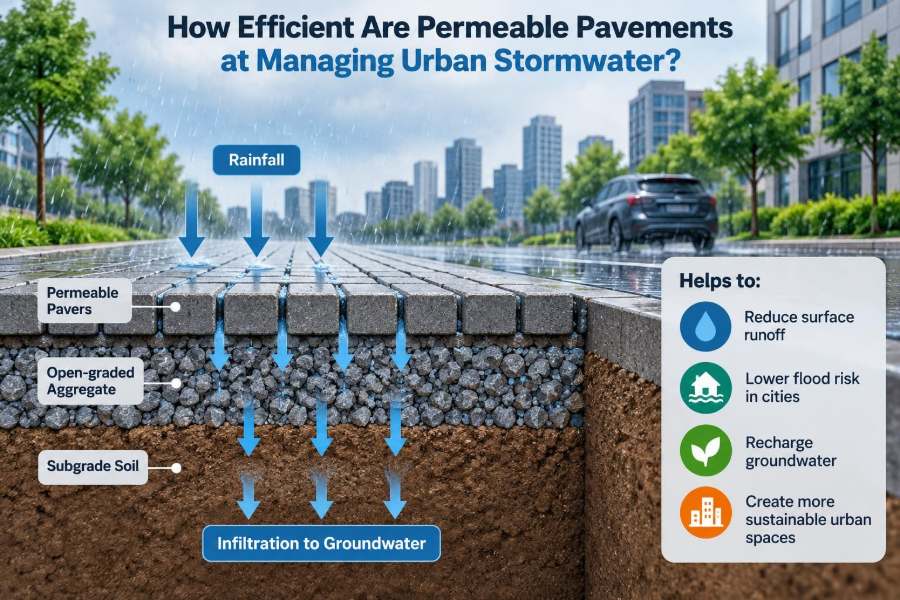
Permeable pavement is a pavement system designed to let water pass through its surface or through joints between units. Beneath the wearing surface is usually an open-graded aggregate reservoir, with interconnected voids that can temporarily hold stormwater.
It is not simply a pavement with holes. It is a layered stormwater-control system that must also carry traffic loads, resist deformation, and direct water in a predictable way.
💧 The basic stormwater pathway
During rainfall, water enters the pavement surface, moves through a bedding or choker layer where used, and reaches the stone reservoir below. From there, it may infiltrate into native soil, drain slowly through an underdrain, or do both.
This delay is central to its value. Instead of sending the full rainfall intensity immediately to a pipe, the system stores water and releases it over a longer period.
🪨 The layers beneath the surface matter most
A visually attractive permeable surface can still perform poorly if its base is undersized or the subgrade is unsuitable. The reservoir layer is often made of uniformly graded crushed stone, selected to provide structural stability while retaining large connected voids.
Geotextiles, geogrids, underdrains, edge restraints, and overflow structures may also be part of the assembly. Their need and placement depend on site conditions rather than a one-size-fits-all detail.
🚗 Common types of permeable pavement
Several systems can manage stormwater effectively when correctly designed. Their differences affect appearance, construction methods, loading capacity, maintenance needs, and likely applications.
| System | How water enters | Common uses | Practical consideration |
|---|---|---|---|
| Porous asphalt | Through interconnected air voids in the asphalt | Parking areas, low-speed lanes | Needs careful mix design and construction control |
| Pervious concrete | Through open voids in the concrete matrix | Parking bays, sidewalks, low-speed areas | Finishing and curing differ from conventional concrete |
| Permeable interlocking concrete pavers | Through aggregate-filled joints or openings | Plazas, sidewalks, parking lots, streets | Individual units can be repaired or replaced |
| Grid or cellular systems | Through open cells filled with aggregate or vegetation | Overflow parking, access routes, low-use areas | Surface fill must match expected traffic and use |
📦 Storage volume is a key measure of efficiency
Stormwater performance is often judged by how much runoff the system can retain before water leaves through infiltration, an underdrain, or an overflow. This depends on the depth and void space of the aggregate reservoir, not just on surface permeability.
A shallow system may accept water quickly but have limited storage. A deeper reservoir can manage a larger design storm, provided groundwater, utilities, grades, and construction cost allow it.
⏱️ Peak-flow reduction is often the main benefit
For dense urban catchments, reducing the peak discharge can be as valuable as reducing the total runoff volume. By storing rain temporarily, permeable pavement can flatten the hydrograph—the graph showing how flow changes during and after a storm.
That moderation can reduce demand on downstream pipes and detention facilities. It does not mean the pavement eliminates flooding everywhere; downstream bottlenecks and rainfall exceeding the design event can still govern outcomes.
🌱 Infiltration can restore part of the natural water cycle
Where native soils can accept water and groundwater conditions are appropriate, an infiltrating pavement can return a share of rainfall to the ground. This reduces discharge volume and may support soil moisture or groundwater recharge.
Infiltration is not automatically desirable at every site. Designers must consider groundwater depth, soil contamination, slope stability, nearby foundations, karst conditions, and whether infiltrated water could mobilize pollutants already present in the soil.
🔧 Underdrains make difficult sites more workable
Low-permeability subsoils do not necessarily rule out permeable pavement. A perforated underdrain can collect water from the aggregate reservoir and release it at a controlled rate to a storm sewer, swale, or other approved outlet.
This approach changes the system from full infiltration to detention and filtration. It can still reduce peak flow, but its long-term drawdown depends on the outlet configuration rather than soil infiltration alone.
🧪 Water-quality treatment is useful but not unlimited
As runoff passes through the surface and aggregate, larger sediment particles can be trapped near the upper layers. The system may also reduce pollutant transport by filtering solids, slowing flow, and allowing some processes to occur within the pavement profile.
However, permeable pavement is not a universal treatment device. Dissolved pollutants behave differently from sediment-bound pollutants, and runoff from industrial operations, fueling areas, or sites with known contamination may require additional controls.
🛢️ Where pollutant hotspots need caution
Sites with frequent spills or concentrated vehicle fluids deserve special evaluation. Examples can include fueling stations, vehicle maintenance yards, loading areas handling chemicals, and locations where de-icing materials are heavily applied.
The concern is straightforward: infiltration can move contaminated water below the surface. A lined system with controlled drainage, source controls, or a different stormwater practice may be more appropriate than direct infiltration.
🏙️ Parking lots are a natural starting point
Parking lots often provide excellent opportunities because they are broad, relatively low-speed paved areas with distributed rainfall loading. A permeable parking bay system can manage water close to where it falls rather than requiring every drop to travel to a perimeter inlet.
For a hypothetical retail lot, permeable stalls paired with conventional driving aisles may balance drainage performance, construction sequencing, and heavy-turning traffic. This hybrid approach is often easier to protect during construction than converting every square metre of pavement.
🚶 Sidewalks, plazas, and trails offer smaller-scale benefits
Pedestrian areas generally carry lighter loads and can be easier to integrate with planting, street trees, and curbside drainage features. Permeable pavers also allow local repairs without demolishing an entire slab.
Still, these surfaces must meet accessibility and walking-surface requirements. Joint width, unit stability, settlement tolerance, and winter maintenance all matter where people use wheelchairs, strollers, bicycles, or mobility aids.
🚚 Traffic loading sets real limits
Permeable pavement can be designed for substantial loads, but repeated heavy truck traffic, braking, turning, and concentrated wheel paths place greater demands on the surface and base. A loading dock approach is not equivalent to a lightly used visitor parking space.
Structural design should address axle loads, traffic repetitions, subgrade strength, frost conditions, and edge support. Calling a pavement permeable does not remove the need for conventional pavement engineering principles.
📐 Native soil testing cannot be skipped
For infiltrating systems, engineers need site-specific information about subgrade permeability and soil stratification. Field investigation is essential because fill, lenses of fine material, compacted layers, and seasonal groundwater can vary significantly over short distances.
Designers also need to distinguish between a test result and a safe design infiltration rate. Conservative assumptions and allowances for long-term performance help avoid reservoirs that drain more slowly than intended.
🧭 Grades and drainage details control performance
Permeable pavement is commonly most straightforward on gentle grades. On sloping sites, water can migrate through the stone layer toward the low end, reducing storage uniformity and potentially creating structural or drainage problems.
Terracing, check dams within the reservoir, underdrain controls, and careful grading can divide a long slope into smaller storage cells. Surface runoff routes must also be planned so that intense storms have a safe overflow path.
🧊 Cold climates create design challenges, not a ban
Freeze-thaw cycles are often raised as an objection, but cold-climate use is possible with sound drainage and structural design. Keeping water from being trapped where it can freeze, providing a free-draining aggregate base, and considering frost-susceptible subgrades are critical.
Winter sanding can accelerate surface clogging, while plow blades can damage paver edges or catch raised features. Snow-storage locations should be chosen carefully so that sediment-laden meltwater does not overwhelm a small pavement area.
🍂 Clogging is the performance risk people should understand
The most common long-term threat is not that the stone reservoir suddenly stops working; it is that fine sediment gradually blocks surface voids or paver joints. Water then ponds or runs off rather than entering the system as designed.
Clogging risk rises when surrounding bare soil, unpaved shoulders, leaf litter, construction sediment, or poorly controlled landscaping can wash onto the pavement. Prevention is usually more effective and less expensive than restoring a heavily clogged surface.
🧹 Maintenance is simple in principle, disciplined in practice
Maintenance typically includes routine inspection, removal of leaves and debris, and vacuum sweeping when sediment accumulates. The appropriate equipment and frequency depend on local sediment loads, tree cover, winter operations, and observed infiltration.
Pressure washing without effective vacuum recovery can push fines deeper into the surface. Likewise, applying loose sand for winter traction may conflict with the pavement’s drainage function unless the maintenance plan accounts for subsequent cleanup.
🏗️ Construction sediment can ruin a system before opening day
A permeable pavement should not be used as a sediment trap during active construction. Runoff from exposed soil can introduce enough fine material to reduce infiltration before the facility is handed over to its owner.
Good sequencing keeps the aggregate reservoir and surface protected until surrounding grading and landscaping are stable. Contractors also need clean aggregate, controlled access, correct compaction procedures, and protection from soil tracking by construction vehicles.
🔍 Inspection should focus on visible warning signs
Owners do not need a laboratory to identify many early problems. After rainfall, they can look for persistent surface ponding, sediment deposits, displaced pavers, rutting, cracking, clogged joints, or water escaping at unintended edges.
Inspection records are valuable because they reveal whether a condition is isolated or recurring. Repeated ponding in one location may point to sediment sources, damaged underdrains, settlement, inadequate slope control, or a localized construction defect.
💰 Cost should be evaluated at the site scale
Permeable pavement may cost more per unit area than a conventional surface, particularly where excavation, specialized materials, underdrains, or detailed construction oversight are required. Surface cost alone, however, is not the whole project cost.
It can sometimes reduce the size or number of inlets, pipes, manholes, detention facilities, and land-consuming stormwater features. Whether that produces a net advantage depends on the project layout, local labor market, utility conflicts, soil conditions, and required maintenance commitment.
🧮 Design storms and overflow planning still matter
No pavement system should be expected to manage every conceivable storm without an overflow route. Designs are based on selected rainfall events and drawdown criteria set by project goals and local requirements.
When rainfall exceeds available storage, water must go somewhere safely. Positive surface grading, curb openings, swales, emergency flow paths, and protected building thresholds are part of resilient design—not evidence that the pavement has failed.
⚖️ Permeable pavement versus conventional detention
Conventional detention commonly collects runoff at a downstream point and releases it slowly. Permeable pavement distributes storage across the paved area, often reducing the distance that water travels before being managed.
The approaches can complement each other. Permeable pavement can control frequent, smaller storms near the source, while downstream detention or conveyance can provide backup for larger events and broader catchment needs.
🌳 Pairing pavement with green infrastructure improves resilience
Permeable pavement works well as part of a treatment train: a sequence of practices that each handle a portion of runoff. Bioswales, rain gardens, tree trenches, green roofs, cisterns, and conventional drainage can all serve different roles.
For example, a curb extension could direct initial runoff through a planted filter area before excess flow reaches a permeable parking zone. This arrangement can spread hydraulic and maintenance demands rather than placing every function on one surface.
📋 A practical suitability checklist
Before selecting a system, project teams should ask targeted questions rather than assuming that permeability is always the answer.
- What runoff volume and peak-flow reduction are required?
- What are the subgrade soils, groundwater conditions, and contamination risks?
- What traffic loads, turning movements, and winter operations will occur?
- Can sediment sources be controlled during construction and throughout operation?
- Who will inspect and maintain the pavement, with what equipment and budget?
- Where will overflow go during storms larger than the design event?
⚠️ Common specification mistakes
A frequent mistake is specifying an attractive surface product without defining the full hydraulic and structural assembly beneath it. Another is relying on generic soil assumptions rather than field investigation.
Projects also run into trouble when drawings omit cleanouts, inspection points, edge details, underdrain outlets, or maintenance responsibilities. A system cannot be managed properly if no one can access, observe, or understand its drainage path.
👷 Roles during design, construction, and ownership
Successful projects require coordination among civil engineers, geotechnical engineers, landscape architects, pavement designers, contractors, inspectors, and facilities staff. Each sees a different failure mode: poor infiltration, weak support, sediment exposure, unsuitable planting, or impractical maintenance.
Early conversations with the eventual owner are especially useful. A design relying on specialized vacuum equipment needs a realistic plan for obtaining and using that equipment after project completion.
📊 How to judge whether it is performing efficiently
Efficiency should be defined against the project objective. For one site, the useful measure may be reduced discharge to a constrained storm sewer; for another, it may be infiltration volume, water-quality treatment, or elimination of nuisance ponding.
Performance can be assessed through inspections, observed drawdown after storms, maintenance records, and—on larger or sensitive projects—monitoring of water levels or flows. A pavement that drains slowly but within its intended design window may be functioning acceptably; one that routinely ponds at the surface needs investigation.
🎯 The core principle: use the right system in the right place
Permeable pavements are not magic sponges, nor are they niche landscaping features. They are engineered stormwater practices capable of reducing runoff volume, delaying peak flows, and filtering sediment when their hydraulic, structural, and operational requirements are respected.
The strongest applications combine appropriate site selection, a properly sized reservoir, reliable overflow routing, sediment control, and planned maintenance. Where those conditions cannot be met, a different or hybrid stormwater strategy may deliver more dependable results.
Permeable pavement is most efficient when it is designed as a complete, maintainable drainage system—not merely installed as a porous surface. Used thoughtfully, it can make paved urban land work harder for both transportation and water management. 🌧️🧱🌿