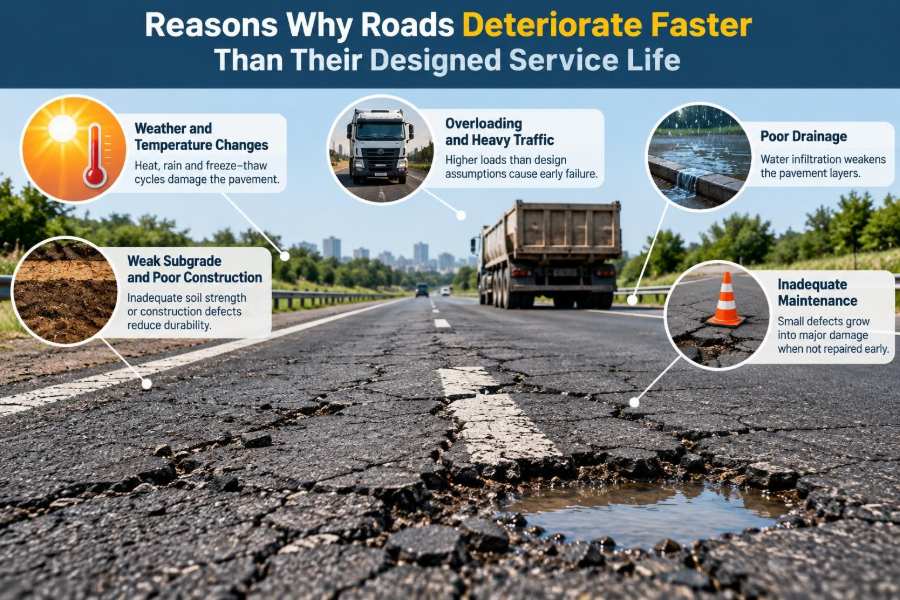

A newly resurfaced road can look flawless: dark asphalt, bright lane markings, and a smooth ride. Yet a few rainy seasons later, drivers may notice wheel-track depressions, cracks spreading from the edge, or potholes forming around utility covers.
That early deterioration is frustrating for road users, but it is also a useful engineering signal. Pavements rarely fail because of one dramatic mistake. More often, several small weaknesses—water entry, heavier vehicles, marginal drainage, poor construction control, or delayed repairs—combine over time.
A road’s “design life” is not a promise that its surface will remain perfect until a particular date. It is the period for which the pavement is expected to provide an acceptable level of service under assumed traffic, climate, materials, construction quality, and maintenance conditions.
When those assumptions no longer match reality, deterioration can accelerate quickly. Understanding why helps engineers make better design decisions and helps asset managers spend limited maintenance funds where they will prevent the most damage.
🛣️ Design Life Is a Planning Assumption, Not an Expiry Date
Pavement design estimates how repeated vehicle loads will affect a layered structure over time. The expected traffic volume, axle loads, soil strength, rainfall, temperature range, drainage, and material properties all influence the selected thickness and materials.
Service life ends when the pavement no longer meets a chosen condition threshold, such as unacceptable roughness, excessive cracking, rutting, or reduced skid resistance. A road may still be open to traffic at that point, but it needs rehabilitation to deliver its intended service safely and economically.
The design can perform exactly as calculated and still deteriorate early if the original assumptions were wrong or conditions change.
🏗️ A Pavement Is a Layered Structural System
Road surfaces do not carry traffic alone. A typical flexible pavement includes an asphalt wearing course, underlying asphalt or granular base layers, a subbase where required, and the natural soil foundation called the subgrade.
Each layer spreads wheel loads over a wider area. If a weak, wet, or poorly compacted layer lies beneath a sound-looking surface, the upper asphalt can crack under bending and repeated movement.
Rigid concrete pavements behave differently, using slabs to distribute load. However, they also depend on sound support, drainage, properly functioning joints, and durable concrete. The governing mechanisms differ, but loss of support and water remain serious concerns for both pavement types.
🚚 Traffic Loads Often Exceed Forecasts
Traffic models are based on forecasts, but land use can change faster than a pavement program. A new quarry, warehouse district, port connection, industrial estate, or detour route may send far more heavy vehicles onto a road than originally anticipated.
Heavy vehicles matter disproportionately because pavement damage rises sharply with axle loading. An overloaded axle does not merely cause a little more damage than a legal axle; its effect can be many times greater, depending on pavement type and load level.
Traffic count data should therefore distinguish cars from trucks and should examine axle configurations, not only total vehicle numbers. A road carrying more vehicles is not automatically more damaging than one carrying fewer, much heavier vehicles.
⚖️ Overloaded Axles Concentrate Structural Damage
Overloading increases stresses and strains in asphalt layers, bases, and subgrade. Repeated high strain can initiate fatigue cracks from the bottom of an asphalt layer, while high compressive stress in weak layers can create permanent deformation.
Loading is especially harmful when trucks travel slowly, stop repeatedly, or follow the same wheel paths. Common locations include intersections, climbing lanes, bus stops, weigh stations, industrial entrances, and toll approaches.
Enforcement, freight planning, and route management are therefore part of pavement preservation. Designing a thicker pavement may be appropriate in freight corridors, but it cannot fully compensate for uncontrolled loading far beyond the design basis.
🌧️ Water Is Often the Hidden Accelerator
Water entering a pavement can reduce the strength of unbound granular layers and fine-grained subgrade soils. It can also weaken the bond between asphalt binder and aggregate, a process commonly associated with moisture damage or stripping.
The visible surface may initially show only a small crack. Below it, water can soften the support layers, so each wheel pass causes more deflection. Cracks widen, the surface loses support, and a local defect can become a pothole.
Water is not always from rain. Leaking utilities, irrigation, high groundwater, poor shoulder drainage, and runoff from adjacent development can keep the pavement foundation wet for long periods.
💧 Surface Drainage Must Remove Water Quickly
Crossfall, also called camber on many roads, directs rainwater toward kerbs, gutters, side drains, or the road edge. If the finished surface has flat spots, ruts, blocked inlets, or poor grades, water ponds in wheel paths and penetrates through surface defects.
Standing water also introduces safety concerns. It can reduce tire contact, conceal potholes, and increase splash and spray. For asphalt, repeated wetting and traffic action can accelerate surface ravelling, where aggregate particles progressively loosen.
Drainage maintenance is not cosmetic housekeeping. Cleaning inlets and restoring outlets can protect the structural investment beneath the road surface.
🕳️ Subsurface Drainage Is Easy to Neglect
Water that reaches the base, subbase, or subgrade needs a route out. Edge drains, drainage blankets, filter layers, geotextiles, and properly detailed shoulders may be used where groundwater or infiltration risk is significant.
A drainage feature can fail if its outlet is blocked, crushed, silted, or placed without a maintainable discharge point. Fine soil particles can also migrate into a drainage layer if filtration is not designed properly.
Engineers should consider the entire water path: where water enters, where it travels, and where it exits. A buried drain without a functioning outlet is not a drainage solution.
🌡️ Temperature Cycling Ages Pavement Materials
Asphalt becomes softer at high temperatures and stiffer at low temperatures. In hot conditions, slow heavy traffic can cause rutting if the asphalt mixture lacks sufficient resistance to permanent deformation or if lower layers are weak.
In colder conditions, thermal contraction can contribute to cracking, particularly where the binder is too stiff for the local climate or has aged substantially. Temperature gradients can also create stresses in concrete slabs.
Climate-responsive material selection matters. A binder grade, mixture design, joint detail, or drainage approach that works in one climate may not be suitable without adjustment in another.
❄️ Freeze–Thaw Action Weakens Saturated Layers
In regions with freezing temperatures, water in pores can freeze and expand. Repeated freeze–thaw cycles can break down aggregate particles, disturb soils, and reduce the integrity of already saturated materials.
Frost heave can lift parts of the pavement unevenly. When thaw arrives, the underlying soil may temporarily have very low bearing capacity, making it vulnerable to heavy traffic.
The critical combination is moisture, frost-susceptible soil, insufficient protection, and traffic during thaw. Keeping water out and providing suitable layer thickness are central defenses.
🧱 Weak or Variable Subgrade Creates Uneven Support
The subgrade is the soil prepared to support the pavement structure. Its strength can vary markedly over short distances because of natural geology, old fills, organic pockets, buried trenches, or changes in moisture.
Weak areas bend more under traffic. That differential movement concentrates stress in the layers above and can produce recurring cracks or depressions in the same locations after repeated patching.
Investigation should identify not only an average soil condition but also weak zones. Targeted stabilization, undercutting, improved drainage, geosynthetics, or local thickness increases may be more effective than treating an entire alignment identically.
📉 Poor Compaction Leaves a Lasting Defect
Compaction removes air voids from asphalt and densifies granular layers and soil. If a layer is placed too loose, later traffic and moisture can cause settlement, instability, and reduced stiffness.
For asphalt, inadequate compaction can leave interconnected air voids that allow water and oxygen to enter. This promotes oxidation of the binder and makes the mixture more vulnerable to ravelling and cracking.
Compaction must occur within a workable moisture and temperature range. Simply making more roller passes cannot correct material that is too cold, too dry, too wet, or segregated.
🔬 Material Quality Can Vary Beyond the Specification
Aggregate shape, cleanliness, gradation, durability, asphalt binder properties, and moisture content all affect pavement performance. A material may meet a basic test result yet still perform poorly if production is inconsistent or if it is used in unsuitable conditions.
For example, excess fine material in a granular base can reduce drainage and increase moisture sensitivity. Contaminated aggregate can weaken asphalt adhesion. A poor aggregate blend may create an asphalt mixture that is difficult to compact or prone to segregation.
Quality assurance should verify both the source material and the placed product. Sampling only at the plant does not reveal whether the correct mixture reached, was laid, and was compacted properly on site.
🧪 Asphalt Mix Design Must Match the Job
An asphalt mixture for a lightly trafficked residential street is not automatically suitable for a slow-moving freight route. Traffic speed, climate, layer thickness, expected loads, and drainage all affect the desired balance between stiffness, flexibility, workability, and durability.
Too much binder can encourage bleeding or instability in heat; too little can leave a dry, brittle mixture that ravels. An inappropriate aggregate structure can limit rut resistance or fatigue performance.
Mixture selection should not be driven only by the cheapest initial option. The relevant question is whether the mix will resist the specific distress mechanisms expected at that location.
🚧 Construction Joints and Segregation Form Weak Lines
Longitudinal and transverse joints are unavoidable in paving, but they require careful construction. A poorly compacted joint can have higher permeability than the surrounding mat, allowing water to enter and cracking to begin along a straight line.
Segregation occurs when coarse and fine particles separate during handling or placement. Coarse, open-textured patches often have low binder content and high air voids, making them vulnerable to ravelling and moisture damage.
Good paving practice controls truck loading, transfer, paver operation, screed setup, joint overlap, and rolling patterns. These details are small on a plan but large in their effect on service life.
🛠️ Utility Cuts Interrupt the Pavement Structure
Water, sewer, gas, power, and telecommunications work often requires trench excavation through the pavement. The restored trench may settle if backfill is poorly compacted or if the reinstated layers do not match the surrounding structure.
Even a neatly patched surface can have a weak interface around its edges. Water can enter there, and traffic creates differential movement between the original pavement and the repair.
Coordinating utility work before major resurfacing, requiring suitable reinstatement details, and inspecting compaction can reduce the familiar pattern of repeated trench settlement.
🚦 Intersections Experience Special Loading Conditions
At intersections, vehicles brake, accelerate, turn, and queue. These actions impose horizontal shear forces in addition to vertical wheel loads, and they concentrate loading in predictable wheel paths.
Asphalt that performs well on a free-flowing road may rut, shove, or crack at an approach where buses and trucks stop in hot weather. Signal timing, turning geometry, and traffic management can therefore influence pavement distress.
Designers may use more rut-resistant mixtures, greater structural capacity, or concrete pavement in selected high-stress zones. The appropriate choice depends on local conditions and lifecycle planning, not on a universal material preference.
🚌 Slow and Channelized Traffic Deepens Ruts
Traffic wandering slightly across a lane spreads loading over a wider area. Channelized traffic repeatedly follows nearly identical paths, concentrating cumulative damage in the wheel tracks.
Bus lanes, freight terminals, climbing lanes, and narrow approach lanes are particularly exposed. Slow movement increases the time a tire load acts on the asphalt, which matters when temperatures are high and the material is softer.
Rut depth should be monitored because it affects both ride quality and drainage. A rut can hold water precisely where tires travel, increasing the chance of splash, hydroplaning risk, and further moisture intrusion.
🪨 Shoulder Failure Can Undermine the Lane Edge
The pavement edge often receives less confinement than the center of the lane. If an unpaved shoulder erodes, drops away, or carries occasional heavy wheel loads, the edge of the asphalt can crack and break.
Water entering through edge cracks can soften the support beneath the lane. This is common on narrow rural roads where vehicles move aside to pass and repeatedly load the same unsupported edge.
Well-compacted shoulders, edge drains where needed, and timely sealing of edge cracks can be cost-effective protection for the main carriageway.
🌱 Vegetation and Adjacent Land Changes Alter Water Movement
Roots can disturb footpaths, kerbs, and shallow pavement layers, while vegetation in ditches can obstruct drainage. The more consequential effect is often indirect: land grading, new driveways, filled ditches, and impermeable development can redirect runoff toward a road.
Changes outside the right-of-way may therefore alter the pavement’s moisture environment. A road designed with one drainage pattern can become vulnerable after adjacent construction changes flow paths.
Drainage reviews should consider the catchment around the road, not just the road surface itself.
🧯 Small Cracks Become Large Failures When Left Open
Crack sealing does not restore lost structural capacity, but it can slow water infiltration and reduce the rate at which a minor surface defect becomes a deeper problem. Timing matters: a narrow, clean crack is easier to treat than a broken, wet area.
Alligator cracking—a pattern of interconnected cracks resembling reptile skin—usually signals structural fatigue and loss of support. Sealing alone is not a durable cure once that pattern is well developed.
A useful maintenance distinction is simple: preserve a sound pavement early; rehabilitate a structurally weakened pavement before repeated superficial repairs waste resources.
🔧 Delayed Maintenance Raises the Cost of Recovery
Pavement condition commonly declines slowly at first and then more rapidly after moisture damage, cracking, or structural deformation begins. This is why preventive actions such as drainage cleaning, crack sealing, thin surface treatments, and localized repairs can offer value when selected appropriately.
Waiting until widespread potholes appear often means the problem has extended below the wearing course. The eventual work may require deep patching, base repair, or reconstruction rather than a simple overlay.
Maintenance decisions should be based on the type and cause of distress, not just what is most visible from a moving vehicle.
📋 Inspection Must Diagnose the Cause, Not Only the Symptom
A pothole is a symptom, not a diagnosis. It may result from surface water entry, stripping, weak base material, failed trench backfill, freeze–thaw damage, or a local drainage leak. Each cause calls for a different repair strategy.
Useful investigations can include visual surveys, drainage inspections, cores, test pits, deflection testing, ground-penetrating methods where appropriate, and traffic observations. No single test answers every question.
For example, filling a pothole above a saturated, weak base may restore ride quality briefly but will not stop recurrence. Repair limits should extend to sound material, and the water source must be addressed.
📏 Design Errors Can Be Small but Consequential
Early deterioration is not always a construction failure. Design shortcomings may include insufficient thickness for actual axle loads, inadequate allowance for seasonal subgrade weakness, inappropriate drainage details, or failure to account for future development.
Details deserve attention alongside calculations: kerb interfaces, edge support, transitions at bridges, utility crossings, drainage outlets, and joints are common locations for distress to begin.
Design also involves uncertainty. Sensitivity checks can reveal whether modest increases in truck traffic, water content, or soil variability would push the structure into a less reliable performance range.
🧭 Rehabilitation Must Fit the Existing Pavement
An overlay can be effective when the existing pavement is structurally sound enough to support it and when drainage problems have been resolved. If the base or subgrade is failing, an overlay may simply reproduce the old cracks and ruts.
Common intervention levels range from surface treatment and milling-and-overlay to full-depth reclamation or reconstruction. Selecting between them requires an assessment of structural condition, not merely surface appearance.
The best repair is the least intensive treatment that corrects the actual failure mechanism and provides the required future performance.
💰 Lowest Initial Cost Is Not Always Lowest Lifecycle Cost
A thinner pavement, lower-cost material, or deferred drainage feature may reduce construction expenditure, but it can increase future disruption and repair needs. Conversely, adding thickness everywhere without evidence can waste resources and embodied materials.
Lifecycle thinking compares realistic construction, maintenance, rehabilitation, user disruption, and risk costs over the road’s intended function. It supports targeted investment rather than an automatic preference for either the cheapest or the heaviest design.
This approach is especially valuable for roads with hard-to-access utilities, high traffic volumes, or strategic freight roles where closure costs are significant.
👷 Construction Quality Control Protects the Design Intent
Specifications establish requirements, but field control confirms whether the pavement built is the pavement designed. Checks may cover layer thickness, density, asphalt temperature, smoothness, material gradation, moisture, levels, drainage fall, and bond between layers.
Communication is also a control measure. If weather changes, delivery delays occur, or the underlying layer is found to be wet or unstable, the team must be able to pause and adjust rather than paving over a known defect.
Records of test results, repairs, locations, and site conditions make later troubleshooting far more reliable.
📊 Asset Management Turns Observations into Better Decisions
Road agencies and owners benefit from condition inventories that track distress type, severity, extent, drainage condition, traffic role, and past treatments. The aim is not paperwork; it is to identify where an early intervention will prevent a more expensive structural failure.
Condition ratings should be interpreted carefully. A smooth road may conceal subsurface weakness, while a rough but stable surface may require a different priority level. Network-level screening should lead to project-level diagnosis before major work is selected.
Repeated failures at similar locations are valuable data. They can reveal a systemic issue in materials, drainage, utility practices, freight routing, or standard details.
✅ A Practical Checklist for Longer-Lasting Roads
Preventing early pavement deterioration requires coordinated decisions from planning through maintenance. The following checks are useful before and after construction:
- Forecast heavy-vehicle loads realistically and revisit them when land use changes.
- Investigate subgrade variability and seasonal moisture conditions.
- Provide surface and subsurface drainage with maintainable outlets.
- Match asphalt, aggregate, and layer design to climate and traffic behavior.
- Control compaction, thickness, joints, segregation, and interlayer bonding.
- Protect edges and manage utility cuts with durable reinstatement.
- Inspect cracks, ruts, ponding, and drainage assets before defects spread.
- Diagnose root causes before choosing patches, overlays, or reconstruction.
🔑 The Core Principle: Keep Loads Managed and Water Moving
Roads deteriorate early when their structure is asked to carry more load, receive more moisture, or tolerate poorer support than it was designed for. Construction defects and delayed maintenance make those stresses more damaging, but water and repeated axle loads are often the forces that expose the weakness.
Long service life is not achieved by surface thickness alone. It comes from a compatible system: realistic traffic assumptions, stable foundations, durable materials, effective drainage, careful construction, and timely intervention.
For students, this is a useful way to read pavement distress in the field. For practitioners, it is a reminder that the visible defect is only the final stage of a chain of decisions and physical processes.
A road lasts closer to its intended service life when its loads, materials, support, drainage, and maintenance are treated as one connected engineering system. 🌧️🛣️🔧