
A concrete truck arrives at a site, steel beams are lifted into place, and pallets of masonry units wait beside an unfinished wall. To most people, these materials look like ordinary industrial products. For an engineer, each one represents a chain of controlled decisions made long before delivery.
A small variation in water content, aggregate grading, furnace temperature, or curing conditions can change how a material behaves. That difference may affect a slab’s cracking risk, a bridge member’s durability, or whether a batch can be accepted under the project specification.
Construction materials do not become reliable simply because they are heavy, hard, or supplied by a familiar brand. They become reliable when their ingredients, production process, testing, records, and delivery conditions are controlled as one system.
Understanding that system helps students read specifications with more confidence and helps working professionals ask better questions when a material certificate, test result, or delivery ticket does not look right.
🏗️ Quality Begins Before Production
Manufacturing quality starts with defining what the material must do in service. A precast drainage pipe, for example, needs adequate strength, but it also needs durability against its exposure, dimensional accuracy for installation, and a surface quality that supports watertight joints.
Project specifications translate these needs into measurable requirements. They may identify a material standard, allowable tolerances, minimum strength, limits on harmful constituents, test methods, sampling frequency, and documentation required before use.
Strength is only one part of quality. A material can meet a compressive-strength target yet still be unsuitable because of poor dimensional control, excessive absorption, contamination, poor weldability, or inadequate durability.
📋 Standards Create a Common Language
Standards provide agreed methods for making, sampling, testing, and classifying materials. Depending on the project location and contract, a specification may refer to national standards, regional codes, or standards developed by recognized technical organizations.
These documents do not eliminate engineering judgment. Instead, they make expectations traceable. When two laboratories test the same properly sampled material by the same method, their results should be reasonably comparable within the method’s known variability.
Manufacturers must verify the exact edition and project requirements. Similar-looking standards can have different acceptance rules, specimen preparation procedures, curing regimes, or reporting requirements.
🧩 Performance Requirements Guide Material Design
Manufacturers begin with a target performance profile. For concrete, this may include specified compressive strength, workability, density, air content, permeability-related requirements, and exposure class. For structural steel, it may include yield strength, tensile strength, elongation, impact toughness, chemical composition, and weldability.
Material design is an exercise in balance. Increasing one property can make another harder to achieve. A very low water-to-cement ratio can improve concrete strength and durability, for example, but may reduce fresh workability unless admixtures and mixing procedures are adjusted.
The best mix or product formula is not necessarily the strongest one. It is the one that consistently meets all relevant requirements with a workable, economical, and controllable process.
⛏️ Raw Materials Need Their Own Controls
A finished product cannot be more consistent than its inputs. Cement, aggregates, steel scrap, iron ore, clay, polymers, chemical admixtures, and supplementary cementitious materials are checked before they enter production.
Manufacturers commonly use supplier approvals, certificates of analysis, visual checks, laboratory testing, and stockpile management. Incoming materials may be rejected, segregated, or used only in applications for which they are suitable.
For example, aggregate that contains excessive fine particles or clay can raise water demand in concrete. This may reduce strength or increase shrinkage unless the mixture is redesigned. A contaminated steel charge can alter chemistry and make required mechanical properties more difficult to achieve.
🪨 Aggregate Grading Controls Concrete Consistency
Aggregates occupy most of the volume of conventional concrete. Their particle-size distribution, called grading, influences how particles pack together, how much paste is needed, and how easily fresh concrete can be placed.
Well-graded aggregate generally provides a balanced distribution of sizes. If a batch contains too many fines, it may require more water. If it lacks intermediate sizes, the mix can become harsh, segregate more easily, or need additional paste to remain workable.
Moisture is equally important. Sand stored outdoors may hold variable surface water after rain. Batch plants compensate for this moisture because uncorrected water changes the effective water-to-cement ratio.
🔥 Heat, Chemistry, and Phase Changes
Many construction materials develop their properties through carefully managed heat. Cement clinker is produced in a high-temperature kiln; steel is refined and alloyed in furnaces; bricks and tiles gain permanent ceramic bonds during firing; asphalt binder and aggregate are heated for mixing.
Temperature is not simply a production convenience. It drives chemical reactions and changes internal structure. Underheating may leave a material incompletely processed, while overheating can produce undesirable phases, oxidation, distortion, or excessive energy use.
Plants monitor temperatures, residence times, fuel conditions, cooling rates, and sometimes atmosphere. The acceptable range depends on the product and process rather than one universal temperature target.
⚙️ Batching Turns a Formula into a Product
Batching means measuring ingredients in specified proportions. Modern plants commonly use calibrated scales, automated controls, moisture sensors, and recipe software, but automation does not remove the need for human oversight.
Each batch should be traceable to the materials used, quantities measured, production time, equipment status, and operator or system record. This traceability becomes vital if later testing identifies an issue.
Common batching risks include incorrect material selection, scale drift, blocked feeders, moisture correction errors, and manual overrides that are not recorded. Good plants treat these as process-control risks, not merely operator mistakes.
🔄 Mixing Must Be Thorough but Controlled
Mixing distributes ingredients uniformly. In concrete, inadequate mixing can leave pockets with different water content, air content, or paste distribution. In asphalt, it can lead to uneven coating of aggregate. In polymer products, poor blending can produce weak zones or inconsistent color and density.
Mixing time must suit the equipment and material. Too little time reduces uniformity; unnecessarily long mixing may affect temperature, entrained air, or material workability. Manufacturers validate their process rather than assuming one duration works for every mixer.
Plant cleanliness also matters. Hardened concrete, residual materials, or contaminated bins can carry unwanted material into the next batch.
🧪 Trial Batches Verify the Proposed Mix
Before regular production, manufacturers often make trial batches or prototype runs. These tests check whether the proposed formula can meet requirements under conditions close to full-scale manufacturing.
For a concrete mixture, a trial may examine fresh properties and strength development at required ages. For a masonry unit, prototypes may be checked for dimensions, appearance, absorption, and compressive strength. For steel products, rolling and heat-treatment parameters may be verified against the intended grade.
A trial result is useful evidence, but it does not guarantee future production. Raw materials, plant settings, ambient conditions, and scale-up effects still require ongoing control.
💧 Water-to-Cement Ratio Is a Critical Concrete Variable
In cement-based materials, the effective water-to-cement ratio strongly influences capillary pore structure, strength, and durability. Excess water may make fresh concrete easier to place, but after hydration it leaves a more porous hardened matrix.
That is why adding water at the site without authorization can be damaging. It may improve apparent workability while reducing later strength and resistance to fluid or salt ingress. A permitted adjustment should follow the approved mixture design and be documented.
Workability can often be improved more appropriately with admixtures, revised aggregate proportions, or better placement planning rather than uncontrolled water addition.
🧫 Admixtures Need Compatibility Checks
Chemical admixtures modify fresh or hardened concrete properties. They may reduce water demand, control setting time, entrain air, improve viscosity, or support pumping. Mineral additions can also affect strength development, heat generation, and permeability-related behavior.
These materials are not interchangeable. Their effect depends on cement chemistry, temperature, dosage, sequence of addition, mixing energy, and interactions with other admixtures. A dosage that works in one plant may behave differently with another cement source.
Manufacturers therefore confirm compatibility through trials and production monitoring. More admixture is not automatically better; overdosing can create delayed setting, excess air, segregation, or finishing problems.
🧱 Forming Creates Shape and Internal Quality
Once mixed, a material must be formed without introducing defects. Concrete may be cast into molds, compacted, extruded, spun, or slipformed. Steel may be rolled, forged, cast, or fabricated. Clay units may be extruded and cut before drying and firing.
Forming affects more than appearance. In precast concrete, inadequate consolidation can leave voids around reinforcement or at corners. In rolled steel, improper processing can affect thickness, shape, and surface condition.
Equipment settings, mold condition, vibration, pressure, feed rate, and alignment are usually controlled because a correct material formula cannot compensate for poor forming.
📐 Dimensional Tolerances Protect Fit-Up
Construction works depend on components fitting together. Tolerances define how far a measured dimension may vary from the specified nominal value without becoming unacceptable.
A slightly undersized paving unit may create wider joints; a precast panel with misplaced inserts may delay erection; a reinforcing bar with incorrect rib geometry may affect bond behavior. The consequence depends on the component and its role.
Manufacturers inspect dimensions using gauges, templates, calibrated tapes, laser equipment, or automated measurement systems. Measurement tools themselves require calibration and suitable handling.
🌡️ Curing Builds Concrete Strength Over Time
Concrete strength develops as cement reacts with water, a process called hydration. Curing keeps suitable moisture and temperature conditions available for this process, especially during early ages.
Precast plants may use water curing, sealed curing, controlled humidity, or carefully managed heat curing. Heat can speed early strength gain, which assists production cycles, but the process must be designed to avoid damaging temperature gradients or undesired long-term behavior.
Fresh concrete exposed to drying wind or high temperature can lose moisture rapidly. The surface may then shrink before the interior has gained enough strength, increasing the risk of early cracking.
🏭 Kilns and Furnaces Demand Process Stability
For cement, brick, ceramic, and steel production, furnace and kiln stability is central to consistent quality. Feed composition, fuel supply, airflow, temperature profile, and cooling conditions can all affect the final product.
In brick manufacture, drying must be controlled before firing. Rapid or uneven drying can cause cracking or warping. Firing then develops the ceramic structure, while cooling must be managed to limit thermal damage.
In steelmaking, chemistry and thermal history influence the microstructure that ultimately governs strength, ductility, hardness, and toughness. The same nominal chemical composition can perform differently if processing history changes.
🔬 Microstructure Explains Why Similar Materials Differ
Microstructure is the material’s internal arrangement of phases, grains, pores, crystals, and interfaces. It is often invisible to the naked eye but strongly affects engineering behavior.
Fine, controlled grain structures in steel can support a desirable combination of strength and toughness. In concrete, a denser cement paste and good bonding at the aggregate interface can improve strength and transport resistance. In fired clay, pore structure influences absorption and frost performance.
This is why visual inspection alone is limited. A smooth-looking product may have an internal defect, while a harmless color variation may not affect performance.
🧾 Routine Sampling Makes Testing Meaningful
Testing only has value when the sample represents the material being supplied. Manufacturers use sampling plans that define where, when, and how samples are taken from production or delivery.
A sample should not be selected simply because it looks favorable. It must be taken without bias and handled according to the relevant method. Improper sampling can create misleading results even when laboratory equipment is excellent.
Batch identification connects a specimen to its production record. If a result is outside the expected range, engineers can investigate the affected material rather than making unsupported assumptions about all production.
🧪 Fresh-Property Tests Catch Early Problems
Some properties are checked while materials are still fresh because they cannot be meaningfully measured later. Concrete may be assessed for consistency, temperature, density, air content, and visible uniformity. Asphalt mixtures may be monitored for temperature and gradation-related indicators.
These checks are process signals, not merely paperwork. A concrete result outside the expected consistency range may point to aggregate moisture changes, a dosing issue, delayed delivery, or unauthorized water addition.
Acceptance limits and test methods must follow the applicable project documents. A field result should be interpreted alongside sampling conditions, elapsed time, equipment calibration, and the material’s intended placing method.
💪 Strength Testing Requires Correct Specimens
Compressive, tensile, flexural, and bending tests measure resistance under defined loading arrangements. Their value depends on specimen geometry, preparation, curing, loading rate, and machine calibration.
Concrete cylinders or cubes, for example, must be made, stored, transported, and tested under prescribed conditions. A poorly compacted or badly cured test specimen can understate the quality of the concrete it was intended to represent.
Likewise, a steel tensile test provides specific measures such as yield behavior, ultimate tensile strength, and elongation for a sampled product. It does not by itself confirm every feature of a fabricated assembly.
🛡️ Durability Tests Address the Service Environment
Strength answers only part of the question: can the material carry load? Durability asks whether it can retain suitable performance through its intended exposure to moisture, salts, freeze-thaw cycles, abrasion, chemicals, temperature changes, or ultraviolet radiation.
A coastal structure, a de-iced parking deck, and an interior partition wall do not demand the same material properties. Engineers specify exposure-appropriate requirements because the most likely deterioration mechanisms differ.
Durability testing can be slower and more complex than strength testing. It should be selected for a realistic mechanism of concern rather than added as a generic checklist item.
🔍 Inspection Combines Eyes, Instruments, and Records
Quality inspection includes visual examination, measurement, test review, and verification of records. Visual checks can reveal cracking, honeycombing, distortion, poor finishes, corrosion, damaged packaging, or labeling errors before material reaches the work.
More advanced methods may be used where justified. These can include ultrasonic examination of steel welds, radiographic methods, magnetic particle inspection, or non-destructive approaches for certain concrete investigations. Each technique has limits and requires competent interpretation.
No single inspection method proves total quality. Confidence comes from several compatible controls: a capable process, representative tests, competent inspection, and clear traceability.
📊 Statistical Control Looks for Trends, Not Just Failures
Production results naturally vary. Statistical process control helps manufacturers distinguish ordinary variation from a signal that the process may be drifting. A gradual fall in average concrete strength, for instance, can prompt investigation before results approach a specified limit.
Control charts and trend reviews can reveal scale drift, changing aggregate moisture, equipment wear, or a new raw-material source. They support prevention rather than waiting for a nonconforming batch.
Statistics do not replace technical understanding. A chart can show that something changed; engineers still need to identify whether the cause is material, equipment, environment, testing, or data handling.
⚖️ Calibration Keeps Measurements Credible
Scales, thermometers, pressure gauges, testing machines, moisture probes, and dimensional tools influence quality decisions. If these instruments are inaccurate, a plant can produce misleadingly precise records.
Calibration compares an instrument with a suitable reference and establishes whether adjustment is needed. Routine checks between formal calibrations can also detect damage, drift, or incorrect zero settings.
Calibration records should identify the device, date, result, applicable range, and next due date. A calibrated machine still needs correct use; a load cell, for example, can produce unreliable data if installed or operated improperly.
🗂️ Traceability Connects the Material to the Evidence
Traceability is the ability to follow a product from raw material through production, testing, storage, and delivery. It may use batch numbers, heat numbers, production dates, barcodes, tags, delivery tickets, or electronic records.
For structural steel, a heat number can connect a product to chemical and mechanical test information. For ready-mixed concrete, a delivery record can identify the mix, batch time, truck, quantities, and permitted adjustments.
Without traceability, even good test data may be difficult to apply. The site team cannot confidently determine which stock was tested, where it was installed, or whether a questionable result affects supplied material.
🚚 Storage and Delivery Can Undo Good Manufacturing
Quality must survive the journey to site. Cement and dry binders need protection from moisture. Reinforcing steel should be stored to avoid contamination and excessive corrosion. Precast elements need correct lifting, supports, and restraints to prevent cracking or distortion.
Concrete is time-sensitive after batching, especially in hot weather or heavy traffic. Delivery planning, truck mixing, discharge procedures, and approved site adjustments all affect the fresh material received.
A compliant factory product can become nonconforming through poor handling. Responsibility must therefore be clear at each handover between manufacturer, transporter, contractor, and site team.
🚧 Nonconformance Requires Investigation, Not Guesswork
A nonconformance occurs when a material, process, or record does not meet a stated requirement. Examples include a failed test, missing certificate, incorrect dimensions, damaged units, or use of an unapproved constituent.
The immediate response should protect the work: identify and segregate affected material, stop unintended use where necessary, preserve relevant records, and notify the appropriate project authority. The final disposition may involve further testing, engineering assessment, repair, restricted use, replacement, or rejection.
Discarding evidence or quietly substituting material makes later assessment harder. A fair investigation considers the test method, sample representativeness, production history, extent of affected supply, and actual structural implications.
🔁 Corrective Action Addresses the Root Cause
Corrective action is more than retesting a failed batch. It seeks the reason the issue occurred and changes the system so recurrence becomes less likely.
A useful investigation may examine raw-material changes, equipment condition, maintenance history, operator instructions, batch data, training, and inspection records. If recurring low strength is linked to a moisture sensor error, the fix may include recalibration, a backup manual check, revised maintenance intervals, and verification after implementation.
Blaming an individual without examining the process often misses the real control weakness. Conversely, process improvement should not excuse deliberate departures from approved procedures.
👷 Site Teams Have Essential Quality Responsibilities
Manufacturers control production, but contractors and inspectors must confirm that supplied materials match the approved submittal and are used correctly. This includes checking labels, certificates, delivery tickets, visible condition, storage arrangements, and expiration or shelf-life requirements where applicable.
Site teams should avoid accepting a certificate as a substitute for inspection. A document may belong to a different batch, refer to a different product form, or omit a project-specific requirement.
Clear communication is especially valuable when conditions change. If pumping concrete through a long line, welding in cold weather, or installing masonry in wet conditions, the construction method may need material-specific controls beyond factory compliance.
🧠 Common Misunderstandings to Avoid
- “Higher strength solves every problem.” It does not automatically provide low permeability, ductility, fatigue resistance, fire performance, or good constructability.
- “A test certificate guarantees the delivered product.” It supports confidence only when identity, scope, and traceability are verified.
- “More testing always means better quality.” Testing cannot compensate for poor sampling, weak process control, or unclear specifications.
- “Visual appearance tells the whole story.” Many critical properties depend on internal structure or chemistry.
- “One failed result always means total rejection.” The appropriate response depends on the contract, test validity, affected extent, and engineering assessment.
🌱 Lower-Carbon Materials Need Equivalent Discipline
Construction is increasingly using supplementary cementitious materials, recycled aggregates, reclaimed asphalt, lower-carbon binders, and recycled metals. These options can reduce demand for virgin resources or lower some emissions, but they still need performance-based control.
Alternative materials may show greater variability or different early-age behavior than conventional materials. That does not make them unsuitable; it means mix design, testing, curing, and specifications must reflect the actual material system.
Sustainability and quality are not competing goals when decisions are based on verified performance, appropriate exposure conditions, and realistic production controls.
🤝 Collaboration Prevents Late Surprises
Reliable materials result from coordination among designers, specifiers, manufacturers, laboratories, contractors, and inspectors. Designers define required performance. Manufacturers explain practical production limits. Laboratories provide valid test data. Contractors protect materials and install them as intended.
Early discussion is particularly useful for unusual shapes, high-strength mixes, aggressive exposure classes, rapid construction schedules, or innovative materials. It allows trial work, logistics planning, and acceptance criteria to be agreed before work is under pressure.
Quality is strongest when it is built into planning rather than inspected into existence after production.
🌉 The Core Principle: Control the Whole Chain
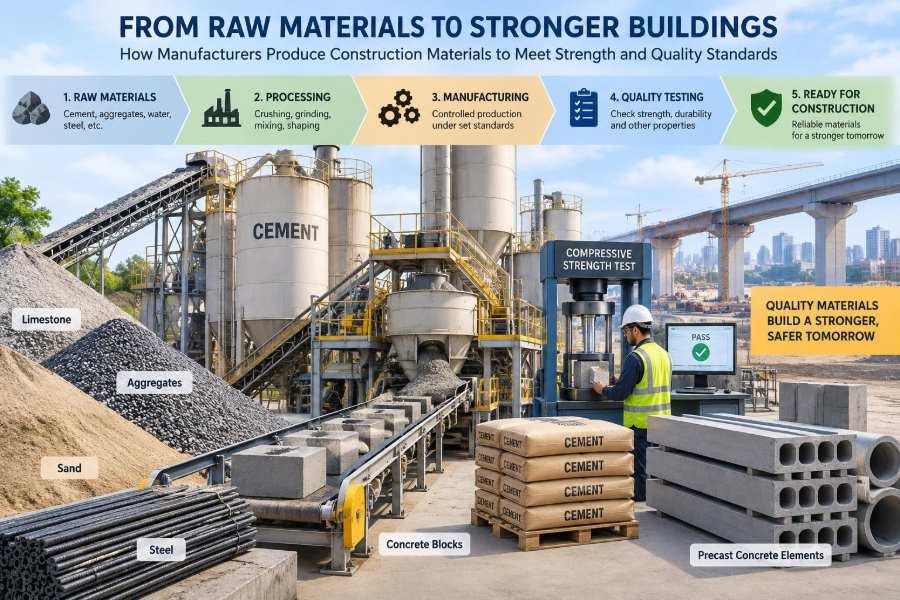
Construction materials meet strength and quality standards through a connected chain: suitable raw materials, validated design, controlled batching and processing, representative testing, calibrated equipment, traceable records, careful delivery, and proper site handling.
A strong test result matters, but it is most trustworthy when supported by a stable process and a clear identity trail. Equally, a well-designed product can still fail in practice if it is stored, altered, or installed incorrectly.
For civil engineers, the practical lesson is to look beyond a single number on a certificate. Ask what requirement is being verified, how the sample was taken, what process produced it, and whether the supplied material remains identifiable and protected until it becomes part of the structure.
Reliable construction depends on controlled processes, not fortunate outcomes: every stage from source material to installed work must support the required performance. 🌉🧪🏗️