
A road can look sound in the morning and develop a pothole after one wet season. The visible hole is usually the last step in a longer process: water entered through a crack, weakened the layers below, traffic loaded the softened area, and the surface finally broke.
This is why a fresh layer of asphalt is not always a lasting repair. If the water path, weak foundation, or heavy loading remains unchanged, the same distress can return—sometimes beside the repair rather than directly through it.
For drivers, poor roads mean rougher travel, standing water, vehicle damage, and delays. For agencies and contractors, they mean repeat work, disrupted traffic, and difficult choices about where limited maintenance funds will do the most good.
Long-lasting pavements are not created by one material or one maintenance activity. They result from a system in which drainage, pavement structure, construction quality, and timely care support one another.
🛣️ Think of a Road as a Layered System
A typical flexible pavement is more than its asphalt wearing course. Beneath it are one or more asphalt layers, a granular base, a subbase where needed, and the compacted soil foundation called the subgrade.
Each layer has a job. The upper layers spread wheel loads; the lower layers provide support and help manage moisture. A failure near the surface may therefore originate much deeper.
💧 Why Water Is Usually the Main Enemy
Water is not automatically harmful. Well-designed drainage moves it away quickly. Trouble begins when water remains in the pavement, saturates the subgrade, or repeatedly freezes and thaws within vulnerable materials.
Many soils lose stiffness when wet. A wet, weak subgrade bends more under passing trucks, and that bending creates fatigue damage in the asphalt above. Water can also strip the bond between asphalt binder and aggregate in susceptible mixtures.
🌧️ Follow the Path Water Takes
Rainwater should have a continuous route from the road surface to a safe outlet. It needs crossfall or camber to reach the edge, an edge detail that does not trap it, a side drain or inlet, and a downstream channel, pipe, or outfall that remains clear.
A drain that starts well but ends at a blocked culvert is not a functioning drainage system. Designers must consider the entire route, including where water goes after leaving the road corridor.
📐 Give the Surface a Reliable Slope
Crossfall is the slope across the roadway that directs water toward a gutter, shoulder, or ditch. Even a durable surface can pond water if it has low spots, poor grade control, or uneven settlement.
Longitudinal grade matters too. On very flat terrain, surface drainage is harder because water has little energy to move along channels. In these locations, careful level control and frequent drainage points become especially valuable.
🕳️ Protect Inlets, Gutters, and Side Drains
In urban streets, inlets and gutters collect runoff before it reaches building entrances or remains in traffic lanes. In rural roads, swales and roadside ditches often serve the same purpose with less built infrastructure.
Both can fail through sediment, leaves, litter, vegetation, collapsed edges, or damaged grates. The practical lesson is simple: drainage capacity on drawings has little value if field assets are not maintained.
🌿 Design Roadside Ditches for Flow and Stability
A ditch should carry runoff without eroding its own bed or banks. If flow is too slow, sediment settles and reduces capacity; if it is too fast, erosion can undercut shoulders and expose the pavement edge.
Grass lining can work for mild conditions, while rock, concrete, geotextiles, or other protection may be needed where velocities, slopes, or concentrated discharge are higher. The appropriate choice depends on local soil, rainfall, terrain, and maintenance capability.
🔄 Keep Culverts Working Through Storms
Culverts pass water beneath roads and driveways. Their opening, alignment, inlet condition, outlet protection, and debris risk all affect performance. A pipe can be structurally intact yet hydraulically ineffective if its entrance is blocked.
Undersized, damaged, or poorly placed crossings may force water across the pavement or saturate the embankment. Inspections after major storms are useful because they reveal actual flow paths, scour, and sediment patterns that routine dry-weather visits may miss.
🏞️ Stabilize the Road Edge and Shoulder
The pavement edge often receives less structural support than the wheel paths, particularly where an unpaved shoulder erodes or drops below the asphalt surface. Water entering this edge can soften the base and contribute to longitudinal cracking.
A stable shoulder helps confine the pavement layers, supports occasional vehicle encroachment, and guides surface water away. Shoulder material should drain appropriately without becoming a persistent source of fine sediment in ditches.
🧱 Start With an Honest Subgrade Assessment
Good pavement design begins with knowing what lies beneath. Soil type, moisture sensitivity, strength, groundwater conditions, frost susceptibility, and variability along the alignment influence layer thickness and drainage needs.
Assuming a uniform subgrade can be expensive. A short weak stretch over a wet clay lens, old fill, or poorly drained cut may control the performance of an otherwise sound roadway.
⚙️ Improve Weak Ground Before Building Upward
Where subgrade support is inadequate, simply adding a thin surface layer is rarely a durable answer. Options can include removing and replacing unsuitable soil, improving compaction, stabilizing soil with a suitable binder, using geosynthetics, raising the grade, or providing better drainage.
Each option has limits. Chemical stabilization, for example, requires compatible soil and controlled construction; geosynthetics help with separation or reinforcement but do not eliminate the need for sound drainage design.
🪨 Build a Strong, Clean Granular Base
Granular base courses distribute load and can help drain water, but only if their gradation, cleanliness, thickness, and compaction are appropriate. Excess fines can reduce permeability, while poor compaction can allow settlement and rutting.
Material selection is a balance. A highly open aggregate may drain well but need confinement and protection from clogging; a dense-graded material may provide strong support but move water more slowly.
🧵 Use Separation and Filtration Where Needed
When fine subgrade soil meets coarse aggregate, traffic and water can pump fines upward into the base. This contaminates the aggregate, reduces drainage, and weakens support.
A properly selected geotextile can separate materials while allowing water to pass. Filter layers serve a similar purpose. Selection must match soil gradation and expected flow; the wrong filter can clog or allow soil migration.
🔥 Select Asphalt Mixtures for Real Conditions
Asphalt mixture design should reflect climate, traffic loading, available aggregate, construction methods, and expected moisture exposure. A surface designed for a lightly trafficked residential street may not suit a truck route with slow, heavy turning movements.
Aggregate shape and quality affect interlock and skid resistance. Binder selection influences temperature response. Air voids and compaction affect both durability and permeability. These choices work together rather than independently.
🧊 Account for Temperature and Freeze-Thaw
In cold regions, water in cracks and pores can freeze, expand, and widen openings. Repeated freeze-thaw cycles can damage bound and unbound layers, especially when drainage is poor.
In hot climates, asphalt may be more prone to permanent deformation under heavy, slow traffic. Material selection and structural design need to reflect the local temperature range, not an idealized average day.
🚚 Design for Loads, Not Just Traffic Counts
A road carrying many passenger cars may experience less structural damage than one carrying fewer heavily loaded trucks. Load magnitude, axle configuration, tire pressure, speed, and lane channelization all influence pavement response.
Intersections, bus stops, climbing lanes, industrial entrances, and freight terminals deserve special attention. Vehicles brake, turn, or move slowly in these locations, increasing shear stresses that can cause rutting and shoving.
📏 Get Layer Thickness and Compaction Right
Pavement thickness is meaningful only when each layer is placed uniformly and compacted to the intended condition. Thin spots concentrate stress, while poorly compacted areas allow excess water entry and later deformation.
Compaction is not merely rolling until the surface looks smooth. It requires suitable equipment, lift thickness, moisture conditions for granular layers, and temperature control for asphalt. Field testing helps confirm that the constructed pavement resembles the design.
🔍 Treat Construction Quality Control as Prevention
Quality control catches problems while correction is still practical. It may include checking aggregate quality, asphalt temperature, mix consistency, grade, density, thickness, joint quality, and drainage elevations.
Quality assurance, often performed independently for the owner, verifies that requirements are being met. The exact testing program varies by project, but the principle is universal: hidden defects are cheapest to address before traffic covers them.
🧩 Build and Seal Good Joints
Longitudinal and transverse joints are common water-entry points. If a joint is poorly compacted, segregated, or left unsealed where sealing is appropriate, water can reach lower layers and cracking may follow the joint line.
Careful paving sequence, clean contact faces, adequate overlap, proper compaction, and prompt attention to joint defects make a disproportionate difference to service life.
🩹 Seal Cracks Before They Become Water Channels
Cracks do not all require the same response. Some are narrow and stable; others are active, wide, or caused by structural movement. Crack sealing or filling can reduce water intrusion, but it does not restore a pavement that has already lost structural capacity.
Timing matters. Sealing a manageable crack is generally simpler than waiting until water, traffic, and weather turn it into a pothole or a broad failed area.
🚧 Understand How Potholes Form
A pothole often begins with an opening in the surface. Water enters, traffic flexes the weakened material, small pieces break loose, and the cavity grows as passing tires pull and impact its edges.
A durable pothole repair requires removing loose material, addressing wet or weak material beneath where feasible, preparing clean vertical edges, using compatible patch material, and compacting thoroughly. Throwing loose mix into standing water is a temporary emergency measure, not a lasting repair.
📉 Use Pavement Condition Surveys to Act Early
Visual surveys document cracking, rutting, raveling, potholes, edge distress, and drainage problems. More detailed programs may also measure roughness, deflection, friction, or structural condition where appropriate.
The goal is not to collect data for its own sake. It is to identify the right treatment window. Preservation treatments are often most effective while the pavement is still structurally sound.
🗓️ Match the Treatment to the Distress
Not every worn road needs reconstruction, and not every surface treatment is suitable for a weak pavement. The underlying cause should guide the intervention.
| Observed condition | Likely focus | Typical response direction |
|---|---|---|
| Minor surface aging, sound structure | Preserve surface and limit water entry | Appropriate surface preservation treatment |
| Isolated potholes or localized settlement | Repair failed area and investigate moisture | Full-depth localized repair |
| Widespread fatigue cracking | Restore structural capacity | Structural rehabilitation or reconstruction |
| Standing water after rain | Correct drainage path and profile | Drainage and geometry improvements |
These are broad directions, not a substitute for project-specific investigation. Similar-looking defects can have different causes.
🚜 Schedule Maintenance Before Failure Spreads
Preventive maintenance includes activities such as drain cleaning, vegetation control, crack treatment, joint repair, shoulder restoration, and localized surface correction. These tasks can appear modest, yet they protect the larger investment in the pavement structure.
Deferring small repairs often changes their cost and complexity. Once water has damaged the base or subgrade, a surface-only treatment may no longer be adequate.
🧹 Make Drain Cleaning a Routine Operation
Drainage maintenance needs a schedule, but it also needs triggers. Leaf fall, agricultural sediment, construction activity, and storm events can change blockage risk quickly.
Useful field checks include looking for ponding, clogged inlets, ditch sediment, culvert debris, eroded outlets, blocked curb openings, and shoulder drop-off. Photographs taken from consistent locations can help crews compare change over time.
🏙️ Adapt Details for Urban Streets
Urban roads have curbs, utilities, driveways, pedestrian crossings, and frequent inlets. These constraints make it harder to alter drainage after construction. A resurfacing project must protect inlet elevations; otherwise, the new surface can reduce gutter flow or create a lip that traps water.
Urban runoff may also carry litter and sediment. Designs should provide access for cleaning and avoid details that are difficult to inspect without disrupting traffic.
🌾 Address Rural Road Challenges
Rural networks often rely on ditches, culverts, embankments, and natural drainage paths. Long distances and limited inspection resources make resilient, simple details valuable.
Common concerns include erosion at outlets, beaver or debris blockage in crossings, shoulder loss, saturated low points, and damage where field access or heavy farm vehicles repeatedly cross the pavement edge.
♻️ Use Recycled Materials With Clear Performance Controls
Reclaimed asphalt pavement and other recycled materials can conserve resources when processed and designed correctly. Their use should be based on material characterization, mixture design, and construction controls rather than an assumption that all recycled inputs behave the same way.
Sustainability also means extending service life. A material choice that reduces initial resource use but causes premature moisture damage is not necessarily the better lifecycle decision.
💰 Compare Lifecycle Cost, Not Only First Cost
The lowest initial bid may not produce the lowest cost over a road’s service life. Durable drainage, sound base preparation, and timely preservation can require investment early while avoiding more extensive disruption later.
Lifecycle decisions should also consider user impacts: delays, detours, safety exposure for road workers, fuel use in congestion, and access for emergency services or freight. Exact comparisons depend on local costs and traffic conditions.
⚠️ Avoid Common Shortcuts That Shorten Service Life
- Overlaying a wet, failed pavement: this can hide distress without correcting its cause.
- Ignoring the road edge: unsupported edges invite cracking and water entry.
- Leaving drainage maintenance reactive: blockages are easier to clear before a storm exposes them.
- Using one treatment everywhere: preservation, patching, and reconstruction solve different problems.
- Neglecting construction details: joints, compaction, and grade control strongly affect durability.
🧭 Coordinate Designers, Builders, and Maintenance Teams
Designers understand intended grades and hydraulic routes. Contractors see construction constraints and material behavior. Maintenance crews know where water repeatedly ponds and which assets clog first.
Projects improve when these perspectives are shared early. A maintainable inlet, accessible culvert, or slightly revised outlet can be more valuable than a theoretically elegant detail that cannot be inspected or cleaned.
📋 Build a Practical Road-Life Plan
A useful plan does not need to be complicated. It should identify drainage assets, known weak locations, inspection intervals, condition records, response priorities, and the point at which a preservation treatment should become a rehabilitation project.
For a hypothetical industrial access road, that might mean checking drains before the wet season, monitoring turning areas for rutting, sealing early cracks, restoring shoulder support, and investigating any recurring patch before another truck season begins.
🌉 The Core Principle: Keep Water Out, Loads Supported, and Defects Small
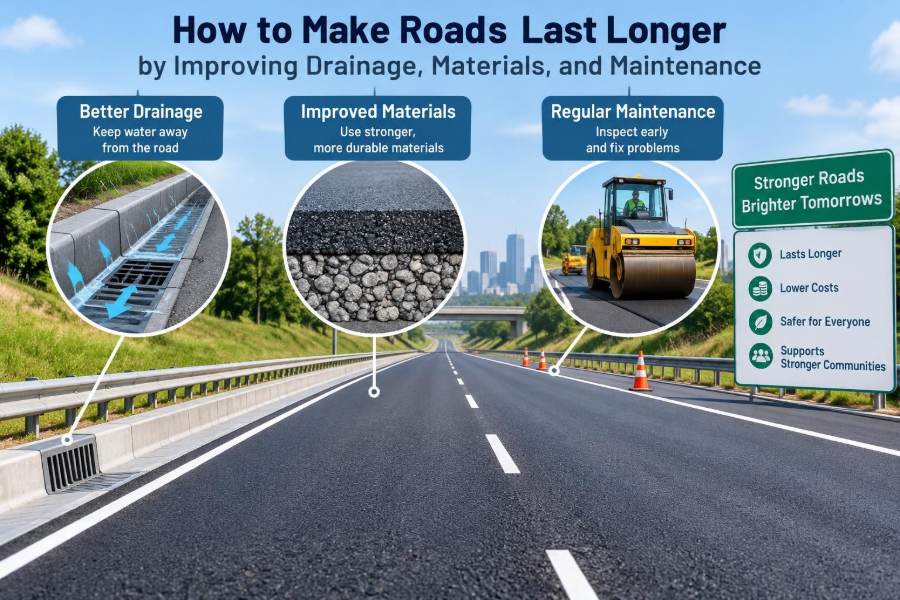
Road longevity depends on controlling three connected issues: moisture, structural support, and deterioration over time. Drainage prevents water from weakening layers; suitable materials and thickness carry anticipated loads; maintenance stops minor openings from becoming structural failures.
No road is maintenance-free, and no single detail works in every climate or soil condition. But a road system that moves water reliably, uses materials suited to its environment, and is inspected before failure spreads will usually provide more dependable service.
The longest-lasting roads are not simply paved well—they are drained well, built as complete structural systems, and cared for before small defects become expensive failures. 🌧️🛣️🔧