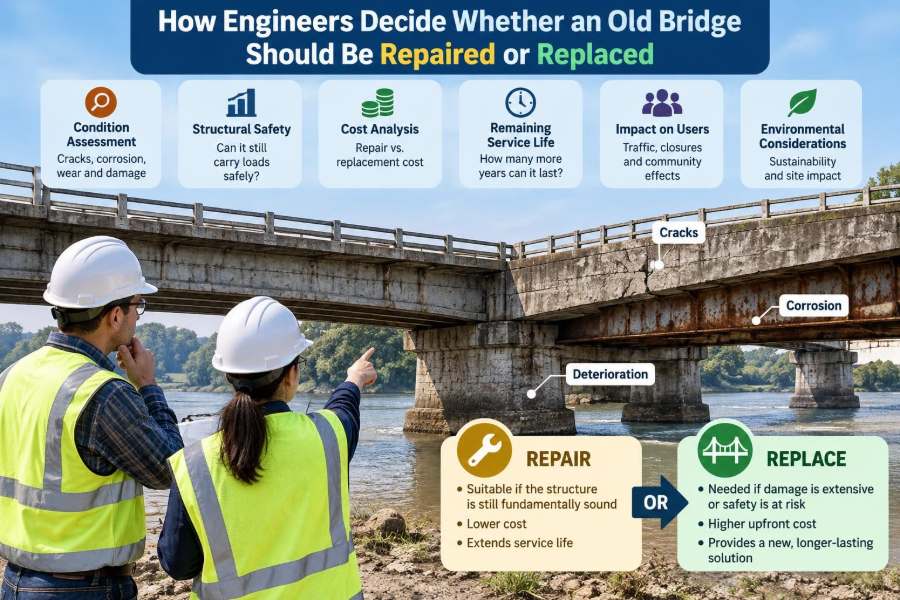

A bridge can look perfectly ordinary on a daily commute—until orange cones appear, traffic slows to one lane, and a sign announces an inspection. For nearby residents, that disruption may feel sudden. For bridge engineers, it is usually the visible result of years of inspection records, calculations, maintenance decisions, and changing demands.
Old does not automatically mean unsafe, and a crack does not automatically mean a bridge must come down. Many bridges remain useful long after their original designers expected, while others require major intervention because a few critical components have deteriorated faster than expected.
The difficult question is not simply, “Can this bridge be fixed?” Almost any structure can be repaired in some way. The more useful question is whether repair can provide a safe, reliable, and economically sensible service life for the people and goods that depend on it.
That decision combines structural engineering with transportation planning, construction practicality, environmental constraints, and public responsibility. Here is how engineers work through it.
🧭 The Decision Is About Service, Not Just Age
A bridge is built to provide a service: carrying people, vehicles, rail traffic, utilities, or emergency routes across an obstacle. Its calendar age is a useful clue, but it is not a verdict.
Two bridges built in the same year can be in radically different condition. One may have protected detailing, light traffic, and regular maintenance. The other may face de-icing salts, heavy trucks, leaking joints, flood debris, and years of deferred work.
Engineers therefore ask whether the structure can continue to perform its intended function safely, reliably, and affordably. A repair may be the sound choice even for a very old bridge; replacement may be justified for a younger one with fundamental limitations.
🔍 Start With a Thorough Condition Assessment
The process begins with inspection, not assumptions. Inspectors document the condition of the deck, superstructure, substructure, bearings, joints, drainage features, rails, and approaches.
They record visible defects such as cracking, spalling, rust staining, exposed reinforcing steel, loose components, settlement, impact damage, and scour. Spalling means pieces of concrete have broken away, often after reinforcement corrosion expands within the concrete.
Inspection findings are compared with earlier reports. A small crack that has remained stable may be monitored. A crack that has widened, multiplied, or appeared with nearby deformation deserves a more detailed investigation.
📋 Separate Cosmetic Defects From Structural Defects
Not every defect carries the same consequence. Surface staining, worn paint, or localized concrete damage may affect appearance and durability without immediately reducing load-carrying capacity.
Other defects occur in components essential to the bridge’s structural load path. For example, severe corrosion in a steel girder flange, section loss in a truss member, or cracking around a prestressed concrete anchorage can directly affect strength.
The central question is: does the damage interrupt, weaken, or make uncertain the route by which loads travel to the ground? Engineers prioritize damage according to both its severity and its location.
⚖️ Understand the Bridge’s Load Path
A load path is the sequence through which a vehicle’s weight moves through a bridge. A truck load typically passes from the deck to girders or beams, then to piers or abutments, foundations, and soil or rock.
Some bridges have multiple members that can share load if one member is damaged. Others depend heavily on a small number of critical elements. This is why similar-looking cracks can lead to different decisions on different structures.
Engineers also consider connections. A bridge member may appear sound, but deteriorated bolts, bearings, welds, or diaphragms can compromise how forces are transferred between components.
🧪 Use Testing When Visual Inspection Is Not Enough
Visual inspection has limits. Damage can be hidden by paint, asphalt overlays, water, soil, or concrete cover. When uncertainty matters, engineers use targeted testing and investigation.
- Non-destructive methods can help locate voids, delamination, moisture, or reinforcement without removing large pieces of material.
- Material samples may be tested to assess concrete quality, chloride exposure, steel condition, or the properties of older materials.
- Surveying can identify gradual movement, settlement, tilt, or changes in alignment.
- Load testing or monitoring may be considered in selected cases, but it must be planned carefully and does not replace structural analysis.
Tests provide evidence, not automatic answers. Results must be interpreted in the context of the bridge’s design, history, and observed behavior.
📐 Recalculate Capacity Under Current Requirements
Historic drawings reveal what designers intended, but engineers must determine what the bridge can safely carry now. They review dimensions, material properties, connection details, deterioration, and the applicable design and assessment requirements.
This is called a load rating or capacity assessment in many bridge management systems. It estimates whether the bridge can carry expected traffic with an appropriate margin of safety.
If a bridge no longer has adequate capacity, options may include strengthening, posting a weight limit, restricting certain vehicles, or replacing the structure. The right response depends on how essential the route is and whether the deficiency can be addressed reliably.
🚛 Today’s Traffic May Be Different From Original Traffic
A bridge designed for lighter vehicles or lower traffic volumes may face modern freight patterns that were not anticipated. Repeated heavy truck loading can accelerate fatigue and expose capacity limitations.
Traffic demand is not just a matter of maximum vehicle weight. Engineers consider vehicle frequency, lane configuration, pedestrian and bicycle use, emergency access, and whether detours are practical.
A low-volume rural bridge may function well with a posted limit and occasional maintenance. The same limitation on a key freight corridor, bus route, or sole emergency access road can make repair far less attractive.
🔁 Fatigue Is Damage Caused by Repetition
Fatigue develops when a component experiences many cycles of stress. A paper clip bent back and forth is a familiar analogy: it can fail even though each individual bend seems modest.
In bridges, fatigue cracks may occur at welded details, connections, or geometric changes where stresses concentrate. They require careful evaluation because they can grow with continued traffic.
Repairing a fatigue crack may involve drilling crack-arrest holes, modifying a detail, adding reinforcement, or replacing a member. If the underlying stress pattern remains unfavorable across many locations, a one-time repair may not offer a durable solution.
🧂 Corrosion Can Be Local or Systemic
Water, oxygen, salts, and poor drainage can drive corrosion in steel and reinforced concrete. In reinforced concrete, corrosion products occupy more volume than the original steel, producing internal pressure that cracks and spalls the surrounding concrete.
Localized corrosion near a leaking joint can often be repaired alongside drainage improvements. Widespread chloride contamination across a deck or multiple substructure elements is more difficult because deterioration may continue beyond patched areas.
Engineers distinguish between treating visible symptoms and controlling the mechanism. Simply patching concrete without addressing water and salt pathways can create an expensive cycle of repeat repairs.
💧 Drainage Often Determines Durability
Water is one of the most persistent threats to bridge service life. Blocked drains, failed joint seals, ponding on the deck, and leaking scuppers can direct water exactly where it causes the most damage.
A practical repair package may include deck waterproofing, improved drainage, joint replacement, protective coatings, and concrete repairs. These measures are less dramatic than a new bridge, but they can substantially slow deterioration when the main structure remains sound.
Conversely, poor drainage after a repair can undermine otherwise good workmanship. Durability is not a finishing detail; it is part of structural asset management.
🌊 Examine Scour and Foundations Below the Waterline
Scour is the removal of soil or sediment around bridge foundations by flowing water. It can occur during floods, around piers, or near abutments where currents become concentrated.
Because much of the foundation is hidden, engineers may use underwater inspection, sonar, probing, historical flood information, and geotechnical investigation. A visually sound bridge above water can still face risk if its foundation support has been reduced.
Countermeasures such as rock armoring, foundation strengthening, or changes to river protection may be feasible. But recurring hydraulic problems, uncertain foundations, or difficult access can shift the balance toward replacement.
🏗️ Check Piers, Abutments, and Bearings
The deck is easy to see, but the support system matters just as much. Piers and abutments transfer forces into the ground, while bearings allow controlled movement from temperature changes, shrinkage, creep, and traffic loading.
Seized, corroded, displaced, or damaged bearings can force loads into parts of the bridge not intended to carry them. Cracked pier caps, settlement, and retaining-wall movement also need investigation.
Some bearing replacements can be performed by temporarily jacking a bridge under controlled conditions. This is a specialized operation, and its feasibility depends on redundancy, access, geometry, condition, and traffic management.
🧱 Decide Whether the Deck Is a Repairable Layer
For many bridges, the deck deteriorates faster than the primary steel or concrete supporting system. Deck replacement can be a sensible rehabilitation strategy when girders, bearings, piers, and foundations have sufficient remaining capacity.
However, a deck is not always merely a wearing surface. On some bridge types, it contributes to stiffness or composite action with girders. Removing it changes the structure’s behavior and must be planned accordingly.
Engineers also weigh construction impacts. Replacing a deck may require long closures, staged traffic, temporary supports, or restrictions on heavy equipment during construction.
🧩 Recognize When Defects Point to a System-Wide Problem
A repair is most effective when damage is limited and its cause can be controlled. The decision becomes harder when defects appear across many similar members, connections, or spans.
For example, repeated concrete delamination throughout a deck, widespread section loss in multiple girders, or chronic deterioration at every joint suggests a system-level condition rather than an isolated defect.
Systemic deterioration does not force immediate replacement. It does mean that engineers must estimate the extent of hidden damage, the likely pace of future repair needs, and whether rehabilitation would leave a collection of weak points.
🛠️ Compare Repair, Rehabilitation, Strengthening, and Replacement
These options are related but not interchangeable. A repair restores a damaged part. Rehabilitation renews several components to extend useful life. Strengthening increases capacity. Replacement removes the existing structure and builds a new one.
| Option | Best suited to | Key limitation |
|---|---|---|
| Localized repair | Isolated, understood damage | May not address hidden or recurring deterioration |
| Rehabilitation | Sound basic structure with several aging components | Can become complex if conditions worsen during work |
| Strengthening | Capacity shortfall in an otherwise viable bridge | Added material may not solve durability or geometry problems |
| Replacement | Fundamental structural, functional, or resilience limitations | Usually higher disruption and larger upfront commitment |
A responsible choice compares realistic alternatives, not a perfect repair with a worst-case replacement.
💰 Use Life-Cycle Cost Rather Than First Cost Alone
The least expensive construction proposal is not necessarily the least expensive decision over time. Life-cycle cost considers initial work, expected maintenance, inspections, future repairs, traffic disruption, and anticipated service life.
A major rehabilitation may cost less upfront than replacement but require repeated closures and significant maintenance sooner. Replacement may have a higher initial cost yet provide better access, drainage, resilience, and lower renewal needs for a longer period.
Forecasts contain uncertainty. Engineers should make assumptions visible, test reasonable scenarios, and avoid implying that a long-range cost estimate is a precise prediction.
🚦 Count the Cost of Traffic Disruption
Bridge work affects more than the agency budget. Lane closures create delay, detours add fuel and travel time, and long diversions can burden businesses, school routes, transit, freight operators, and emergency responders.
In a dense corridor, a rapid replacement using prefabricated elements may be less disruptive than several years of recurring repairs. In a remote setting with low traffic, staged rehabilitation may be more practical.
Construction sequencing matters. A technically excellent design that cannot maintain necessary access may not meet the community’s real needs.
📏 Ask Whether the Bridge Still Fits the Road
Functional obsolescence means a bridge no longer suits current use even if it remains structurally sound. Common issues include narrow lanes, inadequate shoulders, poor sight distance, low vertical clearance, weak railings, sharp approach curves, or no space for pedestrians and cyclists.
This term should not be used casually as a reason to discard a serviceable bridge. Engineers assess whether the mismatch creates a meaningful safety, access, or operational problem and whether targeted upgrades can resolve it.
A bridge that is expensive to repair and still too narrow for its route is a stronger replacement candidate than one whose functional limitations can be corrected during rehabilitation.
🚶 Include People Outside Vehicles
Bridge decisions can reshape walking, cycling, mobility-device access, transit stops, and connections between neighborhoods. A replacement project may create an opportunity to add a sidewalk, protected shared-use path, improved lighting, or safer crossings at approaches.
Those benefits must be balanced against available width, drainage, structural loading, right-of-way constraints, and construction impacts. Adding a path to an old bridge may require strengthening or may be impractical on a constrained structure.
Considering all users early avoids treating access as an afterthought once a preferred alternative is already fixed.
🌪️ Consider Floods, Earthquakes, Wind, and Vessel Impacts
Older bridges may have been designed under different hazard assumptions or before current knowledge of local risks. Engineers review site-specific concerns such as flood overtopping, debris accumulation, scour, seismic movement, high winds, ice, ship collision, and vehicle strikes.
Retrofits can improve resilience. Examples include restrainers that limit unseating during seismic movement, pier protection, improved drainage, or scour countermeasures.
Replacement becomes more compelling when essential resilience upgrades are difficult to integrate into a deteriorated or geometrically constrained structure. The goal is not to eliminate every conceivable risk, but to manage credible hazards appropriately.
🏛️ Respect Heritage and Community Value
Some old bridges have architectural, cultural, or local significance beyond their transportation function. A distinctive truss, masonry arch, or historic crossing may contribute to a community’s identity.
Preservation does not mean ignoring safety or capacity limits. It can mean examining options such as rehabilitation for lighter use, adaptive reuse as a pedestrian bridge, or retaining important features while providing a new crossing nearby.
Early consultation is valuable because preservation constraints discovered late can lead to conflict, redesign, and missed opportunities for a better outcome.
🌿 Account for Environmental and Site Constraints
Work in waterways, wetlands, protected habitats, or dense urban areas can shape the decision as much as the bridge’s condition. Access for cranes, falsework, demolition, material storage, and construction crews may be limited.
Replacement can reduce long-term environmental exposure by eliminating repeated work, but it may also require larger temporary works and more extensive in-water activity. Rehabilitation can preserve existing foundations and reduce disturbance, though repeated interventions also carry impacts.
Environmental planning is therefore integrated with constructability, not left until after the structural choice has been made.
🚧 Determine Whether the Work Can Actually Be Built
Constructability asks whether a proposed solution can be safely and reliably executed at the site. Engineers consider access, lifting plans, worker safety, temporary stability, utilities, railroad coordination, water levels, and available staging areas.
For instance, adding steel plates to corroded members may sound straightforward until the team discovers that connections are inaccessible, traffic cannot be removed, and temporary supports would obstruct a waterway.
A solution that works on drawings but cannot be installed safely or inspected afterward is not a practical solution. Construction expertise should inform alternatives early.
🧠 Manage Uncertainty Instead of Hiding It
Old bridges often have incomplete records, altered details, hidden deterioration, or materials whose properties vary. Investigation reduces uncertainty, but it rarely removes it entirely.
Engineers respond by using conservative assumptions where justified, inspecting critical areas, planning contingencies, and defining decision points. A rehabilitation project may include allowances for concealed conditions and a clear process for responding if more damage is found.
Replacement also has uncertainty: soil conditions, utility conflicts, permitting, and construction markets can affect scope. Transparent uncertainty produces better decisions than false confidence.
📊 Use Bridge Management Data, but Do Not Let Scores Decide Alone
Agencies often use condition ratings, inspection databases, and prioritization tools to manage many structures. These systems help identify trends, allocate funds, and flag bridges needing attention.
A rating is a screening tool, not a complete engineering diagnosis. Two bridges with similar overall scores can have very different risks because of traffic volume, redundancy, deterioration mechanisms, detour length, or foundation condition.
Good asset management combines consistent data with engineering judgment. It also recognizes that preventive maintenance on bridges in fair condition can prevent expensive deterioration later.
👥 Coordinate Structural and Transportation Decisions
No single discipline decides the future of a bridge in isolation. Structural engineers assess safety and capacity; geotechnical and hydraulic specialists assess ground and water; traffic professionals assess operations; environmental teams address site impacts; and owners define service priorities.
Public agencies, utilities, emergency services, freight operators, and nearby communities may also have critical information. Their input does not replace engineering analysis, but it clarifies constraints and consequences.
Clear communication is especially important when a bridge must be restricted or closed. People are more likely to understand difficult decisions when the specific problem and the available options are explained plainly.
⚠️ Avoid Common Decision-Making Mistakes
One common mistake is treating a visible defect as the whole problem. A patched deck may look renewed while leaking joints continue to damage girders and bearings beneath it.
Another is choosing replacement only because it feels permanent, or choosing repair only because it appears cheaper today. Both choices can fail if they overlook future maintenance, functionality, construction impacts, and risk.
- Do not equate age with condition.
- Do not assume an inspection rating is a final design decision.
- Do not ignore foundations, drainage, and connections because they are harder to see.
- Do not compare alternatives with inconsistent assumptions about closures, lifespan, or future repairs.
🗺️ A Hypothetical Decision Path
Imagine a 1960s two-lane bridge over a creek. Inspection finds deck delamination, leaking joints, corroded bearings, and moderate girder corrosion near the ends, but piers and foundations are sound and calculations show adequate girder capacity after localized repairs.
If traffic is modest and the bridge width meets local needs, a deck replacement, bearing renewal, steel repairs, waterproofing, and drainage improvements could be a rational rehabilitation package.
Now change the facts: the route carries heavy freight, the lanes are too narrow, flood scour is recurring, corrosion is widespread, and a major detour is already needed during construction. In that case, replacement may offer greater long-term value despite its larger initial scope. This example is hypothetical; real decisions require site-specific investigation.
✅ The Core Principle: Repair What Can Deliver Reliable Service
The repair-versus-replace decision is not a contest between preserving the old and building the new. It is a disciplined judgment about remaining capacity, deterioration mechanisms, future demands, risk, cost over time, construction feasibility, and community needs.
Repair is often the best choice when damage is understood, the underlying cause can be controlled, the bridge remains functionally suitable, and rehabilitation can provide dependable service. Replacement is often justified when structural problems are widespread, critical uncertainties remain, resilience or geometry is inadequate, or repair would merely postpone repeated major work.
The strongest decisions explain both the evidence and the trade-offs. They protect safety while using public resources responsibly.
An old bridge should be repaired or replaced based on the reliable service it can provide—not on age, appearance, or upfront cost alone. Careful assessment turns a difficult choice into a defensible plan for the next generation of users. 🌉🔧🛣️