
A concrete pour is scheduled for dawn, but the delivery route is not clear, the latest drawing is sitting unopened in someone’s inbox, and a small discrepancy in the reinforcement layout has been noticed only after formwork is nearly complete. None of these issues may seem dramatic on its own. Together, they can turn a routine activity into rework, delay, cost pressure, and a difficult conversation.
Construction mistakes are rarely caused by one careless decision. More often, they develop where information, people, materials, and site conditions fail to line up. A missed revision, an assumed dimension, or an unclear handover can travel through several trades before it becomes visible.
For students, this is a useful reality check: engineering knowledge must be translated into buildable work. For working professionals, it is a reminder that strong project control is not bureaucracy—it is a practical way to protect safety, quality, time, and trust.
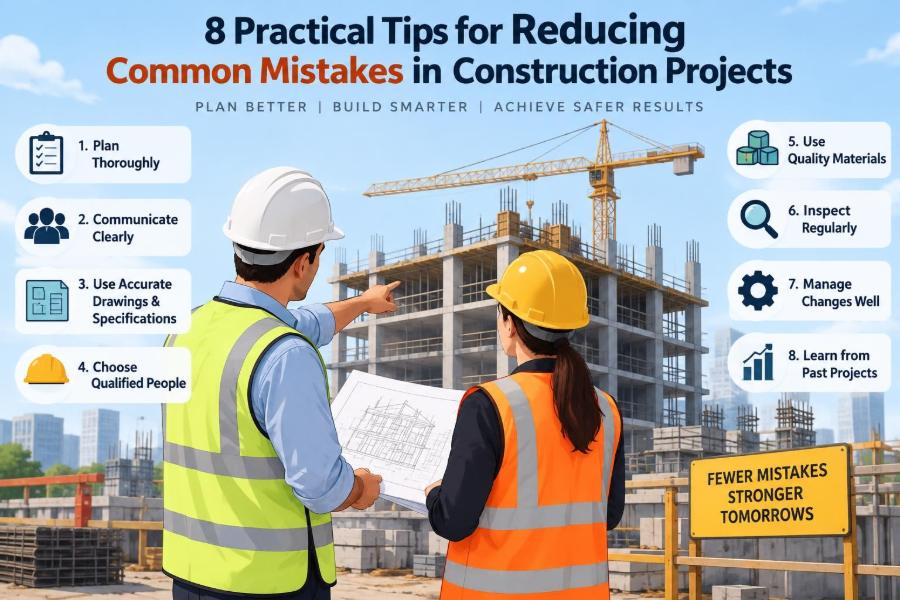
The eight tips in this guide focus on common failure points that project teams can manage before they become expensive field problems. They apply to projects of many sizes, from small building works to complex civil infrastructure.
🏗️ Why Small Construction Errors Grow So Quickly
Construction work is highly interdependent. Excavation affects foundations; foundations affect structural alignment; structural alignment affects cladding, services, finishes, and equipment installation. When an early activity is wrong, later work can conceal it or make correction much harder.
A 20 mm setting-out error, for example, may be manageable before concrete placement. Once columns, beams, and connected services are installed, the same error may require redesign, demolition, or an approved departure from the original detail.
The cheapest mistake to correct is the one found before work begins. This is why prevention depends as much on planning and verification as on skilled execution.
🧭 Understand Where Responsibility Begins and Ends
Ambiguous responsibility is a frequent source of omissions. A contractor may assume a specialist subcontractor will verify an interface; the subcontractor may assume the designer has resolved it. The task then receives no meaningful check.
A responsibility matrix can clarify who prepares, reviews, approves, installs, inspects, and records each major activity. It should cover practical boundaries, such as who confirms embedded items before a pour or who checks temporary works before loading begins.
Responsibility does not remove collaboration. It makes collaboration more effective because the team knows who must act when an issue is identified.
📐 Tip 1: Start With a Buildable Scope, Not Just a Design Scope
Drawings and specifications describe the intended finished asset, but a construction team must also understand the route to building it. That route includes access, lifting, sequencing, temporary stability, tolerances, inspection points, curing, protection, and interfaces with existing work.
Before mobilization, convert the contract information into a practical scope breakdown. Identify each deliverable, its acceptance criteria, the prerequisites for starting it, and the records needed to demonstrate completion.
- What must be complete before this activity starts?
- Which dimensions, levels, or materials are critical?
- Which trades must coordinate at this location?
- What temporary condition could create a safety or quality risk?
- Who has authority to accept the completed work?
A buildability review is especially valuable where design details are technically correct but difficult to install with the available space, equipment, or sequence. Raising that issue early is not resisting the design; it is managing constructability.
🗂️ Control the Latest Information on Site
Using a superseded drawing is one of the most avoidable construction errors. It often happens when printed sets remain in work areas, informal screenshots are shared, or teams rely on memory after a revision meeting.
Every project needs a clear document-control process. The site team should know where the current approved drawing, specification, method statement, and schedule are stored—and how revisions are communicated to the people doing the work.
Removing obsolete copies matters as much as distributing new ones. If a drawing is retained for record purposes, mark it clearly as superseded so it cannot be mistaken for a construction issue.
🔍 Read Drawings as a Coordinated Set
A drawing rarely stands alone. Plans, sections, elevations, schedules, notes, specifications, and discipline-specific drawings may each contain information needed for one installation. Looking only at the plan view can lead to missed elevations, clearances, or connection details.
When reviewing work, trace the element across documents. A drainage run, for instance, should be checked against the civil plan, utility profile, architectural levels, structural openings, and relevant specifications.
Where information appears inconsistent, do not resolve it by choosing the most convenient interpretation. Record the query and seek clarification through the project’s formal communication process.
🧱 Tip 2: Verify Setting Out Before It Becomes Permanent
Setting out transfers design coordinates, lines, levels, and geometry onto the ground or a structure. It is a control activity, not merely a surveying task performed at the start of a job.
Establish reliable control points, protect them from disturbance, and check them against known references. Then independently verify critical work before excavation, formwork closure, drilling, steel erection, or installation of fixed components.
A useful practice is a “hold point”: work cannot continue until a designated check is complete. Typical hold points include formation level approval, pile position confirmation, reinforcement inspection, and bolt layout verification.
Critical Checks for Dimensional Work
- Confirm the drawing revision and coordinate system before measurement begins.
- Check two independent references where practical rather than relying on one baseline.
- Record actual readings, not only a statement that work was checked.
- Recheck after events that can disturb control, such as excavation, heavy plant movement, or removal of temporary supports.
Independent checking is not a sign of distrust. It is a recognition that measurement errors can be systematic and difficult for the original checker to notice.
🌦️ Plan for Actual Site Conditions
Projects are designed using available site information, but conditions can differ from assumptions. Groundwater may be higher than anticipated, existing utilities may be poorly recorded, or access may change after neighboring work begins.
Site investigation information should be reviewed by the people planning the work, not filed away after tender. It provides context for excavation support, dewatering, earthworks handling, foundation methods, and environmental controls.
When an unexpected condition appears, pause long enough to characterize it. Continuing with an untested assumption can create a larger technical and commercial problem than the short delay needed for assessment.
🚧 Separate Temporary Works From Permanent Works
Temporary works are the parts of a project needed to construct the permanent asset: excavation support, formwork, falsework, scaffolding, propping, lifting arrangements, and access platforms. Their temporary nature does not make them low risk.
A common mistake is assuming that a permanent-work drawing automatically explains a safe construction sequence. It may not address partial loading, stability before connections are complete, concrete pressure on formwork, or ground bearing beneath a crane outrigger.
Temporary works should be designed, checked, installed, inspected, and altered under a defined control process. The exact arrangements depend on project risk and local requirements, but the principle is consistent: temporary stability must never be assumed.
🧰 Tip 3: Plan Work Packages Before Crews Arrive
A work package translates a broad programme activity into instructions a supervisor and crew can use. It should connect drawings, sequence, labor, plant, materials, risks, quality checks, and expected production in one practical plan.
Without that preparation, crews often solve constraints in real time. Improvisation can be necessary in a genuine emergency, but it is a poor default method for routine construction.
For a concrete slab pour, the package might specify access routes, delivery intervals, pump position, reinforcement checks, pour sequence, vibration method, finishing requirements, test arrangements, curing, and contingency actions for rain or equipment failure.
🗓️ Link the Programme to Real Constraints
A schedule should describe more than desired dates. Activities must reflect logical relationships, available resources, approvals, procurement lead times, weather sensitivity, access restrictions, and the time needed for testing or curing.
Overly optimistic programmes create pressure that can encourage skipped inspections, crowded work fronts, and premature handovers. A realistic programme does not eliminate pressure, but it makes risks visible early enough to manage.
Short-term look-ahead planning is particularly useful. It asks what must be ready in the next one to three weeks: approved information, labor, plant, materials, access, permits, and preceding work.
📦 Tip 4: Treat Materials as a Quality-Control Issue
Material problems are not limited to ordering the wrong item. Damage in storage, lost certificates, mixed batches, expired products, incorrect handling, and substitution without approval can all affect final performance.
Create a material control chain from submittal through delivery, inspection, storage, issue, and installation. The level of detail should match the product’s importance and risk. Reinforcement, structural steel, waterproofing systems, concrete admixtures, and fire-stopping products often require closer traceability than general consumables.
- Check identity, quantity, condition, and relevant documentation on delivery.
- Store materials according to manufacturer requirements and protect them from moisture, contamination, sunlight, impact, or theft where relevant.
- Segregate accepted, quarantined, and rejected items so their status is unmistakable.
- Do not substitute a product simply because it is available sooner.
Substitutions can be appropriate, but they need technical review and formal acceptance before use. Similar appearance does not mean equivalent strength, durability, compatibility, or fire performance.
🧪 Inspect Before Work Is Covered Up
Many critical elements disappear behind concrete, soil, cladding, ceilings, insulation, or finishes. Once concealed, verification becomes difficult and sometimes destructive.
Inspection and test plans identify what is checked, when it is checked, who witnesses it, and what record is retained. A hold point requires release before proceeding; a witness point gives a designated party an opportunity to observe the work.
The aim is not to create paperwork for its own sake. Good inspection records capture the evidence needed to show that critical requirements were met when direct visual confirmation is no longer possible.
✅ Tip 5: Make Quality Checks Specific and Measurable
“Inspect the work” is not a useful instruction. A useful check states what is being inspected, the acceptance criterion, the tool or method, the responsible person, and the action if work does not comply.
For example, checking reinforcement may include bar size, spacing, lap lengths, cover, cleanliness, supports, tying, and position of embedded items. The required values come from the approved design information, not from habit or a previous project.
Use checklists carefully. They are effective prompts, but they do not replace competent observation. A signed checklist should mean the item was actually checked, not that a form was completed after the event.
🗣️ Build Clear Communication Into Daily Work
Construction teams include designers, supervisors, operators, trades, suppliers, inspectors, and clients. They may work different shifts, speak different first languages, and use different technical vocabulary. Misunderstandings are therefore predictable unless communication is deliberately structured.
Daily briefings should focus on the specific work front: the day’s sequence, changing hazards, drawing revisions, handovers, interface risks, and quality hold points. Short, relevant conversations are generally more useful than long generic talks.
Visual aids can help. Marked-up plans, installation mock-ups, color-coded zones, and photographs of accepted work can make expectations clearer than verbal instruction alone.
🤝 Tip 6: Manage Trade Interfaces Actively
An interface is a point where separate systems, responsibilities, or work packages meet. Many defects occur there: a sleeve missing from a structural wall, a waterproofing layer interrupted at a penetration, or a duct route conflicting with a beam.
Interface management means identifying these handoffs before work begins and assigning someone to coordinate them. It is not enough for each trade to complete its own scope correctly if the combined result cannot function.
Questions That Reveal Interface Risks
- What must be installed before this area is closed or poured?
- Who owns the physical boundary between the two systems?
- Does one trade need another trade’s setting-out information?
- Can this work be inspected and maintained after adjacent work is complete?
- Will one installation damage, block, or compromise another?
Coordination meetings should address real locations and sequences, not only broad status updates. A marked drawing of one congested plant room can prevent more problems than a lengthy general discussion.
🦺 Keep Safety and Quality Connected
Safety and quality are sometimes managed as separate subjects, but weak planning can harm both. An unstable access arrangement can cause injury and make accurate installation difficult. Rushed lifting can damage materials as well as endanger people.
Safe work methods often support better workmanship: stable platforms improve access, clean routes reduce material damage, adequate lighting improves inspection, and orderly storage prevents product mix-ups.
Where a task becomes unsafe because of a changed condition, stopping and reassessing is a professional decision. Completing work quickly is not a valid substitute for controlling a serious risk.
📸 Tip 7: Record Decisions, Changes, and Hidden Work
Memory is unreliable on fast-moving projects. A concise record can explain what was built, what changed, why a decision was made, and who accepted it. This supports handover, future maintenance, payment discussions, and defect investigation.
Useful records include site diaries, inspection reports, delivery tickets, test results, photographs, requests for information, approved variations, meeting actions, and marked-up as-built information. Photographs are most useful when they include context, date control where available, and an identifiable location.
Do not use informal messages as the sole record for significant technical decisions. Confirm the agreed action through the project’s documented process so there is a common, traceable understanding.
🔄 Control Changes Instead of Absorbing Them Informally
Change is normal in construction. A client may alter a requirement, an existing condition may require a redesign, or procurement may reveal that a specified product is unavailable. The mistake is allowing changes to reach the workface before their effects are understood.
Each change should be assessed for design intent, safety, cost, programme, procurement, quality, permits, and downstream interfaces. Small changes can have disproportionate consequences—for example, moving an opening may affect reinforcement, services, waterproofing, finishes, and access.
Once approved, communicate the change to affected parties and update controlled documents. An approved decision that does not reach the crew is still a construction risk.
👷 Invest in Competence, Not Assumptions
Experience is valuable, but it must match the task. A competent worker may still need project-specific instruction when using an unfamiliar system, material, machine, or installation method.
Competence includes technical knowledge, practical skill, awareness of limits, and the willingness to ask for clarification. It should not be confused with confidence or job title alone.
Supervision is particularly important for high-consequence or infrequent tasks, such as post-tensioning, specialized welding, confined-space work, waterproofing details, or erection of complex temporary works. The required level of oversight depends on the risk, complexity, and team capability.
⚙️ Tip 8: Learn From Near Misses and Rework
A near miss in quality is an issue caught before it creates a completed defect: incorrect anchor positions identified before drilling, a mismatched pipe fitting found before installation, or an incomplete pre-pour check stopped in time. These events are valuable information.
Record the immediate correction, then look for the underlying cause. Was the drawing unclear? Was the briefing rushed? Was material labeling inadequate? Did the sequence prevent inspection? A team that only fixes the visible symptom is likely to repeat the problem.
Keep lessons learned short and usable. Share a photograph, revised checklist item, sketch, or toolbox discussion with the teams facing similar work. Learning becomes effective when it changes the next decision.
🧩 Use Root-Cause Thinking Without Blame
Blame may identify who was closest to an error, but it does not necessarily explain why the system allowed it. Root-cause thinking asks what conditions made the mistake possible and what controls failed to detect it earlier.
Consider a misplaced opening. The immediate cause may be incorrect marking. Contributing causes could include an outdated drawing, unclear grid references, no independent set-out check, poor lighting, or pressure to close formwork quickly.
Accountability still matters, especially where procedures were knowingly ignored. However, a fair review distinguishes between deliberate disregard, understandable human error, and weaknesses in planning or control.
📊 Prioritize Risks That Have High Consequences
Not every defect deserves the same level of control. Teams have limited time, so attention should focus on work that could cause severe safety consequences, structural or functional failure, major rework, environmental harm, or difficult-to-detect defects.
A simple risk review considers the likelihood of a problem, the severity if it occurs, and the ability to detect it before handover. This helps determine where to use specialist review, mock-ups, hold points, increased supervision, or independent testing.
| Work example | Typical mistake | Useful preventive control |
|---|---|---|
| Reinforced concrete | Embedded items omitted | Pre-pour checklist and coordinated drawing review |
| Earthworks | Incorrect formation level | Survey verification and documented acceptance |
| Waterproofing | Damaged or discontinuous membrane | Mock-up, inspection before covering, protection plan |
| Structural steel | Incorrect connection components | Controlled bolt identification and connection inspection |
The controls should be proportionate. Applying the most intensive process to every minor task can slow work without improving the risks that matter most.
🌧️ Prepare for Weather, Access, and Logistics
Weather and logistics are often treated as external problems, yet many of their effects can be anticipated. Rain can affect excavation stability, concrete finishing, lifting, traffic routes, and material storage. Heat and wind can influence curing, dust, and safe handling of large panels.
Logistics planning should map delivery routes, unloading zones, storage areas, pedestrian separation, crane coverage, waste removal, emergency access, and changes as the site develops. A route that works during foundations may be unsuitable once the superstructure occupies the site.
Contingency planning does not mean predicting every event. It means agreeing in advance how the team will protect work, communicate decisions, and safely pause or restart activities when conditions change.
🏢 Use Mock-Ups for Repetitive or Sensitive Work
A mock-up is a trial installation used to confirm appearance, sequence, workmanship, interfaces, and inspection standards. It is especially useful for façade details, waterproofing, architectural concrete, finishes, complex reinforcement zones, and repeated utility connections.
Mock-ups reveal practical questions that drawings may not answer: Can the material be installed without damaging adjacent work? Is the specified joint achievable? Can the quality be inspected? Does the installation sequence create a weak point?
Once accepted, the mock-up becomes a reference standard. It should not be treated as a one-time display while later work drifts away from the agreed quality.
💻 Use Digital Tools With Disciplined Inputs
Digital models, common data environments, mobile inspection apps, drones, and scheduling software can improve coordination and traceability. They do not automatically create good decisions.
A model is only as reliable as its current information and agreed use. Field teams still need clear instructions, verified dimensions, and defined authority for resolving clashes. Likewise, an app can collect hundreds of observations without ensuring that corrective actions are closed.
Choose tools that solve a real project problem, train users properly, and maintain simple backup arrangements for critical information. Technology should reduce ambiguity, not add another disconnected system.
🧾 Make Handover a Process, Not a Final-Day Event
Handover begins while construction is underway. Test certificates, as-built records, operation information, defect lists, training needs, and commissioning results are easier to collect progressively than reconstruct at the end.
Commissioning verifies that installed systems operate as intended. It may involve functional testing, balancing, calibration, demonstration, or integrated checks between systems. Installation completion alone does not prove operational performance.
Progressive completion by area can expose missing documents and defects early. It also gives the future operator more confidence that the asset is understood, maintainable, and supported by usable records.
🧠 Build a Culture Where Questions Are Welcome
Workers closest to the activity often notice the first sign that something does not fit: a dimension that seems inconsistent, a material that looks unfamiliar, or a sequence that makes an inspection impossible. Their concern must be heard before it is dismissed as an inconvenience.
Leaders set this tone through their response. If asking a question leads to ridicule or delay without explanation, concerns will remain unspoken. If it leads to a prompt, respectful review, the team is more likely to identify issues early.
Psychological safety does not mean every suggestion is accepted. It means people can raise a genuine concern without being punished for doing their job carefully.
📋 A Practical Weekly Mistake-Prevention Routine
Consistency is more useful than occasional intensive reviews. A short weekly routine can keep controls connected to the work actually approaching on site.
- Review the next work fronts against the latest approved information.
- Identify constraints: access, materials, design queries, permits, plant, labor, and preceding work.
- Confirm high-risk quality hold points and who will attend them.
- Discuss interfaces between trades and any planned change.
- Review recent defects, near misses, and incomplete corrective actions.
- Check that records and photographs are being captured before work is concealed.
This routine should result in named actions and dates, not simply a discussion. A small number of clearly owned actions is more effective than a long issue list with no follow-through.
🌉 The Core Principle: Prevent, Verify, and Learn
Reducing construction mistakes is not about creating a flawless project environment. Construction involves changing conditions, multiple parties, and decisions made under time pressure. Some uncertainty will always remain.
The practical response is a disciplined cycle: prevent foreseeable problems through planning, verify critical work before it becomes permanent, and learn from deviations before they recur. The eight tips work because they strengthen that cycle at the points where projects commonly lose control.
Strong construction management is visible in ordinary actions: a crew using the correct revision, a survey check before a pour, a stored material protected from damage, a supervisor pausing for an interface query, and a record that explains what was done. These habits may look small, but they are how reliable assets are built.
Construction quality is created long before handover—through clear information, careful checks, capable people, and the discipline to address problems while they are still manageable. 🌉🦺📐