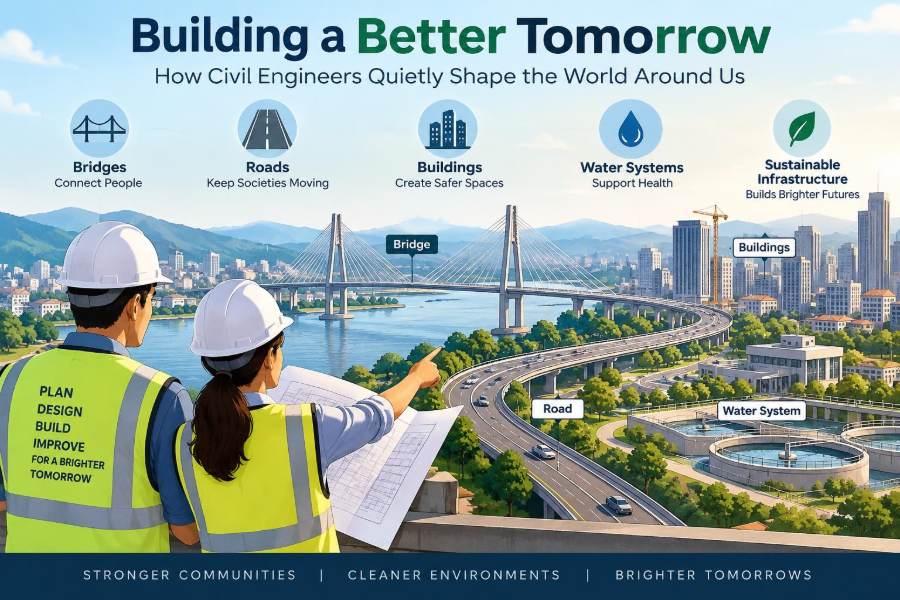

A commuter crosses a bridge without thinking about the soil beneath its foundations. A family turns on a tap, confident that clean water will arrive. During a heavy storm, most people notice the rain—not the drains, channels, pavements, and storage systems working to move it safely away.
These ordinary moments are the visible result of thousands of decisions made long before a road opens, a building is occupied, or a neighbourhood appears on a map. Civil engineering is often most successful when people barely notice it: the journey is smooth, the water stays out, the structure stands firm, and daily life continues.
That quiet reliability does not happen by accident. It depends on engineers who turn scientific principles, site evidence, public needs, budgets, environmental limits, and safety requirements into infrastructure that can serve people for decades.
Understanding their work changes the way we see the built environment. Every curb, retaining wall, rail platform, culvert, and water tower tells a story about risk, trade-offs, and the long-term responsibility of shaping places where people live.
🏗️ Civil Engineering Is the Framework of Everyday Life
Civil engineering is the discipline concerned with planning, designing, constructing, operating, and maintaining the physical systems that support society. It includes buildings and bridges, but it also reaches far beyond them: roads, airports, water networks, flood defenses, ports, tunnels, dams, waste systems, and public spaces all depend on civil engineering.
The field differs from architecture, although the two often work closely together. Architects commonly lead the spatial experience and appearance of a building, while civil and structural engineers determine how loads travel safely into the ground, how materials perform, and how the project connects to wider infrastructure.
🧭 The First Job Is Understanding the Need
A useful project begins with a clear problem, not a preferred structure. Is a crossing needed because a community is isolated during floods? Is a road needed to improve access, or would safer walking routes and public transport solve the real issue more effectively?
Engineers help convert broad needs into measurable objectives. Those may include capacity, travel time, water quality, flood protection, accessibility, cost, resilience, and environmental impact. Defining success early prevents a technically impressive solution from solving the wrong problem.
🗺️ A Site Is Never an Empty Canvas
Before design can begin, engineers investigate what already exists. A site may contain buried utilities, contaminated soil, unstable slopes, flood pathways, protected habitats, archaeological features, neighbouring foundations, and complex ownership boundaries.
A topographic survey records levels and physical features. Utility records and ground-penetrating investigations may help locate services, although records can be incomplete. Site information reduces uncertainty; it does not remove the need for careful judgement when unexpected conditions appear during construction.
🪨 Ground Conditions Control More Than Most People Realize
Every structure eventually transfers its weight to the ground. The ground must be able to support that load without excessive settlement, sliding, or failure. This is why geotechnical engineering—the study of soil, rock, groundwater, and earthworks—is central to safe construction.
Clay may shrink or swell with moisture changes. Loose sand can compact or move under loading. High groundwater can complicate excavations. Engineers use boreholes, laboratory tests, field tests, and geological knowledge to develop a ground model, then select foundations and earthworks suitable for the conditions.
⚖️ Loads Must Have a Safe Path to the Ground
A structural engineer thinks in load paths. A roof carries wind, rain, snow in relevant climates, equipment, and its own weight. Those forces pass through beams, columns, walls, or frames, into foundations, and finally into the soil or rock below.
A missing or weak link in that path can be serious. Removing a wall during renovation, for example, may alter how a building carries load. Engineers assess both dead loads, such as the permanent weight of materials, and live loads, such as people, vehicles, movable furniture, or stored goods.
🌉 Bridges Reveal Engineering as a Balance of Forces
A bridge is not simply a span between two points. Its form responds to distance, loading, foundation conditions, clearance requirements, construction access, maintenance needs, and the behaviour of its materials. A short concrete beam bridge and a long cable-supported bridge solve very different structural problems.
Engineers consider bending, shear, compression, tension, vibration, fatigue, temperature movement, wind, and—in some locations—seismic action. The elegant appearance of a bridge can emerge from these structural demands, but aesthetics alone cannot determine the design.
🧱 Materials Are Chosen for Performance, Not Tradition
Concrete is strong in compression and can be shaped into many forms. Steel is strong in tension and useful for long spans and slender members. Timber can offer a lower-mass structural option when sourced and detailed responsibly. Masonry, asphalt, composites, and earth materials also have roles.
No material is automatically best. Selection depends on durability, local availability, construction skill, fire performance, exposure, maintenance, embodied impacts, and cost over the asset’s life. Reinforced concrete, for instance, relies on steel reinforcement being protected from corrosion by adequate concrete quality and cover.
🛣️ Roads Are Transportation Systems, Not Just Pavement
A road must support traffic, guide drivers, accommodate drainage, connect pedestrians and cyclists, and fit the surrounding land use. Its pavement is a layered system: the surface carries traffic and provides grip, while lower layers spread wheel loads to the subgrade soil.
Good road design also asks who is excluded by a car-only approach. Crossings, footpaths, bus stops, cycle facilities, lighting, and speed management can matter as much as lane capacity. A wider road may move more vehicles, but it can also create harder, less safe crossings if people are not considered.
🚦 Small Design Choices Shape Road Safety
Road users read their environment. A broad, straight street can encourage higher speeds even if a sign displays a low limit. Narrower lane geometry, visible crossings, protected turning movements, clear sight lines, and forgiving roadside design can make the intended behaviour easier to understand.
Safety engineering aims to reduce both crash likelihood and crash severity. It recognizes that people make mistakes. Rather than assuming perfect attention, a safer system provides recovery space, understandable layouts, and physical protection where consequences could be severe.
💧 Water Supply Depends on an Invisible Network
Safe water is a chain of connected processes: protecting or collecting a source, treating water where required, storing it, pumping or distributing it, and monitoring the system. Pressure must be managed so water reaches users while pipes and fittings are not overstressed.
Network design is not only about laying larger pipes. Engineers consider peak demand, fire-flow requirements where applicable, elevation changes, leakage, water age, isolation valves, and the ability to repair sections without cutting off an entire area.
🚽 Wastewater Engineering Protects Public Health
Wastewater systems carry used water away from homes, workplaces, and industry for treatment before discharge or reuse. Gravity sewers are common because they move flow downhill without continuous pumping, but their slopes must be sufficient to limit solids settling without creating damaging velocities.
Treatment processes vary by location and discharge requirements. Their purpose is to reduce pollutants and protect receiving waters. Collection networks also need maintenance access, because blockages, root intrusion, damaged pipes, and illegal connections can disrupt service and create health risks.
🌧️ Drainage Is About Managing Water Where It Falls
Urban development often replaces soil and vegetation with roofs, asphalt, and concrete. These impermeable surfaces reduce infiltration and increase runoff speed. If drainage systems cannot manage the flow, water may pond on roads, enter buildings, or overload downstream channels.
Modern drainage approaches increasingly use features that slow, store, filter, or soak in water close to its source. Swales, permeable paving, rain gardens, detention basins, and green roofs can complement conventional pipes. Their suitability depends on space, soil permeability, groundwater conditions, maintenance, and local rainfall patterns.
🏙️ Cities Work as Connected Systems
A new housing development affects more than its plot boundary. It may change school travel patterns, water demand, traffic at junctions, runoff volumes, waste collection routes, and pressure on nearby public spaces. Civil engineers coordinate with planners, environmental specialists, utility providers, architects, and communities to understand those connections.
Thinking in systems avoids shifting a problem elsewhere. Sending stormwater rapidly away from one site, for example, can worsen flooding downstream if the wider catchment is ignored.
♿ Accessibility Is a Core Design Requirement
Infrastructure serves people with different mobility, vision, hearing, balance, cognition, and temporary injuries. A route that looks accessible on a drawing may fail in practice if it has steep gradients, awkward kerbs, poor lighting, slippery surfaces, obstructed footways, or confusing wayfinding.
Inclusive design benefits more than one group. Step-free routes help wheelchair users, parents with pushchairs, travellers with luggage, delivery workers, and people recovering from injury. Designing for a broad range of users from the beginning is usually more effective than adding limited adaptations later.
🌿 Environmental Design Starts Before Construction
The environmental effect of a project is shaped early, when location, scale, alignment, and material choices are still flexible. Avoiding a sensitive habitat or reducing excavation can have a greater effect than trying to compensate after the route and form are fixed.
Engineers assess issues such as habitat disturbance, erosion, noise, dust, water quality, carbon emissions, resource use, and construction traffic. Mitigation may include careful timing, sediment controls, habitat crossings, reused materials, lower-impact specifications, or revised construction methods.
♻️ Whole-Life Thinking Changes the Best Answer
The cheapest initial option is not always the least expensive over an asset’s life. A surface that needs frequent replacement, a pump station with high energy demand, or a detail that traps water and accelerates corrosion can create substantial future costs and disruption.
Whole-life assessment considers planning, construction, operation, inspection, maintenance, renewal, and eventual removal or reuse. It does not mean choosing the most expensive option; it means making costs and consequences visible before committing to a design.
🌡️ Climate Resilience Means Designing for Changing Conditions
Infrastructure is often expected to serve for many decades, while rainfall intensity, heat, drought, coastal conditions, and other environmental stresses may change over that period. Engineers use available climate information and scenario-based thinking to test whether a design has adequate margin.
Resilience can involve larger overflow routes, heat-tolerant materials, raised equipment, backup power, flexible water sources, or inspection plans that target vulnerable components. There is no universal resilience measure: the appropriate response depends on the hazard, the asset’s consequences of failure, and local evidence.
🔍 Inspection Prevents Small Defects Becoming Major Failures
Infrastructure ages. Water enters joints, bearings wear, coatings deteriorate, pavements crack, and soil can erode around structures. Inspection identifies these changes before they become harder and more expensive to manage.
Condition assessment may involve visual surveys, measurements, monitoring instruments, material testing, and remote inspection tools. Data supports decisions, but interpretation still matters: a crack can be harmless movement in one context and a warning sign in another.
🔧 Maintenance Is Engineering, Not an Afterthought
Maintenance is sometimes treated as less visible than new construction, yet it is essential to reliable public infrastructure. Clearing drains, sealing pavement defects, repainting exposed steel, lubricating moving parts, and replacing worn components can extend useful life substantially.
Deferred maintenance may appear to save money in a tight budget cycle, but it can allow manageable deterioration to become a disruptive repair or replacement project. Good asset management prioritizes work according to condition, consequence, service needs, and available resources.
🏗️ Construction Turns Drawings into Reality
A design is only useful if it can be built safely and accurately. Construction engineers and site teams sequence work, manage temporary conditions, coordinate deliveries, control quality, and respond to real site constraints. Temporary works—such as scaffolds, excavation supports, formwork, and lifting arrangements—can be as safety-critical as the final structure.
Clear communication matters because drawings cannot anticipate every field condition. When site findings differ from assumptions, teams must assess the change rather than improvising a fix that could compromise the design intent.
🦺 Safety Must Be Designed Into the Work
Construction hazards include falls, lifting operations, moving plant, live utilities, traffic, excavations, confined spaces, and unstable temporary conditions. The most effective controls often remove a hazard or reduce exposure through design and planning, rather than relying only on personal protective equipment.
For example, specifying components that can be assembled at ground level may reduce work at height. Designing access for future inspection can protect maintenance workers as well as construction crews. Safety is strongest when it is considered throughout the project lifecycle.
📐 Standards Guide Decisions but Do Not Replace Judgement
Codes, specifications, permits, and design standards provide shared requirements and tested methods. They establish a baseline for issues such as loads, materials, detailing, accessibility, drainage, and quality control. Local requirements vary, so engineers must apply the rules relevant to the project location and type.
Compliance alone does not solve every problem. Unusual sites, new materials, existing structures, and changing climate conditions may require additional analysis, review, or specialist advice. Professional judgement connects written requirements to the real conditions on site.
💻 Digital Tools Improve Coordination When Used Well
Engineers use models, geographic information systems, surveying tools, sensors, spreadsheets, and analysis software to test options and coordinate complex projects. Building information modelling can help teams identify clashes, such as a pipe route intersecting a structural beam, before construction begins.
However, a polished model can still contain poor assumptions. Digital outputs must be checked against site data, engineering principles, and constructability. Technology speeds up iteration; it does not transfer responsibility away from the people making decisions.
🤝 Public Trust Is Part of Infrastructure Delivery
Projects affect the people living nearby through noise, access changes, visual impact, land take, and construction disruption. Communities may also hold local knowledge about recurring flooding, dangerous crossings, or service problems that is not obvious from maps and reports.
Meaningful engagement explains constraints as well as benefits, listens early enough for feedback to influence decisions, and avoids promising outcomes that cannot be delivered. Not every concern can be resolved in the same way, but respectful communication builds better information and more workable projects.
💰 Engineers Manage Trade-Offs, Not Perfect Choices
Most projects involve competing goals. A wider flood channel may improve hydraulic capacity but affect habitats and land use. A higher-specification material may last longer but have greater initial cost or limited local availability. A route that avoids one impact may create another.
Sound engineering makes these trade-offs explicit. It compares alternatives, records assumptions, identifies risks, and explains why a chosen option is appropriate. The goal is not to claim that a design has no disadvantages, but to manage disadvantages responsibly.
📚 Students Build Strong Foundations Beyond Calculations
Technical fundamentals remain essential: mechanics, materials, fluid flow, soil behaviour, surveying, and structural analysis give engineers the language to understand physical systems. But strong practice also requires communication, drawing interpretation, project planning, ethics, and the ability to ask useful questions.
Students can develop these skills by studying local infrastructure, reading drawings when opportunities arise, learning why specifications exist, and practicing clear explanations. A calculation is more valuable when its assumptions, limits, and implications can be communicated to someone who must act on it.
🧠 Early-Career Engineers Learn Through Review
Checking is a professional habit, not a sign of weakness. Design reviews, independent calculations, constructability discussions, and site visits reveal gaps that are difficult to see when working alone. Asking a senior colleague why a detail is arranged a certain way can uncover lessons that no formula provides.
Useful questions include: What happens if this drain blocks? How will this member be installed? Where will water go at an expansion joint? Can an inspector reach this component? These questions connect design intent with operation in the real world.
⚠️ Common Mistakes Begin With Unexamined Assumptions
Many engineering problems start when an assumption is treated as a fact: a utility location is accepted without verification, ground conditions are generalized from limited information, maintenance access is overlooked, or an old drawing is assumed to match the existing asset.
- Ignoring interfaces: many failures occur where disciplines, materials, or systems meet.
- Designing only for normal operation: blocked drains, power loss, misuse, and extreme weather need proportionate consideration.
- Leaving maintenance unresolved: inaccessible components create predictable future problems.
- Communicating ambiguity poorly: unclear drawings and specifications invite inconsistent construction.
The remedy is not endless analysis. It is targeted investigation, documented assumptions, sensible review, and escalation when uncertainty has meaningful safety or service consequences.
🔗 The Core Principle: Build for People, Place, and Time
Civil engineering is the practice of making long-term public life possible through physical systems. Its success rests on understanding people’s needs, respecting local conditions, applying scientific knowledge carefully, and accepting responsibility for what happens after construction ends.
The strongest solutions are rarely defined by a single dramatic feature. They combine safe load paths, workable drainage, durable materials, accessible routes, manageable maintenance, environmental awareness, and clear communication. Each decision may be quiet, but together they determine whether infrastructure remains useful when it is needed most.
Civil engineers shape a better tomorrow by treating every structure and network as a lasting promise to the people who depend on it. When that promise is designed, built, inspected, and maintained with care, the ordinary world works a little more safely and smoothly. 🌉💧🏙️