
A fully loaded truck approaches an intersection, slows, turns across the wheel path, and pulls away again. This routine movement happens thousands of times on industrial access roads, freight corridors, port approaches, bus lanes, and highway ramps.
To road users, the pavement may simply look like asphalt or concrete. To an engineer, however, those two surfaces can respond very differently to the same axle load, temperature swing, drainage problem, or construction defect.
The question of which pavement is safer for heavy traffic does not have a one-word answer. Flexible asphalt pavements and rigid concrete pavements can both provide safe service when they are designed, built, drained, and maintained for their actual conditions.
Safety comes from more than surface material. It depends on structural capacity, skid resistance, ride quality, water management, visibility, maintenance timing, and whether the pavement continues to perform predictably under heavy repeated loading.
🚛 What “Safe” Means for a Heavy-Traffic Pavement
For pavement engineering, safety includes the road surface’s ability to support vehicles without creating hazards. A safe pavement provides reliable tire grip, a reasonably smooth ride, effective drainage, clear lane geometry, and structural performance that does not deteriorate into dangerous defects.
Heavy traffic adds another dimension: repeated high axle loads. Freight vehicles may not look dramatically different from cars at a distance, but their loads can impose far greater stresses on the pavement structure.
A pavement can be structurally strong yet still be unsafe if it becomes polished, holds water, develops severe bumps, or suffers failures that surprise drivers. Conversely, a smooth new surface is not automatically safe if the layers below it are too weak for the traffic.
🛣️ The Basic Difference Between Flexible and Rigid Pavements
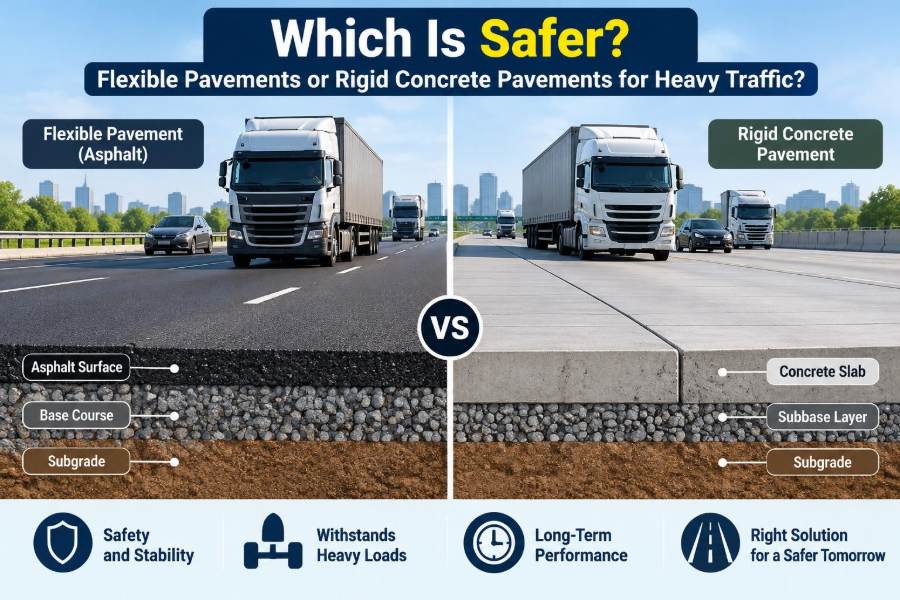
Flexible pavement usually consists of asphalt layers over granular base and subbase layers, placed on prepared subgrade soil. It is called flexible because the layered system deflects slightly under wheel loads.
Rigid pavement uses a concrete slab as its main structural layer. Concrete has high stiffness, so the slab spreads wheel loads over a broader area of the supporting layers beneath it.
The terms do not mean asphalt is weak or concrete never moves. Both systems deform to some degree. The useful distinction is how each system carries loads and where damage tends to develop.
⚖️ Why Heavy Vehicles Change the Design Problem
Pavements are not designed only for a vehicle’s total weight. Engineers also consider axle configuration, tire contact pressure, wheel spacing, expected repetitions, speed, lane distribution, and likely overloading.
Repeated loading matters because small strains occurring millions of times can accumulate into damage. A road serving occasional delivery trucks has a very different demand profile from a container terminal route carrying loaded multi-axle trucks all day.
Slow or stopped heavy vehicles are especially demanding at intersections, toll areas, loading bays, and bus stops. Their loads act repeatedly in nearly the same locations, and turning forces can further stress the surface.
🧱 How Flexible Pavement Carries a Wheel Load
In an asphalt pavement, the wheel load is transferred downward through successive layers. The asphalt surface resists traffic wear and distributes load; base and subbase layers spread it further before it reaches the subgrade.
Each layer must have adequate thickness, stiffness, compaction, and drainage. If one layer is weak, saturated, or poorly bonded, the pavement’s overall performance can be compromised.
A useful analogy is a layered cushion. It can carry a load effectively when all layers work together, but a soft spot beneath the cushion concentrates deformation at the top.
🧩 How Rigid Concrete Pavement Carries a Wheel Load
A concrete slab behaves more like a plate bridging over its support. Its bending stiffness allows it to distribute a concentrated wheel load across a relatively broad footprint on the base or subgrade.
This load-spreading ability often makes rigid pavement attractive for locations with very heavy, channelized traffic. However, concrete is not immune to distress. It can crack, fault at joints, pump fines from beneath slabs, or lose support if drainage and joint details are poor.
Rigid pavement performance relies heavily on slab thickness, concrete quality, joint layout, load transfer across joints, foundation uniformity, and curing.
📊 A Direct Comparison for Heavy-Traffic Decisions
| Issue | Flexible Asphalt Pavement | Rigid Concrete Pavement |
|---|---|---|
| Primary load response | Layered load distribution with measurable deflection | Stiff slab spreads load over a wider area |
| Common heavy-load distress | Rutting, fatigue cracking, shoving, depressions | Cracking, joint faulting, pumping, slab corner damage |
| Opening after construction | Often faster, depending on mix and temperature | Usually requires adequate curing before traffic |
| Maintenance approach | Localized patching and periodic overlays are common | Joint repairs and slab repairs can be more disruptive |
| Turning and stopping loads | Can deform if mix or support is inadequate | Often resists deformation well when joints perform properly |
| Key vulnerability | Water and heat-related deformation in weak systems | Joint, drainage, and cracking details |
This comparison describes general tendencies, not fixed rules. A well-designed asphalt pavement can outperform poorly designed concrete, and the reverse is equally true.
🕳️ Rutting: A Key Flexible-Pavement Safety Concern
Rutting is a longitudinal depression in the wheel path. It may result from permanent deformation in asphalt layers, granular layers, or the subgrade below.
Deep ruts can collect water during rainfall, increasing splash, spray, and the possibility of hydroplaning. They may also affect steering feel, particularly where trucks and cars change lanes or approach curves.
Rutting is not inevitable in asphalt. Appropriate mix design, sufficient layer thickness, stable aggregate structure, sound compaction, and strong underlying support can substantially reduce the risk.
🧊 Cracking and Joint Distress in Concrete
Concrete naturally shrinks and expands with temperature and moisture changes, so joints are intentionally formed to control where movement occurs. Joints are not a weakness by definition; they are a planned part of the system.
Problems arise when joints lose load transfer, sealants fail, support becomes nonuniform, or slabs crack in unplanned locations. A vertical mismatch between adjacent slabs is called faulting, and it can produce a noticeable bump for drivers.
Good joint design, dowels where appropriate, durable sealing, and drainage help preserve ride quality and prevent water-related deterioration beneath the slabs.
🌧️ Water Is a Safety Problem Before It Is a Maintenance Problem
Water enters pavement systems through surface cracks, joints, shoulders, drainage inlets, and poorly controlled runoff. Once it reaches vulnerable layers, it can reduce support, strip asphalt binder from aggregate, or move fine material beneath concrete slabs.
At the surface, water must leave quickly. Cross slope, longitudinal grade, drainage channels, and clean inlets all affect whether rainwater sheets away or remains in wheel paths.
A pavement selection that ignores drainage is incomplete. In many cases, improving drainage and foundation protection does more for long-term safety than merely choosing a thicker surface layer.
🌡️ Temperature Affects Asphalt and Concrete Differently
Asphalt is viscoelastic: its response depends partly on temperature and loading time. Under slow, heavy traffic in hot weather, an unsuitable asphalt mixture may be more susceptible to deformation.
Concrete expands in heat and contracts in cold conditions. These movements create stresses that must be accommodated through jointing, reinforcement strategy where used, and sound construction practices.
Climate therefore influences the safer choice. A design appropriate for a cool, wet freight corridor may not be appropriate for a hot industrial yard with slow-turning trucks.
🚦 Intersections Are Harder Than Straight Highway Lanes
On a straight high-speed road, loads are distributed along a lane over time. At a signalized intersection, trucks brake, wait, accelerate, and turn in predictable wheel paths. This concentrates vertical and horizontal forces.
Asphalt may shove or rut near stop lines if the mix and support are not designed for these conditions. Concrete can perform well in such areas, but joint placement must avoid creating weak points directly in the most heavily trafficked wheel paths where possible.
This is why a corridor may use different pavement solutions in different locations. A single material choice for every part of a project is not always the most resilient approach.
🏗️ Industrial Yards and Ports Need Special Attention
Container yards, quarry roads, warehouse docks, and logistics centers combine high wheel loads with slow speeds, tight turns, stationary loading, and frequent reversing. These conditions can be much more severe than ordinary highway travel.
Concrete is often considered for heavily loaded hardstands because of its stiffness and resistance to permanent surface deformation. Yet it needs careful detailing around drains, utility trenches, dock edges, and joints.
Asphalt can also be practical in yards where staged construction, quick repairs, or frequent utility changes are expected. The correct choice depends on the load pattern and the owner’s ability to maintain the facility.
🛞 Skid Resistance Is Not Determined by Pavement Type Alone
Skid resistance is the tire’s ability to develop friction with the pavement, especially on wet surfaces. It depends on aggregate texture, surface macrotexture, polishing resistance, contamination, water depth, speed, and tire condition.
Both asphalt and concrete can be finished with safe textures. Asphalt mixes may use durable, angular aggregate to maintain texture, while concrete may receive a suitable textured finish during construction.
Over time, surfaces can polish or become contaminated by oil, rubber, dust, or fines. Friction monitoring and timely surface treatment matter more than assuming one material will permanently provide better grip.
💧 Hydroplaning Risk Depends on Surface Shape
Hydroplaning occurs when a tire rides partly on a film of water and loses meaningful contact with the surface. It is affected by water depth, vehicle speed, tire condition, pavement texture, and drainage geometry.
Ruts, poor crossfall, clogged drainage, and localized depressions can all retain water. These defects can occur in either pavement type, although their causes and repair methods differ.
For safety, engineers should inspect where water actually travels after rain. A drainage drawing may look adequate, but field observations can reveal ponding at inlets, joints, transitions, or wheel paths.
📐 Foundation Uniformity Matters More Than Many People Expect
The subgrade is the prepared soil supporting the pavement system. Its strength is important, but uniformity is often just as critical. A pavement crossing alternating firm and soft zones may develop uneven distress even if the average soil strength appears acceptable.
Rigid slabs can bridge small variations in support, but substantial loss of support can lead to cracking or rocking. Flexible pavements may show depressions, cracking, and rutting above weak zones.
Problem areas commonly include utility trenches, widened embankments, transitions to structures, poorly compacted fills, and locations with changing groundwater conditions.
🔍 Construction Quality Can Override Material Advantages
A pavement design is only a set of assumptions until it is built. Poor compaction, segregated asphalt, inadequate tack coat, weak concrete curing, incorrect joint cutting, and uncontrolled layer thickness can all shorten pavement life.
For asphalt, density and bond between layers are especially important. For concrete, consistent batching, placement, consolidation, finishing, curing, and timely joint construction have major effects on durability.
Quality assurance should verify materials and workmanship while the work is still correctable. Waiting until widespread distress appears is expensive and disruptive.
🧪 Material Selection Must Match the Loading Pattern
“Heavy traffic” is too broad to be a complete design input. Engineers need to understand whether loads are fast-moving or slow, evenly distributed or channelized, seasonal or constant, and whether overloaded vehicles are likely.
For example, a hypothetical freight road with long, steady truck movement may favor a different asphalt structure than a warehouse entrance where trucks repeatedly stop and turn. The surface material should be selected with the entire loading pattern in mind.
Aggregate quality, asphalt binder grade, concrete strength development, reinforcement details, and base type should all follow from that analysis rather than from habit.
⏱️ Opening Time and Traffic Management Affect Real-World Safety
Asphalt construction can often allow staged work and relatively rapid reopening, which may reduce the duration of traffic diversions. This can be valuable on congested routes where long closures introduce their own risks.
Concrete generally needs sufficient curing before carrying design traffic. Accelerated approaches may be used in certain projects, but they require disciplined material and curing control rather than simply rushing the process.
A safer construction plan considers temporary lanes, clear work-zone signs, access for emergency vehicles, safe transitions, and the risk created when heavy trucks are diverted onto unsuitable streets.
🔧 Maintenance Has a Different Rhythm for Each System
Flexible pavements are commonly maintained through crack sealing, localized patching, milling, and overlays. These treatments can restore surface quality and structural capacity, but they must be timed before defects become extensive.
Concrete maintenance may include joint resealing, crack repair, dowel retrofit in suitable cases, slab stabilization, partial-depth repair, or full-depth slab replacement. Repairs can last well, but lane closures and curing requirements may complicate logistics.
The safer option is partly the one an owner can inspect and maintain consistently. Deferred maintenance turns manageable distress into abrupt hazards.
🚧 Work Zones Are Part of the Pavement Safety Equation
Every major repair creates a work zone. Lane shifts, narrowed lanes, uneven temporary surfaces, and truck queues may create risks even when the finished pavement will be excellent.
Projects should account for repair frequency and practical constructability. A facility with almost no opportunity for daytime closures may value materials and designs that minimize intervention, while another location may prioritize fast overnight repair.
This is not an argument against necessary maintenance. It is a reminder that life-cycle safety includes both the operating pavement and the work needed to keep it safe.
💰 Lowest Initial Cost Is Not the Same as Lowest Risk
Initial construction cost is a legitimate project constraint, but it does not capture future resurfacing, traffic disruption, freight delay, safety exposure, or the cost of repairs after failures develop.
Rigid pavement may involve higher initial cost in some contexts, while flexible pavement may offer advantages in staged construction and rehabilitation. Actual cost relationships vary with local materials, labor, climate, traffic control needs, and design details.
Life-cycle evaluation should compare realistic alternatives over the intended service period. Using an unrealistically thin pavement simply to reduce initial spending can create an avoidable maintenance burden.
📋 Design Inputs That Should Drive the Choice
A defensible pavement decision begins with site-specific information. Designers should not select asphalt or concrete solely because it was used on a nearby project.
- Expected axle loads, vehicle types, and traffic growth
- Slow-turning, stopping, and channelized truck movements
- Subgrade strength, moisture sensitivity, and variability
- Rainfall, temperature range, frost conditions, and drainage paths
- Available construction windows and acceptable closure durations
- Local material supply, contractor capability, and maintenance resources
- Utilities, future excavations, shoulders, and connections to structures
These inputs help identify which structural system can provide consistent performance, not merely acceptable performance on the day it opens.
⚠️ Common Mistake: Treating the Surface as the Whole Pavement
Drivers see the surface, so it is tempting to judge a pavement only by its top layer. Yet many surface failures begin below: saturated base material, weak subgrade, insufficient thickness, poor compaction, or drainage that carries water into the structure.
Adding a surface overlay can be useful, but it may only conceal a foundation problem temporarily. Before rehabilitation, engineers should investigate the cause of distress through field inspection, drainage review, coring or sampling where appropriate, and evaluation of structural condition.
A durable surface needs durable support. This principle applies to asphalt and concrete alike.
🧭 Common Mistake: Using One Solution Everywhere
Uniformity can simplify construction, but site demands often vary along the same route. Bridge approaches, bus bays, climbing lanes, intersections, toll plazas, and freight entrances may need different structural attention from ordinary lanes.
For instance, a project may reasonably use asphalt on long mainline sections and a rigid or specially reinforced solution at a heavily loaded intersection. Such a choice is not inconsistency; it is matching the design to the demand.
Transitions between systems need careful design so that differences in stiffness, elevation, drainage, and settlement do not create a new roughness problem.
🧱 Common Mistake: Ignoring Shoulders and Edges
Pavement edges receive less support than interior areas and are vulnerable when trucks wander, park partly off-lane, or make tight turns. Water can also enter more easily at poorly protected edges.
Concrete slabs may crack near unsupported edges, while asphalt edges may unravel or deform. Adequate shoulder design, edge support, drainage, and lane width are therefore safety features, not cosmetic details.
At industrial facilities, vehicle tracking studies can reveal where trailer wheels actually travel. Designing only for the painted lane may miss the real load path.
🧠 A Practical Selection Framework
Start by identifying the critical location rather than asking which material is universally better. Is the concern high-speed wet-weather friction, slow truck turning, recurring utility cuts, weak soil, limited closure time, or long-term maintenance access?
Then compare realistic pavement sections using local design methods and project data. Include drainage measures, construction quality controls, expected repair strategies, and traffic management—not just top-layer thickness.
- Define traffic loading and its spatial concentration.
- Investigate subgrade and groundwater conditions.
- Design drainage and edge support early.
- Evaluate flexible and rigid alternatives on equal performance expectations.
- Plan inspection, maintenance, and work-zone management before construction.
This approach replaces material preference with engineering judgment.
✅ When Flexible Pavement Can Be the Safer Choice
Flexible pavement can be a very safe choice when it has adequate structural thickness, stable materials, reliable drainage, and a maintenance plan that responds before ruts and cracking become severe.
It is often attractive where rapid staged construction, utility access, rehabilitation flexibility, or short closure windows are dominant constraints. It can also provide a smooth, quiet riding surface when constructed well.
For heavy traffic, the key is to design the complete asphalt system for expected axle repetitions and site temperature—not to rely on a thin surface course over weak support.
✅ When Rigid Concrete Pavement Can Be the Safer Choice
Rigid pavement can be a strong option where very heavy vehicles repeatedly stop, start, turn, or queue in fixed paths. Its slab action can limit the permanent wheel-path deformation that may challenge inadequately designed asphalt surfaces.
It may be particularly suitable for heavy-duty intersections, bus stops, port facilities, toll areas, and industrial hardstands. Its benefits depend on sound joints, uniform support, drainage, and repair planning.
Concrete is not a “fit and forget” material. Joint condition, slab distress, and drainage still need routine attention to maintain a smooth and predictable driving surface.
🏁 The Core Principle: Design the System, Not the Label
Flexible and rigid pavements are both proven structural systems. Neither is automatically safer for every heavy-traffic application, and neither can compensate for poor drainage, inadequate foundations, poor construction, or neglected maintenance.
The most reliable choice is the pavement system that fits the actual axle loading, movement pattern, climate, soil, drainage conditions, construction constraints, and maintenance capability. That system may be asphalt, concrete, or a carefully planned combination of both.
For students and professionals, the central lesson is simple: pavement safety is a life-cycle performance question. It should be evaluated from the subgrade upward and from the first truck load through future repairs.
For heavy traffic, the safer pavement is not defined by whether it is flexible or rigid; it is the one engineered and maintained to keep loads, water, and surface conditions under control. 🌉🚛🛣️