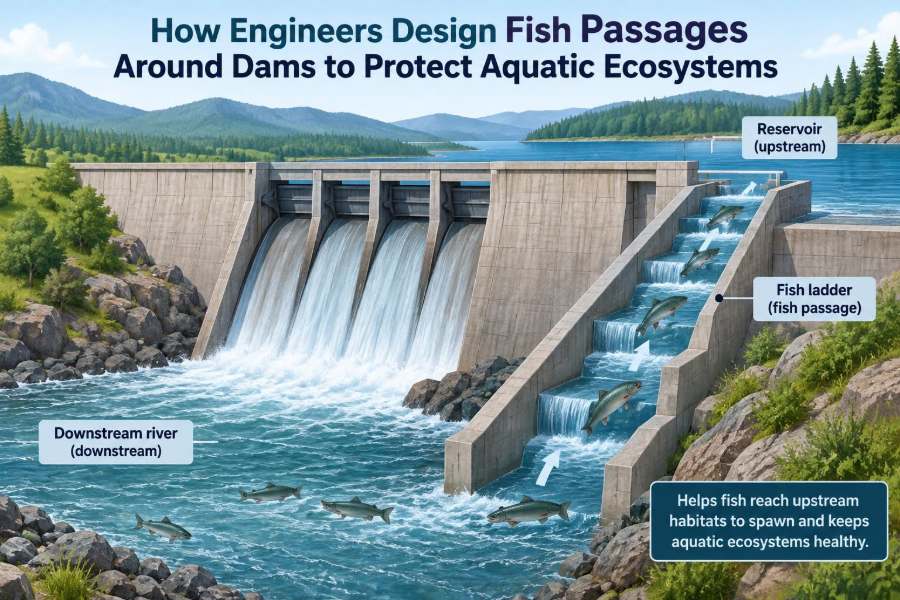

A river can look continuous on a map while being divided into separate worlds in reality. A dam may supply electricity, store water, reduce flood exposure, or support irrigation, yet it can also stop fish at the exact point where their life cycle depends on moving upstream or downstream.
For a migrating fish, a concrete wall is not simply an obstacle. It may block access to spawning gravel, cool upstream habitat, feeding areas, or refuge from seasonal heat. Downstream travel can be equally hazardous if fish are drawn toward turbines, spillways, or outlet works.
Fish passages are the engineered routes intended to restore that connection. They are often called fishways, fish ladders, fish lifts, or bypass systems, but their purpose is broader than helping fish “climb” around a dam.
Designing one successfully requires civil engineers to combine hydraulics, structures, geotechnics, ecology, operations, and monitoring. The central challenge is simple to state but difficult to solve: create a route that fish can find, enter, traverse, and survive under changing river conditions.
🐟 A Dam Changes More Than Water Level
Dams alter a river’s longitudinal connectivity: the ability of water, sediment, organisms, and nutrients to move along the channel. Fish that migrate between different habitats are especially affected, but resident species can also lose access to seasonal refuge and breeding areas.
The change is not limited to the structure itself. A reservoir slows water, modifies temperature and sediment behavior, while downstream releases can change flow timing, depth, and channel form. A fish passage addresses one major barrier, but it operates within this larger altered system.
🧭 Why Fish Need to Move
Not all fish migrate in the same way. Some move from the sea into freshwater to spawn, some travel downstream toward the sea, and others make shorter movements within a river network. Even species that never enter the ocean may need to reach tributaries during particular seasons.
Movement lets populations use different habitats as conditions change. A shallow floodplain may offer nursery habitat, deep pools may provide drought refuge, and upstream gravels may suit egg laying. Blocking these routes can isolate populations and reduce their resilience to floods, heat, and poor water quality.
🌊 Upstream and Downstream Passage Are Different Problems
Upstream passage asks whether fish can locate and ascend an alternate route. Downstream passage asks whether they can leave the reservoir or river reach without injury, delay, or being routed through unsafe infrastructure.
A project that provides an effective upstream fish ladder but no safe downstream route is incomplete for species that must make a return journey. Engineers therefore evaluate the full migration corridor, including the reservoir, dam, tailwater, tributary junctions, and receiving channel.
🔎 Start With the Species, Not the Structure
The familiar stepped fish ladder is not a universal answer. Passage design begins by identifying the fish expected at the site: their size, swimming ability, jumping behavior, preferred depths, migration season, sensitivity to turbulence, and tendency to travel alone or in schools.
These characteristics vary greatly. A passage suitable for strong, adult salmonids may be unsuitable for small-bodied species, bottom-oriented fish, or juvenile fish. Engineers work with fisheries biologists to define target species and life stages before selecting a concept.
- Which species and sizes must pass?
- When do they move, and under what flow or temperature conditions?
- Can they leap, burst-swim, or only sustain modest velocity?
- Do they follow the riverbed, bank, surface, or a particular flow cue?
📍 Define What “Successful Passage” Means
Success is more demanding than observing a few fish in a channel. A robust objective considers attraction, entry, ascent or descent, exit, survival, and delay. A route may be physically passable but still fail if fish cannot find its entrance or hesitate long enough to miss spawning conditions.
Objectives also need to reflect the project’s role. A site designed for a single focal species may use different criteria from a river restoration project intended to reconnect a diverse fish community. Clear objectives guide hydraulic modeling, layout decisions, and later monitoring.
🗺️ Read the River Before Drawing the Fishway
Site investigation maps the flow field around the dam. Engineers survey channel geometry, tailwater variation, banks, bed material, existing outlets, gates, and structures that could create competing currents or hazardous recirculation zones.
Seasonal hydrology matters as much as a single design flow. The tailwater below a dam can rise and fall as turbines operate, gates open, tributaries enter, or floods pass. A fishway entrance that is well positioned at one water level can become poorly connected at another.
🧲 Attraction Flow Helps Fish Find the Entrance
Fish often orient toward moving water, particularly the strong river-like current below a barrier. Attraction flow is water released or routed near a fishway entrance to create a detectable hydraulic cue that leads fish toward it.
The entrance cannot be hidden in stagnant water, behind a powerful competing discharge, or in an eddy that traps fish. Yet attraction flow must also avoid producing velocities or turbulence that the target species cannot negotiate. Its design is therefore a careful balance of visibility and passability.
🚪 Entrance Location Can Decide the Outcome
At a hydropower dam, fish may gather near turbine discharges because those flows dominate the tailwater. At a flood-control structure, fish may concentrate near gates or the former main channel. Locating the entrance where fish naturally search is usually more valuable than making the route visually prominent to people.
Multiple entrances may be justified where tailwater levels vary widely or flow patterns change between operating modes. The routes can join farther upstream, but each entrance must remain hydraulically usable and protected from debris.
🪜 Pool-and-Weir Fish Ladders
A pool-and-weir ladder divides an elevation change into a sequence of pools separated by walls. Water passes through notches, slots, or openings, and fish move from one pool to the next instead of confronting the dam’s full height in one effort.
The key variables are drop per pool, opening geometry, pool volume, velocity, turbulence, and resting opportunity. These systems can work well for species able to swim through concentrated flow, but overly high drops or energetic jets can exclude weaker swimmers.
↔️ Vertical-Slot Fishways
In a vertical-slot fishway, each cross-wall contains a slot extending through much of the water depth. This allows fish to pass at different depths and can tolerate some variation in upstream and downstream water levels.
The slot creates a jet, while the pool dissipates part of that energy before the next slot. Good layouts provide an identifiable route through the pools without generating chaotic flow that makes orientation difficult. Wall shape and baffle arrangement are as important as the nominal slot width.
🌿 Nature-Like Bypass Channels
A nature-like bypass channel routes water around the barrier through a constructed stream, often with varied bed material, bends, riffles, pools, and banks. It may resemble a small side channel rather than a conventional concrete fish ladder.
This approach can accommodate a broader range of species and can offer habitat value, but it requires space and a reliable water supply. Grade control structures, erosion protection, and sediment management are essential; a “natural-looking” channel is still an engineered hydraulic system.
🛗 Fish Lifts and Locks for Tall Barriers
Very high dams may be impractical to bypass with a long sloping channel. Fish lifts collect fish in a holding area and mechanically raise them to an upstream release point. Fish locks use chambers and controlled water levels to move fish through the elevation difference.
These systems can fit constrained sites, but they introduce operational dependence. Screens, crowding conditions, handling, lift timing, and reliability all influence performance. A lift is not passive infrastructure: staff, automation, inspections, and backup procedures are part of the design.
🌀 Fish-Friendly Turbines and Downstream Routes
Downstream migrants may pass through turbines, spillways, dedicated bypasses, surface collectors, or outlet structures. Each route presents different risks, including strike, pressure changes, shear zones, turbulence, predation, and delay.
Some turbine designs and operating practices can reduce injury risk for particular fish sizes and conditions, but they do not remove the need for site-specific assessment. Where possible, engineers use behavioral guidance, screens, and bypass flows to encourage fish toward safer routes before they reach intake entrances.
🧱 Screens Exclude Fish From Dangerous Intakes
Physical screens can prevent fish from entering turbines or other unsuitable outlets. Their effectiveness depends on bar spacing, approach velocity, screen angle, cleaning performance, and a nearby bypass that fish can actually locate.
A screen that is too fine may clog with leaves, ice, or debris and create unacceptable head loss. A screen that is too coarse may admit vulnerable fish. Design must account for hydraulic loading and maintenance access, not only biological intent.
💨 Velocity, Turbulence, and Fish Energy
Hydraulic design cannot be reduced to one allowable velocity. Fish experience local jets, eddies, acceleration, pressure gradients, and recirculating zones. A reach with an acceptable average velocity may still contain a barrier at a narrow slot or abrupt transition.
Engineers distinguish between sustained swimming capacity and short burst capability. Fish can sometimes cross a brief high-velocity zone, but repeated demands without rest can cause fatigue. Pools, low-velocity margins, and gradual transitions reduce the energetic burden.
🧪 Physical Models and Numerical Models
Scaled physical hydraulic models remain useful for complex entrances, spillway interactions, and turbulence-sensitive features. They allow engineers to observe flow paths, surface behavior, and local circulation that may be difficult to infer from drawings alone.
Computational fluid dynamics can examine velocity fields and alternative geometries in detail. However, model output is only as reliable as its assumptions, boundary conditions, and calibration. Neither a numerical image nor a small model substitutes for field observations of actual fish behavior.
🏗️ Structural Design in a Wet, Abrasive Environment
Fish passages must withstand hydrostatic loads, uplift, abrasion from sediment, debris impact, freeze-thaw exposure in cold regions, and repeated gate operation. Reinforced concrete is common, but construction joints, embedded rails, seals, and transitions need particular attention.
Structural details can affect biology. A protruding edge may create an unwanted jet, a damaged baffle can change pool hydraulics, and settlement can misalign slots. Civil, structural, and hydraulic design should be coordinated early rather than treated as separate packages.
🪨 Foundations, Seepage, and Slope Stability
Bypass channels and fishway structures often sit beside a dam on variable ground. Geotechnical investigations examine bearing capacity, settlement, rock quality, seepage paths, groundwater pressure, and the stability of adjacent slopes.
Water can undermine structures through erosion or piping, the internal removal of soil by seepage. Cutoffs, filters, drains, anchors, and erosion-resistant linings may be required. These components are largely invisible after construction, but they can determine whether the passage remains serviceable.
🌡️ Water Temperature and Water Quality
Fish migration is strongly influenced by temperature, dissolved oxygen, and water quality. Reservoir releases can differ from natural river conditions because water may be drawn from different depths, each with distinct temperature and oxygen characteristics.
A passage cannot compensate for unsuitable water conditions by itself. Designers assess whether the route will have adequate depth, oxygen exchange, and acceptable temperature conditions during the migration period. Stagnant zones and long holding areas deserve particular scrutiny in warm weather.
🪵 Sediment, Debris, and Ice Must Have Somewhere to Go
Rivers transport more than water. Floods can bring branches, trash, gravel, woody debris, and ice, all of which can block entrances or damage screens. Sediment can fill resting pools, bury roughness features, and alter the intended channel slope.
Designers include access for raking, flushing, inspection, and repair. In a nature-like channel, sediment movement may be part of the intended process, but the channel still needs a strategy for preventing progressive blockage or erosion at control structures.
⚙️ Dam Operations and Fish Passage Must Work Together
A fishway is tied to dam operations. Turbine dispatch, spill schedules, gate openings, reservoir drawdown, and flood releases can all change the hydraulics that guide fish. Operating rules should identify conditions when passage routes are available and how competing flows are managed.
This can involve trade-offs. Water allocated to attraction flow may have an energy or water-supply value, while spill adjustments may affect other objectives. Transparent operating plans help operators make consistent decisions when river conditions are changing quickly.
📏 Design for a Range of Water Levels
Passages are sometimes designed around a preferred flow and then perform poorly outside it. A more resilient approach evaluates the expected operating envelope: low flow, typical migration flow, high tailwater, partial turbine operation, and relevant flood conditions.
Adjustable gates, multiple entrances, control sections, and carefully selected elevations can extend the usable range. Flexibility has a cost, but it can prevent a facility from becoming ineffective during the very seasonal windows when fish need it most.
👷 Construction Sequencing Protects the River
Building beside or within a river may require cofferdams, dewatering, diversion, temporary access roads, and work windows that limit disturbance during sensitive migration or spawning periods. Construction planning should address fish rescue, turbidity control, erosion prevention, and safe public access.
Temporary works deserve the same engineering discipline as permanent works. A poorly planned diversion can create abrupt velocities, stranded fish, sediment releases, or flood vulnerabilities, even when the finished passage is well designed.
📡 Monitoring Reveals Whether the Design Works
Monitoring is how engineers learn whether fish passage assumptions were correct. Depending on the site, methods may include visual counts, video, tagging and tracking, antennas that detect tagged fish, sonar, trap data, and hydraulic measurements.
Useful monitoring asks practical questions: Are fish reaching the entrance? How long do they delay? Which flow conditions improve entry? Are certain sizes or species excluded? Are downstream fish using the intended bypass? Observations should inform operational and physical adjustments.
🔧 Adaptive Management Turns Evidence Into Improvements
Fish passage projects often need refinement after commissioning. An entrance may be moved, attraction flow adjusted, a baffle reshaped, lighting reduced, debris management improved, or an operating schedule changed based on field evidence.
This is adaptive management: treating monitoring as a decision tool rather than a final report. It does not excuse weak initial design; instead, it recognizes that living systems and variable rivers contain uncertainty that should be planned for.
⚠️ Common Mistakes That Undermine Fishways
Many failures arise at the interfaces between disciplines. A structurally sound passage can fail biologically, while an ecologically appealing concept can fail because it cannot survive floods or be maintained.
- Copying a standard layout without confirming target species and local flow conditions.
- Underestimating tailwater variation, leaving entrances poorly submerged or difficult to find.
- Ignoring downstream passage while focusing only on adults moving upstream.
- Designing without maintenance access for screens, sediment, gates, and debris.
- Assuming hydraulic passability equals biological use without monitoring actual movement.
🤝 Collaboration Is a Design Requirement
No single discipline can deliver an effective fish passage alone. Civil and hydraulic engineers shape the flow path and structures; geotechnical engineers address ground and seepage; biologists define ecological needs; operators explain real operating constraints; and maintenance teams identify what can be kept functional.
Early collaboration reduces expensive redesign. For example, a biologist may identify a migration period that changes the design flow case, while operators may reveal a daily tailwater pattern that requires a different entrance arrangement.
🌍 Fish Passage Is Part of River Connectivity
Passage infrastructure should be considered alongside habitat restoration, environmental flows, sediment management, water-quality improvements, and barrier removal where feasible. A fishway cannot restore habitat that has disappeared upstream, nor can it solve poor conditions throughout a watershed.
Still, reconnecting a barrier can be a meaningful step when the upstream network contains usable habitat and the dam remains necessary. The best choice depends on the river, the dam’s purpose, the species present, and the practical alternatives available.
🧠 The Core Principle: Design the Whole Journey
Effective fish passage is not a concrete chute attached to a dam. It is a connected system that begins where fish approach the structure and ends where they safely re-enter suitable habitat. Finding the route, passing through it, and surviving the trip are equally important.
The most reliable designs combine site-specific ecology with disciplined hydraulic and civil engineering. They account for changing flows, constructability, operations, maintenance, and monitoring from the beginning rather than adding those considerations after the main structure is complete.
When engineers design for the fish’s entire journey instead of only the dam’s obstacle, infrastructure can serve human needs while preserving a river’s essential connections. 🌊🐟🌉