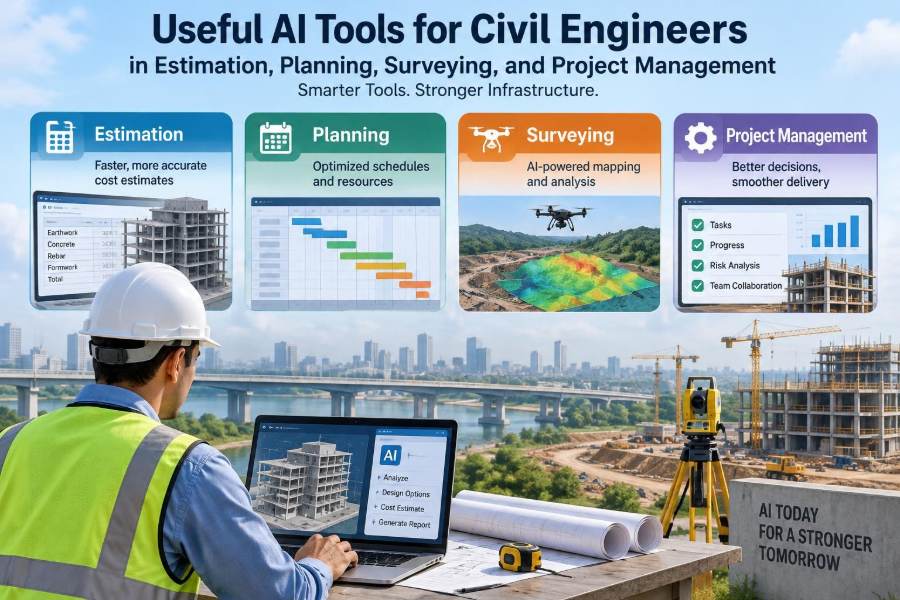

A quantity take-off is due before lunch, the programme has slipped after a late drawing revision, and a site team is waiting for clarification on an excavation level. None of these problems is unusual in civil engineering. What changes is the volume of information a small team must process to respond well.
Artificial intelligence can help with parts of that workload: reading repetitive documents, finding patterns in project records, drafting first versions, sorting field evidence, or flagging mismatches for review. It can turn a tedious first pass into a faster one.
But a tool that produces a neat spreadsheet or a confident answer has not necessarily produced a correct engineering decision. Civil work still depends on verified drawings, sound assumptions, competent measurement, contractual awareness, and professional judgement.
The most useful question is therefore not, “Which AI will replace the engineer?” It is, “Which tasks can AI accelerate while leaving the engineer firmly responsible for checking the result?”
🏗️ What AI Means in a Civil Engineering Workflow
In day-to-day practice, AI usually means software that can recognize patterns, interpret language, classify images, predict outcomes from data, or generate text and calculations from instructions. It is not one single product or method.
A useful distinction is between generative AI, which creates a draft response, summary, image, or code, and predictive AI, which estimates a likely outcome from historical or live data. A chatbot may help draft an RFI, while a predictive model may highlight a risk of programme delay.
🧭 Start With a Problem, Not a Tool
Buying or subscribing to an AI tool because it is fashionable rarely fixes a project problem. Start with a recurring bottleneck: slow measurement of standard items, inconsistent daily reports, unstructured drone imagery, or difficult retrieval of old correspondence.
Describe the current process, its inputs, the required output, and the person who verifies it. If the task is already unclear or poorly documented, AI may simply produce unclear results faster.
🔍 The Human Engineer Remains Accountable
AI can assist an estimator, planner, surveyor, or project manager. It cannot assume professional responsibility for quantities, design intent, safety decisions, payment recommendations, or construction methods.
Outputs should be treated as drafts, prompts for investigation, or decision support. Before using them in a tender, report, programme, or site instruction, a competent person must check the source data, assumptions, units, scope, and contractual implications.
📄 Document Intelligence for Drawing Sets
Document-intelligence tools can search, categorize, extract text, and compare revisions across large sets of PDFs, specifications, schedules, and correspondence. This is particularly useful when information is scattered across many files.
For example, a tool may identify every reference to a retaining wall, concrete grade, or access constraint. That speeds up review, but it does not confirm that the tool read a scanned note correctly or understood the hierarchy of contract documents.
📏 AI-Assisted Quantity Take-Off
Some estimating platforms use drawing recognition to identify walls, doors, slabs, pipes, or repeated symbols and suggest measured quantities. For conventional, clearly drawn elements, this can reduce the time spent tracing similar items manually.
It is less reliable where drawings are incomplete, symbols vary, hatch patterns are ambiguous, or the quantity depends on construction detail rather than visible geometry. A foundation excavation, for example, may require allowances for working space, slopes, dewatering, or support that cannot be inferred safely from a plan alone.
🧮 Turning Drawings Into a Checkable Estimate
The value of AI take-off is not merely speed; it is the chance to create a more traceable review process. Good workflows retain links between measured items and their drawing locations.
- Check drawing scale, revision, and coordinate units before measurement.
- Compare AI-suggested quantities with a manual sample from representative areas.
- Separate measured quantities from assumptions, waste factors, and temporary works allowances.
- Record exclusions and unresolved design information clearly.
An estimate is defensible when another engineer can retrace how it was built.
💰 Cost Databases Need Local Judgement
AI can help organize historic bid data, group similar cost items, and create first-pass rate build-ups. It may also identify unusual rates that deserve a second look.
Rates are highly context-dependent. Labour productivity, haul distance, ground conditions, supplier availability, specification requirements, access, currency, and market timing can all change the cost of apparently similar work. A historical rate is evidence, not a promise.
🧱 Scope Gaps Are More Dangerous Than Fast Arithmetic
Most estimating failures do not arise because multiplication was slow. They arise because something was omitted, counted twice, assigned to the wrong trade, or priced without its enabling works.
Use an AI assistant to create a scope-review checklist from drawings and specifications, then challenge it against the actual procurement package. Consider interfaces such as testing, traffic management, disposal, permits, utility protection, temporary drainage, and reinstatement.
📊 Spreadsheet Assistance Without Blind Trust
AI features in spreadsheet software can suggest formulas, explain tables, classify data, and help create summaries. They are useful for cleaning inconsistent item descriptions or creating a first draft of a cost report.
Yet a formula can be syntactically valid and still be wrong. Protect key cells, show units in headings, use independent checks, and inspect ranges after any automated modification. A missing row in a subtotal is not made safer by an elegant dashboard.
🗓️ Building a Logical Baseline Programme
Planning tools can use AI to suggest activity groupings, summarize constraints, or identify patterns in previous programmes. They can give a planner a structured starting point for a work breakdown structure.
A baseline programme still needs real logic: predecessor relationships, calendars, resources, approvals, procurement lead times, access restrictions, testing, and handover conditions. The critical path is only meaningful when the logic and durations reflect an achievable construction sequence.
🔗 Checking Programme Logic and Constraints
AI can scan schedule data for missing predecessors, unusually long activities, excessive lags, or activities with no successors. These are useful warning flags, especially in large schedules.
Flags are not automatic corrections. A long activity could conceal several measurable operations, while an unusual relationship may reflect a genuine site constraint. The planner must ask whether each link describes physical reality, contractual control, or simply a convenient chart.
🌦️ Forecasting Delay Risk Carefully
Predictive models can combine progress records, planned production, weather data, inspection status, and procurement information to identify activities that may be at risk. This can help teams focus meetings on emerging issues rather than only past delay.
Predictions are weakest when the data is sparse, inconsistent, or drawn from projects unlike the current one. Weather-sensitive earthworks on a coastal project, for example, cannot be evaluated well using generic production history alone.
🚧 Short-Interval Planning From Site Evidence
Daily diaries, photographs, delivery records, plant logs, and field forms often contain useful operational information but are difficult to consolidate. AI can summarize repeated observations and extract recurring constraints such as late deliveries or access conflicts.
The result should support the next coordination meeting: what was planned, what was achieved, what blocked progress, and what must happen next. It should not replace direct discussion with foremen and crews, who understand conditions that a written record may miss.
🛰️ AI in Drone and Aerial Surveying
Photogrammetry software converts overlapping aerial images into maps, point clouds, or surface models. AI-assisted image processing may classify visible features and help identify stockpiles, roads, vegetation, or disturbed ground.
This is valuable for progress records and broad site measurement. It does not eliminate the need for ground control, suitable flight planning, camera calibration, accuracy checks, permissions, and safe operating procedures.
📍 Ground Control Determines Survey Confidence
A detailed-looking orthomosaic can still be poorly positioned or scaled. Ground control points are surveyed reference markers used to tie aerial data to a known coordinate system; independent check points help test the result.
Before using an AI-derived surface for payment, earthwork balancing, or setting-out decisions, verify its datum, coordinate reference system, vertical control, point density, and stated accuracy. Visual quality is not a measurement certificate.
🌍 Point Clouds and Feature Classification
Laser scanning and mobile mapping can create dense point clouds containing millions of measured points. AI classification can label likely ground, structures, utilities, vegetation, or vehicles, making large datasets easier to manage.
Classification errors are common near edges, shadows, reflective surfaces, clutter, and partially hidden features. A pipe partly obscured by spoil may be missed; a temporary object may be labelled as permanent. Inspect critical features in the original data.
⛏️ Earthworks Models Need Engineering Assumptions
AI can assist with comparing terrain models, calculating cut and fill volumes, and highlighting areas where actual and design surfaces differ. These capabilities are useful for monitoring bulk earthworks.
Volume results depend on surface boundaries, grid or triangulation method, void handling, material swell and shrinkage assumptions, and whether unsuitable material is included. The model must match the commercial or construction question being asked.
👷 Computer Vision for Site Progress
Computer vision analyzes photographs or video to detect visible objects, activities, or changes. It can help organize thousands of site images and compare repeated views of a work area over time.
A photograph shows what was visible from one angle at one moment. It may not reveal reinforcement cover, compaction quality, hidden services, concrete strength, or whether an activity meets specification. Visual detection is useful evidence, not final quality acceptance.
🦺 Safety Observations Require a Responsible Process
Some systems can flag apparent missing personal protective equipment, people near plant, or entry into defined zones. These alerts may help safety teams review a large volume of imagery.
They must be implemented carefully. Camera angle, lighting, occlusion, local PPE rules, privacy expectations, and false alerts all affect results. A safety observation should lead to human review and constructive intervention, not automated blame.
📝 Meeting Minutes, RFIs, and Daily Reports
Language models are particularly helpful for drafting routine project communication. Give the tool structured notes and ask it to prepare concise meeting minutes, an RFI draft, a daily report summary, or an action register.
Check names, dates, commitments, technical statements, and tone before circulation. A draft that invents a decision or changes a qualified statement into a firm instruction can create avoidable conflict.
📬 Finding Decisions in Project Correspondence
Project managers often need to locate a decision made months earlier in email threads, transmittals, and meeting records. Search and summarization tools can cluster related correspondence and surface references to a topic.
Always open the source record. A summary can miss conditions, attachments, or later reversals. For contractual matters, the relevant question is not merely what a tool summarized, but what the authoritative communication actually says and when it was issued.
🏢 BIM, Digital Twins, and Connected Data
Building information modelling (BIM) provides structured digital information about assets and construction elements. AI can help check model completeness, identify inconsistent naming, classify objects, or connect model data to schedules and field records.
A digital twin is more than a 3D model: it is a digital representation connected to relevant real-world information. It becomes valuable only when its data is current, governed, and tied to operational decisions rather than used as an attractive visual display.
🔄 Interoperability Is Often the Real Challenge
Estimating, planning, survey, design, and document-control systems may use different formats, IDs, coordinate systems, and naming rules. AI cannot reliably join disconnected data if the underlying project information is inconsistent.
Set common conventions early for file names, revision status, work packages, location codes, asset IDs, units, and coordinate reference systems. Clean data is the foundation that makes advanced analysis useful.
🔐 Protect Confidential Project Information
Drawings, bids, commercial records, site photographs, and personal information may be confidential. Before uploading anything to an AI service, understand who can access it, where data is stored, whether it is retained, and whether it may be used to improve a provider’s systems.
Follow organizational policy and contractual obligations. Where uncertainty exists, use approved enterprise tools, remove sensitive details, or avoid external processing until the data-handling position is clear.
⚠️ Hallucinations, Bias, and False Precision
A generative AI system can produce a plausible answer with incorrect facts, invented references, or unsuitable technical advice. This behaviour is often called a hallucination. It is especially risky when answers contain standards, specifications, quantities, or legal and contractual interpretations.
Ask for the source document or calculation basis, not just a conclusion. If a response cannot be traced to a verified source, treat it as a lead for research rather than information ready for project use.
✅ A Practical Verification Routine
A simple review routine prevents many errors from reaching the project record.
- Confirm the source files, revisions, units, and data date.
- State the task, scope boundaries, and assumptions clearly.
- Test the output on a small sample with a known answer.
- Check unusual values manually and compare with independent evidence.
- Record the reviewer, changes made, and final approved result.
This creates an audit trail and helps teams learn where a tool is dependable and where it needs close supervision.
🎓 Skills Civil Engineers Should Build
Engineers do not need to become data scientists to use AI well. They do need data literacy: understanding data quality, basic statistics, uncertainty, spatial reference systems, databases, and the difference between correlation and cause.
Clear prompting also matters. A good request identifies the source material, desired format, limits, assumptions, audience, and checks required. Specific instructions produce more reviewable drafts than broad requests such as “analyse this project.”
🧪 Pilot Small Before Changing a Whole Process
Choose one repeatable use case, such as extracting action items from meeting notes or classifying standard drawing elements. Define what “better” means: reduced preparation time, fewer missed actions, more consistent coding, or faster retrieval of records.
Run the pilot alongside the established method for a period. Compare outputs, document failure modes, and adjust the workflow before relying on it for a major tender or critical construction decision.
🧰 A Sensible Tool Selection Checklist
When evaluating an AI-enabled platform, focus on fit rather than impressive demonstrations.
- Does it work with the team’s actual drawings, models, survey files, and project systems?
- Can users export data and retain a reviewable audit trail?
- Are accuracy limits and confidence indicators explained?
- Does the provider’s data policy meet project requirements?
- Can field and office staff realistically learn the workflow?
- What happens when the tool is unavailable or produces a questionable result?
The best tool is often the one that improves a narrow process reliably, not the one that claims to automate every discipline.
🤝 Better Decisions Through Human-AI Collaboration
AI is strongest at processing volume and repetition. Engineers are strongest at interpreting context: ground behaviour, constructability, stakeholder priorities, contractual nuance, safety consequences, and the practical realities of a live site.
A productive workflow combines both. Let software organize evidence and identify possible issues; let qualified people validate, explain, decide, and communicate the action.
🌉 The Core Principle for Responsible Adoption
AI can reduce administrative friction across estimation, planning, surveying, and project management. It can help teams get to the right questions sooner, preserve knowledge more effectively, and spend more time on engineering judgement.
Its output becomes valuable only when it is traceable to reliable inputs and reviewed in the context of the actual project. Treat AI as a capable assistant with clear limits, not as an authority that can replace measurement, verification, or accountability.
The practical advantage comes from combining faster digital assistance with disciplined engineering review. Used this way, AI can support better prepared teams without weakening the standards that civil infrastructure demands. 🌉📐🤝