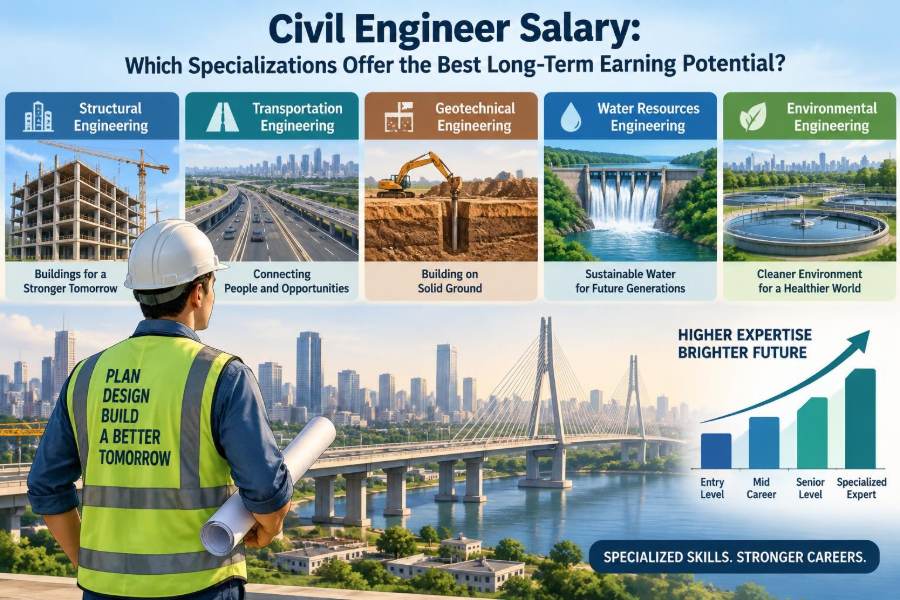

A civil engineering graduate may start by comparing offers for a site engineer, a design engineer, and a transportation planner. The advertised salaries can look close enough that the decision seems simple: take the highest number.
Several years later, the picture is usually more complicated. One engineer may be managing construction risk on a major project, another may have become a licensed specialist in water systems, and a third may have moved into digital delivery or public infrastructure leadership.
Salary in civil engineering is not determined by discipline alone. Location, professional licensure, project scale, market cycle, employer type, and the ability to carry responsibility all change the result.
Still, specialization matters because some fields consistently place engineers near high-value assets, complex regulation, scarce technical expertise, or large capital programs. Understanding that relationship helps students choose deliberately and helps working engineers plan their next move.
🧭 What “Earning Potential” Actually Means
A high starting salary and high long-term earning potential are not the same thing. Starting pay reflects the immediate market for junior staff, while long-term pay reflects how much responsibility, technical scarcity, and business value an engineer can build over time.
For this discussion, earning potential includes base salary, overtime or site allowances where applicable, bonuses, benefits, consulting income, and the opportunity to advance into management, ownership, or specialist advisory work. The mix varies substantially between countries and employers.
📍 Why Salary Data Needs Local Context
Salary figures are highly location-dependent. A role in a major metropolitan area may pay more in nominal terms but also involve much higher housing, transport, taxes, or commuting costs.
Licensing rules, public-sector pay structures, infrastructure spending, and labor agreements also differ by jurisdiction. Use broad salary comparisons to identify patterns, then verify current local openings, professional body guidance, and employer information before making a decision.
⚖️ The Four Forces Behind Higher Pay
Specializations tend to command stronger compensation when they combine several forces: difficult technical work, meaningful consequences if work fails, limited supply of qualified practitioners, and clients with major project budgets.
- Complexity: advanced analysis, uncertain ground conditions, demanding interfaces, or unusual materials.
- Accountability: decisions affecting public safety, approvals, schedules, or major financial risk.
- Scarcity: skills that require years of supervised work, credentials, or niche experience.
- Capital intensity: projects involving expensive assets, construction packages, or regulated operations.
No discipline automatically has all four. A capable engineer can earn very well in a less glamorous field by becoming the person clients trust with difficult decisions.
🏗️ Construction Engineering and Project Delivery
Construction engineering can offer strong earnings because engineers work close to cost, schedule, procurement, productivity, safety, and claims. A small improvement in sequencing or a timely response to a site problem can protect a large amount of project value.
As responsibility grows, roles such as project engineer, construction manager, package manager, and project director can pay well, particularly on complex civil works. The trade-off is often long hours, site travel, intense deadlines, and exposure to cyclical construction markets.
📊 Why Commercial Skills Raise Construction Pay
Technical site knowledge becomes more valuable when paired with commercial judgment. Engineers who can read a contract, track change orders, understand quantities, and communicate a defensible time impact are useful far beyond routine supervision.
This does not mean turning into a lawyer or accountant. It means understanding how a design change becomes a cost, a delay, a record, and eventually a client decision. These skills can open paths into project controls, contract administration, and senior delivery leadership.
🪨 Geotechnical Engineering and Subsurface Risk
Geotechnical engineers deal with the ground beneath every structure, roadway, embankment, excavation, tunnel, and retaining wall. Ground conditions are inherently variable, so their work involves interpreting incomplete evidence and managing uncertainty.
Complex foundations, deep excavations, slopes, seismic design, mining interfaces, and underground construction can create strong demand for experienced specialists. Errors can be expensive and disruptive, which is why credible judgment developed through site observation and analysis is highly valued.
🔬 The Geotechnical Experience Curve
Geotechnical compensation often rises noticeably with experience because judgment cannot be learned only from software outputs. Engineers must connect borehole logs, laboratory data, groundwater behavior, construction methods, and observed field performance.
A junior engineer may prepare calculations under review; a senior engineer may decide whether the available investigation is adequate for a critical design decision. That progression makes mentoring, field exposure, and professional sign-off especially important in this specialization.
🌊 Water Resources and Flood Resilience
Water resources engineers design and assess drainage networks, rivers, dams, stormwater systems, flood defenses, and hydraulic structures. Demand is supported by urban growth, aging infrastructure, watershed management, and the need to account for changing rainfall and flood conditions.
Higher-value opportunities often sit at the intersection of modeling, regulation, and public infrastructure planning. Engineers who can explain model uncertainty clearly to planners, agencies, and communities bring value that extends beyond producing a hydraulic model.
🚰 Water and Wastewater Treatment
Water and wastewater engineering can offer durable career prospects because treatment plants and networks are essential public assets. The field requires process understanding as well as civil design, including pumping, storage, pipelines, residuals handling, and operational reliability.
Pay may not always have the dramatic project premiums seen in certain heavy-construction roles, but utility and environmental infrastructure work can provide long project pipelines and meaningful technical progression. Operational knowledge is particularly valuable because designs must work reliably every day, not only on paper.
🚇 Transportation and Major Mobility Programs
Transportation engineers work on roads, railways, airports, ports, bridges, traffic operations, and active travel networks. Major programs involve extensive coordination: geometry, structures, drainage, utilities, land, construction staging, environmental approvals, and public stakeholders.
Senior compensation can be attractive where there is sustained investment in large transport programs. Engineers who understand both design standards and constructability are well positioned, especially when they can manage multidisciplinary interfaces without losing sight of safety and network performance.
🌉 Structural Engineering: High Skill, Varied Markets
Structural engineering is intellectually demanding and central to the built environment, but its pay varies widely by sector. Routine building design in a competitive market may have different salary growth than bridge design, industrial facilities, offshore structures, or specialist assessment work.
Long-term earnings improve when a structural engineer develops a clear niche: seismic design, strengthening, temporary works, complex analysis, materials rehabilitation, or independent checking. Professional accountability is high, so strong peer review habits matter as much as analytical ability.
⚡ Energy Infrastructure and Civil Works
Energy projects need civil engineers for sites, foundations, roads, drainage, substations, transmission corridors, ports, storage facilities, and environmental controls. Renewable energy, grid upgrades, conventional generation, and industrial energy projects each create different forms of demand.
These roles can pay competitively because schedules are commercially significant and work often occurs in remote or logistically difficult locations. Engineers should weigh compensation against travel demands, project volatility, and whether their experience will transfer easily across sectors.
🏭 Industrial, Mining, and Heavy Civil Projects
Industrial plants, mining facilities, marine terminals, and large process sites can reward engineers who understand difficult construction environments. Civil scope may include earthworks, foundations, water management, materials handling infrastructure, and site development.
Higher pay may reflect remote work, rotational schedules, safety-critical operations, and substantial capital exposure. These positions are not automatically preferable: commodity markets and project approvals can create abrupt changes in hiring, so transferable design and delivery skills remain essential.
🌱 Environmental Engineering and Permitting Expertise
Environmental civil engineering covers areas such as contaminated land, erosion and sediment control, waste facilities, environmental compliance, and permitting support. Compensation is strongest when an engineer can solve technical problems while navigating the approval pathway that determines whether a project can proceed.
Regulatory expertise can be a durable differentiator, but rules are jurisdiction-specific. Engineers should avoid becoming narrowly dependent on one approval process unless they also maintain broadly useful technical capabilities.
🏙️ Land Development and Urban Infrastructure
Land development engineers design grading, local roads, utilities, drainage, and servicing for housing, commercial, and mixed-use projects. The work builds broad coordination skills because it touches architects, planners, surveyors, utilities, contractors, and local authorities.
Pay can be very strong in active development markets, particularly for engineers who manage clients and approvals. It can also be sensitive to interest rates, financing conditions, and development cycles, making it wise to develop skills usable in municipal or infrastructure work as well.
🛰️ Digital Delivery, BIM, and Civil Data Skills
Building information modeling, digital twins, geographic information systems, automation, and data management are changing how civil projects are coordinated and operated. These tools do not replace engineering judgment, but engineers who use them to reduce rework and improve decisions can become unusually valuable.
The best-paid digital roles usually combine technology with domain expertise. Knowing a software package is useful; knowing how to set up reliable models, information requirements, quality checks, and workflows for a real infrastructure project is much more valuable.
🧮 Project Controls, Planning, and Claims
Project controls professionals forecast cost and schedule performance, manage progress data, and identify emerging risk. Claims and dispute work examines how events, instructions, delays, and records affect contractual rights and project outcomes.
These paths can offer strong long-term compensation because they sit close to commercial decisions. However, credibility depends on rigorous documentation, realistic scheduling logic, and impartial analysis. A claims role is not simply arguing for one side; weak analysis damages professional reputation quickly.
🛡️ Public-Sector Engineering Versus Consulting
Public agencies, municipalities, and utilities may provide structured progression, predictable benefits, and direct stewardship of long-lived assets. Consulting firms can offer faster exposure to varied projects, client development, and specialist technical tracks.
Neither route is universally higher paid. A public engineer who becomes a technical authority or program leader may have an excellent career, while a consultant may gain more upside through project leadership or ownership. Compare the full package, workload expectations, and learning environment rather than base salary alone.
🏢 Contractor, Designer, and Owner Roles
Design consultants focus on analysis, design documentation, coordination, and advice. Contractors focus on means and methods, production, procurement, and delivery. Owners and developers focus on asset outcomes, budget, procurement strategy, and long-term operations.
Moving between these sides can increase earning potential because it broadens perspective. A designer who understands construction sequencing produces more practical documents; a contractor who understands design intent can manage risk more effectively. The transition may require patience while learning a new commercial language.
📜 Licensure and Professional Responsibility
Professional licensure or chartership, where applicable, is often a significant salary milestone. It can expand the work an engineer may lead, sign, review, or take responsibility for, and it signals that a recognized standard of experience and ethics has been met.
Credentials alone do not guarantee higher pay. Their value is greatest when paired with demonstrable competence, sound judgment, and the ability to communicate risk. Start recording projects, decisions, lessons learned, and supervisory experience early so the application process is less stressful later.
🧰 Technical Depth Versus Management Breadth
Many engineers assume management is the only route to high earnings. Management can broaden influence, but specialist expertise can be equally valuable when it addresses difficult problems that few others can solve.
A useful question is whether you enjoy becoming accountable for people, budgets, clients, and competing priorities, or whether you prefer solving the hardest technical questions. The strongest careers often develop both: a technical foundation first, followed by enough leadership skill to guide decisions.
🗣️ Communication Is a Salary Skill
Civil engineering decisions are rarely made by calculations alone. Engineers must explain constraints to clients, translate risk for non-specialists, write clear reports, and resolve disagreements among disciplines.
Clear communication reduces the chance that a good analysis is misunderstood or ignored. It also makes an engineer more ready for client-facing roles, design review, negotiation, and leadership. Writing one concise, well-reasoned technical note can sometimes have more impact than producing another complicated spreadsheet.
🎯 Choosing a Specialization Without Chasing a Number
Choose a field by looking for the overlap between market demand, your aptitudes, and work you can sustain for years. Someone who dislikes travel may struggle in a highly paid remote construction role; someone who enjoys field investigations may find a desk-only role limiting.
- Review local job descriptions, not only graduate salary summaries.
- Ask what senior engineers in the field actually do each week.
- Look for recurring project types and infrastructure investment in your region.
- Test your interest through internships, site visits, electives, or short assignments.
- Consider lifestyle costs: travel, overtime, professional development, and relocation.
🪜 A Practical Early-Career Strategy
During the first few years, prioritize work that creates a strong evidence base: field experience, calculations you understand, drawings you can explain, reports with clear recommendations, and exposure to construction or operations.
Seek feedback from engineers whose judgment you respect. Rather than trying to specialize immediately in a very narrow topic, build durable fundamentals in design standards, soil or material behavior, hydraulics, construction methods, and quality assurance. Depth is easier to build on a broad, solid base.
🚫 Salary Decisions That Commonly Backfire
The most common mistake is choosing a role solely for a short-term pay premium while ignoring learning quality, supervision, safety culture, and future mobility. A poorly supported role can slow development even if the first offer looks attractive.
Another mistake is treating a job title as a precise description of work. “Project engineer” can mean junior coordination in one company and major delivery responsibility in another. Ask about project type, decision authority, mentoring, workload, and how performance is evaluated.
🔄 How to Pivot Into a Better-Paying Niche
A pivot is easier when framed as a bridge, not a restart. For example, a drainage designer can move toward flood resilience; a site engineer can move into project controls; a structural engineer can build expertise in temporary works or rehabilitation.
Identify the missing evidence for the target role, then pursue it through a project assignment, targeted course, software training, professional committee, or mentor. Be realistic about the entry point: a new niche may require accepting a lateral move before it produces a salary increase.
📈 Building Value That Compounds Over Time
Long-term earning potential compounds when each role adds a capability that makes the next role more valuable. Technical competence, site understanding, licenses, commercial awareness, client trust, and leadership do not develop at the same speed, but they reinforce one another.
Keep a private record of problems solved, quantities or budgets managed, risks reduced, approvals obtained, and lessons learned. This is useful for interviews, performance reviews, licensure applications, and recognizing where your real strengths are developing.
🔑 The Core Principle for Civil Engineering Pay
The highest-paying specialization is not a fixed ranking. It depends on the local market and on whether you become capable of carrying meaningful responsibility in that field.
Construction delivery, geotechnical engineering, water systems, transportation, energy infrastructure, digital delivery, and project controls can all lead to strong earnings. Their common feature is not a particular job title; it is the ability to reduce uncertainty, protect value, and help complex projects move forward safely.
The most durable route to higher civil engineering earnings is to develop scarce, trusted capability at the point where technical decisions, project risk, and real-world delivery meet. Choose a direction that fits your strengths, build evidence of sound judgment, and let responsibility—not hype—guide your career choices. 🌉📐🚧