
Most drivers know the frustration: the road ahead is clear, yet the signal remains red. A few blocks later, a queue forms at a green light because the downstream intersection is already full. These moments can make an urban street network feel oddly irrational.
Traffic signals are not simply timers mounted above an intersection. They are control devices managing competing movements: pedestrians crossing, buses stopping, cyclists entering, emergency vehicles approaching, and streams of vehicles arriving unevenly throughout the day.
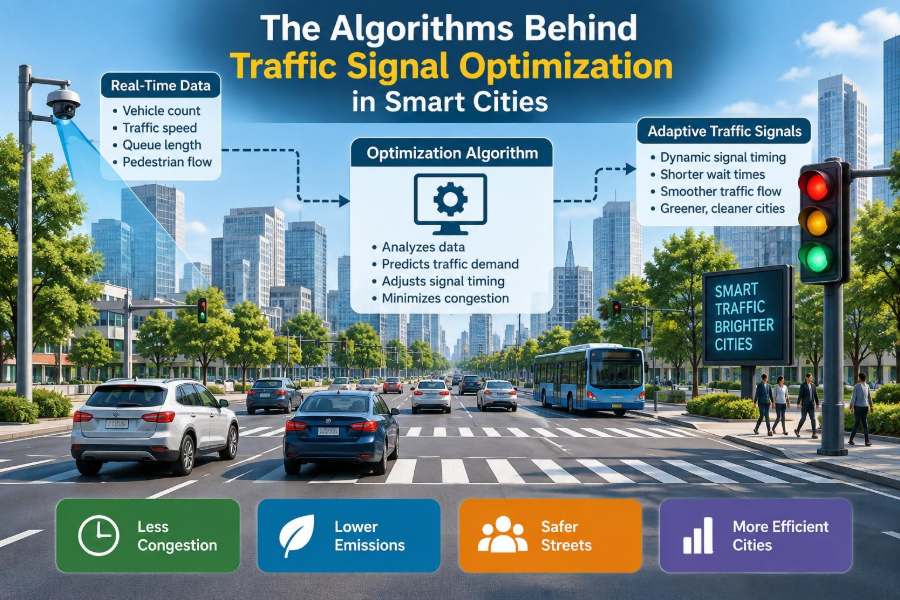
In a smart city, algorithms help turn observations from the street into timing decisions. Their purpose is not to make every driver happy at every instant; that is impossible where movements conflict. The purpose is to use limited road space more safely, predictably, and efficiently.
For civil engineers, understanding the logic behind signal optimization matters because the best algorithm cannot repair a poorly designed junction, missing pedestrian facilities, or a network with no realistic capacity. Good outcomes come from combining traffic engineering judgment with reliable data and carefully chosen control methods.
🚦 What Traffic Signal Optimization Actually Means
Traffic signal optimization is the process of selecting signal timings and control rules that serve defined operational goals. Those goals may include reducing delay, limiting queues, improving transit reliability, lowering stop-and-go movement, or protecting pedestrian crossing opportunities.
It is not identical to maximizing vehicle speed. A corridor that moves cars quickly in one direction may create excessive delay for side streets, people walking, or buses. Optimization therefore begins with a policy choice: who should receive priority, when, and under what constraints?
🧭 The Intersection as a Competing-Movements Problem
An intersection is a small but complex scheduling problem. A northbound left turn may conflict with opposing through traffic; a pedestrian crossing may conflict with a permissive turn; two non-conflicting movements may be served together.
Signal algorithms arrange these movements into phases. A phase is the portion of a cycle that gives right-of-way to a compatible set of movements. The controller must sequence phases without creating unsafe conflicts or starving a movement that has been waiting too long.
📏 The Basic Timing Variables
Several variables define a conventional traffic signal plan. The cycle length is the time required to complete all phases once. A green split is the portion assigned to a phase, while an offset aligns the start of cycles between neighboring intersections.
Yellow change intervals and all-red clearance intervals provide transition time between conflicting movements. These are safety-critical values, not spare seconds available for optimization. An algorithm should adjust usable green time around them, not casually reduce them to gain capacity.
⏱️ Why Fixed-Time Signals Still Have a Place
Fixed-time control follows a preplanned schedule. It may use one plan for a morning peak, another for midday, and a different plan for evening conditions. The controller repeats the same cycle even if individual arrivals vary.
This approach is practical where demand is stable, detection is limited, and predictability is valued. It is also easier to review and maintain. Its weakness appears when traffic differs sharply from the assumptions behind the plan, such as after an event, incident, or sudden weather change.
📡 The Data That Makes Signals Responsive
Responsive control depends on observations of demand. Sensors may indicate whether a vehicle is present, estimate vehicle counts, measure occupancy, identify queues, or detect pedestrians requesting a crossing.
Common sources include inductive loops in pavement, video detection, radar, thermal sensors, and connected-vehicle messages where available. Each has limitations: cameras can be affected by glare or obstruction, loops can fail after pavement work, and connected data may represent only part of the traffic stream.
🔍 Detection Is Not the Same as Understanding
A detector reporting a vehicle near the stop line does not automatically reveal the full queue behind it. Likewise, a high occupancy reading may mean dense traffic, a standing queue, or a sensor configuration problem.
Algorithms therefore work best when engineers understand what each measurement really represents. Data quality checks should flag impossible values, missing sensor feeds, and sudden changes that may be equipment faults rather than a genuine traffic event.
🚗 Vehicle Actuation and Gap-Out Logic
Actuated control extends or terminates green based on detected demand. When vehicles continue arriving with short gaps, the controller may extend green up to a maximum. When the gap between vehicles becomes sufficiently long, it can end the phase early; this is often called gap-out.
For example, a minor street may receive green only when a vehicle is detected. Once that vehicle clears, the main road can regain green rather than losing time to an empty approach. Minimum green and maximum green settings prevent this flexibility from becoming unfair or unsafe.
🧮 Capacity, Saturation Flow, and Lost Time
Every movement has a practical discharge rate when its queue begins moving during green. Engineers describe this with saturation flow: the approximate maximum rate at which a standing queue can pass a green signal under prevailing conditions.
Not all green time is equally productive. Drivers need time to react when green begins, and clearance intervals consume part of each cycle. This is called lost time. Long cycles reduce the proportion lost to transitions, but they can also impose long waits and create larger queues.
📊 The Volume-to-Capacity Ratio
A useful diagnostic compares demand with available capacity. When a movement approaches or exceeds its capacity, queues can grow from cycle to cycle. This is often expressed through a volume-to-capacity ratio, though estimates depend on accurate turning counts, lane use, and saturation assumptions.
High demand does not automatically mean an intersection needs more green. The bottleneck may be downstream, a blocked lane, poorly balanced turn lanes, or a pedestrian phase that has not been properly represented in the model. Diagnosis should precede timing changes.
🌊 Coordinating Signals Along a Corridor
Signal coordination aims to create progression: groups of vehicles traveling near a chosen speed encounter a series of green indications. The visual effect is often called a green wave, but it is better understood as a moving window of opportunity.
Offsets are central to coordination. If intersections are spaced unevenly, travel speeds vary, or buses stop frequently, one fixed offset cannot perfectly serve every traveler. Engineers usually choose a practical balance between directions and between major and minor movements.
🔄 Why Two-Way Progression Is a Compromise
On a two-way arterial, the timing that creates strong progression outbound may not create equally strong progression inbound. Different peak-direction demands further complicate the problem.
Some corridors use time-of-day plans to favor the dominant direction during a commute period. This may be reasonable, but the effect on crossings, local access, and the opposite direction should be measured rather than assumed. A smooth drive for one stream can shift delay elsewhere.
🗺️ Network Optimization Goes Beyond One Junction
Optimizing each intersection independently can produce poor network behavior. Giving extra green to an upstream approach may send more vehicles into a downstream queue with no storage space, causing blockage that spreads back through the network.
Network-based algorithms consider interactions among junctions. They may seek to reduce total delay, keep queues below critical lengths, preserve transit routes, or prevent spillback. The objective function—the mathematical definition of “better”—strongly shapes the resulting operation.
🚧 Queue Spillback Is a Critical Constraint
Spillback occurs when a queue extends beyond the available storage area and blocks an upstream intersection, driveway, or rail crossing. At that point, releasing more traffic toward the blockage can worsen the entire corridor.
Effective control may deliberately hold vehicles upstream until downstream space becomes available. This can feel counterintuitive to a driver facing a red light on an apparently open approach, but it protects the network from gridlock caused by blocked intersections.
🧠 Rule-Based Adaptive Control
Many adaptive strategies use understandable rules. If the main-road queue exceeds a threshold, extend its green; if side-street demand has waited beyond a limit, serve it; if downstream occupancy is high, restrict the upstream release.
Rule-based systems are attractive because their behavior can be inspected and bounded by engineering constraints. Their limitation is that a large rule set may become difficult to tune when traffic patterns are diverse or the network has many interacting junctions.
📈 Model-Based Predictive Control
Model predictive control uses a model to estimate how queues and flows may evolve over a short future horizon. It tests possible timing actions, selects one that best satisfies the objective and constraints, applies it briefly, then repeats with updated data.
This rolling process is valuable because traffic conditions change continuously. Yet a model is only an approximation. Uncertain arrivals, imperfect sensors, parking maneuvers, and incidents can make forecasts wrong, so the controller needs robust fallback rules.
🤖 Reinforcement Learning and Its Promise
Reinforcement learning trains an agent through repeated decisions and feedback. In a simulated traffic environment, an agent may learn that certain phase choices reduce cumulative delay or avoid queues over many time steps.
The method is promising for complex control problems, but it should not be treated as a magic replacement for traffic engineering. A reward function that values vehicle delay alone can neglect pedestrians or induce undesirable behavior. Real-world deployment also requires safe exploration, explainability, and extensive validation.
⚖️ Choosing the Right Objective Function
An algorithm acts on what it is asked to minimize or maximize. Common measures include delay, number of stops, queue length, travel time, throughput, emissions estimates, and transit schedule deviation.
These measures can conflict. Reducing average vehicle delay may mean repeatedly serving a large approach while one pedestrian waits too long. A stronger objective includes service constraints, such as maximum waiting times, protected clearance intervals, and penalties for queue spillback.
🚶 Pedestrian Timing Is Core Infrastructure
Pedestrian service cannot be an afterthought appended to vehicle optimization. Crossing time must reflect crossing distance, expected walking speeds, visibility, accessibility needs, and the behavior of turning traffic.
Pedestrian calls can be integrated into actuated and adaptive systems, but a system should not repeatedly defer a crossing simply because vehicle demand remains high. A reliable crossing opportunity is part of intersection performance, not a disruption to it.
🚲 Designing for Cyclists and Micromobility
Cyclists may accelerate and clear an intersection differently from motor vehicles. Detection devices also need to recognize bicycles reliably, especially where riders use separated facilities or wait in designated areas.
Signal plans may include bicycle-specific phases, leading intervals, or coordinated speeds suitable for cycling corridors. These treatments must fit local geometry and conflict patterns; copying a timing concept without examining turning movements can create new hazards.
🚌 Transit Signal Priority
Transit signal priority adjusts normal operation to help a late or approaching bus or tram. It may extend a green, shorten a conflicting phase within limits, or provide an early green at the next signal.
Priority works best when it is conditional rather than unconditional. A bus that is already on schedule may not need intervention, while an overused request can disrupt coordination and transfer delay to everyone else. Emergency vehicle preemption is different: it uses stronger control to clear a path for an emergency response.
🚑 Preemption Requires Careful Recovery
Emergency preemption interrupts ordinary phase order to provide a safe route for an authorized vehicle. Once the vehicle has passed, the intersection cannot simply resume as if nothing occurred; queued approaches and coordination offsets may now be badly disturbed.
A recovery strategy restores safe phase sequence, clears critical queues, and gradually returns to coordination where appropriate. Engineers must also consider pedestrian stages and rail-related constraints during both the preemption and recovery process.
📱 Connected Vehicles and Signal Phase Data
Connected systems can share information such as signal phase and timing—often described as SPaT—and potentially receive vehicle requests or trajectory data. A vehicle might use this information to advise a driver or automated system about a likely upcoming signal state.
Potential benefits depend on coverage, communication reliability, cybersecurity, and privacy safeguards. A network should continue operating safely when connected messages are absent, delayed, or inconsistent. Traditional detection and field-tested controller logic remain necessary.
🌦️ Incidents, Weather, and Special Events
Rain, poor visibility, crashes, construction, stadium departures, and school dismissal can make a normal timing plan unsuitable. Adaptive systems can respond if their data identifies the changed demand, but unusual conditions may also confuse detection or invalidate normal assumptions.
Operators need incident plans, manual override capability, and clear thresholds for switching control modes. A well-designed system is not merely clever during ordinary conditions; it remains understandable and safe when conditions become abnormal.
🧪 Simulation Before Field Deployment
Microsimulation represents individual vehicles and their interactions in a virtual network. It can help test proposed phase sequences, coordination plans, transit priority rules, and demand scenarios before changing equipment in the street.
Simulation results are conditional on the model inputs. Calibration against observed volumes, travel times, queues, and turning behavior is essential. A visually convincing animation is not evidence by itself; engineers should test sensitivity to uncertain demand and examine whether the model reproduces existing problems.
🛠️ Field Tuning and Performance Monitoring
After deployment, performance must be observed in the field. Useful checks include queue lengths, cycle failures, pedestrian wait experience, bus travel time, detector health, and whether coordination functions at actual operating speeds.
Monitoring should compare conditions before and after a change while accounting for seasonal variation, roadworks, and unusual events. The goal is not to declare a system permanently optimized, but to maintain it as demand, land use, and street design evolve.
⚠️ Common Errors in Signal Optimization
Some failures are technical, while others come from framing the problem too narrowly. The following mistakes often produce disappointing or inequitable results:
- Optimizing average delay while ignoring extreme queues and spillback.
- Using faulty detector data without validation or alarms.
- Assuming a faster vehicle corridor is automatically safer.
- Giving priority to one mode without defining limits or recovery rules.
- Changing timings without checking pedestrian clearance and accessibility.
- Relying on a simulation model that has not been calibrated to field conditions.
🔐 Cybersecurity, Privacy, and System Resilience
Smart signal systems rely on controllers, communications, servers, and data feeds. These assets must be protected against unauthorized access, corrupted messages, and simple equipment failures. Security is a traffic operations concern because compromised control can affect safety and mobility.
Resilience also means graceful degradation. If central communications fail, local controllers should retain safe timing plans. If a sensor fails, the system should recognize the problem and use a conservative fallback rather than confidently optimizing around false data.
🏙️ Signal Timing Cannot Fix Street Design Alone
Algorithms cannot create storage where none exists, provide a missing crosswalk, or overcome a bottleneck caused by an undersized bridge, blocked curb lane, or conflicting land-use access. Signal optimization should be paired with geometric design, curb management, transit operations, and demand management.
For instance, a recurring left-turn queue may require a revised lane arrangement, a protected turn phase, access changes, or a different route strategy. Adding green time is one tool, not a universal remedy.
👷 The Civil Engineer’s Role
Civil and traffic engineers translate community needs into safe, implementable operating rules. They interpret counts and field observations, select control strategies, specify detection, evaluate models, and ensure that design choices meet applicable local requirements.
They also ask questions that a purely mathematical system cannot answer on its own: Is the crossing understandable? Does queueing block a fire station? Are delays being shifted onto a residential street? Does a proposed improvement support the city’s broader mobility goals?
🧩 A Practical Evaluation Framework
Before adopting a new optimization approach, agencies can structure decisions around a few disciplined steps:
- Define users, objectives, and non-negotiable safety constraints.
- Audit geometry, existing timings, detection coverage, and data quality.
- Identify the actual bottleneck through field observation and analysis.
- Test feasible strategies, including no-build operational changes and design alternatives.
- Deploy gradually, monitor multiple performance measures, and retain safe fallback plans.
This framework prevents technology from becoming the starting point. The right question is not “Which algorithm is most advanced?” but “Which control approach solves this location’s verified problem?”
🌉 The Core Principle of Smarter Signals
Traffic signal optimization is ultimately a constrained coordination task. It balances time among people and vehicles that cannot occupy the same conflict area at once, while accounting for safety, uncertainty, physical space, and the wider network.
The most successful systems combine dependable sensing, transparent objectives, conservative safety rules, and continuous engineering review. Sophisticated algorithms can improve decisions, but they work best when they support—not replace—sound street design and professional judgment.
Smart traffic signals are not about eliminating every red light; they are about allocating limited intersection time safely, fairly, and intelligently across the whole city. 🚦🏙️📈