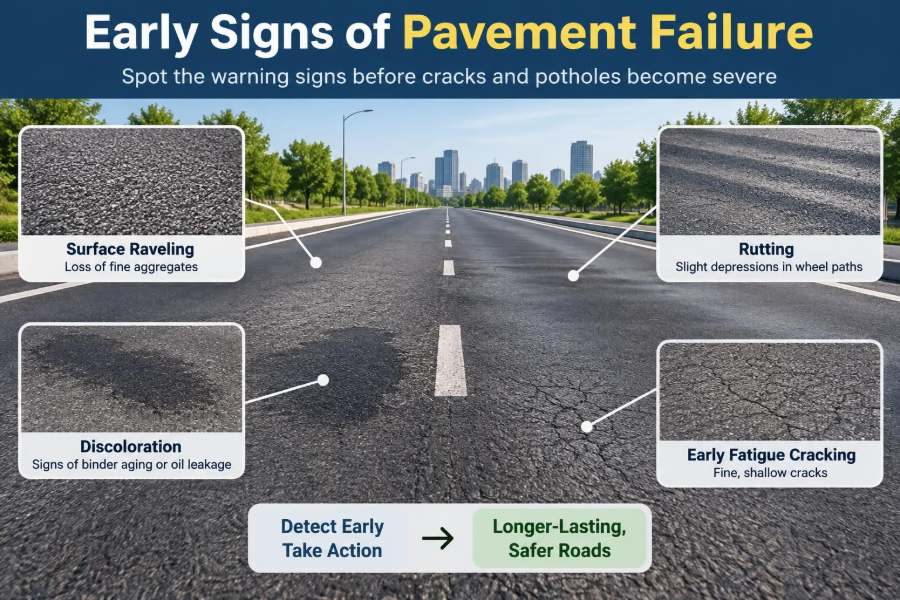

A road can look serviceable from a passing car while its structure is already losing strength. The surface may still be mostly intact, yet a faint wheel-path depression, a small patch of loose aggregate, or water lingering after rain can signal a problem developing below.
This is familiar to maintenance crews, municipal engineers, site managers, and road users alike: a minor defect is noticed, deferred, and later returns as a larger repair zone, traffic disruption, or pothole complaint. By the time a pothole is obvious, the pavement has often been deteriorating for some time.
Recognizing early pavement distress is not about treating every blemish as an emergency. It is about distinguishing cosmetic aging from evidence that water, traffic loading, material behavior, drainage, or the supporting soil is beginning to compromise the pavement system.
For students, these observations connect pavement theory to real infrastructure. For working professionals, they support better inspection records, more timely preservation work, and repair decisions that address causes rather than only visible symptoms.
🛣️ Pavement Failure Starts Below the Surface
A pavement is a layered system, not simply a sheet of asphalt or concrete. Flexible pavements commonly include an asphalt surface over base and subbase layers, all supported by subgrade soil. Rigid pavements use a concrete slab that distributes load differently but still depend on support and joint performance.
Failure occurs when one or more parts of this system can no longer perform its intended function under traffic and environmental exposure. A visible surface defect may therefore be the last part of a much deeper sequence.
🔎 Why Early Detection Changes the Repair Decision
Early-stage distress can often be managed with preservation treatments, localized repairs, drainage corrections, or closer monitoring. Once deterioration reaches the base, subgrade, or a broad area of the surface, more extensive rehabilitation may be necessary.
The practical difference is substantial. Sealing an early crack and correcting a drainage outlet is very different from removing failed material, rebuilding base layers, and restoring the surface course. The best intervention is usually the one applied before structural damage spreads.
🧱 Surface, Structural, and Functional Distress
Inspectors benefit from separating three overlapping categories. Surface distress affects the wearing course; structural distress indicates inadequate capacity within the pavement system; functional distress affects ride, skid resistance, noise, or drainage even when the pavement remains structurally adequate.
| Distress category | Typical early clue | Possible implication |
|---|---|---|
| Surface | Raveling or oxidation | Binder aging or loss of aggregate retention |
| Structural | Wheel-path deformation | Repeated-load damage in asphalt, base, or subgrade |
| Functional | Water ponding or rough ride | Crossfall, drainage, or profile problem |
One condition can belong to more than one category. For example, a rut may first be a functional drainage concern but can also reveal structural weakness.
👀 The Value of a Slow Visual Survey
A slow walk-through often reveals details that a windshield survey misses. Inspectors can note changes in texture, elevation, drainage behavior, joint condition, and the relationship between defects and nearby features such as curb inlets, utility cuts, trees, or shoulders.
Visual inspection is a screening tool, not a complete diagnosis. Its strength lies in identifying where closer investigation is justified and documenting how a condition changes over time.
🗺️ Map Patterns Instead of Isolated Marks
A single blemish may result from a localized construction issue. Repeating defects are more informative. Distress concentrated in wheel paths points toward traffic-related loading, while defects aligned with a trench may indicate utility-cut settlement or inadequate restoration.
Record location, length, width, direction, severity, and nearby conditions. A simple sketch or consistent photo sequence can show whether a defect is stable, seasonal, or expanding.
🚗 Wheel-Path Depressions and Early Rutting
Rutting is a longitudinal depression in the wheel tracks. In asphalt pavements, it can form when the surface mixture deforms under repeated loads, when layers below it consolidate or shear, or when the subgrade weakens.
Early rutting may be subtle enough to feel only after rain, when it holds a thin line of water. Its location matters: a depression confined to the asphalt layer has different repair implications from one accompanied by broad deformation of the pavement and shoulder.
🌊 Water Ponding Reveals Profile Problems
Standing water is not merely an inconvenience. It increases infiltration opportunities, can reduce skid resistance, and accelerates damage when water enters cracks or joints. Ponding along a wheel path may also magnify traffic loading effects because vehicles repeatedly pass through the same wet zone.
Observe water after rainfall where safely possible. Note whether it drains slowly because of a shallow depression, blocked inlet, poor cross slope, edge settlement, or an outlet problem beyond the pavement.
🪨 Raveling and Loss of Surface Aggregate
Raveling is the gradual loss of aggregate particles from an asphalt surface. At first, the pavement may look rough, gray, and open-textured. Later, loose stone, exposed voids, and localized material loss can appear.
It may result from binder aging, inadequate compaction, poor aggregate-binder bonding, moisture damage, or traffic abrasion. Early raveling is worth documenting because the increasingly open surface allows water and air to accelerate deterioration.
☀️ Oxidation Is More Than a Change in Color
Asphalt commonly fades from black to gray as it ages and oxidizes. Color alone does not prove failure, but a dry-looking, brittle surface with fine surface checking may have reduced flexibility.
Oxidized binder is less able to accommodate movement and repeated loading. Preservation options may still be suitable when the pavement remains sound, but a dark surface after a seal treatment should never be treated as evidence of restored structural capacity.
🕸️ Fine Surface Checking and Hairline Cracks
Very fine, closely spaced cracks can be an early warning that the asphalt surface is aging or that stresses are developing. They may resemble a faint network before becoming clearly visible alligator cracking.
Not every hairline crack has the same significance. Isolated transverse cracks may be associated with thermal contraction, while interconnected cracks in wheel paths more strongly suggest repeated-load fatigue. Crack pattern is often more useful than crack width alone.
🦴 Fatigue Cracking Begins as a Pattern
Fatigue cracking, often called alligator cracking because of its interconnected pattern, develops under repeated traffic loading when the pavement system cannot adequately resist tensile strain. It commonly begins in loaded wheel paths.
At the early stage, the pattern can be small and subtle. If it expands, individual pieces loosen and water reaches lower layers. Surface sealing may slow moisture entry, but advanced fatigue cracking generally requires investigation of the underlying structural condition.
↔️ Longitudinal Cracks Need Context
Longitudinal cracks run roughly parallel to traffic. They may occur near lane construction joints, wheel paths, pavement edges, or utility trenches. Their location provides clues about the likely mechanism.
A crack exactly at a lane joint can indicate joint weakness or inadequate compaction. A crack near the edge may reflect insufficient lateral support, drainage problems, or widening-related construction issues. Treating all longitudinal cracks as identical can lead to poor repair selection.
❄️ Transverse Cracks and Seasonal Movement
Transverse cracks run across the lane and are commonly associated with temperature-related shrinkage in asphalt or movement in underlying layers. In cold climates, freeze-thaw action can worsen the consequences after water enters these openings.
They should be assessed for width, spacing, seal condition, and evidence of associated settlement. A stable, isolated crack may be managed differently from a crack accompanied by faulting, pumping, or widespread surface deformation.
📏 Edge Cracking and Missing Shoulder Support
Cracks near the pavement edge are especially common where shoulders are weak, unpaved, poorly drained, or repeatedly traversed by heavy vehicles. The edge carries less confinement than the center of the lane, making it more vulnerable to bending and water intrusion.
Look beyond the crack itself. A drop-off to the shoulder, eroded edge, soft verge, or drainage ditch issue may be part of the cause. An edge patch without restoring support often has a short service life.
🚧 Utility Cuts and Trench Settlement
Pavement over a utility trench can settle when backfill compacts under traffic, loses moisture, or was inadequately compacted during construction. Early signs include a shallow linear dip, cracking along patch boundaries, and water collecting over the trench.
This does not automatically mean the utility installation failed; settlement can have several causes. Still, the repair should consider the trench, backfill, and surrounding pavement rather than simply placing a thin surface patch over a depressed area.
🔧 Patch Edges Tell a Maintenance Story
Patches are necessary and often effective, but their boundaries deserve attention. Cracking, separation, or raveling around a patch can let water enter and may indicate poor bond, differential movement, weak adjacent pavement, or unsuitable patch geometry.
A patch that repeatedly fails in the same location is useful evidence. The recurring problem may be wet subgrade, unresolved utility leakage, inadequate depth of repair, or a load condition not addressed by the original work.
💧 Moisture Damage Can Be Hidden
Water is one of pavement’s most persistent enemies because it can reduce the strength of unbound granular layers and subgrade soil, weaken aggregate-binder adhesion, and move fine material. The surface may look acceptable until traffic exposes the weakened zone.
Potential clues include dark damp areas that persist, fine material deposited after rain, soft spots, repeated potholes, and distress concentrated near drainage paths. These are indicators, not proof; confirmation may require field testing or sampling.
🚿 Pumping, Staining, and Ejected Fines
Pumping occurs when water and fine material are forced through cracks, joints, or edges by repeated wheel loads. In concrete pavements, it can be associated with loss of support near joints. In asphalt systems, ejected fines may point to water movement and weakened underlying material.
Look for muddy staining, fine sediment at cracks, or debris near joints after wet periods. These signs warrant prompt attention because material loss can create voids and increase deflection under traffic.
🕳️ Soft Spots and Localized Deflection
A soft spot may be felt as a localized dip, a slight bounce under heavy vehicles, or a visibly deflected surface near a drain, trench, or low area. It suggests that the support below is weaker than surrounding pavement.
Visual observations should be supplemented where appropriate by engineering assessment. Depending on the project, this may include coring, test pits, moisture evaluation, proof rolling, deflection testing, or review of drainage and utility records.
🚛 Traffic Loading Leaves Distinct Clues
Traffic is not simply a count of vehicles. Load magnitude, axle configuration, tire pressure, stopping and turning actions, speed, and lane channelization all influence pavement response. Bus stops, loading bays, intersections, and industrial access roads commonly experience concentrated loading.
For example, a hypothetical warehouse entrance may develop early shoving where heavily loaded trucks brake and turn slowly. That localized distress calls for a different diagnosis than uniform aging across a residential street.
🔄 Shoving, Corrugation, and Surface Movement
Shoving is a localized bulging or displacement of asphalt, often where vehicles brake, accelerate, or turn. Corrugation is a series of transverse ripples. Both can indicate an unstable asphalt mixture, weak bond between layers, high temperatures, or demanding traffic actions.
These defects should not be dismissed as roughness alone. If material is moving laterally, a thin overlay may reproduce the problem unless the unstable layer and interface conditions are addressed.
🌡️ Weather Changes the Meaning of Distress
Temperature, rainfall, freeze-thaw cycles, and prolonged wet periods change how pavement defects appear. Cracks can open in cold weather and appear less visible in warmth. Weak support may become evident only after heavy rain.
Inspection programs should account for these conditions. A pavement evaluated only during dry weather may conceal drainage-related weakness, while a winter survey may reveal crack opening that needs sealing before a wet season.
🌱 Vegetation, Roots, and Edge Intrusion
Vegetation growing through cracks or along joints is usually a symptom of openings that retain moisture and debris; it is not necessarily the original cause. Roots can also lift or distort pavement, particularly near mature trees and constrained urban corridors.
Removing visible vegetation without cleaning and sealing the opening solves little. Root-related work requires balance: pavement safety, drainage, utility conflicts, and tree health may all need consideration.
📐 Ride Quality Can Deteriorate Before Obvious Breakup
Drivers often notice a change in ride before they can identify a crack. Repeated small bumps, a subtle dip at a patch, or a jolt near a joint can indicate settlement, slab movement, profile irregularity, or localized loss of support.
Ride observations are valuable, but they are subjective unless measured consistently. Agencies and contractors may use straightedges, profilographs, inertial profilers, or other tools suited to their pavement type and maintenance objectives.
🧪 Confirming the Cause Before Choosing Treatment
Visible distress identifies symptoms; diagnosis identifies mechanisms. A sound assessment combines condition observations with construction history, traffic information, drainage review, and, when justified, testing of pavement thickness, material condition, layer support, or moisture.
There is no single test that answers every question. The appropriate level of investigation depends on risk, traffic importance, available records, extent of distress, and the consequences of selecting the wrong repair.
📝 Build an Inspection Record That Can Be Compared
Useful records are repeatable. Photograph defects from similar angles, include scale where practical, record date and weather, identify lane position, and describe whether the condition is isolated or recurring.
- Use consistent terms for crack type, raveling, rutting, and patch condition.
- Record dimensions rather than relying only on words such as “small” or “severe.”
- Note drainage features, traffic operations, and nearby repairs.
- Flag changes since the previous inspection, not just the current appearance.
A well-kept record supports prioritization and makes it easier to explain why maintenance is needed before dramatic surface failure occurs.
🛠️ Match the Treatment to the Distress Stage
Preventive maintenance is most effective when the pavement is still structurally sound. Crack sealing, surface treatments, localized patching, drainage maintenance, and thin overlays may each have a role, but none is universally appropriate.
When there is widespread fatigue cracking, deep rutting, pumping, or soft support, preservation at the surface alone may be inadequate. The repair scope should restore the failed function, whether that means surface integrity, drainage, layer strength, or edge support.
⚠️ Common Mistakes in Early-Failure Response
One common mistake is waiting for a defect to become visually dramatic before investigating it. Another is assuming that a neat-looking patch, seal, or overlay has corrected the underlying weakness.
- Sealing cracks without checking whether water is already trapped below.
- Filling potholes repeatedly without identifying why the same area stays wet or weak.
- Ignoring shoulders, curb inlets, and outlet paths during pavement repairs.
- Using a visual rating alone where traffic safety or structural risk calls for further assessment.
Good maintenance is not simply fast repair; it is repair informed by the likely failure mechanism.
🏗️ Construction Quality Shapes Future Distress
Early defects are sometimes rooted in construction details that are no longer visible: inadequate compaction, poor layer bond, variable thickness, segregated asphalt, weak trench backfill, or drainage installed without a reliable outlet.
Quality control during construction cannot eliminate every future defect, since traffic and weather continue to act on the pavement. It does, however, reduce the likelihood that vulnerable areas will appear soon after opening.
🚦 Prioritize by Consequence, Not Appearance Alone
A modest defect on a heavily trafficked route, bus corridor, steep approach, or drainage low point may deserve more urgent action than a larger but stable defect on a low-volume access road. Safety, traffic loading, water exposure, and the potential for rapid progression all affect priority.
This is why condition management is not a beauty contest. The most visible defect is not always the one with the greatest operational or structural consequence.
🤝 Communication Between Field Staff and Designers
Field crews often notice recurring wet spots, changing ride, or patches that fail repeatedly. Designers and asset managers can connect those observations to drainage layouts, traffic assumptions, material specifications, and long-term program decisions.
Clear descriptions improve that exchange. “Pothole near curb” is less useful than “recurring material loss at the downstream edge of a patched wheel path beside a blocked inlet after rainfall.”
📚 What Students Should Learn to See
Pavement courses introduce stresses, strains, material properties, layer thickness, and drainage. Field observation gives those concepts form. A crack pattern becomes evidence of loading and movement; ponding becomes an indicator of geometry and water pathways.
When visiting a site, ask three questions: Where does water go? Where do the heaviest loads act? What pattern does the distress follow? Those questions do not replace design analysis, but they create a disciplined starting point.
✅ The Core Principle: Observe Early, Diagnose Carefully
Early pavement failure rarely announces itself with one unmistakable sign. More often, it appears as a combination of subtle clues: a depressed wheel path, open texture, recurring dampness, a crack at a joint, a weakening patch edge, or a change in ride.
The goal is not to overreact to every imperfection. It is to recognize patterns, verify likely causes, correct water and support problems where possible, and choose a treatment proportionate to the actual condition.
Small surface changes deserve attention because they can reveal a developing system problem long before a road breaks apart. Protecting pavement begins with seeing the early signals, understanding what they may mean, and acting while practical options remain open. 🛣️💧🔧