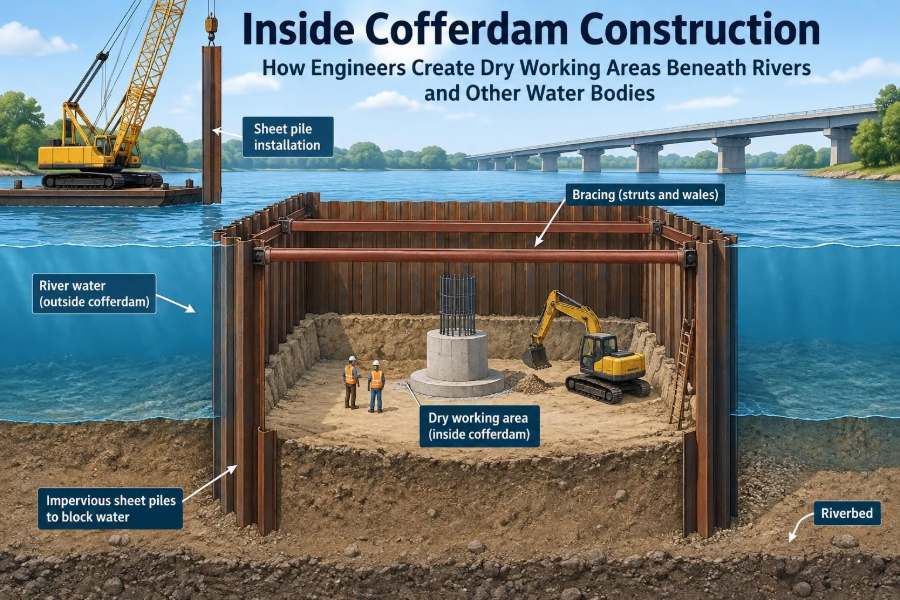

A bridge pier standing in the middle of a river can look simple from the riverbank: a column, a deck, traffic moving overhead. What is harder to see is the temporary engineering effort that made it possible to build the foundation below the waterline.
Concrete does not need a perfectly dry environment to exist, but excavating soil, placing reinforcement, inspecting formwork, and connecting structural elements underwater are far more difficult and hazardous. Engineers therefore often create a controlled dry zone before permanent construction begins.
That temporary enclosure is called a cofferdam. It is one of civil engineering’s most practical answers to a seemingly impossible request: build a foundation where water is constantly trying to occupy the same space.
From river bridges and port terminals to dam repairs and water-intake structures, cofferdams turn water-covered ground into a manageable work area. Their success depends not only on holding water back, but also on understanding soil, groundwater, river flow, structural stability, environmental constraints, and construction sequencing.
🌊 What a Cofferdam Actually Is
A cofferdam is a temporary watertight or water-resisting enclosure built within or beside a water body so that construction can proceed in a dewatered area. After the enclosure is built, pumps remove water from inside it, exposing the ground or existing structure.
It is not necessarily completely watertight. In practice, many cofferdams permit some seepage, which is collected and pumped out. The design objective is to limit inflow to a manageable level while keeping the excavation and surrounding ground stable.
🏗️ Why Engineers Need Dry Work Areas
Dry conditions allow crews to excavate accurately, inspect founding material, install reinforcing steel, place concrete, and verify dimensions. These tasks can be done underwater in specialized situations, but the equipment, methods, quality controls, and risks are substantially different.
For a typical bridge pier, a cofferdam may allow workers to construct a pile cap or spread footing below the riverbed. For a lock gate or dam repair, it can expose an existing structural face that would otherwise remain submerged.
🧱 The Difference Between a Cofferdam and a Dam
A dam is generally a permanent structure built to retain, divert, or control water across a watercourse. A cofferdam is usually temporary and local: it isolates only the portion of the water body needed for construction.
A cofferdam may redirect water around a work zone, but its main role is not long-term storage or flood control. Once permanent works are complete, the enclosure is usually removed or, in some designs, partly left in place if it forms part of the final structure.
🗺️ Where Cofferdams Are Used
Cofferdams appear wherever a project needs access below a water surface. Their scale ranges from relatively small excavations at a shoreline to major enclosures in tidal estuaries and broad rivers.
- Bridge foundations, piers, and abutments
- Marine wharves, quay walls, and ferry terminals
- Dam, weir, lock, and hydropower repairs
- Water-intake and outfall structures
- River crossings for pipelines or utility works
- Maintenance of submerged structural components
The chosen method depends on water depth, current, soil type, available working area, environmental requirements, and whether the structure is new or already in service.
🔍 The Site Investigation That Comes First
A cofferdam design begins long before steel sheets or rock fill arrive on site. Engineers need to understand the riverbed, banks, groundwater, seasonal flows, scour potential, obstructions, and nearby structures.
Boreholes and in-situ testing help identify whether the subsurface contains dense sand, soft clay, boulders, weathered rock, or permeable gravel. A wall that can be driven into soft material may be impractical where shallow rock or large obstructions are present.
Hydraulic information matters just as much. Water levels and flow velocities can change rapidly after rainfall, snowmelt, upstream releases, tidal cycles, or navigation-related waves.
📐 The Central Design Problem: Water Pressure
Water pushes sideways against cofferdam walls, and that pressure increases with depth. Once the inside is pumped down, the wall has water on one side and a much lower water level on the other, creating an unbalanced load.
The soil also responds to this difference. Outside water pressure can drive seepage beneath or through the enclosure, while the excavation removes soil that would otherwise help resist lateral movement. A cofferdam is therefore a soil-water-structure system, not merely a barrier made of steel or earth.
💧 Seepage Is Expected, but Must Be Controlled
Water can enter through wall joints, cracks, gaps around obstructions, porous soil, or beneath the wall toe. Small, clear seepage may be manageable with sump pumps, but increasing flow, sand-laden water, or cloudy discharge can signal a more serious problem.
Fine particles carried by seepage can create internal erosion, often called piping. As soil is washed out, paths enlarge and water flow can accelerate. This may undermine the wall or cause sudden ground loss inside the excavation.
⬇️ Dewatering Without Damaging the Ground
Dewatering is the removal of water from the enclosed area. It is often performed gradually because a rapid drop in internal water level can sharply increase wall loads and alter groundwater pressures in surrounding soils.
For low inflows, a sump at the bottom of the excavation may be enough. More permeable soils may require wellpoints, deep wells, or other groundwater-control methods. Pumped water must be managed so that sediment is not discharged untreated into the water body.
⚖️ Uplift and the Risk of a Heaving Base
Removing water from inside a cofferdam does not automatically remove pressure below the excavation. Groundwater beneath the base can exert upward pressure, particularly where a relatively impermeable layer traps water below it.
If upward pressure exceeds the weight and shear resistance of the soil or base slab, the bottom can heave, boil, or fail. Engineers may reduce this risk by driving walls deeper, lowering groundwater pressure, adding a thicker base seal, using anchors, or changing the excavation sequence.
🪨 Scour Changes the Conditions Around the Wall
Scour is the erosion of bed material by moving water. Flow accelerates around cofferdam corners and constricted channels, potentially removing soil that supports the enclosure.
Rock armor, mattresses, temporary berms, and carefully shaped flow transitions can reduce local erosion. Monitoring is especially important during high flows because the bed profile may change even when the visible water surface seems routine.
🔩 Sheet-Pile Cofferdams
Steel sheet piles are interlocking sections driven into the ground to form a continuous wall. They are common because they can be installed relatively quickly, provide useful resistance to bending, and can often be extracted and reused.
Sheet piles work well in many granular and cohesive soils, but hard layers, boulders, old foundations, or bedrock can prevent full penetration. Their interlocks reduce seepage but rarely eliminate it completely, so pumping and joint treatment may still be necessary.
🔺 Braced Cofferdams and Internal Supports
A wall that stands unsupported over a large depth may bend excessively or require very heavy sections. In a braced cofferdam, internal members such as wales and struts support opposing walls and reduce their unsupported span.
Wales distribute load along the wall; struts transfer it across the excavation. The arrangement must leave enough space for excavation, cranes, concrete placement, and workers. A support layout that is structurally adequate but blocks construction access is not a practical design.
⚓ Anchored Cofferdams for Open Interiors
Where internal struts would interfere with the permanent work, tie rods and ground anchors can support the wall from outside the excavation. This produces a more open work area, which is valuable for large foundation caps or complex formwork.
Anchors require reliable ground beyond the wall and careful coordination with property boundaries, utilities, navigation areas, and adjacent foundations. They also introduce their own load path and inspection requirements.
🏞️ Earthfill and Rockfill Cofferdams
Earthfill cofferdams use compacted soil, often with a low-permeability clay core or upstream impervious layer. Rockfill cofferdams use larger rock, frequently combined with a membrane, grout curtain, or internal impervious zone to limit seepage.
These forms can be economical where material is available nearby and there is sufficient footprint. They are generally less suited to tight urban sites or deep water, and they need protected slopes because flowing water can erode unprotected fill.
🧺 Cellular Cofferdams for Large Water Loads
Cellular cofferdams are made from interconnected steel sheet-pile cells filled with granular material. The fill mass provides stability, while the sheet piles form the cell boundaries.
They have been used for substantial marine and river works where conventional bracing would be impractical. Their behavior depends on geometry, fill quality, interlock integrity, and foundation conditions, so construction control is central to performance.
🧱 Concrete and Diaphragm-Wall Solutions
For deep excavations or permanent waterfront structures, reinforced-concrete diaphragm walls may form part of the excavation support and the final structure. They are constructed in panels using slurry-supported trenches, then filled with concrete.
These systems can offer stiffness and lower seepage, but they require specialized equipment and careful panel-joint control. They are not automatically the best choice for every water project; temporary sheet piling may be more efficient for modest, short-duration works.
🧰 Bottom Seals When Pumping Alone Is Not Enough
A bottom seal is an underwater concrete layer placed across the base of a cofferdam before full dewatering. It resists uplift and reduces inflow through the bottom, creating a more stable working platform.
Tremie concrete is commonly used for this purpose. Concrete is delivered through a pipe with its lower end kept embedded in fresh concrete, limiting contact with water during placement. Once the seal has gained suitable strength, the enclosure can be pumped dry above it.
🚧 A Typical Cofferdam Construction Sequence
Exact sequences vary, but construction follows a deliberate order because each step changes loading and water conditions. The permanent foundation should not begin until the temporary enclosure has been verified as stable and workable.
- Survey the work area and establish access, safety zones, and environmental controls.
- Prepare the riverbed or shoreline, including removal of obstructions where feasible.
- Install the enclosure walls, fill, or support system.
- Check alignment, penetration, joints, and initial seepage behavior.
- Dewater in stages while monitoring water levels and wall response.
- Excavate, install bracing or anchors as required, and prepare the base.
- Construct the permanent foundation or repair works.
- Backfill or flood the enclosure in a controlled manner, then remove temporary works if planned.
📊 Monitoring Turns Assumptions into Field Decisions
Design calculations are based on investigated conditions and anticipated loads, but actual field behavior must be checked. Monitoring provides early warning when the cofferdam is moving, leaking, or experiencing water levels different from those assumed.
Common observations include water levels inside and outside the enclosure, pump discharge, wall deflection, settlement, strut loads, anchor loads, turbidity, and scour depth. Readings are meaningful only when someone reviews trends and knows what response is required.
🌧️ Floods, Tides, and Emergency Planning
Temporary works are vulnerable because they often have lower crest levels and shorter design lives than permanent flood barriers. A rainstorm upstream or a changing tide can raise water outside the enclosure faster than construction crews can react.
A project should establish trigger levels and practical responses before an event occurs. These may include suspending excavation, securing plant, evacuating personnel, increasing pumping readiness, protecting open excavations, or deliberately flooding the inside to equalize dangerous pressure differences.
🐟 Environmental Protection Around the Work Zone
Cofferdams alter local flow and can disturb sediment, aquatic habitat, and water quality. Work near water may also involve permits, timing restrictions, fish-protection measures, spill prevention, and limits on turbidity.
Good practice includes containing fuels and hydraulic fluids, treating turbid pumped water where required, controlling concrete washout, and avoiding unnecessary disturbance beyond the approved work footprint. Environmental planning is not separate from construction planning; it affects the feasible method and schedule.
👷 Safety Hazards Inside a Cofferdam
A dry excavation surrounded by water can create a false sense of security. Hazards include flooding, wall movement, falling objects, unstable excavated faces, confined work areas, electrical equipment near water, lifting operations, and difficult emergency access.
Safe work requires engineered access, ladders or stairs, clear escape routes, reliable communications, competent inspection, and restrictions on work during unsafe flow or weather conditions. Personnel must understand that an unusual leak, ground movement, or support-system noise is a reason to stop and report, not to improvise.
🧮 Construction Loads Are Often Overlooked
Cofferdams must resist more than water and soil pressure. Excavators, cranes, material stockpiles, concrete pumps, vehicle traffic, and temporary platforms can impose significant loads near the wall crest.
Placing spoil beside an excavation is a common mistake because the added weight raises lateral soil pressure and may reduce stability. Construction staging plans should specify where plant and materials can safely be positioned.
❌ Common Failure Modes and Their Warning Signs
Failures usually develop through recognizable mechanisms, although warning time can be short. A sound response focuses on the mechanism rather than treating every leak or movement as the same problem.
- Excessive seepage: rising pump demand, muddy water, or sand movement may indicate erosion paths.
- Wall movement: changing alignment, cracking, or distressed bracing can indicate inadequate support or unexpected soil pressure.
- Base instability: bubbling water, softening ground, or upward soil movement can indicate uplift or boiling.
- Overtopping: water approaching the crest can lead to erosion, rapid flooding, and unequal pressure changes.
- Scour: deepening around exterior toes may reduce foundation support.
🔄 Diversion Versus Enclosure
Not every project should place a cofferdam directly in flowing water. Sometimes a channel can be temporarily diverted through a bypass, culvert, pipe, or alternate channel while work occurs in the original alignment.
Diversion may reduce loading on the work enclosure, but it requires space and can create its own hydraulic and environmental impacts. Enclosure is often favored where flow must remain in the main channel or where the work area is localized.
🏙️ Tight Urban Sites Need Different Thinking
In a dense city, nearby basements, utilities, railway structures, roads, and existing foundations can control the cofferdam solution. Noise and vibration from pile driving may also influence the selected installation method.
Low-vibration pressing, predrilling, internal bracing, and detailed utility investigations may be needed. A method that is economical on an open riverbank can become unsuitable when movement limits for adjacent assets are strict.
🏛️ Building a Bridge Pier: A Hypothetical Example
Consider a proposed bridge pier in a shallow river with alluvial sand and gravel over denser material. A contractor may install a rectangular sheet-pile cofferdam around the pier location, drive the sheets to a depth selected to control seepage and stability, then dewater gradually.
As excavation proceeds, internal bracing may be installed at planned levels. If inflow from the permeable gravel is too high or the base shows uplift risk, the team may revise the approach by adding groundwater control or placing a concrete bottom seal.
This example illustrates an essential point: the cofferdam is not simply installed and forgotten. Its behavior informs the next construction decision.
🧱 When Underwater Concrete May Be Better
A dry cofferdam is not always the preferred method. In deep water, high-flow channels, or areas where a large enclosure would severely disrupt navigation or the environment, engineers may use tremie concrete, precast elements, drilled shafts, or other underwater construction methods.
Underwater work avoids some temporary enclosure challenges but demands specialized quality control and limits direct inspection. The choice is a project-specific balance among safety, constructability, cost, schedule, water conditions, and the required durability of the completed structure.
📋 What a Good Cofferdam Plan Includes
A robust temporary-works plan makes responsibilities and response actions explicit. It should be reviewed by appropriately qualified engineers and adapted as site conditions become known.
- Design drawings, assumptions, and installation sequence
- Water-level, weather, flood, and tidal information
- Dewatering capacity and backup pumping arrangements
- Inspection and monitoring requirements with action thresholds
- Rules for excavation depth, surcharge loads, and equipment locations
- Emergency flooding, evacuation, and communication procedures
- Environmental protection and discharge-management measures
🧠 The Core Principle: Control Water, Soil, and Sequence
Cofferdam construction works when engineers manage three connected issues: the water trying to enter the excavation, the soil supporting and transmitting loads, and the sequence that changes both conditions over time.
The wall itself is only one part of the solution. Reliable foundations beneath water depend on suitable ground investigation, an enclosure matched to the site, controlled dewatering, adequate support, continuous observation, and a realistic plan for high-water events.
For students, cofferdams are a useful reminder that temporary works deserve the same disciplined engineering attention as permanent structures. For working professionals, they remain a daily example of how careful planning turns difficult site conditions into buildable projects.
A cofferdam succeeds not by making water disappear, but by controlling how water and ground behave long enough for permanent construction to be completed safely. 🌉💧🦺