
A streambank begins to crumble after several heavy storms. Soil slips from beneath a roadside embankment. A drainage channel cuts deeper into its bed each season. These failures often start quietly, with moving water or surface runoff carrying away small amounts of soil.
Engineers need ways to hold vulnerable ground in place without simply blocking water and creating a new problem elsewhere. One long-established option is the gabion wall: a structure made from rock-filled wire mesh baskets.
Gabions can look simple, but their performance depends on sound engineering. Their ability to resist erosion, drain water, flex slightly, and add weight makes them useful on riverbanks, slopes, channels, and retaining works.
Understanding how these stone-and-mesh structures work helps designers, contractors, and site teams recognize where gabions fit—and where a different solution is needed.
🧺 What a Gabion Wall Is
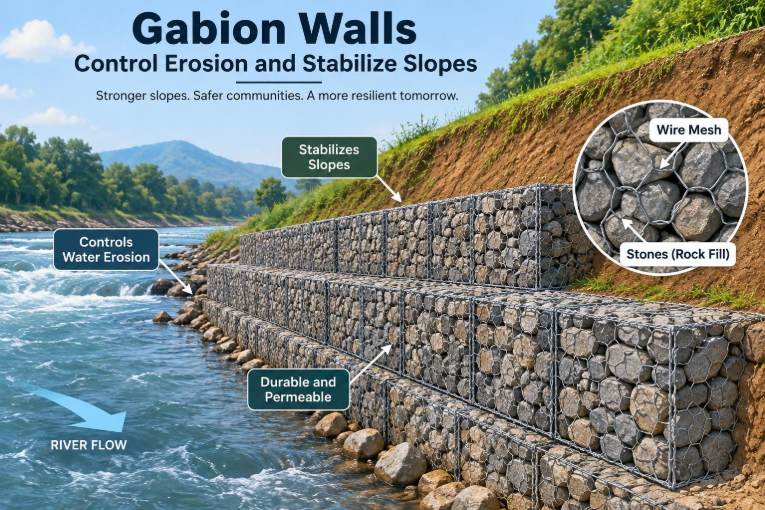
A gabion is a rectangular, cylindrical, or mattress-shaped mesh container filled with durable rock. Individual units are wired or clipped together to form a larger protective or retaining structure.
A gabion wall is usually built in stepped layers, with wider courses at the bottom. The stones provide mass, while the mesh confines them so they act as a stable, permeable unit rather than loose riprap.
🪨 The Basic Materials Behind the System
Most gabion systems contain three essential materials: mesh, rock fill, and connection components. Geotextile fabric, drainage aggregate, anchors, or geogrids may also be included depending on the site.
- Mesh: commonly galvanized or coated steel wire, welded mesh, or double-twisted woven mesh.
- Rock: hard, angular to subangular stone large enough not to pass through the mesh openings.
- Fasteners: lacing wire, rings, spirals, or proprietary connectors joining panels and adjacent baskets.
The material specification matters because a wall is only as durable as its wire protection, stone quality, and connections.
🌊 Why Flowing Water Causes Erosion
Water moving along a bank or channel exerts shear stress on the soil surface. If that force exceeds the soil’s resistance, particles detach and are carried away.
Fast water, waves, bends in rivers, sudden changes in channel shape, and concentrated outfalls all increase local erosion potential. Once a bank toe—the lower edge of the slope—is scoured away, the unsupported soil above can slump or collapse.
🛡️ How Gabions Protect Soil From Scour
Gabions place a rough, heavy rock layer between flowing water and erodible soil. Water still passes through and around the stones, but the rock absorbs and disrupts much of the flow energy.
The mesh prevents the rock from dispersing under hydraulic forces. This is especially useful where isolated stones might otherwise roll, be displaced, or leave gaps that expose the underlying soil.
💧 Permeability Is a Major Advantage
Unlike a solid concrete wall, a gabion wall contains many voids between stones. These voids allow water to drain through the structure rather than building up behind it.
This reduces hydrostatic pressure, the lateral force created when water is trapped in soil behind a retaining wall. Good drainage does not eliminate all stability concerns, but it can greatly reduce one common cause of wall distress.
⚖️ Weight and Gravity Resist Lateral Movement
Many gabion retaining walls work as gravity walls. Their own weight resists the sideways pressure exerted by retained soil.
A wider, heavier base creates a more stable foundation for the upper courses. Stepping the face back into the slope also shifts the wall’s overall weight toward the retained ground, improving resistance to overturning.
🧩 Interlocking Baskets Create One Mass
A single basket has limited structural significance. A properly assembled wall behaves as a connected mass because adjacent baskets are tied together along their edges.
Internal diaphragms divide larger baskets into cells, limiting stone movement and helping the unit retain its shape. Tight connections are not a cosmetic detail; loose or missing ties can allow separation and localized deformation.
🌱 Flexibility Helps on Uneven Ground
Gabion walls are comparatively flexible. They can tolerate modest settlement or small ground movements better than rigid masonry or plain concrete systems, which may crack when the foundation moves unevenly.
Flexibility is not the same as unlimited movement capacity. Significant settlement, soft foundation soils, or active landslides can still distort a gabion wall beyond an acceptable condition.
🏞️ Common Places Where Gabions Are Used
Gabions are selected where erosion protection and drainage are both important. Typical applications include:
- Riverbanks, stream crossings, and bridge approaches
- Road embankments and roadside drainage channels
- Slope toes beneath cut or fill slopes
- Outfall protection below culverts and stormwater pipes
- Retaining structures in rural, industrial, and landscape works
- Coastal edges where wave conditions are suitable for the design
The same basket system can serve different purposes, but hydraulic loading, soil conditions, and geometry must be assessed separately for each use.
📐 Wall Geometry Determines Stability
Wall height, base width, batter, embedment, and slope angle all influence performance. A low erosion-control facing can often be simple, while a tall wall retaining soil requires formal geotechnical and structural checks.
Designers commonly examine sliding, overturning, bearing pressure, and overall slope stability. They also consider whether the wall could be undermined by scour or overloaded by vehicles, buildings, or stored materials above it.
🧱 The Importance of a Stable Foundation
Gabions should sit on prepared ground, not loose topsoil, organic material, or a hidden layer of soft mud. The foundation must be level enough to support the first course and strong enough to carry the wall without excessive settlement.
Where water may erode the base, the wall often needs toe embedment, a launching apron, or another scour-protection detail. A wall can have excellent baskets and stone yet fail because water removed the soil beneath it.
🧵 Geotextile Separates Soil From Stone
A filter geotextile is often placed between native soil and the gabion rock. Its main purpose is to let water pass while limiting the migration of fine soil particles into the stone voids.
Without suitable filtration, soil can wash through the wall, causing settlement behind the facing or clogging drainage paths. Filter design should consider the soil gradation and hydraulic conditions rather than treating fabric as a universal fix.
🌧️ Drainage Behind Retaining Gabions
Permeable baskets help, but a retaining gabion wall may still require a drainage layer behind it. Free-draining granular fill can guide water downward and away from the retained soil.
Surface runoff must also be managed. If roof, road, or hillside runoff is discharged directly behind the wall, water may soften the soil, wash fines into voids, or create concentrated flow paths.
🔍 Choosing the Right Rock Fill
Rock should be durable, clean, and sized to remain inside the mesh. Weak, friable, or weathered stone may break down over time, reducing basket volume and increasing the chance of mesh deformation.
Angular rock generally interlocks more effectively than rounded river stone. Rounded stone can be used in some applications, but it may be less stable under movement and can be harder to pack tightly at visible faces.
🔩 Mesh Type and Corrosion Protection
Gabion mesh is exposed to moisture, oxygen, soil chemicals, abrasion, and sometimes saltwater. Galvanizing and polymer coatings are used to slow corrosion, but the appropriate protection depends on the exposure environment.
Welded mesh creates crisp, rectangular faces and is common in architectural or low-energy applications. Double-twisted woven mesh can better accommodate localized deformation because damage to one wire is less likely to unravel an entire panel.
🧱 Building the Baskets Correctly
Construction begins by unfolding panels, forming the basket shape, and securely connecting edges and diaphragms. Baskets must be aligned before filling; correcting a distorted unit after it is full is difficult.
Temporary bracing or tension wires may be used to prevent outward bulging during filling. Lids should be closed only after the basket is full, shaped, and internally tied where required by the system details.
👷 Hand Packing and Machine Filling
Excavators can efficiently place rock into baskets, especially on large projects. However, machine filling alone can leave voids, damage mesh, or create an uneven face.
Visible outer faces are commonly hand packed so larger, flatter stones create a neat and stable surface. Workers should avoid dropping rock from excessive heights, which can deform the basket or break protective coatings on the wire.
📚 A Simple Construction Sequence
- Survey the alignment and excavate to the required formation level.
- Prepare and compact the foundation as specified.
- Install filter fabric or drainage layers where required.
- Assemble, align, and connect empty baskets.
- Fill in controlled lifts, adding internal ties and face packing.
- Close lids, connect adjacent units, and build subsequent courses.
- Finish drainage, backfill, surface protection, and site grading.
Actual sequences vary with access, water levels, and project specifications, but the principle is consistent: build a connected system on stable, drained ground.
🌊 Gabion Mattresses for Channel Beds
A gabion mattress is a shallow, wide unit used mainly for erosion protection rather than high retaining walls. It can line a channel bed, protect a bank, or form an apron below a culvert outlet.
Its broad footprint spreads hydraulic forces and protects the soil from direct scour. Mattress thickness and stone size must suit expected flow conditions; a thin layer is not automatically adequate for fast or debris-laden water.
🌀 River Bends and the Need for Toe Protection
Water often flows fastest near the outside of a river bend, where it can erode the toe of a bank. A gabion revetment may protect the slope surface, but its lower edge must remain protected as the channel bed changes.
Designers may extend protection below the expected bed level or provide a flexible apron that can settle into a developing scour hole. This detail is critical because upper-slope armoring cannot compensate for loss of support at the bottom.
🚧 Gabions on Roadside Slopes
Along roads, gabion walls may retain cut slopes, support widened embankments, or protect drainage paths. Their drainage capacity is particularly useful where groundwater or rainfall can accumulate behind a rigid wall.
Road loading changes the design problem. Traffic surcharge, guardrail forces, utilities, limited right-of-way, and maintenance access may all affect wall geometry and reinforcement requirements.
🏗️ When Reinforced Soil Is Added
For taller structures, gabion facing may be combined with geogrid reinforcement extending back into compacted fill. This creates a reinforced soil system rather than relying only on the weight of the front baskets.
The geogrid layers distribute loads through the backfill and improve internal stability. Such systems require controlled fill placement and compaction; they should not be improvised using whatever soil is available on site.
⚠️ Common Design and Installation Mistakes
Failures often result from incomplete attention to water, foundations, or construction details rather than from the gabion concept itself. Recurring mistakes include:
- Using undersized, weak, or poorly graded rock
- Omitting filter layers where fine soil can wash out
- Failing to tie baskets, diaphragms, and lids properly
- Building on soft or sloping ground without preparation
- Ignoring scour at the toe or outlet velocities
- Overfilling baskets until lids cannot close naturally
- Allowing uncontrolled runoff to discharge behind the wall
Each error can start locally, then develop into bulging, settlement, soil loss, or broader instability.
🧭 Gabions Are Not a Solution for Every Slope
A gabion wall may be unsuitable where space is too restricted for a gravity base, where foundations are very weak, or where a slope is moving deeply rather than suffering shallow erosion.
Very aggressive wave action, highly corrosive environments, or locations demanding a smooth hydraulic surface may require another approach. Options can include reinforced concrete, sheet piling, soil nailing, mechanically stabilized earth, riprap, or bioengineering measures.
🌿 Blending Hard Protection With Vegetation
Gabions can support ecological and landscape objectives when used thoughtfully. Soil can accumulate in surface voids, and vegetation may establish around or through the stones, softening the appearance over time.
Vegetation is most useful when roots can develop in stable soil and when species suit local moisture conditions. It should not be treated as a substitute for correctly designed toe protection, drainage, or structural stability.
🔄 Comparing Gabions With Other Erosion Controls
| Method | Best suited to | Main strength | Main limitation |
|---|---|---|---|
| Gabion wall | Drainage, moderate movement, erosion and retaining needs | Flexible and permeable | Needs good stone, mesh, and assembly |
| Loose riprap | Bank and slope armoring | Simple rock protection | Can move without confinement |
| Concrete wall | Confined sites and rigid geometry | High strength in limited space | Requires drainage and can crack with settlement |
| Vegetated slope | Low-energy surface erosion | Natural appearance and shallow soil reinforcement | Not sufficient for strong hydraulic attack |
Selection should follow site conditions, not appearance alone. A low-cost option that fails to address water or ground conditions can become the most expensive option to repair.
🔎 Inspection During Construction
Inspection should verify basket dimensions, wire condition, connection spacing, diaphragm installation, rock size, fill quality, and the condition of the foundation before it disappears beneath the work.
For retaining walls, checking line, level, batter, drainage details, and backfill placement is equally important. Photographs and records of concealed layers are valuable for future maintenance and investigation.
🛠️ Maintenance After Floods and Storms
Gabions are durable but not maintenance-free. Inspections after high flows, major storms, or ground movement should look for toe scour, displaced stones, broken mesh, settlement, bulging, and erosion at the ends of the protected reach.
Small defects are usually easier to repair before they enlarge. Replacing lost stones, retying damaged sections, and restoring adjacent drainage may prevent a local issue from becoming a wall reconstruction project.
📋 What Engineers Need to Investigate First
Before selecting a gabion solution, engineers typically need to understand the ground, water, loading, and construction constraints. Useful information includes site levels, soil profile, groundwater behavior, drainage paths, channel geometry, expected flow conditions, available stone, and access for equipment.
For substantial retaining or waterway works, a qualified engineer should perform the necessary stability and hydraulic assessments. Gabions are straightforward to recognize, but their safe design can involve geotechnical, structural, and hydraulic engineering.
🧠 Reading a Gabion Wall as a System
The visible stone face is only one part of the system. Behind it may be filter fabric, drainage aggregate, compacted backfill, reinforcement, and a carefully prepared foundation; below it may be buried toe protection.
When assessing a wall, ask where the water goes, what supports the base, how the baskets are connected, and whether the protected soil can escape through the rock. Those questions reveal more than appearance alone.
✅ The Core Principle: Control Water, Support Soil, Allow Drainage
Gabion walls work because they combine several functions in one adaptable structure. Rock resists erosion and supplies weight, mesh confines the rock, voids relieve water pressure, and proper filters preserve the soil behind the wall.
They perform best when designed as part of the whole site: drainage above and behind the wall, stable ground below it, erosion protection at the toe, and construction quality throughout. A basket of stones is not automatically a retaining wall; a connected, well-detailed system is.
A successful gabion wall controls the energy of water while keeping soil supported, drained, and protected from loss. When those conditions are respected, stones and wire mesh can provide practical, resilient infrastructure for demanding sites. 🌊🪨🏗️