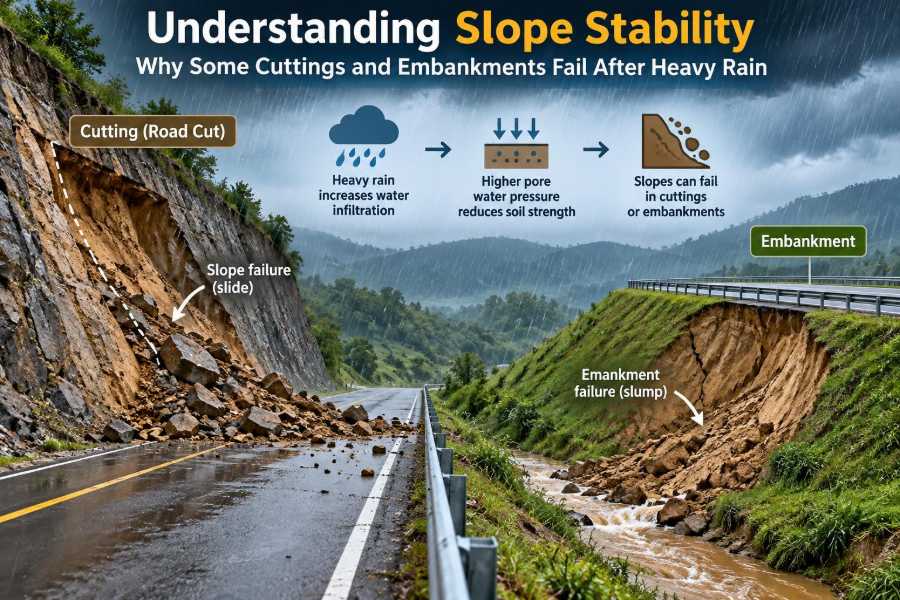

A road cutting can look perfectly sound through a long dry spell. Its face may be green with grass, apparently firm, and familiar to everyone who drives past it. Then a period of heavy rain arrives, and soil, rock fragments, or a whole slice of ground moves downhill.
The same pattern occurs on railway embankments, housing developments, canal banks, and earth dams. The visible failure may take only seconds or minutes, but the conditions that made it possible often developed over days, seasons, or years.
For civil engineers, slope stability is not simply a question of whether ground is steep. It is about the balance between forces that pull material downhill and the soil or rock strength that resists that movement.
Heavy rain matters because water can quietly change both sides of that balance. Understanding those changes helps designers, inspectors, contractors, and asset owners recognize risk before a small drainage problem becomes a disruptive or dangerous slope failure.
⛰️ What slope stability means
Slope stability is the ability of a natural or constructed slope to remain in place without unacceptable movement. A slope may be a hillside, an excavated cutting, a roadway embankment built from fill, or the side of an earth-retaining structure.
Stability is assessed by comparing available resisting forces with driving forces. Soil weight, steepness, surcharge loads, and water-related forces tend to drive movement; friction, particle interlock, cohesion, reinforcement, and structural support resist it.
A stable slope is not necessarily motionless. Small seasonal movements can occur, particularly in clay soils. The engineering concern is whether movement could accelerate, damage infrastructure, block a route, or threaten people and property.
⚖️ The basic balance of forces
Imagine a block of soil resting on a tilted board. Gravity pulls the block downward along the board, while friction between the surfaces resists sliding. A real slope is more complicated, but the central idea is similar.
Engineers express this balance through a factor of safety: the ratio of resisting capacity to driving demand. A value above one indicates that calculated resistance exceeds calculated driving force, but design targets are set higher to allow for uncertainty, variable ground conditions, loading changes, and consequences of failure.
Rainfall can increase the downhill demand and reduce resistance at the same time. That double effect is why a slope that tolerated its normal condition may become unstable during or after prolonged wet weather.
🌧️ Why rain changes the problem
Rain falling on a slope has several possible paths. Some runs across the surface, some is intercepted by vegetation, some evaporates, and some infiltrates into pores, joints, cracks, and loose fill.
Once water enters the ground, it may add weight, soften certain materials, generate pore-water pressure, erode exposed soil, and find unexpected routes along layers or buried services. The response depends on rainfall intensity and duration, soil permeability, antecedent moisture, slope geometry, and drainage.
A short intense storm can cause erosion and local washout. A longer wet period may be more critical for deep-seated sliding because it gives water time to reach a potential failure surface deeper within the slope.
💧 Pore-water pressure in plain language
Soil contains solid particles and voids. The voids may hold air, water, or both. Pore-water pressure is the pressure exerted by water within those void spaces.
This pressure does not directly make grains stick together. Instead, it reduces the effective contact force between particles. In practical terms, the soil skeleton carries less of the load, so frictional resistance falls.
A useful analogy is a wet beach: firm, draining sand can support a footprint, while water-saturated sand may feel less secure when water pressure pushes grains apart. The analogy is imperfect, but it captures the key point that water within soil changes how particles transfer load.
🧱 Effective stress and soil strength
Effective stress is the portion of stress carried through contact between soil particles. It is often described as total stress minus pore-water pressure. Higher pore pressure generally means lower effective stress.
Many soils gain much of their shear strength from friction between particles. When effective stress decreases, that frictional contribution reduces. In clays, apparent cohesion and drainage conditions also matter, so engineers must use strength parameters appropriate to the loading rate and soil behaviour.
This explains an initially counterintuitive observation: adding water can make a slope less stable even when the slope geometry has not changed. The internal stress state has changed, and it can be more significant than the visible wetness at the surface.
🪨 Rain also adds weight
Water is heavy. As soil becomes wetter, its bulk unit weight increases, increasing the gravitational force acting down the slope. This effect is usually considered together with pore-pressure changes, rather than in isolation.
For loose, shallow material, the added weight can be particularly relevant during rapid saturation. Water flowing through a slope can also exert seepage forces, encouraging particles to move in the direction of flow.
Not every wet slope fails because of weight gain. In many cases, rising pore-water pressure is the dominant concern. Still, the combined effects mean rain should never be treated as merely a surface issue.
🕳️ Infiltration depends on the ground
Coarse sand and gravel can transmit water relatively quickly, while dense clay often allows slow movement through its intact mass. However, clay slopes may contain fissures, roots, old desiccation cracks, sand seams, or construction defects that allow water to bypass the slow matrix.
Layering is especially influential. Water moving through a permeable layer may meet a less permeable clay or weathered rock layer, then travel sideways along the boundary. That boundary can become a weakened zone or form part of a potential sliding surface.
Ground investigation should therefore identify not only broad soil types but also stratification, discontinuities, groundwater levels, permeability contrasts, and signs of prior movement.
📐 Slope angle and geometry
Steeper slopes have a larger component of self-weight acting parallel to the slope. All else being equal, steepening a slope increases the driving force and can reduce the margin against failure.
Geometry includes more than face angle. A high slope can have a deep potential failure surface; a long slope can collect more runoff; and an abrupt change in grade can concentrate water or stress. Benches, berms, and flatter profiles may improve performance when they are designed with reliable drainage.
Excavating at the toe, whether for a ditch, road widening, or erosion repair, deserves particular attention. The toe often provides crucial passive support to material higher on the slope.
🔍 Cuttings and embankments fail differently
A cutting is created by excavating into existing ground. Its behaviour is governed by natural geology, weathering, groundwater, joints, historic landslides, and the loss of material that previously supported the hillside.
An embankment is built from placed fill. Its performance also depends on fill quality, compaction, lift thickness, foundation condition, drainage, and whether weak or organic material was left beneath it.
Both can fail after rain, but the questions are different. For a cutting, engineers ask what natural layers and groundwater pathways have been exposed. For an embankment, they also ask whether water is entering, being trapped within, or undermining the constructed fill.
↘️ Common modes of slope movement
Slope failure is not one single mechanism. Identifying the mode helps determine the cause and the appropriate remedy.
| Movement type | Typical description | Rain-related trigger |
|---|---|---|
| Rotational slide | A mass rotates along a curved slip surface, common in cohesive soils. | Rising groundwater and reduced effective stress. |
| Translational slide | Material moves along a relatively planar weak layer or interface. | Water along bedding, a clay seam, or a soil-rock boundary. |
| Shallow slide | A thin near-surface layer slips, often on a steep face. | Rapid saturation, erosion, or loss of root reinforcement. |
| Flow or debris movement | Very wet loose material deforms and travels downslope. | High water content and concentrated runoff. |
| Rockfall | Blocks detach from a rock face. | Water pressure in joints, weathering, or freeze-thaw effects. |
🌀 Rotational slips in clay slopes
Rotational failures often produce a curved, spoon-shaped failure surface. The upper part of the moving mass may settle back, creating a head scarp, while the lower part bulges outward at the toe.
They are commonly associated with cohesive soils such as clay, especially where a slope is high enough for a deep failure mechanism to develop. Rainfall may raise groundwater slowly, so movement can occur after the heaviest rain has ended.
Warning signs can include tension cracks near the crest, hummocky ground, tilted fence posts, ponding in new depressions, and bulging at the toe. These signs require professional assessment; they do not by themselves identify the full failure surface.
📚 Translational slides along weak layers
A translational slide moves along a flatter or more planar surface. This can occur where a permeable soil layer overlies clay, where weathered rock sits on intact rock, or where geological bedding dips toward the slope face.
Water often has a clear role: it may build pressure at the interface or lubricate a pre-existing shear zone. In engineered fill, an inadequately bonded layer, geotextile interface, or buried topsoil horizon can create a similarly weak plane.
Because these slides can extend across broad areas, a small exposed failure may be only part of the problem. Repair should be based on investigation rather than simply reinstating the visible face.
🌊 Surface runoff and erosion
Not all rain-related failures begin deep underground. When runoff concentrates at the crest or on the face, it can cut rills and gullies, remove fine particles, and progressively steepen local areas.
Water spilling from a damaged kerb, overflowing ditch, or unprotected outlet can erode a narrow channel quickly. The resulting notch may undermine vegetation, expose loose fill, and direct even more runoff into the damaged zone.
Surface erosion is sometimes dismissed as cosmetic. It is not: it can remove cover, compromise drainage assets, and initiate shallow slips that grow during later storms.
🚰 Drainage is often the decisive control
Good drainage aims to keep water from entering the slope, collect water that does enter, and discharge it safely without erosion. It is a system, not a single pipe.
Typical measures include crest ditches, lined channels, catch drains, toe drains, filter layers, drainage blankets, relief wells, and horizontal drains. The suitable combination depends on geology, slope geometry, groundwater regime, maintenance access, and the likely consequences if a component blocks or fails.
Drainage must have a positive outlet. A perforated drain that cannot discharge, or that becomes clogged by fine soil, may provide little long-term benefit.
🧰 The role of filters and separators
Where water is expected to flow through soil, filters prevent fine particles from being carried into drains or coarse granular layers. A well-designed filter allows water to pass while retaining the protected soil.
Geotextiles can act as separators and filters, but their performance depends on appropriate selection, installation, survivability during construction, and compatibility with the surrounding soil. They are not interchangeable fabrics to be specified by appearance alone.
Without effective filtration, internal erosion or clogging can gradually reduce drainage capacity. The slope may then retain water precisely when drainage is most needed.
🏗️ Construction quality shapes future performance
Embankments are built in layers, often called lifts. Moisture conditioning and compaction are needed to achieve the intended density and strength. Fill placed too wet, too dry, too thick, or with insufficient compaction can behave differently from the design assumptions.
Construction sequencing also matters. Leaving an unfinished embankment exposed through wet weather, blocking temporary drainage, or allowing construction traffic to rut the crest can create preferential paths for water.
Records of material source, placement conditions, testing, and changes in ground conditions are valuable long after construction. They help later engineers understand what lies inside an asset that is no longer visible.
🌱 Vegetation helps, but has limits
Vegetation can reduce raindrop impact, slow surface runoff, and reinforce shallow soil through roots. It may also remove some water through transpiration during the growing season.
These benefits are real but limited. Roots generally do not stabilize deep failure surfaces, and seasonal vegetation effects vary. Trees can add wind loading, create preferential flow paths around roots, and leave decaying root channels after removal.
Vegetation management should be treated as part of slope maintenance, not as a substitute for geotechnical design. Dense growth can also conceal cracks, blocked drains, and erosion that need inspection.
🚧 Loads at the crest and toe
Loads placed near a slope crest add stress that can increase driving forces. Buildings, stored materials, heavy vehicles, stockpiles, and even poorly located drainage ponds deserve review before they are introduced.
At the toe, removal of soil or erosion can reduce support. Conversely, a properly designed buttress berm may increase resistance by adding stabilizing weight in the right location.
The same load can be helpful or harmful depending on where it is placed. This is why simple rules such as “add more soil” are unsafe without understanding the likely slip geometry.
🛣️ Roads, railways, and buried services
Transport infrastructure is vulnerable because it often runs beside cuttings and across embankments. Even modest movement can distort pavement, affect track geometry, block drainage, or narrow a route.
Buried water mains, sewers, and culverts can complicate the picture. A leaking pressure pipe can saturate a slope locally; a damaged culvert can concentrate flow; and a pipe trench may form a permeable route through otherwise less permeable ground.
After heavy rain, drainage assets should be checked alongside the slope itself. The apparent source of water at the face may be rainfall, a blocked system, a leak, or a combination of all three.
👀 Early warning signs worth noticing
Many failures provide clues, although not every clue means imminent collapse. Changes should be documented and evaluated in context, especially when they appear after wet weather.
- Fresh cracks in soil, pavement, walls, or at the slope crest.
- Bulging ground, displaced kerbs, or new depressions that hold water.
- Persistent seepage, muddy discharge, or unexpectedly wet patches.
- Leaning trees, fence lines, signposts, or retaining walls.
- Rills, gullies, sinkholes, blocked drains, or soil deposited at the toe.
- New rock fragments or widening open joints on a rock face.
A change in pattern is often more informative than a single observation. Photographs taken from repeatable locations can be useful for comparing conditions over time.
⏱️ Why failure can occur after the storm
It is tempting to assume the greatest risk occurs at peak rainfall. For shallow runoff-driven erosion, that may be true. For deeper slopes, groundwater often responds more slowly.
Water may take time to infiltrate through fissures, travel along layers, and raise pressure at depth. A slope can therefore fail during a dry-looking interval after prolonged rain, when pore pressures are still rising or have not yet dissipated.
This delayed response is one reason weather forecasts alone cannot define stability. Site-specific groundwater behaviour and drainage condition are essential.
🧪 Site investigation before a remedy
A sound repair begins with a conceptual ground model: a reasoned picture of soils, rock, groundwater, drainage, geometry, loading, and the likely failure mechanism. It is tested and refined through investigation.
Depending on the situation, work may include walkover surveys, boreholes, trial pits, laboratory testing, groundwater monitoring, drainage surveys, aerial mapping, and targeted geophysical methods. No single technique answers every question.
Investigation should extend beyond the visible scar. The aim is to locate the causes and extent of instability, not merely confirm that material has already moved.
📊 Monitoring turns uncertainty into evidence
Monitoring can show whether a slope is moving, how fast it is moving, and how movement relates to rainfall or groundwater. Common instruments include piezometers for pore pressure, inclinometers for subsurface movement, survey points, crack gauges, and remote sensing systems.
Measurements need interpretation. A rising groundwater level may be expected seasonally; an accelerating displacement trend may be more concerning. Thresholds should be developed by competent professionals for the specific asset and its risk context.
Monitoring is especially useful where immediate large-scale intervention is not justified or cannot be completed at once. It does not make an unstable slope safe by itself.
🧮 What engineers analyse
Engineers use stability analyses to test possible failure surfaces and compare driving and resisting forces. Methods may range from simplified limit-equilibrium calculations to numerical models that represent staged construction, seepage, deformation, and soil-structure interaction.
The result is only as credible as the ground model and input parameters. Soil strength, groundwater pressure, loading, and geometry all contain uncertainty, so sensitivity checks are crucial.
Analysis is not a substitute for judgment. A sophisticated model based on the wrong groundwater condition can be less useful than a simpler method grounded in good site observations and investigation.
🪜 Regrading and buttressing solutions
Regrading reduces slope angle and therefore lowers driving forces. It can be highly effective where land is available and material can be safely excavated, placed, and drained.
A toe buttress adds engineered fill or rock at the base to increase resistance. It must be founded on suitable ground and designed so that it does not block drainage or simply transfer loading to a weak foundation.
These earthworks solutions are often robust because they address overall geometry. Their drawbacks may include land take, haulage, environmental disturbance, utility conflicts, and temporary construction risks.
🧱 Retaining structures and reinforcement
Retaining walls, piles, soil nails, anchors, reinforced soil systems, and gabions can support slopes where regrading is impractical. Each relies on a specific load path and needs drainage, durability, construction control, and inspection access.
For example, soil nails reinforce a soil mass by mobilizing tensile resistance, while a piled wall transfers lateral loads to deeper ground. A surface facing may control erosion but is not automatically a deep stabilizing system.
Structural measures can be efficient in constrained sites, but they are rarely “install and forget” solutions. Corrosion, drainage blockage, movement, and changing loads must be considered over the asset’s service life.
🪨 Rock slopes need a different lens
In rock cuttings, stability often depends on discontinuities: joints, bedding planes, faults, and fractures. Their orientation relative to the slope face can permit planar sliding, wedge failure, toppling, or rockfall.
Rainwater can enter joints, increase water pressure, soften infill material, and contribute to weathering. Inspection should consider loose blocks, open fractures, drainage paths, and protection at the base of the slope.
Typical controls include scaling loose material, rock bolts, mesh, draped netting, shotcrete in selected situations, drainage holes, and catch ditches. The correct choice depends on the rock mass and the type of movement anticipated.
🚫 Common responses that miss the cause
Several intuitive actions can be incomplete or harmful if used without diagnosis. Covering a wet slope with topsoil may hide erosion while leaving a drainage failure untouched. Filling cracks can prevent visible water entry locally but does not resolve deep groundwater pressure.
Other frequent mistakes include:
- Rebuilding a slipped face at the same steep angle without changing drainage.
- Clearing a drain but ignoring a broken outlet or missing filter.
- Adding heavy material near the crest to “hold it down.”
- Removing toe material for access without temporary support.
- Assuming grass establishment alone will stabilize a deep slide.
Emergency works may be necessary, but permanent repairs should follow an understanding of the mechanism, groundwater regime, and construction constraints.
🦺 Safety during and after heavy rain
Fresh cracks, active ground movement, falling debris, and unexpected seepage can indicate a hazardous condition. People should not enter a failed area, stand below a suspect slope, or attempt informal repairs during severe weather.
For managed assets, an emergency plan should identify inspection responsibilities, escalation routes, traffic or public controls, safe access limits, and the information needed by geotechnical specialists. Temporary drainage measures must also be installed safely; rushing onto unstable ground to unblock a channel can create additional risk.
Where there is a credible threat to people, buildings, railways, roads, or utilities, local emergency procedures and competent professional advice are needed promptly.
🗓️ Inspection and maintenance through the year
Slope resilience depends on routine care as much as occasional repairs. Inspections are particularly valuable before wet seasons, after significant rainfall, and following work that changes drainage, loading, or vegetation.
A practical inspection regime commonly checks crest drains, channels, culvert inlets and outlets, toe ditches, erosion protection, seepage points, cracks, vegetation growth, and access for future maintenance. Findings should be recorded consistently so gradual deterioration is visible.
Maintenance is not glamorous, but removing sediment from a ditch or repairing a damaged outlet can preserve the assumptions behind a much larger stabilization scheme.
🌦️ Designing for variable weather
Rainfall is variable, and future weather conditions may not match the conditions observed during a short site visit. Design should consider credible wet periods, runoff routes, blocked-drain scenarios where relevant, and the time needed for groundwater to respond.
There is no universal rainfall threshold at which all slopes fail. The same storm can have very different effects on a sandy roadside cutting, a fissured clay embankment, and a jointed rock slope.
Robust designs provide drainage capacity, safe overflow paths, erosion resistance, inspection access, and practical maintenance. They also avoid relying on one component whose failure would remove all stability margin.
🧭 A practical way to think about a wet slope
When assessing a slope after heavy rain, start with a sequence of questions: Where is the water coming from? Where is it going? What material is the slope made of? Has the geometry or loading changed? What signs suggest shallow erosion versus deep movement?
Then ask what evidence is missing. A visible wet patch may justify checking a drain, but it may also justify groundwater monitoring or a targeted investigation if the slope supports important infrastructure.
This disciplined approach prevents a common error: treating every wet slope as a surface-drainage problem or every crack as proof of a major landslide. Evidence, mechanism, and consequence should guide the response.
🎯 The core lesson for stable slopes
Heavy rain exposes weaknesses in the relationship between ground, water, geometry, and maintenance. It does not create every problem from nothing; it often activates a vulnerability that has been developing through poor drainage, weathering, unfavourable layering, inadequate construction, toe erosion, or changed loading.
The most effective slope-stability work connects surface water management with groundwater control, sound geotechnical investigation, realistic analysis, suitable construction, and long-term inspection. A repair that addresses only what can be seen may leave the critical mechanism untouched.
For students, the key is to follow the chain from rainfall to infiltration, pore pressure, effective stress, shear strength, and movement. For practitioners, the enduring task is to test that chain against the specific ground and asset in front of them.
A slope remains stable when its resisting strength reliably exceeds the forces trying to move it—and managing water is often the most practical way to preserve that balance. 🌧️⛰️🛠️