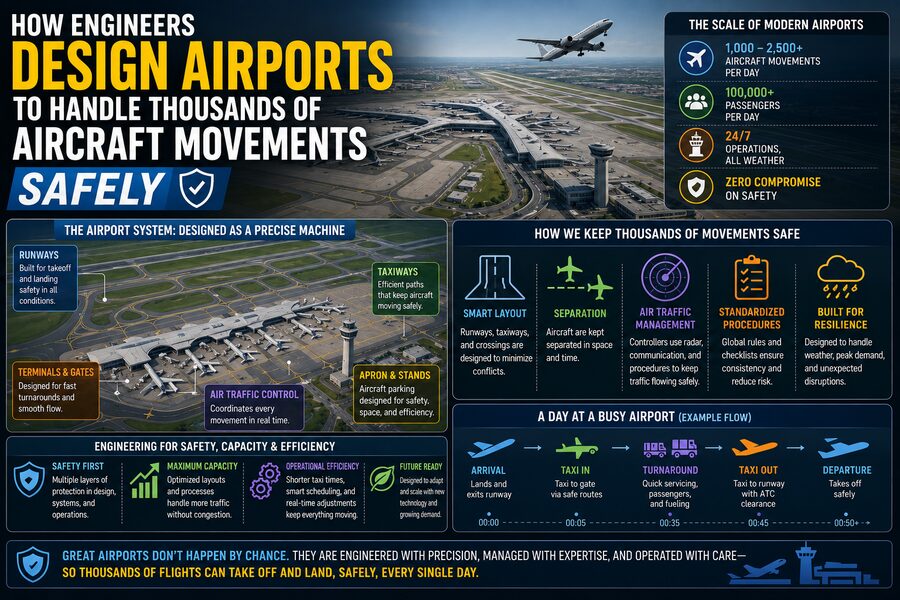

A major international airport can function like a carefully choreographed city in motion. Aircraft are landing, taking off, taxiing, refueling, boarding passengers, loading cargo, undergoing maintenance, and being repositioned—often at the same time. 🛫🛬
Behind this apparent complexity is an enormous amount of engineering.
Airport designers must create a system that allows thousands of aircraft movements to occur safely, efficiently, and predictably while accounting for weather, human behavior, aircraft size, runway capacity, ground traffic, emergency access, and future growth.
An aircraft movement generally refers to a takeoff or landing, while airport operations also include large amounts of taxiing and ground movement between runways, terminals, gates, hangars, and service areas.
The goal is not simply to build long runways.
Engineers must design the entire airport as an interconnected transportation network where every aircraft has enough space, guidance, time, and separation to move safely.
🛬 Runways Are the Core of Airport Capacity
The runway system is one of the most important factors determining how many aircraft an airport can handle.
A runway must be long enough for the types of aircraft expected to use it under anticipated operating conditions.
Required runway length depends on factors such as:
- Aircraft type
- Aircraft weight
- Temperature
- Airport elevation
- Wind
- Runway slope
- Surface condition
- Takeoff and landing performance
A heavily loaded long-haul aircraft may require substantially more runway than a small regional aircraft.
Engineers therefore study the airport’s expected fleet mix before determining runway dimensions.
But runway length is only the beginning.
📐 Runway Orientation Is Determined by Wind
Aircraft generally prefer to take off and land into the wind.
A headwind improves relative airflow over the wings and can reduce the ground distance needed for takeoff and landing.
For this reason, runway orientation is strongly influenced by local wind patterns. 🌬️
Airport planners analyze years of historical wind data to determine the most favorable runway directions.
If winds typically come from one dominant direction, one main runway alignment may handle most operations.
If winds vary substantially, an airport may need crossing runways or multiple runway orientations.
The objective is to provide acceptable operating conditions during as much of the year as practical.
🔢 Why Runways Have Numbers
Runway numbers are based approximately on their magnetic heading, rounded to the nearest ten degrees and with the final zero removed.
For example, a runway aligned approximately toward 270 degrees may be designated:
Runway 27
The opposite end points roughly 180 degrees away and may be:
Runway 09
If an airport has parallel runways, letters are added:
- L = Left
- C = Center
- R = Right
So a large airport might have:
27L, 27C, and 27R
These designations help pilots and air traffic controllers clearly identify the correct runway.
🛫 Multiple Runways Increase Capacity
One runway can handle only a limited number of arrivals and departures within a given period.
Every aircraft requires safe spacing from the aircraft ahead.
If traffic demand is high enough, airports may build multiple runways.
Parallel runway systems are particularly useful because they can allow multiple aircraft flows to operate simultaneously under appropriate procedures and conditions.
One runway might primarily handle arrivals while another handles departures.
At some airports, both may handle a mixture.
The exact operation depends on runway spacing, weather, traffic levels, airspace procedures, and regulatory requirements.
Runway geometry therefore directly influences airport capacity.
🌪️ Wake Turbulence Limits How Closely Aircraft Can Follow
Large aircraft produce swirling air behind their wings known as wake turbulence.
Wingtip vortices can remain in the atmosphere after an aircraft passes.
A smaller aircraft encountering strong wake turbulence can experience a sudden and dangerous rolling motion.
Air traffic procedures therefore require appropriate spacing between aircraft depending partly on aircraft category and operating conditions.
This means an airport cannot simply place one aircraft immediately behind another.
Even if a runway is physically empty, controllers may need to wait before allowing the next aircraft to use it.
Wake turbulence is therefore both a safety issue and a capacity constraint.
🚕 Taxiways Keep Runways From Becoming Roads
Aircraft spend a significant portion of their airport time taxiing.
A taxiway is a designated path connecting runways with terminals, gates, hangars, cargo facilities, and other airport areas.
Good taxiway design is critical because every extra second an aircraft spends occupying a runway can reduce the number of takeoffs and landings the airport can handle.
Engineers therefore try to let aircraft enter and exit runways efficiently.
A busy runway should ideally be used for one thing:
Taking off and landing.
Aircraft should leave it quickly after touchdown.
⚡ Rapid-Exit Taxiways
High-capacity airports often use rapid-exit taxiways, sometimes called high-speed exits.
Instead of forcing a landing aircraft to slow nearly to taxi speed before making a sharp turn off the runway, a rapid-exit taxiway joins the runway at a shallower angle.
This allows aircraft to leave the runway at a higher speed.
Imagine Aircraft A lands.
The sooner it clears the runway, the sooner Aircraft B may be able to land or Aircraft C may depart.
Reducing runway occupancy time by even a few seconds can matter when repeated hundreds of times per day. ⏱️
Airport capacity is often improved through these small operational efficiencies.
🛣️ Parallel Taxiways Reduce Runway Crossings
A well-designed airport often includes taxiways running parallel to its runways.
Aircraft can then travel alongside the runway without occupying it.
This is especially important at airports with terminals located between or beside multiple runways.
Poorly designed layouts may force aircraft to cross active runways repeatedly.
Every runway crossing creates an additional coordination task and potential safety risk.
Engineers therefore try to minimize unnecessary runway crossings wherever practical.
⚠️ Runway Incursions Are a Major Design Concern
A runway incursion occurs when an aircraft, vehicle, or person is incorrectly present on a protected runway area.
Because aircraft may be traveling at very high speeds during takeoff or landing, runway incursions can be extremely dangerous.
Airport design helps reduce the risk through:
- Clear taxiway geometry
- Standardized markings
- Signs
- Lighting
- Stop bars
- Surface surveillance
- Controlled access points
Human-factors engineering is extremely important.
Pilots must be able to quickly understand where they are and where they should go—even at night, in rain, or at an unfamiliar airport.
🚦 Airport Signs and Markings Form a Visual Language
Airport pavement contains a carefully standardized visual system.
Different colors and patterns communicate different meanings.
Pilots use pavement markings and signs to identify:
- Runways
- Taxiways
- Holding positions
- Gates
- Restricted areas
- Taxi routes
For example, runway holding-position markings tell pilots where they must stop unless cleared to proceed.
The goal is to make airport navigation understandable at a glance.
This visual language reduces ambiguity and supports safe movement during complex operations. 👀
💡 Airfield Lighting Keeps Operations Moving at Night
Airport operations do not stop when the sun goes down.
Lighting systems help pilots navigate during darkness and reduced visibility.
Airports may include:
- Runway edge lights
- Taxiway edge or centerline lights
- Approach lighting
- Threshold lights
- Runway centerline lights
- Stop-bar lights
- Guidance signs
Different colors help pilots identify different parts of the airfield.
These lighting systems are carefully positioned so they provide guidance without creating confusing visual clutter.
🌫️ Low-Visibility Operations Require Extra Engineering
Fog, heavy rain, snow, or low clouds can greatly reduce what pilots can see.
Airports designed for reliable operation in poor weather may include precision navigation and landing systems.
One traditional technology is the Instrument Landing System, or ILS.
An ILS provides electronic guidance that helps an aircraft align with the runway and descend along the appropriate path.
Other modern navigation technologies can provide similar precision through satellite-based and advanced approach procedures.
When visibility becomes very low, aircraft spacing may need to increase.
That can reduce airport capacity even if the physical runway system has not changed.
📡 Air Traffic Control Coordinates the Entire System
Airport infrastructure alone cannot safely handle large volumes of traffic.
Air traffic controllers coordinate aircraft movements.
At a major airport, different controllers may specialize in different phases of operation.
Examples include:
- Approach control
- Tower control
- Ground control
- Clearance delivery
An arriving aircraft may transition through several controllers before reaching its gate.
Departing aircraft follow the process in reverse.
This division of responsibilities helps make highly complex traffic manageable.
🗼 Why the Control Tower Is Positioned Carefully
The airport control tower must provide controllers with a useful view of critical movement areas.
Engineers and planners consider:
- Sight lines
- Runway locations
- Terminal structures
- Future construction
- Glare
- Building height
If terminals or hangars block important areas, surveillance technology can supplement direct visual observation.
Some airports and air navigation systems also use remote or digital tower technologies that rely heavily on cameras and sensors.
The underlying objective remains the same:
Controllers need reliable awareness of what is happening on the ground and in nearby airspace.
📡 Surface Surveillance Tracks Aircraft and Vehicles
At large airports, controllers may use surface surveillance systems to monitor aircraft and service vehicles.
This becomes especially valuable at night or during poor visibility.
Aircraft transponders and airport sensors can help display the positions of moving objects.
Advanced systems can also provide conflict warnings.
For example, if an aircraft begins entering a runway when another aircraft is approaching, automated safety systems may generate an alert.
Technology adds an additional safety layer to human control.
🏢 Terminal Design Affects Aircraft Flow Too
Terminals are not simply passenger buildings.
Their geometry strongly influences how aircraft move.
If gates are poorly arranged, aircraft may block one another while pushing back.
A taxi lane may become congested.
Service vehicles may interfere with aircraft movement.
Engineers therefore design terminal aprons and gate layouts with aircraft maneuvering in mind.
They must account for:
- Wingspan
- Turning radius
- Jet blast
- Pushback paths
- Ground-equipment zones
- Passenger boarding systems
A terminal that handles passengers efficiently but causes severe aircraft congestion is not an efficient airport.
🅿️ Gates Are Like Parking Spaces for Aircraft
Each gate must accommodate specific aircraft sizes.
A narrow-body jet and a large wide-body aircraft have very different space requirements.
Some airports use flexible gate systems where neighboring stands can be reconfigured depending on aircraft size.
Gate scheduling is another major optimization problem.
Airlines need gates at particular times, but flights frequently arrive early or late.
If one delayed aircraft remains parked too long, the next flight assigned to that gate may have nowhere to go.
Airports therefore use sophisticated gate-management software to adjust assignments dynamically. 💻
🔄 Aircraft Turnaround Time Matters
After landing, an aircraft normally needs to be prepared for its next flight.
This process is called the turnaround.
Activities may include:
- Passenger deboarding
- Boarding
- Refueling
- Catering
- Baggage unloading
- Baggage loading
- Cabin cleaning
- Water servicing
- Maintenance inspections
Many of these tasks happen simultaneously.
Good airport apron design allows service teams to work around the aircraft without interfering with one another.
Shorter and more predictable turnaround times help airlines keep aircraft moving and reduce gate congestion.
🚚 Airports Have Their Own Ground-Traffic Networks
A busy apron may contain dozens of vehicle types:
- Baggage tractors
- Fuel trucks
- Catering vehicles
- Passenger buses
- Maintenance vehicles
- Pushback tractors
- Emergency vehicles
Aircraft and vehicles often operate in the same general area.
Engineers design dedicated service roads and operating zones to reduce unnecessary conflicts.
Markings, speed limits, training, and communication procedures help coordinate ground traffic.
At a major airport, managing vehicles can resemble designing a small city’s road system. 🚛
🔥 Jet Blast Must Be Considered
Jet engines produce enormous exhaust forces.
If an aircraft applies substantial thrust while another vehicle or structure is behind it, the resulting jet blast can be dangerous.
Airport engineers therefore consider engine thrust when determining:
- Stand orientation
- Taxiway separation
- Blast fences
- Building locations
- Vehicle roads
Some areas may include specially designed blast deflectors that redirect high-speed exhaust.
⛽ Fuel Infrastructure Must Support High Throughput
Large airports consume enormous quantities of aviation fuel.
Driving individual fuel trucks from distant storage facilities to every aircraft may create congestion.
Some major airports use underground hydrant systems.
Fuel is transported through pipelines beneath the apron to connection points near aircraft stands.
A smaller servicing vehicle connects the hydrant to the aircraft.
This reduces the amount of large fuel-tanker traffic moving around busy terminal areas.
Infrastructure hidden beneath the pavement can therefore improve both efficiency and safety.
🧱 Pavement Must Support Enormous Loads
Airport runways and taxiways are much more heavily engineered than ordinary roads.
Large aircraft can weigh hundreds of tonnes.
Their landing gear concentrates substantial loads onto relatively small pavement areas.
Engineers design pavement layers to distribute these forces into the ground.
They consider:
- Aircraft weight
- Landing gear configuration
- Number of movements
- Soil strength
- Temperature
- Water drainage
- Material fatigue
Repeated aircraft movements gradually wear pavement.
Maintenance programs therefore monitor cracking, deformation, surface friction, and structural condition.
🌧️ Drainage Is a Safety System
Water on a runway can reduce tire grip and increase the risk of hydroplaning.
Airport engineers therefore give enormous attention to drainage.
Runways are designed with carefully controlled slopes that help water flow toward drainage systems.
Surface texture also helps tires maintain contact with pavement.
Engineers monitor runway friction because landing and braking performance depend on it.
Rainfall that seems routine on a city street can become a significant operational issue for an aircraft landing at high speed. 🌧️
❄️ Snow and Ice Can Reduce Airport Capacity
Cold-weather airports need additional infrastructure for winter operations.
Snowplows, sweepers, deicing equipment, storage areas, and treatment systems may be required.
Runways and taxiways must sometimes be cleared rapidly between aircraft movements.
Aircraft themselves may also require deicing before departure.
A layer of frost or ice on a wing can interfere with airflow and reduce lift.
Airport layouts may therefore include dedicated deicing pads positioned so treated aircraft can reach the runway efficiently.
🧴 Deicing Fluid Must Be Managed Environmentally
Aircraft deicing uses specialized fluids.
Large volumes may be required during severe winter weather.
Engineers design collection and drainage systems to prevent uncontrolled release into the surrounding environment.
Some airports can recover or treat parts of the fluid.
This illustrates how airport engineering must combine operational performance with environmental management.
🧯 Emergency Response Shapes Airport Layout
Airports must be prepared for emergencies even though serious incidents are rare.
Specialized aircraft rescue and firefighting services need rapid access to runways and other operational areas. 🚒
Fire stations are positioned based partly on required response performance.
Emergency routes need to remain clear.
Airport planners also consider:
- Fuel fires
- Medical emergencies
- Disabled aircraft
- Evacuations
- Hazardous-material events
An efficient airport layout must work not only during normal traffic but also during abnormal situations.
🛠️ What Happens When an Aircraft Breaks Down on a Runway?
A disabled aircraft can severely disrupt operations.
If an aircraft stops on the only available runway, the entire airport may temporarily lose much of its capacity.
Large airports therefore develop aircraft-recovery plans.
Specialized equipment may be available to move damaged or disabled aircraft.
Multiple-runway airports have additional operational flexibility because traffic may sometimes be shifted to other runways.
Redundancy is an important part of resilient airport design.
🧭 Runway Separation Is Carefully Engineered
When airports use multiple runways, the distance and geometry between them matter.
Spacing affects whether operations can occur independently or whether one runway’s traffic constrains another.
Engineers must account for:
- Aircraft separation
- Navigation accuracy
- Wake turbulence
- Taxiway connections
- Emergency areas
- Air traffic procedures
Parallel runways that appear simple from above actually involve a complicated combination of civil engineering and airspace design.
🌐 Airport Capacity Depends on Airspace Too
An airport may have enough runways physically to handle more aircraft, but the surrounding airspace may become the limiting factor.
Arriving aircraft must follow safe routes toward the airport.
Departing aircraft need routes away from it.
Nearby airports may have overlapping traffic patterns.
Mountains, restricted airspace, military zones, and weather can further constrain routing.
Airport engineering therefore extends beyond the airport boundary.
Airspace planners and airport engineers must work together.
🛬 Arrival Streams Are Carefully Sequenced
During busy periods, aircraft may approach an airport from many directions.
Air traffic controllers organize them into orderly arrival streams.
Aircraft may be instructed to change:
- Speed
- Altitude
- Heading
The objective is to establish safe and efficient spacing before they reach the runway.
Modern systems can use sophisticated arrival-management tools to help sequence aircraft.
An efficient arrival flow reduces unnecessary holding and fuel consumption.
🛫 Departures Must Also Be Sequenced
Departing aircraft do not simply take off whenever they reach the runway.
Controllers must consider:
- Arrival traffic
- Wake turbulence
- Departure routes
- Weather
- Aircraft performance
- Airspace restrictions
A line of aircraft waiting for takeoff may include aircraft of very different sizes and destinations.
The departure sequence can sometimes be optimized to increase runway utilization while maintaining required separation.
This turns runway management into a real-time scheduling problem.
⏱️ Airport Slots Help Manage Demand
Some extremely busy airports have more demand than available runway or terminal capacity.
In such cases, airlines may receive specific operating times known as slots, depending on the applicable airport and regulatory system.
Slots help prevent every airline from scheduling flights during the same peak period.
Without demand management, an airport might theoretically have 100 aircraft scheduled to depart during a period when its infrastructure can reliably handle far fewer.
Capacity planning therefore involves both physical engineering and scheduling.
📊 Simulation Helps Engineers Test Airport Designs
Before building a new runway or terminal, engineers often create detailed computer simulations.
These can model:
- Aircraft arrival rates
- Taxi times
- Runway occupancy
- Gate usage
- Weather
- Delays
- Pushbacks
- Ground vehicles
The model may simulate an entire day of operations.
Engineers can then ask:
What happens if traffic grows by 20%?
Will this taxiway become congested?
Would an additional rapid-exit taxiway reduce delays?
Simulation allows expensive infrastructure ideas to be tested virtually before construction begins. 🖥️
🤖 Optimization Software Coordinates Complex Operations
Modern airports increasingly rely on software to coordinate aircraft movements.
Algorithms can help optimize:
- Gate assignments
- Runway sequences
- Taxi routes
- Departure timing
- Ground handling
- Passenger connections
The challenge is that all these systems interact.
Changing a gate assignment might shorten passenger walking distance but increase aircraft taxi time.
Moving one departure earlier may create a wake-turbulence conflict.
Airport optimization therefore involves balancing many objectives simultaneously.
📈 Peak-Hour Capacity Matters More Than Daily Totals
An airport might be able to handle many flights over 24 hours but still experience severe congestion during the morning peak.
Engineers therefore focus heavily on peak-hour capacity.
Infrastructure has to handle intense bursts of demand.
This is similar to designing a highway.
Average daily traffic is useful, but morning rush hour often determines how many lanes are needed.
Airports face the same challenge with runways, gates, baggage systems, security checkpoints, and access roads.
🧳 Passenger Systems Must Match Aircraft Capacity
Aircraft operations cannot be separated from passenger operations.
Suppose a runway system can handle 60 arrivals per hour, but immigration facilities can process passengers from only 40 flights.
The terminal becomes the bottleneck.
Likewise, inadequate baggage systems can delay aircraft departures.
Airport engineers therefore consider the entire passenger journey:
Road or rail → Terminal → Security → Gate → Aircraft
and the reverse for arrivals.
Capacity is only as strong as the weakest major subsystem.
🧳 Baggage Handling Is an Engineering Network of Its Own
Large airports may move tens of thousands of bags every hour.
Conveyor systems, sorting machines, scanners, and tracking technology route bags toward the correct flights.
Bags may need to travel considerable distances beneath terminals.
Transfer passengers create additional complexity because luggage must move quickly between arriving and departing aircraft.
A delayed baggage system can delay flights even when runways and gates are operating perfectly.
🛰️ Navigation Technology Increases Predictability
Modern aircraft rely on increasingly precise navigation technologies.
Accurate aircraft positioning allows routes and procedures to be designed more efficiently.
Performance-based navigation can help aircraft follow repeatable tracks through busy airspace.
Predictability makes it easier to manage traffic flows and reduce unnecessary vectoring.
The broader trend is toward treating airport and airspace operations as a coordinated information system rather than simply a collection of concrete surfaces.
🌳 Wildlife Management Is Part of Flight Safety
Birds and other animals can create serious risks around airports.
Bird strikes can damage aircraft engines, windshields, and other components.
Airport planners therefore consider wildlife when designing surrounding landscapes and drainage systems.
They may avoid features that strongly attract birds near flight paths.
Operational teams also monitor and manage wildlife activity.
Even landscaping decisions can become part of aviation safety. 🐦
🔊 Noise Influences Airport Design
Aircraft noise strongly affects communities around airports.
Runway orientation and flight paths can influence which neighborhoods experience the greatest noise exposure.
Engineers and planners may use:
- Noise modeling
- Preferential runway procedures
- Land-use planning
- Sound insulation programs
The challenge is balancing operational efficiency with community impact.
An airport cannot always simply route every aircraft along the technically shortest path.
🌱 Environmental Efficiency Is Becoming More Important
Airports increasingly try to reduce unnecessary fuel burn and emissions.
A large jet burns fuel while taxiing.
Long ground queues therefore waste both time and energy.
Efficient taxiway layouts, gate planning, and departure sequencing can reduce unnecessary engine operation.
Some airports also use electric ground equipment, renewable energy, efficient terminal systems, and improved public transportation connections.
Operational efficiency and environmental efficiency are often closely connected. 🌍
🔌 Toward More Automated Ground Operations
Future airport operations are likely to involve increasing automation.
Possible technologies include:
- Automated towing systems
- AI-assisted traffic management
- Advanced surface surveillance
- Digital towers
- Autonomous ground vehicles
- Predictive maintenance
- Collaborative airport operations platforms
The objective is not simply automation for its own sake.
It is to improve predictability and reduce conflicts in an environment where hundreds of independent activities are happening simultaneously.
🧠 Human Factors Remain Critical
Despite advanced technology, airports remain human-centered systems.
Pilots, controllers, ground crews, maintenance workers, dispatchers, and emergency teams all make critical decisions.
Engineers therefore design systems around human limitations.
Signs need to be readable.
Radio instructions need to be clear.
Taxiway routes should avoid unnecessary complexity.
Control interfaces must highlight important information without overwhelming users.
A technically efficient design that consistently confuses people is not truly safe.
🧱 Airports Are Designed With Safety Margins
Aviation engineering rarely assumes everything will happen perfectly.
Runways include protected areas around them.
Aircraft are separated by minimum distances or times.
Pavements are designed for repeated loads.
Critical systems may have backup power.
Air traffic procedures incorporate redundancy.
This reflects a central principle of aviation safety:
Do not rely on one perfect action to prevent an accident.
Instead, create multiple layers of protection. 🛡️
🔄 Collaborative Decision-Making Improves Efficiency
An airport is operated by many organizations.
These can include:
- Airport operator
- Airlines
- Air traffic control
- Ground handlers
- Security agencies
- Fuel suppliers
- Maintenance teams
- Weather services
If each works from different information, inefficiency increases.
Modern airport operations increasingly emphasize collaborative decision-making.
Shared information about delays, gate readiness, weather, and departure times allows everyone to coordinate around the same operational picture.
Better information can sometimes improve capacity without adding any new concrete.
🏗️ Airports Must Be Designed for Future Growth
Building major airport infrastructure can take years.
A runway or terminal may then operate for many decades.
Engineers therefore cannot design only for today’s traffic.
They must forecast:
- Passenger growth
- Cargo demand
- Aircraft fleet changes
- Airline networks
- Urban development
- New technologies
Land may be reserved for future taxiways, terminals, or runways.
Designing expansion paths early can avoid extremely expensive reconstruction later.
⚖️ Capacity Is Always a System Problem
An airport cannot be judged solely by the number of runways.
Capacity depends on the interaction of many components:
Runways + Taxiways + Gates + Airspace + Terminals + Ground handling + Weather + Procedures + Technology
If any one component becomes overloaded, delays can spread through the entire airport.
For example:
A gate delay may prevent an aircraft from leaving the terminal.
That blocks another arriving aircraft.
The arrival may then need to wait for a stand.
Taxiways become congested.
Runway sequencing may be affected.
One small disruption can propagate through the system.
This is why airport engineering increasingly uses network thinking.
✅ The Bottom Line
Engineers design airports to handle thousands of aircraft movements safely by treating the airport as a highly coordinated transportation system rather than simply a collection of runways.
Runways are oriented around wind and designed for aircraft performance.
Taxiways minimize runway occupancy and unnecessary crossings.
Rapid-exit taxiways help arriving aircraft clear runways quickly.
Lighting, signs, markings, and navigation systems guide pilots.
Air traffic controllers maintain safe separation.
Surface surveillance helps monitor movements.
Terminals and gates are arranged to prevent congestion.
Pavement, drainage, emergency response, fueling, baggage, and ground vehicles are all engineered to support continuous operations. ✈️🏗️
Computer simulation and optimization then help planners understand how the entire system behaves under peak traffic, delays, poor weather, and future growth.
The result is remarkable.
At a busy hub, an aircraft may land, exit the runway, taxi through a complex network, reach an assigned gate, unload hundreds of passengers, be serviced by multiple teams, push back, taxi again, and depart—all while dozens of other aircraft are doing the same thing nearby.
Most passengers experience only the final result: a smooth arrival or departure.
Behind that experience is an enormous network of civil engineering, transportation planning, air traffic management, human-factors design, software, and safety systems working together. 🛫🛬
That is how modern airports turn what could be chaotic movement into one of the most carefully organized transportation systems in the world.