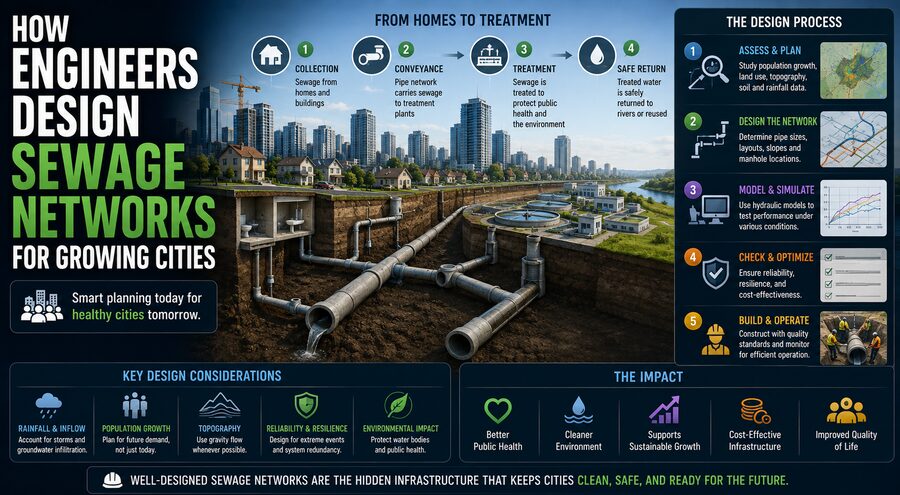

As cities expand, one of the most important systems growing beneath the streets is largely invisible: the sewage network. Every new apartment building, school, hospital, office tower, factory, and neighborhood creates additional wastewater that must be collected and transported safely to treatment facilities. 🏙️🚽
A sewage network may look simple from the surface—pipes carrying wastewater downhill—but designing one for a growing city requires careful engineering.
Engineers must estimate how much sewage the city will produce decades into the future, determine how quickly wastewater will flow through pipes, prevent blockages and overflows, choose pipe sizes and slopes, locate pumping stations, account for groundwater and rainfall, and make sure the entire system can be maintained.
The basic goal is straightforward:
Collect wastewater ➡️ Transport it safely ➡️ Prevent backups and overflows ➡️ Deliver it to treatment
Achieving that goal for millions of people requires a combination of hydraulics, urban planning, surveying, geotechnical engineering, environmental science, and long-term forecasting. 🌍⚙️
🚽 What Is a Sewage Network?
A sewage network is a system of underground pipes and related infrastructure designed to collect wastewater from homes, businesses, institutions, and industries.
Wastewater may contain:
- Human waste
- Soap and detergents
- Food particles
- Household wastewater
- Commercial wastewater
- Industrial discharges
Smaller pipes from individual buildings connect to larger public sewers.
Those larger sewers gradually combine into even bigger pipes that carry wastewater toward a treatment plant.
A simplified network looks like:
House connection ➡️ Local sewer ➡️ Branch sewer ➡️ Trunk sewer ➡️ Treatment plant
The farther downstream the wastewater travels, the larger the flow usually becomes.
🏙️ Why City Growth Makes Sewer Design Difficult
A sewage system designed for a city of 100,000 people may not be adequate when the population reaches 500,000.
Growth can come from:
- New housing
- Urban densification
- Industrial development
- Commercial districts
- Population migration
- Tourism
- Expansion into surrounding suburbs
Engineers therefore cannot design only for today’s demand.
They must estimate future wastewater generation over a planning horizon that may extend 20, 30, or even 50 years.
If the network is too small, the city may experience overflows and expensive reconstruction.
If it is dramatically oversized, construction costs rise unnecessarily and low flow velocities may allow solids to settle inside the pipes.
Good design requires finding the right balance. ⚖️
👥 Step 1: Forecast the Future Population
One of the first tasks is estimating how many people the sewer system may need to serve.
Engineers and planners analyze:
- Current population
- Historical growth
- Planned housing projects
- Zoning
- Land availability
- Development policies
- Migration trends
Suppose a district currently contains:
100,000 residents
but planning projections suggest:
180,000 residents in 25 years
The future population is usually much more important for pipe sizing than the present population.
Engineers may also divide the city into smaller catchment areas so growth can be estimated neighborhood by neighborhood.
💧 Step 2: Estimate Wastewater Production
Next, engineers estimate how much wastewater each person or activity generates.
Domestic wastewater production is often related to water consumption.
If residents use water for:
- Toilets
- Showers
- Cooking
- Laundry
- Cleaning
a large percentage of that water eventually enters the sewer network.
A simplified calculation might use:
Average sewage flow = population × wastewater generation per person
For example, if:
150,000 people × 150 liters per person per day
the average flow would be:
22.5 million liters per day
Real designs may also account for commercial, institutional, and industrial wastewater.
📈 Average Flow Is Not Enough
Sewage flow does not remain constant throughout the day.
Residential areas may produce relatively little wastewater at 3:00 a.m. but experience much higher flows in the morning when people wake up.
Another peak may occur in the evening.
Engineers therefore calculate not only average flow but also peak flow.
A peak factor may be applied:
Peak flow = average flow × peak factor
The peak factor depends on the size and characteristics of the population.
Smaller communities can sometimes experience larger proportional fluctuations than very large cities.
The pipes must be able to handle these peak periods without overflowing.
🌧️ Infiltration and Inflow Add Extra Water
A sewer network may receive more than normal wastewater.
Groundwater can leak into damaged pipes through:
- Cracks
- Pipe joints
- Manholes
- Defective connections
This is known as infiltration.
Rainwater may also enter through:
- Illegal storm-drain connections
- Roof drains
- Manhole covers
- Flooded areas
This is called inflow.
Together, these are often referred to as I&I—Infiltration and Inflow.
During heavy rain, I&I can dramatically increase flow through the sewer network.
Engineers must account for these additional volumes, particularly in older cities with aging infrastructure.
🌧️ Separate vs. Combined Sewer Systems
Cities generally use one of two broad approaches.
🚽 Separate Sewer System
A separate system uses different pipe networks for:
- Sanitary sewage
- Stormwater
Wastewater travels to a treatment plant, while rainwater is handled through storm drains, channels, detention systems, or other drainage infrastructure.
🌧️ Combined Sewer System
A combined system carries both wastewater and stormwater in the same pipes.
These systems are common in some older cities.
During heavy rainfall, the combined flow can exceed pipe or treatment capacity.
That may lead to combined sewer overflows, where untreated or partially treated water is discharged to prevent dangerous backups.
Modern urban design often prefers separate systems for new development.
🗺️ Step 3: Divide the City Into Sewer Catchments
A large city cannot usually be designed as one enormous drainage area.
Engineers divide the city into smaller sewer catchments or drainage zones.
Each catchment contributes wastewater to a particular branch of the system.
The boundaries may depend on:
- Ground elevation
- Road layout
- Development areas
- Existing pipes
- Rivers and valleys
- Pump-station locations
Digital mapping systems such as GIS help engineers organize these catchments and calculate the sewage contribution from each area.
⛰️ Gravity Is the Preferred Driving Force
Whenever possible, sewage networks are designed to use gravity.
Wastewater naturally flows downhill, which means no energy is required to move it.
A gravity sewer has a carefully controlled downward slope.
Conceptually:
Higher elevation ➡️ Sloping sewer pipe ➡️ Lower elevation
Gravity systems have major advantages:
- Lower energy consumption
- Fewer mechanical components
- Lower operating costs
- Greater reliability
However, the pipe cannot simply be made as steep as possible.
The velocity must remain within an acceptable range.
📐 Choosing the Correct Pipe Slope
If a sewer pipe is too flat, wastewater moves too slowly.
Solid particles may settle to the bottom and create blockages.
If the pipe is excessively steep, flow can become very fast, potentially creating abrasion, turbulence, hydraulic problems, or difficult connections.
Engineers therefore design for appropriate self-cleansing velocity.
The objective is to keep enough velocity to transport solids under normal operating conditions.
Slope and pipe diameter are closely connected.
A larger pipe at a very low flow may have less effective flow depth and lower velocity than expected.
🧮 Manning’s Equation and Sewer Hydraulics
Engineers often use hydraulic equations to estimate how much flow a sewer can carry.
One common relationship for gravity flow is Manning’s equation.
In simplified form:
Flow capacity depends on pipe area, hydraulic radius, slope, and roughness
The equation helps engineers answer questions such as:
- What diameter is required?
- How much sewage can this pipe carry?
- What velocity will the wastewater reach?
- How does changing slope affect capacity?
Modern design software solves these equations automatically across thousands of pipe sections.
🪠 Why Sewer Pipes Are Usually Not Designed to Run Completely Full
Gravity sewers are often designed to operate only partly full during normal conditions.
The upper part of the pipe contains air.
Leaving spare hydraulic capacity helps accommodate:
- Peak flows
- Future growth
- Infiltration
- Temporary surges
It also helps maintain gravity-flow behavior.
When a sewer becomes fully pressurized unexpectedly, upstream water levels can rise and increase the risk of manhole overflows or building backups.
🧱 Step 4: Select Pipe Diameters
Pipe diameter increases as wastewater moves downstream.
A small residential branch might serve a few streets.
Farther downstream, dozens of branches may enter a larger trunk sewer.
Conceptually:
Small lateral ➡️ Medium branch ➡️ Large interceptor ➡️ Treatment plant
Engineers calculate cumulative flow at each junction.
The downstream pipe must carry all contributing upstream flows, plus allowances for growth and infiltration.
Large trunk sewers in major cities can reach several meters in diameter.
🕳️ Manholes Provide Access
Sewer pipes need regular access for:
- Inspection
- Cleaning
- Maintenance
- Camera surveys
- Blockage removal
Engineers therefore install manholes at strategic locations.
They are typically placed near:
- Changes in direction
- Changes in slope
- Changes in pipe diameter
- Pipe junctions
- Regular intervals along long straight sections
Inside the manhole, channels guide sewage smoothly from incoming pipes to the outgoing pipe.
Good manhole design reduces turbulence and maintenance problems.
🔄 Why Pipe Alignment Matters
Sewers are commonly placed beneath roads because roads provide accessible corridors through developed areas.
However, engineers must coordinate with many other underground systems:
- Drinking-water mains
- Gas pipelines
- Electricity cables
- Telecommunications
- Storm drains
- District heating pipes
The sewer also needs sufficient depth to receive gravity connections from surrounding buildings.
Utility coordination can become extremely complex in dense city centers. 🏙️
⬇️ How Deep Should a Sewer Be?
A sewer must normally be deep enough to:
- Receive building connections
- Maintain the required slope
- Avoid damage from traffic loads
- Remain protected from surface activity
But excessive depth increases construction cost.
Deep excavation may require:
- Trench support
- Dewatering
- Larger machinery
- More safety precautions
Very deep sewer tunnels may require specialized tunneling techniques instead of ordinary open trenches.
Engineers therefore try to optimize both depth and alignment.
🏗️ Pumping Stations Solve Topographic Problems
Gravity cannot always carry sewage all the way to the treatment plant.
A low-lying neighborhood may sit below the elevation of the downstream sewer.
In these situations, engineers use a sewage pumping station, sometimes called a lift station.
Wastewater flows into a wet well.
Pumps then lift it to a higher elevation.
The sequence becomes:
Gravity sewer ➡️ Wet well ➡️ Pump ➡️ Force main ➡️ Higher gravity sewer
The pressurized pipe leaving the pump station is called a force main.
⚡ Pumping Stations Require Redundancy
Sewage cannot simply stop arriving when a pump fails.
For this reason, pump stations usually include redundancy.
A station may have:
- Two duty pumps
- One standby pump
- Backup electrical supply
- Emergency generators
- High-level alarms
- Remote monitoring
If one pump fails, another can continue operating.
This redundancy is crucial because pump-station failure can lead quickly to sewage overflow.
🧪 Industrial Wastewater Requires Special Attention
Industrial districts may produce wastewater very different from domestic sewage.
It can contain:
- High chemical concentrations
- Oils
- Metals
- Acids
- High temperatures
- Organic loads
Some industrial wastewater must be pretreated before entering the municipal sewer.
Engineers assess whether industrial discharges could:
- Corrode pipes
- Create toxic conditions
- Damage treatment processes
- Produce explosive gases
Local discharge regulations help protect both the sewer network and the treatment plant.
☣️ Sewer Gases and Ventilation
Wastewater can produce gases such as:
- Hydrogen sulfide
- Methane
- Carbon dioxide
Hydrogen sulfide can be toxic and can also contribute to corrosion in concrete sewer structures.
Methane can create explosion hazards under certain conditions.
Engineers consider:
- Ventilation
- Gas monitoring
- Corrosion-resistant materials
- Odor-control systems
Large pump stations and enclosed structures require especially careful gas-safety design.
🧱 Choosing Sewer Pipe Materials
Pipe materials depend on diameter, soil conditions, depth, pressure, and chemical exposure.
Common materials can include:
- PVC
- HDPE
- Reinforced concrete
- Ductile iron
- Fiberglass-reinforced pipe
Engineers evaluate:
- Strength
- Corrosion resistance
- Joint performance
- Installation method
- Expected lifespan
- Cost
A pipe that works well in one neighborhood may be unsuitable in another.
🌍 Soil and Groundwater Affect the Design
Sewer design is not purely hydraulic.
Geotechnical conditions matter greatly.
Engineers investigate:
- Soil strength
- Groundwater level
- Rock depth
- Settlement risk
- Excavation stability
In soft ground, heavy pipes may settle if the bedding is poorly designed.
In areas with high groundwater, empty pipes can even experience upward buoyancy forces.
Good geotechnical design helps keep the sewer aligned throughout its service life.
📊 Hydraulic Modeling of the Entire Network
Modern engineers often build digital hydraulic models representing the complete sewer network.
The model may contain:
- Thousands of pipes
- Manholes
- Pump stations
- Flow inputs
- Ground elevations
- Pipe slopes
- Future development areas
The software simulates how wastewater moves through the system.
Engineers can test questions such as:
What happens during peak morning flow?
What happens if the population increases 30%?
What happens if one pump fails?
Where would the network overflow during extreme rainfall?
This allows problems to be identified before infrastructure is built.
🚨 Preventing Sewer Overflows
Sewer overflow is one of the most serious failures a city can experience.
Untreated wastewater can enter:
- Streets
- Homes
- Rivers
- Lakes
- Coastal waters
Overflows can create major public-health and environmental problems.
Engineers prevent them using:
- Adequate pipe capacity
- Storage tanks
- Pump redundancy
- Overflow monitoring
- Infiltration reduction
- Network rehabilitation
Growing cities must carefully monitor older districts because new development can overload downstream pipes originally designed decades earlier.
🏙️ Future Growth Must Be Added Upstream and Downstream
Suppose a new suburb is built at the edge of a city.
Its local sewer pipes may be perfectly adequate.
However, that sewage eventually enters older trunk sewers closer to the city center.
Those downstream pipes may not have enough spare capacity.
Engineers therefore analyze the entire downstream path, not just the new neighborhood.
Sometimes city growth requires upgrading infrastructure kilometers away from the development itself.
🔄 Designing Networks That Can Expand
Future-ready sewage networks may include provisions such as:
- Oversized trunk sewers in growth corridors
- Reserved pump-station sites
- Extra treatment capacity
- Duplicate force mains
- Space for additional pumps
- Future connection points
This allows the system to expand without rebuilding everything.
However, engineers must avoid excessive oversizing that creates poor hydraulic performance or unnecessary cost.
📡 Smart Sewer Monitoring
Modern sewage systems increasingly use sensors and remote monitoring.
Sensors can track:
- Flow rates
- Water levels
- Pump operation
- Pressure
- Overflow events
- Gas concentrations
This information may be transmitted to a central control room.
Operators can identify unusual conditions quickly and adjust pumps or investigate potential blockages.
Real-time monitoring turns the sewer network into a more actively managed infrastructure system. 📡
🤖 Predictive Maintenance
Cities are also beginning to use data analytics to predict sewer failures.
Historical information may reveal patterns associated with:
- Blockages
- Pipe collapse
- Root intrusion
- Pump failure
- Corrosion
Maintenance teams can then prioritize high-risk sections instead of inspecting every pipe equally often.
This reduces emergency failures and makes maintenance budgets more effective.
🌱 Climate Change Complicates Sewer Planning
Growing cities must increasingly consider changing rainfall patterns.
More intense storms may create additional inflow into sanitary sewers or overload combined systems.
Sea-level rise can also affect coastal sewer networks.
High sea levels may:
- Increase groundwater infiltration
- Reduce gravity discharge capacity
- Flood pump stations
Climate resilience may therefore influence pipe sizing, pump-station elevation, emergency storage, and flood protection.
💰 Cost Optimization Is Essential
Sewer systems are expensive.
Costs include:
- Pipes
- Excavation
- Pump stations
- Road restoration
- Land acquisition
- Energy
- Maintenance
A design with large pipes everywhere would provide high capacity but could waste enormous amounts of money.
A design with very small pipes might be cheaper initially but expensive to upgrade later.
Engineers compare life-cycle costs rather than construction costs alone.
A slightly more expensive gravity route may be cheaper over decades if it avoids permanent pumping energy.
🛠️ Maintenance Influences Design
A sewer that performs hydraulically but cannot be maintained safely is not a good design.
Engineers consider:
- Access for cleaning equipment
- Manhole spacing
- Pump removal
- Valve access
- Inspection routes
- Replacement procedures
Modern sewer inspection may use robotic cameras that travel through the pipe and record cracks, roots, deposits, and joint failures.
Designing for maintenance can greatly extend infrastructure life.
🚧 Construction in Busy Cities
Building sewage networks in growing urban areas can be difficult because construction disrupts roads and businesses.
Engineers may use trenchless technologies to reduce surface disruption.
Examples include:
- Microtunneling
- Pipe jacking
- Horizontal directional drilling
- Pipe bursting
These methods can install or replace pipes beneath:
- Highways
- Railways
- Rivers
- Dense neighborhoods
without excavating the entire route.
🧠 Example: Designing for a New Urban District
Imagine a city plans a new district for:
80,000 residents
Engineers might proceed as follows:
- 👥 Forecast population and development.
- 💧 Estimate average wastewater production.
- 📈 Calculate peak flows.
- 🌧️ Add infiltration allowances.
- 🗺️ Divide the area into catchments.
- 📐 Determine gravity pipe slopes.
- 🧮 Size branch and trunk sewers.
- 🕳️ Locate manholes.
- ⚡ Add pump stations where gravity is impossible.
- 📊 Model future conditions.
- 🚨 Check overflow risk.
- 🏗️ Plan staged construction as the district grows.
The result is not simply a pipe network.
It is a long-term infrastructure plan designed to evolve with the city.
🌟 The Bigger Picture
Designing a sewage network for a growing city means planning infrastructure that must operate reliably every hour of every day for decades.
Engineers begin by estimating how populations, neighborhoods, industries, and wastewater volumes may change.
They then use hydraulic calculations to determine how sewage can move through pipes using gravity wherever possible.
The complete system may include:
Building connections 🚽 ➡️ Local sewers ➡️ Branch sewers ➡️ Trunk sewers ➡️ Pump stations ⚡ ➡️ Treatment plant 🌱
Every component must work together.
Pipes need enough capacity for peak flows but sufficient velocity to prevent solids from settling. Pump stations need redundancy. Manholes must allow maintenance. Materials must survive soil loads, chemicals, groundwater, and decades of service.
Modern engineers also use GIS, hydraulic modeling, sensors, predictive maintenance, and climate-risk analysis to make networks more resilient.
Perhaps the greatest challenge is that sewer infrastructure must be designed for a city that does not yet fully exist.
Neighborhoods will grow. Water use may change. Industries may move. Rainfall patterns may intensify. New regulations may require higher environmental standards.
A successful sewage network therefore does more than handle today’s wastewater. It creates enough flexibility, capacity, and resilience to support the city of the future. 🏙️🌍
When designed well, the public barely notices it.
That invisibility is actually a sign of success: wastewater disappears safely from homes and businesses, streets remain clean, rivers remain protected, and urban growth can continue without overwhelming one of the city’s most essential systems. 🚰⚙️🌱