
Before engineers can safely construct a building, bridge, road, storage tank, airport runway, or industrial facility, they must answer a basic question:
Can the ground underneath support it? 🌍
Sometimes the answer is no—at least not in its natural condition.
A construction site may contain loose sand, soft clay, organic soil, uncontrolled fill, highly compressible silt, collapsible deposits, or groundwater conditions that make the ground too weak or unstable for the planned structure. If heavy construction is placed directly on such soil, the ground may compress excessively, settle unevenly, lose strength, or even fail.
One solution is to excavate the poor soil and replace it with better material. Another is to bypass weak layers using deep foundations such as piles.
But these approaches can be expensive.
A third option is ground improvement. 🏗️⚙️
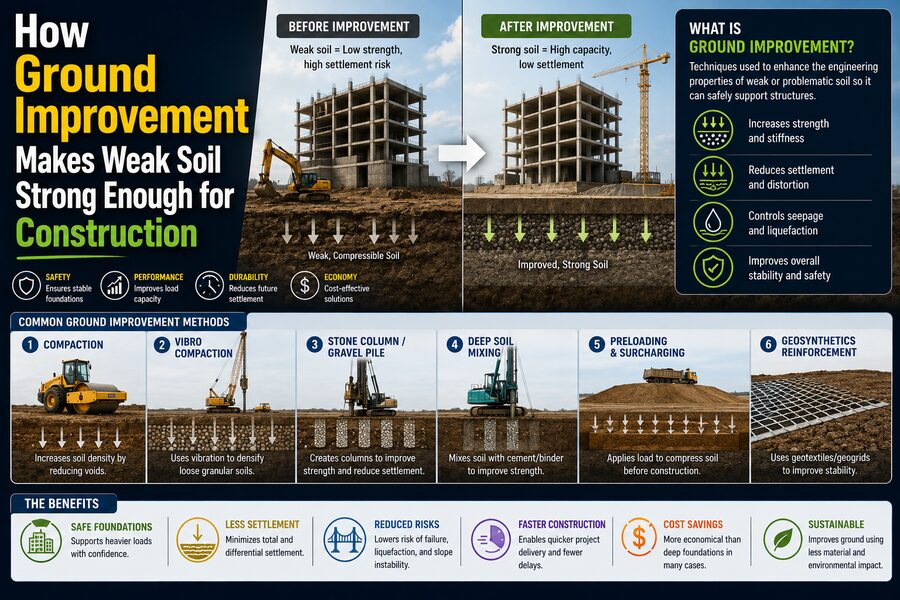
Ground improvement uses mechanical, hydraulic, chemical, or reinforcement techniques to modify weak soil so that it performs better under construction loads. Engineers may compact it, drain it, densify it, mix it with cement, reinforce it with stone columns, or accelerate settlement before the final structure is built.
The objective is not necessarily to transform soil into rock. Instead, engineers improve exactly the properties needed to make the site suitable for construction.
🧠 What Is Ground Improvement?
Ground improvement is the deliberate modification of soil or fill to improve its engineering behavior.
Depending on the project, engineers may want to increase:
- Bearing capacity
- Shear strength
- Density
- Stiffness
- Drainage
- Liquefaction resistance
They may also want to reduce:
- Settlement
- Compressibility
- Permeability
- Shrinkage
- Swelling
- Lateral movement
Different methods solve different problems.
For example, loose sand might need to be densified, while soft saturated clay may need improved drainage and consolidation.
Understanding the soil is therefore the first step.
🔍 Why Weak Soil Is a Construction Problem
Structures transfer their weight into the ground through foundations.
If the soil cannot safely resist those loads, several problems can occur.
📉 Excessive Settlement
Soil compresses under load.
A small amount of settlement can often be tolerated, but excessive settlement may damage:
🧱 Walls
🚪 Doors
🪟 Windows
📏 Floors
🔩 Utility connections
If different parts of a structure settle by different amounts, the problem becomes differential settlement.
This can cause cracking and distortion even when the total settlement is moderate.
⚠️ Bearing Capacity Failure
Soil can only support a limited amount of pressure.
If foundation loading exceeds the ground’s bearing capacity, the soil may shear and move outward.
The foundation could tilt or sink suddenly.
Engineers therefore evaluate whether the soil has enough strength to safely transfer structural loads.
Ground improvement can increase this strength.
🌊 Soft Soil Can Continue Settling for Years
Soft clay presents a special problem because it often contains large amounts of water.
When a new building is constructed, the added weight increases pressure within the soil.
Water trapped in tiny pores gradually escapes.
As the water leaves, the soil skeleton compresses.
This process is called consolidation.
In low-permeability clay, consolidation can continue for months or years.
A building constructed too early may keep settling long after completion.
Engineers can use ground improvement to accelerate this process before the building is constructed.
🧪 Step 1: Engineers Investigate the Ground
Ground improvement begins with a geotechnical site investigation.
Engineers need to understand what exists beneath the surface.
Investigation methods may include:
🕳️ Boreholes
🧪 Soil sampling
📏 Standard Penetration Tests
🔍 Cone Penetration Tests
💧 Groundwater measurements
🌊 Permeability tests
🧱 Laboratory strength tests
A soil profile might reveal:
0–2 m: loose fill
2–8 m: soft clay
8–15 m: dense sand
Below 15 m: stiff clay
The improvement technique depends heavily on this layering.
A method that works extremely well in loose sand may be ineffective in soft clay.
🚜 1. Compaction Improves Shallow Soil
One of the simplest ground-improvement methods is compaction.
Compaction rearranges soil particles into a denser configuration by applying mechanical energy.
Construction equipment may include:
🚜 Smooth rollers
⚙️ Vibratory rollers
🛞 Pneumatic rollers
🔨 Rammers
Compaction reduces air voids and increases density.
Well-compacted soil generally has:
✅ Greater strength
✅ Higher stiffness
✅ Lower settlement potential
✅ Better resistance to deformation
This technique is commonly used for roads, building pads, embankments, and engineered fills.
💧 Why Moisture Content Matters During Compaction
Soil does not compact equally well at every moisture level.
If soil is too dry, particles may not rearrange efficiently.
If it is too wet, pore water can interfere with densification.
Engineers often determine an optimum moisture content using laboratory compaction tests.
At this moisture level, a given compactive effort produces approximately the maximum dry density.
Construction crews then measure field density to verify that required compaction has been achieved.
This is why earthwork specifications may require something such as:
95% of maximum dry density
rather than simply saying the soil should be “well compacted.”
🔨 2. Dynamic Compaction Densifies Deeper Ground
Ordinary rollers mainly improve shallow layers.
For deeper loose soils, engineers may use dynamic compaction.
A very heavy weight is repeatedly dropped from a large height onto the ground.
Each impact sends powerful stress waves through the soil.
The soil particles rearrange into a denser configuration.
The process may create dramatic craters that are later filled and recompacted.
Dynamic compaction can be useful for:
🏗️ Loose fill
🏭 Industrial sites
🧱 Reclaimed land
🏚️ Former landfill areas in suitable conditions
🌍 Loose granular deposits
The effectiveness depends on soil type, groundwater, drop energy, and treatment depth.
🌊 3. Vibrocompaction Densifies Loose Sand
Loose saturated sand can often be improved using vibrocompaction.
A vibrating probe is lowered into the ground.
The vibration temporarily reduces friction between sand grains, allowing them to rearrange into a denser configuration.
Additional granular material may be added at the surface to fill the reduced volume.
As treatment progresses upward, the surrounding soil becomes denser.
Vibrocompaction can improve:
📈 Bearing capacity
📉 Settlement behavior
🛡️ Liquefaction resistance
It works best in relatively clean granular soils such as sand.
Soils containing large amounts of clay may not respond effectively because cohesive particles do not rearrange in the same way.
🌎 Why Densification Helps Resist Liquefaction
Loose saturated sand can lose much of its strength during strong earthquake shaking.
This phenomenon is known as liquefaction.
During rapid shaking, pore-water pressure can increase faster than the water can drain.
The effective stress between soil grains decreases.
The ground may temporarily behave more like a fluid than a stable solid. 🌊⚠️
Densification reduces the tendency for this pressure buildup.
Ground-improvement methods such as vibrocompaction, dynamic compaction, and certain column systems are therefore commonly considered for liquefaction mitigation.
🪨 4. Stone Columns Reinforce Weak Soil
Stone columns, also called granular columns, are constructed by replacing or displacing portions of weak soil with compacted gravel or crushed stone.
A typical arrangement consists of many vertical stone columns installed in a grid beneath the future structure.
The improved ground becomes a composite system:
Weak soil + strong granular columns
The stone columns can:
✅ Carry part of the structural load
✅ Increase overall stiffness
✅ Reduce settlement
✅ Improve drainage
✅ Increase shear resistance
They are frequently used under embankments, tanks, industrial slabs, and buildings where site conditions are appropriate.
💧 Stone Columns Also Act as Drains
One important advantage of stone columns is their high permeability.
Soft clay drains very slowly because its pore spaces are tiny.
Stone columns provide much easier vertical drainage paths.
When loads are applied, pore water can move toward the columns and escape more rapidly.
This can accelerate consolidation.
So stone columns may both reinforce the soil mechanically and improve its drainage hydraulically.
🧱 5. Deep Soil Mixing Creates Soil-Cement Columns
Some weak soils cannot be effectively compacted.
Soft clay, peat-like deposits, or highly compressible soils may instead be strengthened using deep soil mixing.
Large rotating tools mix the existing soil with binders such as cement or lime.
After curing, the treated soil becomes much stronger and stiffer.
The process can create:
- Individual columns
- Overlapping panels
- Continuous walls
- Large treated blocks
Deep soil mixing is useful for:
🏢 Foundation support
🛣️ Embankment stabilization
🌊 Excavation support
💧 Seepage control
⚓ Marine construction
Instead of removing poor soil, the method improves it in place.
🧪 How Cement Changes Soil Behavior
When cementitious binders are mixed with soil and water, chemical reactions create bonds among soil particles.
The resulting material may have much greater:
📈 Compressive strength
📏 Stiffness
🛡️ Erosion resistance
and lower:
💧 Permeability
The amount of binder required depends on soil chemistry and desired performance.
Engineers typically conduct laboratory mixing trials before construction.
Organic soils and certain chemical conditions may interfere with cement hydration, so testing is essential.
🌀 6. Jet Grouting Creates High-Strength Soil Columns
Jet grouting uses high-energy jets of fluid to break up soil and mix it with cement grout.
A drilling tool is lowered into the ground and then rotated while being withdrawn.
The jet erodes and mixes the surrounding soil.
After hardening, a soil-cement column remains.
Jet grouting can be useful where precise treatment is needed in difficult locations.
Applications include:
🏢 Underpinning existing buildings
🚇 Tunnel construction
💧 Groundwater cutoffs
🕳️ Excavation support
🔧 Foundation repair
Because equipment can operate through relatively small access points, jet grouting is valuable in congested urban sites.
🧱 7. Grouting Can Fill Voids and Strengthen Ground
Grouting generally involves injecting a fluid material into soil or rock.
The grout later stiffens or hardens.
Different grouting techniques work in different ways.
💉 Permeation Grouting
Low-viscosity grout flows through existing soil pores without significantly disturbing the ground structure.
🧱 Compaction Grouting
A stiff grout is injected to displace and compact surrounding soil.
⚙️ Chemical Grouting
Low-viscosity chemical solutions penetrate small pores and then form a gel or solid.
Grouting can be used to:
✅ Increase strength
💧 Reduce water flow
🕳️ Fill underground voids
🏢 Stabilize foundations
⏳ 8. Preloading Makes Weak Soil Settle Before Construction
Suppose engineers know that a building will eventually place a large load on soft clay.
Instead of allowing the finished building to cause the settlement, they can intentionally load the soil before construction.
This technique is called preloading or surcharging.
Temporary soil or other heavy material is placed on the site.
The added weight compresses the weak soil.
Over time, pore water escapes and the ground settles.
Once most of the expected settlement has occurred, the temporary surcharge is removed and construction begins.
The goal is simple:
Make the ground experience much of its future settlement before the permanent structure arrives. ⏳🏗️
🚰 9. Vertical Drains Accelerate Consolidation
Preloading alone can take a very long time in soft clay.
To speed the process, engineers may install prefabricated vertical drains, often called wick drains.
These are thin synthetic drainage strips inserted deep into the ground.
Instead of pore water traveling a long vertical distance through clay, it can move horizontally toward a nearby drain.
Water then travels upward through the drainage path.
This dramatically shortens the drainage distance.
A project that might otherwise require years of natural consolidation may be accelerated considerably.
Vertical drains are commonly combined with surcharge loading beneath:
🛣️ Highways
🏗️ Embankments
⚓ Ports
✈️ Airport facilities
🌬️ 10. Vacuum Consolidation Uses Atmospheric Pressure
Another technique for soft ground is vacuum consolidation.
The treatment area is sealed using an airtight membrane.
Vacuum pumps reduce pore pressure beneath the membrane.
This increases effective stress in the soil without requiring the same amount of heavy surcharge fill.
The soil consolidates as water is removed.
Vacuum methods can be particularly useful when placing a very heavy embankment would create stability problems.
🧵 11. Geosynthetics Reinforce Soil
Not all ground improvement changes the soil itself.
Sometimes engineers reinforce it.
Geosynthetics are manufactured polymer materials used within soil systems.
Examples include:
🧵 Geotextiles
🕸️ Geogrids
💧 Geocomposites
A geogrid placed beneath an embankment can distribute loads and restrain lateral soil movement.
Reinforced soil behaves somewhat like a composite material.
The soil carries compression effectively while the geosynthetic provides tensile resistance.
Applications include:
🛣️ Roads over soft ground
🏗️ Working platforms
🧱 Retaining walls
🌄 Reinforced slopes
🔩 12. Soil Nailing Stabilizes Slopes and Excavations
Soil nailing reinforces existing soil using closely spaced steel bars installed into a slope or excavation face.
The nails work with the surrounding soil to create a stronger reinforced mass.
A facing layer—often shotcrete—helps stabilize the exposed surface.
Soil nailing is widely used for:
🚧 Road cuttings
🏙️ Urban excavations
🌄 Slope stabilization
🚇 Infrastructure projects
Although it is not primarily a foundation treatment, it is an important form of ground improvement because it modifies how the soil mass resists movement.
🧊 13. Ground Freezing Can Temporarily Strengthen Soil
In special construction situations, engineers can freeze groundwater inside the soil.
Pipes are installed and chilled fluid circulates through them.
As the ground freezes, water turns to ice and bonds soil particles together.
The frozen soil can become much stronger and far less permeable.
Ground freezing may be used for:
🚇 Tunnel shafts
🕳️ Deep excavations
💧 Groundwater control
⛏️ Underground construction
The treatment is usually temporary.
When refrigeration stops, the ground eventually thaws.
This method is expensive but extremely useful in difficult groundwater conditions.
🧮 How Engineers Choose a Ground-Improvement Method
There is no universal best technique.
Engineers consider numerous factors.
🪨 Soil Type
Sand, silt, clay, peat, and fill respond differently.
📏 Treatment Depth
A roller might improve the upper meter while deep mixing can extend many meters underground.
🏗️ Structural Load
A lightly loaded warehouse floor has different requirements from a high-rise tower.
💧 Groundwater
Saturated conditions can influence both soil behavior and construction methods.
🏙️ Nearby Structures
Vibration from dynamic compaction may be unacceptable next to sensitive buildings.
💰 Cost
The technically strongest solution may not be economically justified.
⏱️ Schedule
Some methods work immediately, while preloading may require months.
The selected technique represents a balance between performance, constructability, time, and cost.
📊 Ground Improvement vs. Deep Foundations
Suppose a building site contains weak soil extending 10 meters below the surface.
One option is to use piles extending through the weak layer into stronger material below.
Another is to improve the weak soil itself.
Neither approach is automatically better.
Deep foundations may be preferred when:
🏢 Loads are extremely high
📏 Weak layers are very thick
⚙️ Settlement requirements are strict
Ground improvement may be attractive when:
🏗️ Loads are moderate
📐 Large areas require support
💰 Piles would be expensive
🛣️ Structures such as embankments cannot practically use conventional piles everywhere
Engineers often compare several foundation and improvement alternatives during design.
🏢 Raft Foundations Can Work Together With Improved Ground
A large raft foundation spreads structural load across a wide area.
When combined with ground improvement, it can create an efficient foundation system.
For example, columns of improved soil may be installed beneath a raft.
The raft distributes building loads while the improved zones increase soil stiffness and reduce settlement.
This approach may provide a practical alternative to a large pile foundation in suitable conditions.
🌊 Ground Improvement Helps Reclaimed Land Become Buildable
Coastal cities often create new land by placing sand or fill into shallow water.
Fresh reclamation may be loose and highly compressible.
Building directly on it could lead to excessive settlement or liquefaction risk.
Engineers may use:
🔨 Dynamic compaction
🌀 Vibrocompaction
⏳ Preloading
🚰 Vertical drains
🪨 Stone columns
to prepare reclaimed areas for ports, airports, roads, and buildings.
Some of the world’s largest infrastructure developments depend heavily on these methods.
🗑️ Poor Fill Requires Special Attention
Not all fill is engineered.
Old industrial sites may contain uncontrolled material placed over decades.
This might include:
🧱 Construction debris
🪨 Loose soil
🏚️ Demolition material
🗑️ Waste
Such deposits can be highly variable.
One location may be dense while another contains large voids.
Ground-improvement methods such as dynamic compaction or grouting can sometimes reduce this variability, although extensive investigation is necessary.
📐 Quality Control Is Essential
Engineers must verify that ground improvement actually achieved the intended result.
Quality-control methods may include:
🔍 Cone Penetration Testing
📏 Standard Penetration Testing
🧪 Core sampling
💪 Strength tests
📉 Settlement monitoring
🧱 Load testing
For cement-treated ground, samples may be tested for compressive strength.
For compacted soil, density measurements verify that the required compaction has been achieved.
For vibrocompaction, penetration resistance before and after treatment may be compared.
Ground improvement is not complete merely because the equipment finished operating.
The improved soil must demonstrate the required performance.
📡 Instrumentation Helps Monitor the Ground
Large ground-improvement projects often use monitoring instruments.
These may include:
📏 Settlement plates
💧 Piezometers
📐 Inclinometers
🛰️ Survey systems
Piezometers measure pore-water pressure.
During preloading, engineers track whether pore pressure is decreasing as consolidation progresses.
Settlement plates measure how much the ground surface has moved downward.
These measurements help engineers determine when sufficient consolidation has occurred and when permanent construction can safely proceed.
⚠️ Ground Improvement Can Affect Nearby Buildings
Some methods generate considerable vibration or ground displacement.
For example:
🔨 Dynamic compaction
🌀 Vibrocompaction
💉 High-pressure grouting
may affect neighboring structures if used too close to them.
Engineers therefore sometimes install vibration monitors and movement sensors.
In dense urban areas, quieter techniques such as deep soil mixing or controlled grouting may be preferred.
The construction method must improve one site without damaging another.
🌱 Ground Improvement Can Reduce Material Waste
Excavating weak soil produces large quantities of material that must be transported and disposed of.
Replacement soil must then be imported.
Ground improvement can sometimes avoid much of this process by treating the existing material in place.
Potential benefits include:
🚚 Fewer truck movements
⛽ Lower fuel consumption
🗑️ Less disposal
🪨 Less imported aggregate
🌍 Lower environmental disturbance
Cement-based methods still have their own environmental impacts, so engineers increasingly compare solutions using life-cycle considerations.
💰 Why Ground Improvement Can Save Money
Weak ground does not automatically mean a project needs an extremely expensive foundation.
If appropriate improvement methods are available, the site may become usable with a more conventional shallow foundation.
For example:
Weak soil + piles
might be replaced by:
Improved soil + raft foundation
under suitable circumstances.
Savings may come from:
💰 Reduced foundation materials
⏱️ Shorter construction time
🚜 Less excavation
📉 Reduced long-term settlement repairs
The economic advantage depends on the project, but ground improvement gives engineers more options.
🧩 Sometimes Multiple Techniques Are Combined
Complex sites may require more than one method.
For example:
Vertical drains + surcharge
accelerate consolidation.
Stone columns + geogrid
combine reinforcement with load distribution.
Deep soil mixing + raft foundation
creates a stiff composite support system.
Compaction + grouting
may address different soil zones.
Ground improvement is therefore often customized rather than selected from a single standard solution.
🏗️ Ground Improvement Is Designed Around Performance
Modern geotechnical engineering increasingly uses performance-based design.
Instead of saying only:
“Install stone columns.”
engineers define required outcomes, such as:
- Maximum allowable settlement
- Minimum bearing capacity
- Required liquefaction resistance
- Target soil strength
- Maximum residual pore pressure
The contractor’s improvement method must then demonstrate that these targets have been achieved.
This focuses the project on what ultimately matters: how the ground behaves.
🚀 The Future of Ground Improvement
Ground engineering is becoming increasingly data-driven.
Future projects may use:
🛰️ Automated surveying
📡 Wireless instrumentation
🤖 Intelligent construction equipment
💻 Three-dimensional geotechnical models
🧠 Machine-learning assisted interpretation
📊 Real-time quality-control dashboards
Equipment can already record information such as drilling depth, grout pressure, mixing energy, and column installation parameters continuously.
Combining these records with site-investigation data can create detailed digital maps of the improved ground.
This helps engineers identify weak zones before construction progresses.
✅ Conclusion
Ground improvement makes weak soil suitable for construction by deliberately changing the way the ground carries load, drains water, compresses, and resists deformation.
The correct method depends on the problem.
Loose granular soil can be densified using compaction, dynamic compaction, or vibrocompaction. Soft clay can be strengthened or accelerated through stone columns, vertical drains, preloading, vacuum consolidation, or deep soil mixing. Grouting can fill voids and reduce permeability, while geosynthetics reinforce weak soil by adding tensile resistance. 🏗️🌍
These methods can increase bearing capacity, reduce settlement, improve slope stability, accelerate consolidation, and reduce liquefaction risk.
Most importantly, ground improvement allows engineers to work with soil rather than simply treating weak ground as something that must always be removed or bypassed.
A construction site that initially appears unsuitable may become highly capable after carefully designed treatment.
The principle is straightforward:
If the natural ground cannot safely support the structure, engineers can often modify the ground until it can. ⚙️🧱
That ability has made ground improvement essential for modern construction on reclaimed coastlines, soft river deposits, loose fills, weak clays, earthquake-prone sands, and countless other difficult sites.
Instead of asking only where strong soil already exists, geotechnical engineers increasingly have another option:
Create the ground conditions the project needs. 🏗️✅