
Building a durable road is relatively straightforward when the ground beneath it is firm, well-drained, and capable of carrying heavy loads. But many highways, rural roads, construction access routes, rail yards, and industrial pavements must be built over soft clay, loose silt, wet soil, peat, or other weak ground. 🌧️🏗️
These soils can deform significantly when trucks and construction equipment pass over them. Aggregate can sink into the subgrade, soft soil can pump upward into the road base, wheel loads can create deep ruts, and repeated traffic can eventually cause cracking or structural failure.
One way engineers improve these difficult foundations is by installing synthetic materials known as geosynthetics.
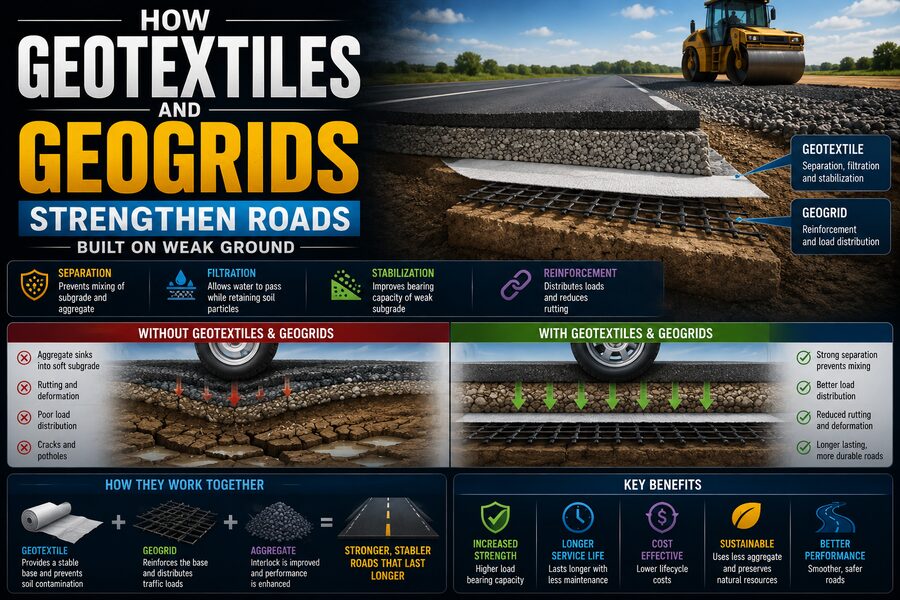
Two of the most important are geotextiles and geogrids. Although they look different and perform different primary functions, both can help a road distribute loads more effectively and maintain a stable aggregate layer over weak ground.
A geotextile often acts mainly as a separator, filter, and sometimes reinforcement layer, while a geogrid uses a stiff open grid to confine aggregate and improve load distribution. 🧱
Together, these technologies can reduce rutting, preserve road-base thickness, improve construction reliability, and sometimes reduce the amount of expensive aggregate required.
🌍 Why Weak Ground Is a Problem
A pavement does not support vehicles by itself.
Every wheel load must eventually be transferred downward through the pavement layers and into the natural soil beneath.
A simplified road structure might contain:
Asphalt or concrete surface
⬇️
Base course
⬇️
Subbase
⬇️
Natural subgrade
The subgrade is the soil supporting the entire pavement system.
If that soil is weak, the pavement may deform under load.
Imagine placing a heavy boot on firm gravel. The gravel remains relatively stable.
Now place the same boot on wet mud. The surface sinks and moves sideways.
A road built on weak soil experiences a similar problem, except the loads may come from vehicles weighing tens of tonnes. 🚚
📉 What Happens Without Stabilization?
Suppose crushed stone is placed directly on soft clay.
When construction trucks drive across it, the aggregate is pushed downward.
At the same time, soft clay can migrate upward into spaces between the stones.
This creates intermixing.
The aggregate layer gradually becomes contaminated with fine soil.
Once that happens, the base no longer behaves like a clean, strong granular layer.
Its drainage and structural performance can deteriorate.
Over time, the road may develop:
- Ruts
- Depressions
- Cracks
- Potholes
- Uneven settlement
- Localized bearing failures
Geosynthetics are used to interrupt or reduce these mechanisms. 🛡️
🧵 What Is a Geotextile?
A geotextile is a permeable synthetic fabric used in contact with soil or aggregate.
It is commonly manufactured from polymers such as:
- Polypropylene
- Polyester
Geotextiles can be:
- Woven
- Nonwoven
- Knitted in specialized applications
For road construction, woven and nonwoven geotextiles are especially common.
A geotextile may look like a heavy fabric roll that is spread directly across prepared soil before aggregate is placed on top.
Although it looks simple, its engineering role can be extremely important.
🚧 Separation: One of the Most Important Functions
One of the main functions of a road geotextile is separation.
Without a separator:
Aggregate ↔ Soft soil
can mix together.
With a geotextile:
Aggregate
──────────── Geotextile
Soft soil
the two materials remain much more distinct.
This matters because crushed aggregate works best when its particles can interlock and maintain a stable skeleton.
If mud fills the spaces between the particles, the structural characteristics change.
By preventing contamination, the geotextile helps preserve the designed thickness and quality of the road base. 🧱
💧 Geotextiles Can Also Provide Filtration
Water frequently moves through road foundations.
A geotextile can allow water to pass while preventing larger quantities of soil particles from migrating with it.
This is known as filtration.
The geotextile contains pores carefully selected for the soil conditions.
Ideally:
Water passes through → soil particles remain in place
This can reduce erosion and pumping of fines.
Proper filtration is especially important in wet subgrades where repeated wheel loading can create pressure changes in pore water.
Without adequate control, fine particles may migrate into drainage or aggregate layers.
🌧️ Drainage and Water Management
Water is one of the greatest enemies of pavement performance.
Many soils become significantly weaker when saturated.
If water accumulates beneath a road, it can reduce subgrade strength and increase deformation.
Some geotextiles, especially nonwoven types, can assist with drainage by providing paths for water movement in certain applications.
However, geotextile selection must be carefully engineered.
A material that filters effectively in one soil may clog or perform poorly in another.
Drainage design therefore considers:
- Soil particle size
- Water flow
- Geotextile permeability
- Pore size
- Hydraulic gradient
💧⚙️
🕸️ What Is a Geogrid?
A geogrid looks very different from a geotextile.
Instead of a continuous fabric, it has an open grid structure made from intersecting polymer ribs.
It may resemble a strong plastic mesh with square, rectangular, or triangular openings.
The openings allow aggregate particles to partially penetrate through the grid.
When compacted, the stone becomes mechanically interlocked with the geogrid.
This interlocking is central to how geogrids stabilize road bases. 🔲
🧱 Aggregate Interlock
Imagine placing crushed stone on a flat sheet.
The stone can move sideways when loaded.
Now imagine placing the same stone inside a rigid grid.
The openings restrict lateral movement.
A geogrid works on this principle at road scale.
Aggregate particles become lodged within and around the grid apertures.
When a vehicle applies downward force, the stones attempt to move laterally.
The geogrid ribs resist this movement.
The result is called lateral confinement or aggregate stabilization.
This helps the base layer behave as a more coherent structural mass. 💪
↔️ Why Preventing Sideways Movement Matters
Granular road bases gain much of their strength from particle-to-particle contact.
When aggregate moves sideways excessively, the layer can deform downward under wheel loads.
A geogrid restrains lateral displacement.
This means a wheel load is not concentrated only beneath the tire.
Instead, stresses can be redistributed through a larger portion of the base.
Conceptually:
Without stabilization: concentrated deformation ⬇️
With geogrid: load spreads outward ↙️⬇️↘️
This wider load distribution can reduce stress reaching the weak subgrade.
📐 Improving Load Distribution
A strong pavement system spreads wheel loads before they reach the soil.
If the load spreads over a larger area, the pressure applied to any particular section of weak ground decreases.
Geogrid-stabilized aggregate can help create this effect by increasing the stiffness and confinement of the granular layer.
Suppose a truck tire applies a heavy load to a small contact area.
Without sufficient stabilization, the load path may remain relatively concentrated.
With a well-designed aggregate-geogrid system, the base can distribute forces more broadly.
Lower subgrade stress means less deformation and rutting. 🚚📉
🛡️ Geotextile vs. Geogrid
Although both are geosynthetics, they are not interchangeable.
🧵 Geotextile
Often used primarily for:
- Separation
- Filtration
- Drainage
- Some reinforcement applications
🔲 Geogrid
Often used primarily for:
- Aggregate stabilization
- Reinforcement
- Lateral confinement
- Improved load distribution
In some projects, engineers use both.
For example:
Aggregate base
Geogrid
Geotextile
Soft subgrade
The geotextile prevents soil contamination while the geogrid stabilizes the aggregate above.
🏗️ How Installation Works
A typical construction sequence may begin by preparing the weak subgrade.
Workers remove major debris and smooth the surface without unnecessarily disturbing the soft soil.
The geotextile or geogrid is then rolled out.
Adjacent rolls may require specified overlaps or connections.
Aggregate is placed carefully over the material.
Heavy equipment generally should not drive directly on an exposed geosynthetic unless the design and manufacturer allow it.
The aggregate is then spread and compacted to the required thickness.
Once properly installed, the geosynthetic becomes buried permanently within the pavement foundation. 🚜
⚠️ Installation Damage Matters
Geosynthetics must survive construction before they can provide long-term performance.
Dumping sharp aggregate from excessive height or driving heavy equipment directly over thin cover can damage the material.
Possible problems include:
- Tearing
- Puncturing
- Folding
- Excessive wrinkles
- Displacement
Engineers therefore specify minimum cover thicknesses, aggregate properties, overlap requirements, and construction procedures.
The installation stage is critical because a highly engineered product cannot work properly if it is badly damaged before the road opens.
📏 Reducing Required Aggregate Thickness
One potential economic benefit of geogrid stabilization is the ability to achieve required pavement performance using less aggregate in suitable projects.
Suppose a conventional design requires a very thick layer of imported crushed stone to protect weak subgrade.
A stabilized design may sometimes achieve comparable performance with a thinner aggregate layer.
This can reduce:
- Quarry material
- Truck deliveries
- Fuel consumption
- Construction time
- Excavation requirements
🚚💰
However, thickness reduction should be determined through proper pavement design rather than assumed.
The benefit depends on subgrade strength, traffic loading, aggregate type, geogrid characteristics, and design methodology.
🚛 Helping Construction Traffic Cross Soft Ground
Sometimes the first challenge is simply getting construction equipment onto the site.
Very weak soil may not support dump trucks or graders before the permanent road even exists.
A geotextile or geogrid layer beneath temporary aggregate can create a more stable working platform.
This allows construction traffic to move while reducing severe rutting and aggregate loss into the subgrade.
Such stabilization is commonly valuable for:
- Temporary access roads
- Wind farm roads
- Pipeline construction
- Forestry roads
- Mining sites
- Remote infrastructure
🏗️
🌱 Reducing Aggregate Consumption and Environmental Impact
Aggregate often has to be quarried, crushed, processed, and transported.
If geosynthetic stabilization allows a project to use less aggregate, potential environmental benefits can include:
- Less quarry extraction
- Fewer truck trips
- Lower fuel consumption
- Reduced construction emissions
- Less excavation of weak soil
However, the geosynthetic itself also has an environmental footprint because polymers require raw materials and manufacturing.
A complete sustainability assessment considers the entire life cycle.
The most significant benefit may occur when better stabilization extends pavement life and reduces future reconstruction. 🌱
🔁 How Geogrids Help Reduce Rutting
Rutting occurs when repeated wheel loads permanently deform pavement layers.
On weak subgrades, the base can push downward while aggregate moves laterally.
Geogrid confinement helps restrict that sideways movement.
The stabilized base can retain its shape more effectively under repeated traffic.
This does not mean rutting becomes impossible.
Performance still depends on:
- Traffic intensity
- Drainage
- Aggregate quality
- Pavement thickness
- Installation
- Subgrade properties
But geogrids can significantly improve resistance to deformation when properly selected and designed.
🪨 Aggregate Size Must Match the Grid
Geogrid performance depends partly on interaction between the aggregate and the openings.
If the particles are poorly matched to the aperture size, interlock may be reduced.
Engineers consider:
- Aggregate gradation
- Particle shape
- Geogrid aperture dimensions
- Rib stiffness
- Junction strength
Angular crushed stone often provides good mechanical interlock because irregular particles resist movement better than smooth rounded material.
The geogrid and aggregate should therefore be treated as a combined system rather than independent components. ⚙️
🧪 Weak Soil Is Often Measured With CBR
One common measure of subgrade strength is the California Bearing Ratio, or CBR.
Low CBR values generally indicate weaker soils.
Very soft subgrades may require substantial pavement thickness if left untreated.
Geosynthetic stabilization can become increasingly attractive as subgrade strength decreases.
However, no single CBR value automatically determines whether a geotextile or geogrid should be used.
Engineers also examine:
- Soil type
- Moisture conditions
- Traffic
- Drainage
- Expected service life
- Construction constraints
🌊 Soft Clay Applications
Soft clay can be particularly difficult because it may contain large amounts of water and have low shear strength.
When aggregate is placed directly on it, the stone can sink while clay moves upward.
A geotextile separator can help maintain the boundary between the materials.
A geogrid above the clay can further stabilize the aggregate.
Together, these mechanisms allow the road foundation to distribute loads while reducing contamination.
This combination is especially useful where removing and replacing all weak soil would be prohibitively expensive.
🏞️ Roads Over Peat and Extremely Soft Ground
Peat and organic soils can be exceptionally compressible.
Geosynthetics may help improve construction stability, but they cannot eliminate all settlement caused by deep weak deposits.
If a thick layer of peat compresses under the entire embankment, surface reinforcement alone may not be sufficient.
Projects may also require techniques such as:
- Soil replacement
- Lightweight fill
- Vertical drains
- Preloading
- Deep soil mixing
- Piles
Geosynthetics are powerful tools, but they must be part of a broader geotechnical design. 🧠
🧱 Reinforcement vs. Stabilization
The terms reinforcement and stabilization are sometimes used loosely, but engineers may distinguish them.
Reinforcement typically involves tensile forces developed within the geosynthetic that contribute directly to structural resistance.
Stabilization often emphasizes improvements to granular-layer behavior through confinement and interlock.
A geogrid beneath an aggregate road base may provide several mechanisms simultaneously.
The dominant mechanism depends on the design, deformation level, material properties, and ground conditions.
🪢 The Tensioned-Membrane Effect
Under relatively large deformation, a geosynthetic can sometimes behave like a tensioned membrane.
Imagine a flexible sheet stretched over soft material.
As a loaded area deflects downward, tensile forces develop in the sheet.
These forces can provide additional support.
However, substantial deformation may be required before strong membrane action develops.
For normal pavement serviceability, engineers often want to limit deformation before severe rutting occurs.
Therefore, aggregate confinement and improved layer stiffness may be more important in many stabilized road applications.
🌡️ Frost and Seasonal Ground Changes
Road foundations can also weaken seasonally.
Freeze-thaw cycles can alter soil structure, while spring thaw may produce saturated, low-strength subgrade.
Geotextile separation helps preserve the granular base when wet soil becomes vulnerable to pumping.
Good drainage remains essential.
Geosynthetics do not replace proper frost design, but they can improve the resilience of pavement layers under changing ground conditions. ❄️💧
🚂 Beyond Roads
The same engineering principles are used in other transportation and civil infrastructure.
Geotextiles and geogrids can appear beneath:
- Railways 🚆
- Airport pavements ✈️
- Container yards
- Parking areas
- Industrial platforms
- Embankments
- Unpaved roads
- Construction working platforms
Any project placing granular fill over weak soil may potentially benefit from separation, filtration, or stabilization.
💰 Why Geosynthetics Can Save Money
The material itself adds cost.
So why use it?
Because it may reduce larger costs elsewhere.
Potential savings can include:
- Less aggregate
- Reduced excavation
- Faster construction
- Fewer truckloads
- Reduced maintenance
- Longer pavement life
- Improved access during construction
The economics are particularly attractive where high-quality aggregate must be transported long distances.
One relatively thin manufactured layer can protect and improve the performance of thousands of tonnes of granular material.
📊 Why Engineering Design Is Essential
It would be incorrect to assume that simply placing any geotextile or geogrid beneath a road will automatically strengthen it.
Different products have different characteristics.
Engineers consider properties such as:
For geotextiles:
- Tensile strength
- Puncture resistance
- Permittivity
- Apparent opening size
- Survivability
For geogrids:
- Tensile stiffness
- Junction strength
- Aperture geometry
- Rib characteristics
- Durability
Product selection must match the soil, aggregate, loading, and intended function.
⏳ Durability Underground
Once installed, geosynthetics may need to perform for decades.
They are buried away from sunlight, which helps reduce ultraviolet degradation.
However, engineers still consider long-term effects such as:
- Chemical exposure
- Oxidation
- Creep
- Installation damage
- Temperature
- Soil environment
Modern geosynthetic products intended for civil engineering are designed with long-term performance in mind, but durability must be considered during specification.
🧠 A Simple Analogy
Imagine trying to walk across deep mud.
If you throw loose stones directly into it, many stones disappear into the mud.
Now place a strong fabric over the ground first.
The stones remain separated from the soil.
Add a stiff grid above the fabric, and the stones become more confined and resistant to sideways movement.
The result is a much more stable surface.
That simplified example captures the two major ideas:
Geotextile → keep materials separated
Geogrid → lock aggregate together
🧵 + 🔲 = 🛣️
🆚 Geosynthetics vs. Removing Weak Soil
One traditional solution is to excavate weak soil and replace it with stronger material.
This can work well, but it may require:
- Large excavation volumes
- Disposal of unsuitable soil
- Significant imported aggregate
- More truck traffic
- Longer construction time
Geosynthetic stabilization can sometimes reduce the amount of undercut and replacement required.
However, very weak or unstable ground may still need deeper treatment.
The choice depends on engineering and economics.
🔍 Quality Control During Construction
Successful installation requires inspection.
Construction teams may check:
- Correct product type
- Roll orientation
- Overlap dimensions
- Wrinkles
- Tears
- Aggregate placement
- Minimum cover
- Compaction
If a geotextile becomes severely torn, it may no longer provide reliable separation.
If a geogrid becomes folded instead of lying correctly, aggregate interlock may be compromised.
Good construction quality control ensures that the design assumptions actually exist in the field. 👷
🌍 Why These Materials Have Become So Common
Geosynthetics are attractive because a relatively lightweight product can influence the behavior of a huge volume of soil and aggregate.
A truckload of geogrid or geotextile rolls can potentially stabilize an area that would otherwise require many additional truckloads of stone.
Their advantages include:
- Rapid installation
- Consistent manufactured properties
- Low transportation weight
- Compatibility with many soils
- Versatility
- Potential lifecycle savings
This has made them important tools in modern geotechnical and transportation engineering.
✅ Conclusion
Geotextiles and geogrids strengthen roads on weak ground by improving how the road’s aggregate layers interact with the soil beneath them. 🛣️🧱
A geotextile primarily helps maintain separation between clean aggregate and soft subgrade while allowing controlled water movement. By preventing soil contamination, it preserves the quality and thickness of the road base.
A geogrid uses an open, stiff network of ribs to mechanically interlock with aggregate. This confinement limits sideways particle movement, improves base-layer stability, and helps distribute wheel loads over a larger area.
When conditions justify it, engineers may use both materials together:
Aggregate → Geogrid → Geotextile → Weak Soil
The combination can reduce rutting, improve construction access, protect drainage performance, and sometimes reduce the amount of aggregate or excavation required.
However, geosynthetics are not universal substitutes for good geotechnical engineering. Deep settlement, poor drainage, extremely weak soils, and severe loading may require additional ground-improvement methods.
Their real power comes from using a relatively thin engineered layer to control the interaction between two much larger materials: the road base above and the soil below.
By keeping aggregate clean, restraining its movement, and spreading loads more efficiently, geotextiles and geogrids can turn weak ground that would otherwise deform badly into a much more reliable foundation for roads and other infrastructure. 🌍🛣️⚙️