
A driver feels a familiar jolt while crossing a rough patch of pavement. A bridge inspector notices a hairline crack near a connection. Neither sign automatically means failure is imminent, but both raise the same practical question: is this a minor defect, or the beginning of a much larger problem?
Roads and bridges rarely deteriorate in one dramatic moment. More often, water enters a crack, traffic repeats a load thousands of times, corrosion advances out of sight, or a foundation shifts slightly after heavy rainfall. By the time damage is obvious to a passing motorist, repair options may already be more disruptive and expensive.
Technology is changing the timing of that discovery. Sensors, imaging, mapping, data platforms, and predictive models can help engineers identify unusual behavior earlier and direct attention to the assets that need it most.
That does not mean a computer can simply announce that a bridge will fail on a particular day. Prediction in civil engineering is about managing uncertainty, understanding deterioration, and making better maintenance decisions before a small defect becomes a major repair.
🛣️ What “Predicting Damage” Really Means
In infrastructure management, prediction usually means estimating an asset’s condition, rate of deterioration, and likely maintenance need. It is not a guarantee that a specific crack will grow at an exact pace or that a road will remain safe for a precisely stated number of years.
Engineers combine observations of current condition with information about loads, weather, materials, age, drainage, and past repairs. The result is often a risk-based forecast: which locations deserve inspection first, which defects need closer monitoring, and which repairs should be planned before serviceability declines.
🔍 Why Early Detection Changes Maintenance Decisions
A sealed pavement crack may prevent water from reaching lower layers. The same crack, left open through wet seasons and traffic cycles, can develop into potholes, base failure, and eventually a larger rehabilitation project.
On bridges, early detection can reveal leakage at joints, coating breakdown, localized corrosion, bearing movement, or fatigue-prone details before they affect a wider structural zone. Acting early does not eliminate cost, but it can preserve more of the original structure and reduce closures.
The goal is not to repair every visible imperfection immediately. It is to intervene at the point where action has the greatest value for safety, durability, mobility, and available budget.
🏗️ The Different Ways Roads and Bridges Deteriorate
Roads and bridges are not damaged by one universal mechanism. Pavements may rut under repeated heavy loads, crack because of thermal movement, or weaken when poor drainage saturates the subgrade, the soil supporting the pavement structure.
Bridge components face a different combination of hazards: corrosion of steel or reinforcing bars, fatigue from repeated stress cycles, deck deterioration from moisture and salts, scour around foundations, and movement at bearings or expansion joints.
Because causes differ, useful prediction begins with a sound engineering question: what mechanism is likely acting here? A surface image may show distress, but it cannot always reveal the cause below or behind it.
📊 Condition Data Is the Starting Point
Predictive systems depend on condition data gathered over time. Agencies may record crack type, pothole location, rut depth, roughness, deck condition, corrosion indicators, drainage defects, and findings from routine inspections.
Repeated observations are especially valuable. A single inspection says what was seen on one day. Several comparable inspections can show whether a defect is stable, seasonal, or progressing.
Data quality matters as much as data volume. If one survey team calls a crack minor and another calls it severe without a consistent definition, a model may learn inconsistency instead of real deterioration patterns.
📡 Structural Health Monitoring on Bridges
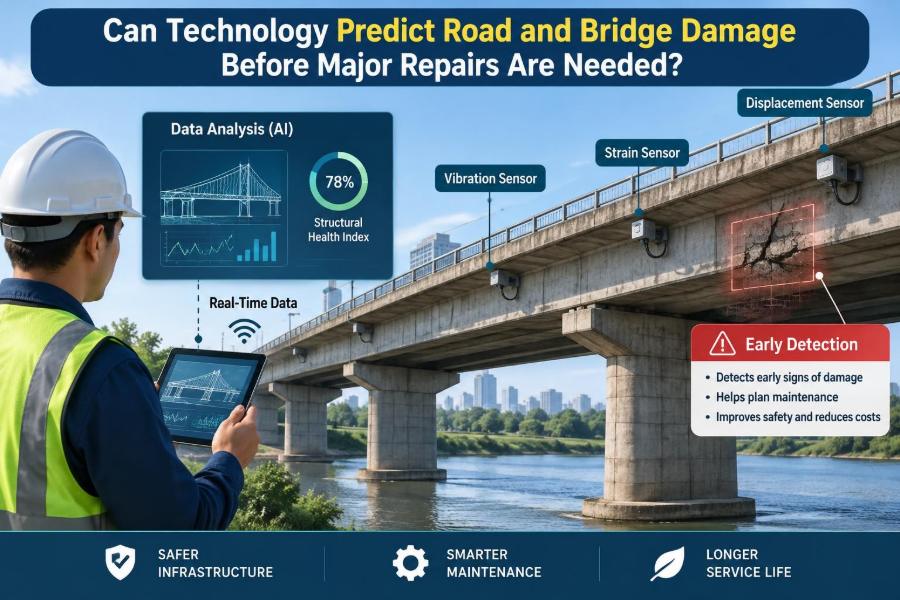
Structural health monitoring uses instruments to observe a bridge’s response during service. Depending on the asset and question being investigated, systems may measure strain, acceleration, displacement, tilt, temperature, humidity, or corrosion-related conditions.
A strain gauge, for example, measures tiny deformation in a structural element as loads pass. An accelerometer records vibration. Neither measurement alone declares a bridge safe or unsafe; engineers interpret the readings alongside structural behavior, traffic, temperature, and inspection evidence.
Permanent monitoring is usually most justified for complex, heavily used, unusually long, difficult-to-inspect, or high-consequence structures. It is not automatically the best choice for every small bridge.
🌡️ Why Temperature Can Mislead a Sensor System
Bridges expand in warmth and contract in cold conditions. Sunlight can heat one part of a structure more than another, while seasonal changes can alter bearing positions, deck movement, and measured strain.
If a monitoring system treats every movement as damage, it will create false alarms. Good interpretation separates expected environmental variation from behavior that cannot be explained by normal temperature, traffic, or operating conditions.
This is why baseline data is essential. Engineers need to know what normal looks like across different seasons before they can reliably identify abnormal change.
🚁 Drones Make Visual Inspection More Reachable
Unmanned aerial vehicles can capture close photographs and video of high piers, cable systems, undersides of decks, slopes, and other difficult locations. They can reduce exposure to traffic and eliminate some access challenges associated with lifts, ropes, or temporary lane closures.
Drone imagery is particularly useful for documenting visible changes over time. A repeatable flight path can help compare a stain, crack, spall, or exposed reinforcement from one inspection period to the next.
However, image quality, lighting, permissions, wind, pilot competence, and safe flight planning all affect results. A drone is an inspection tool, not a substitute for engineering judgment or hands-on examination where access is necessary.
📷 Computer Vision Can Sort What Images Reveal
Computer vision uses software to identify patterns in images. For infrastructure, it can assist with locating visible features such as cracks, spalling, corrosion staining, missing fasteners, lane markings, and pavement distress.
The greatest advantage is scale. A large image collection can be screened quickly so inspectors spend more time assessing likely defects and less time manually reviewing every frame.
Yet a dark line in an image may be a shadow, sealant, joint, or actual crack. Systems must be trained and checked against representative field conditions. Human review remains important, especially when a classification could lead to a safety-critical decision.
🛰️ Satellite and Aerial Mapping See Network-Level Change
Satellite imagery and manned aerial surveys can support asset management across wide areas. They may help identify land movement, flood impacts, slope instability, vegetation encroachment, changing drainage patterns, or broad pavement condition trends.
Some remote-sensing methods can detect very small ground movements over time by comparing radar observations. This can be valuable near embankments, approaches, tunnels, and areas susceptible to settlement or landslides.
Resolution and timing set practical limits. A network-scale view can flag a concern, but local investigation is needed to determine whether a change affects the structure, the road surface, or only surrounding ground conditions.
🧭 LiDAR Builds Detailed Three-Dimensional Records
LiDAR, short for light detection and ranging, measures distances with laser pulses to create dense three-dimensional point clouds. Mobile, terrestrial, airborne, and drone-mounted systems can capture road corridors, bridge geometry, clearances, slopes, and surface features.
Repeated surveys allow engineers to compare geometry over time. Changes in a riverbank, embankment, settlement-prone approach, or bridge component can become easier to identify when accurate reference models exist.
LiDAR is powerful for geometry, but it does not directly measure every material property. It cannot by itself determine hidden corrosion or confirm the internal condition of concrete.
🌊 Scour Monitoring Addresses a Hidden Foundation Risk
Scour is the removal of soil or riverbed material around bridge foundations by flowing water. It can be especially difficult to assess during storms, when high water and debris make direct inspection hazardous or impossible.
Water-level sensors, sonar, bathymetric surveys, and remotely collected flow information can help identify changing channel conditions. Monitoring is most useful when linked to a clear action plan, such as a post-event inspection threshold or a temporary traffic restriction procedure.
Scour risk depends on local hydraulics, foundation type, channel shape, debris, and past flood behavior. A sensor trend may indicate concern, but engineers must interpret it within the site’s geotechnical and hydraulic context.
🧪 Non-Destructive Testing Looks Below the Surface
Non-destructive testing, often called NDT, examines materials without removing large samples or damaging the structure. Methods may include ground-penetrating radar, ultrasonic testing, impact echo, infrared thermography, and electrical techniques related to corrosion assessment.
For a bridge deck, an NDT survey can help identify zones that may contain moisture, delamination, or other subsurface anomalies. For pavement, radar can contribute information about layer thickness and possible moisture-related concerns.
Each method has limits. Signal interpretation can be affected by material type, moisture, reinforcement, surface condition, and equipment settings. NDT findings are strongest when confirmed through targeted inspection, testing, or engineering evaluation.
🚚 Traffic Loads Provide a Critical Part of the Story
Infrastructure experiences damage under real loading, not under age alone. A road carrying frequent heavy trucks will deteriorate differently from a lightly traveled residential street, even if both were built at the same time.
Traffic counts, vehicle classification, weigh-in-motion systems, and freight-route data can improve predictions by showing how load exposure changes. On bridges, truck passage can also be correlated with measured response from monitoring instruments.
Load data should not be treated as perfect. Vehicle paths vary, overloads may be intermittent, and traffic patterns can change after a new development, detour, port expansion, or industrial activity begins.
🌧️ Weather, Water, and Drainage Often Drive Damage
Water is among the most influential factors in infrastructure deterioration. It can weaken pavement support, carry salts into concrete, trigger freeze-thaw damage in suitable climates, erode slopes, and accelerate corrosion when moisture and oxygen reach steel.
Weather stations, rainfall records, water-level gauges, and maintenance observations can reveal useful patterns. A pavement defect recurring after intense rain may point to drainage failure rather than a purely surface-level problem.
Predictive maintenance should therefore include culverts, ditches, inlets, joints, waterproofing, and drainage outlets. Repairing a cracked surface without correcting the water path often treats the symptom rather than the cause.
🧠 Machine Learning Finds Patterns, Not Physical Truth
Machine learning can identify relationships within large, complex datasets that would be difficult to examine manually. It may help prioritize bridge inspections, classify pavement distress in images, estimate remaining condition categories, or detect unusual sensor patterns.
But a model is only as reliable as its data, assumptions, and intended use. If historical repairs were delayed in certain neighborhoods because of funding constraints, a model trained only on repair records may confuse delayed maintenance with lower engineering need.
Machine learning should support decisions, not conceal them. Engineers need understandable inputs, sensible outputs, performance checks, and the authority to question recommendations that conflict with field evidence.
🧮 Physics-Based Models Remain Essential
Physics-based models use known structural, material, hydraulic, or pavement principles to simulate behavior. A bridge model may estimate stresses and deflections under loading; a pavement model may consider layers, climate, traffic, and material response.
These models are valuable because they connect predictions to mechanisms. If a calculation indicates unusual behavior, engineers can investigate whether the issue is load, stiffness loss, boundary movement, material degradation, or an incorrect model assumption.
In many practical systems, the best approach is hybrid: monitoring data updates a model, while engineering mechanics helps explain whether a detected pattern is plausible.
🗂️ Digital Twins Connect Data to an Asset Model
A digital twin is a digital representation of a physical asset that can be updated with information from inspections, drawings, sensors, maintenance records, and sometimes analytical models. The term is used broadly, so its actual capability varies widely.
For a bridge owner, a useful digital twin may simply connect component locations, inspection history, photographs, repair details, and current alerts in one accessible environment. More advanced versions can compare measured behavior with modeled behavior.
The value comes from decision support, not the label. An incomplete model with unreliable records is not made more trustworthy by a sophisticated interface.
🧩 Data Integration Is Often the Hardest Work
Infrastructure data commonly sits in separate systems: inspection forms, maintenance logs, traffic databases, drone folders, design drawings, sensor dashboards, and spreadsheets. Different IDs, dates, coordinate systems, and terminology can prevent these sources from working together.
Before investing heavily in artificial intelligence, organizations often benefit from basic discipline: consistent asset identifiers, defined defect categories, documented inspection methods, secure storage, and clear ownership of data updates.
A simple, well-maintained condition history can be more useful than a complex platform filled with inconsistent records.
⚠️ False Alarms and Missed Defects Require Different Responses
A false positive occurs when a system flags a problem that is not significant. A false negative occurs when it fails to identify a real concern. Both matter, but their consequences differ by asset type and use.
Too many false alarms can overwhelm staff and reduce trust in the system. Missed defects can allow deterioration to continue without attention. The appropriate threshold depends on risk: a screening tool for minor pavement cracking can tolerate different uncertainty from a system monitoring a critical bridge component.
| System outcome | Potential consequence | Practical control |
|---|---|---|
| False positive | Unnecessary inspection or investigation | Review rules and verify with field evidence |
| False negative | Delayed recognition of meaningful deterioration | Maintain routine inspections and independent checks |
| Uncertain result | Decision is postponed without a clear plan | Define escalation, monitoring, or testing steps |
👷 Inspection Still Needs Skilled People
Technology can extend an inspector’s reach, improve records, and focus limited time. It does not replace the ability to recognize whether cracking reflects shrinkage, overload, restraint, corrosion, settlement, fatigue, or another mechanism.
Experienced inspectors also notice context that systems may miss: a blocked drain near a distressed area, unusual vibration reported by users, a new truck route, debris caught at a pier, or a repair that is no longer bonded to surrounding material.
The strongest workflow is usually collaborative: technology screens and measures; inspectors verify; engineers interpret; asset managers decide and document action.
📅 Prediction Supports Planning, Not Just Emergency Response
Maintenance planning becomes more effective when agencies can compare likely needs over several years rather than reacting only after defects become severe. Forecasts can support work packaging, material procurement, traffic management planning, and coordination with utility or corridor projects.
For example, a pavement network model might identify several nearby segments likely to need surface treatment within a similar period. Coordinating work can reduce repeated disruptions, provided field checks confirm that the forecast matches actual conditions.
Predictions should be revised as new inspections and changing conditions emerge. A forecast is a living planning input, not a fixed promise.
💰 The Best Technology Is Not Always the Most Advanced
A small local authority may gain more from standardized mobile inspection forms, reliable photographs, and a clear maintenance database than from an expensive sensor network requiring specialist support.
Conversely, a major river crossing with difficult access and high traffic consequences may justify permanent instrumentation, remote sensing, and dedicated analytical review. The appropriate investment depends on consequence of failure, uncertainty, inspection difficulty, expected benefit, and long-term operating capacity.
Buying equipment without budgeting for calibration, training, data review, repairs, cybersecurity, and replacement is a common route to underused technology.
🔐 Connected Infrastructure Needs Cybersecurity
Sensor networks and remote dashboards create new operational dependencies. Unauthorized access, corrupted data, interrupted communications, or poorly managed user permissions can affect confidence in the monitoring system.
Cybersecurity does not mean every field device needs an elaborate solution. It means planning for sensible controls: authenticated access, protected data transmission, software updates, backups, logs, and procedures for checking suspicious readings.
For critical assets, organizations should also decide what happens when the system is unavailable. Safe engineering decisions must not depend entirely on a single online platform.
🧭 A Practical Workflow for Predictive Maintenance
Technology is most effective when it fits a repeatable decision process rather than operating as an isolated pilot project. The sequence below applies to many road and bridge programs.
- Define the decision: prioritize inspection, detect a specific mechanism, plan repairs, or monitor an active concern.
- Identify the relevant data and establish consistent baseline condition.
- Select methods that match the asset, risk, environment, and staff capability.
- Set thresholds for review, field verification, escalation, and documentation.
- Compare predictions with inspection results and improve the process over time.
Without the final feedback step, systems cannot reveal whether their predictions were useful or merely impressive-looking.
🚧 Common Implementation Mistakes to Avoid
One mistake is collecting data without assigning anyone responsibility for reviewing it. A dashboard that is rarely checked cannot provide early warning.
Another is measuring what is easy rather than what answers the engineering question. Installing vibration sensors, for instance, is not helpful if no baseline, traffic context, or interpretation method exists.
- Assuming a visible defect explains the underlying cause.
- Using historical data without checking whether conditions or inspection practices changed.
- Ignoring drainage, foundations, and surrounding ground while focusing only on surface symptoms.
- Treating model output as a final decision instead of evidence to be evaluated.
- Failing to record completed repairs, which weakens future forecasts.
🎓 Skills Civil Engineers Need in a Data-Rich Field
Engineers do not need to become full-time programmers to work effectively with predictive tools. They do need enough data literacy to ask useful questions: Where did this data come from? What does the sensor actually measure? What uncertainty is present? Does the conclusion match physical behavior?
Communication is equally important. Engineers must translate a probability, anomaly score, or condition trend into a clear maintenance recommendation that decision-makers can act on.
Fundamentals remain central: structural behavior, geotechnics, materials, hydraulics, construction practice, inspection methods, and risk assessment provide the framework for interpreting digital information.
🔮 What a Realistic Future Looks Like
The likely future is not fully autonomous infrastructure management. It is a more connected system in which field observations, remote sensing, instrumentation, asset records, and engineering models reinforce one another.
As records improve, owners may identify deterioration earlier, target investigations more efficiently, and explain maintenance priorities more transparently. Yet unpredictable events, changing climate conditions, construction variability, and incomplete information will remain part of civil engineering practice.
Good prediction will therefore remain probabilistic. Its purpose is to reduce avoidable surprises, not claim perfect foresight.
🌉 The Core Principle: Better Evidence, Better Timing
Technology can help predict road and bridge damage before major repairs are needed when it detects meaningful change, connects that change to likely mechanisms, and feeds a defined maintenance decision.
Its greatest value is often not an automated warning by itself. It is the ability to give engineers better evidence at the right time: a repeat image showing crack growth, a sensor trend that prompts inspection, a drainage pattern linked to pavement failures, or a model that helps prioritize a constrained budget.
Early action works best when technology, sound engineering judgment, and disciplined asset management operate together.
Roads and bridges become more resilient not because technology predicts every defect perfectly, but because it helps people see deterioration sooner and respond with better-informed decisions. 🌉📡🛣️