
A road can look sound on Monday and develop a sharp-edged pothole after a week of rain, freezing weather, or heavy traffic. To a driver, the failure appears sudden: one day there is pavement, the next there is a wheel-catching hole.
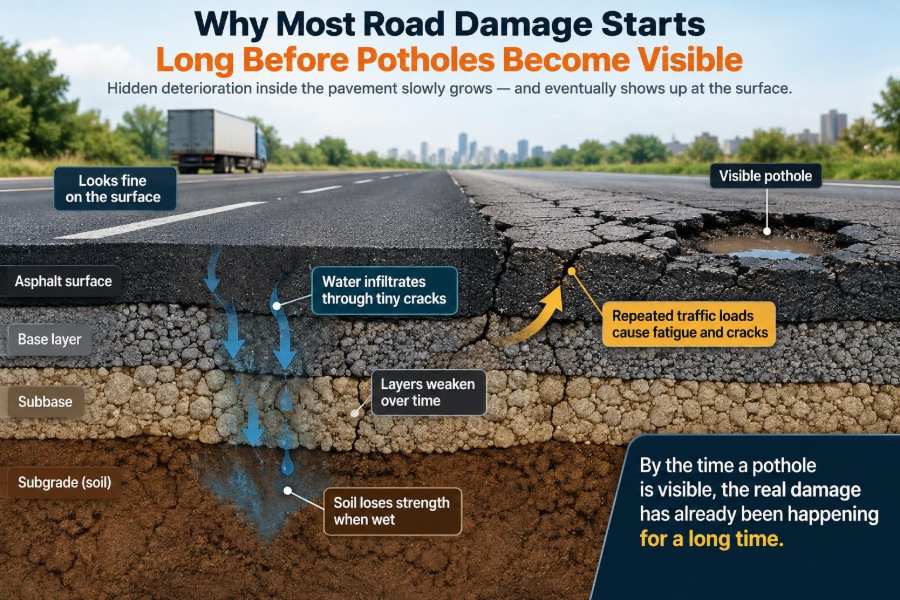
But potholes are usually the last visible stage of a much longer process. The damage often begins beneath the surface, where water, weak support, repeated loading, and small construction defects gradually reduce the pavement’s ability to carry traffic.
That hidden period matters because repairs are far cheaper and less disruptive when problems are still small. A sealed crack or corrected drainage outlet may prevent a future reconstruction project; ignoring the same warning can allow the road structure itself to deteriorate.
Understanding what happens before a pothole appears helps engineers design better pavements, helps road agencies target maintenance, and helps everyone recognize why a smooth black surface is not always a healthy road.
🛣️ A Pothole Is a Symptom, Not the First Failure
A pothole is a localized loss of pavement material that leaves a depression or hole in the road surface. It commonly forms after cracking has already allowed water and traffic action to break loose pieces of asphalt.
The visible hole is therefore not the whole problem. In many cases, the pavement layers below it have been weakening for months or years before the surface finally collapses.
🧱 Roads Work as Layered Structural Systems
Flexible pavements, including most asphalt roads, distribute wheel loads through several layers. The asphalt surface provides a smooth, durable running course; underlying asphalt or granular layers spread loads; and the compacted subgrade soil supplies the final support.
Each layer depends on the one beneath it. If the subgrade softens or the base loses material, the asphalt may bend more than it was designed to bend, even if its surface initially looks intact.
🚚 Repeated Loads Cause Accumulated Fatigue
One properly controlled truck axle usually does not break a sound pavement. The challenge is repetition: thousands or millions of wheel passes create small strains in the asphalt and supporting layers.
This is called fatigue. Like bending a paper clip repeatedly, the material may tolerate individual movements but eventually develops cracks after enough cycles. Heavy vehicles matter especially because pavement damage rises sharply as axle loading increases.
💧 Water Is Often the Turning Point
Water is not automatically harmful when it is kept out of the pavement structure and drained away quickly. Trouble starts when it enters cracks, joints, poorly sealed edges, utility cuts, or defects around drainage structures.
Once inside, water can soften fine-grained subgrade soils, reduce friction between aggregate particles, and carry fine material away. Traffic then pumps water and loosened particles through the layers, accelerating the loss of support.
🌧️ Drainage Begins Beyond the Road Edge
Good pavement drainage is more than a crowned surface that sheds rainwater. It includes side ditches, inlets, culverts, subsurface drains where needed, stable shoulders, and an outlet that remains clear throughout the road’s service life.
A blocked culvert or filled ditch can keep water near the pavement edge for long periods. That is why edge deterioration often reveals a drainage issue rather than simply an asphalt issue.
🔍 Tiny Cracks Create Entry Paths
Hairline cracks may look cosmetic, but they can become pathways for moisture. Thermal movement, aging binder, traffic loading, and construction joints all contribute to small openings in the surface.
Crack sealing is not a cure for every pavement problem. However, when the underlying structure is still sound, it can slow water intrusion and delay the much more expensive sequence of stripping, breakup, and patching.
❄️ Freeze-Thaw Cycles Widen Existing Weaknesses
In cold climates, water within cracks and pores can freeze and expand. Repeated freezing and thawing widens openings and can loosen aggregate particles near the surface.
Freeze-thaw action is most damaging when drainage is poor and pavement is already cracked. It rarely acts alone; it amplifies vulnerabilities created by moisture, load repetition, and inadequate support.
🪨 The Subgrade Can Control the Entire Pavement
The subgrade is the prepared soil beneath the pavement structure. Its strength varies with soil type, density, moisture content, and seasonal conditions, so two nearby road sections can perform very differently.
Clay-rich soils, for example, may lose stiffness when wet and may shrink or swell with changing moisture. Designers account for such behavior through investigation and material testing, but unexpected wet conditions and poor drainage can still alter field performance.
📉 Loss of Support Produces Deflection
Deflection is the downward movement of pavement under a wheel load. Some movement is expected, but excessive or uneven deflection bends asphalt layers and concentrates stress.
A depressed wheel path is often an early clue. It may indicate permanent deformation in asphalt, densification in a granular layer, or subgrade movement; the correct repair depends on identifying which mechanism is present.
🧊 Weak Base Layers Can Become Saturated
Base and subbase layers are often made from crushed aggregate selected for strength and drainage. If they contain excessive fines, are poorly graded, or remain saturated, their load-spreading ability can decline.
Under traffic, water and fine material can move within the layer. This process, often called pumping when material is expelled through openings, leaves voids and weak zones that later show up as cracking or surface breakup.
⚙️ Compaction Is a Structural Requirement
Compaction reduces air voids in soil and aggregate and helps particles interlock. It is not merely a construction formality: inadequate compaction can permit settlement, moisture entry, and progressive densification after the road opens.
Compaction must be achieved at suitable moisture conditions and in lifts thin enough for the equipment to affect the full depth. A smooth surface placed over loose material can conceal a problem until traffic reveals it.
🌡️ Asphalt Needs the Right Temperature Window
Asphalt mixture must be placed and compacted while it remains workable. If it cools too much before adequate compaction, the finished layer can retain excessive interconnected air voids.
Those voids admit water and oxygen. Oxidation stiffens the asphalt binder over time, making it less able to flex under traffic and more prone to cracking, especially in colder conditions.
🧪 Material Quality Shapes Long-Term Durability
Pavement mixes require a deliberate balance of aggregate size, asphalt binder, air voids, and moisture resistance. Too little binder can leave aggregate insufficiently protected; too much may contribute to instability and rutting under heat and load.
Aggregate cleanliness and the bond between binder and aggregate also matter. Moisture damage can weaken that bond, a process known as stripping, so quality control and appropriate mix design are central to durability.
🚧 Construction Joints Are Vulnerable Lines
Longitudinal joints occur where adjacent paving lanes meet, while transverse joints occur between paving passes. If joints are poorly constructed or inadequately compacted, they can be more permeable than the surrounding mat.
Water then enters along a nearly continuous line. Early cracking beside a lane line should prompt inspection because resealing or localized treatment may protect the pavement before water reaches deeper layers.
🟫 Pavement Edges Often Fail First
The outer edge of a road has less lateral confinement than the center and is closer to shoulder drainage. It can also be loaded by vehicles drifting toward the edge, especially on narrow roads.
Unsupported edges crack and unravel more easily. A stable, well-compacted shoulder and effective runoff control are practical structural features, not just finishing details.
🔄 Rutting and Potholes Have Different Origins
Rutting is a longitudinal depression in the wheel path. It may result from permanent deformation in asphalt under hot-weather loading, but it can also reflect weak underlying layers or subgrade deformation.
A pothole generally involves material loss after cracking and disintegration. Treating every rut with a thin overlay can be ineffective if the real problem is deep structural weakness or trapped water.
🕸️ Crack Patterns Offer Diagnostic Clues
Surface patterns do not provide a complete diagnosis, but they are valuable clues when combined with drainage observations, traffic history, and field testing.
| Visible pattern | Common implication | Useful next step |
|---|---|---|
| Alligator-like interconnected cracking | Repeated loading over weakened support | Investigate depth and structural capacity |
| Longitudinal edge cracking | Weak edge support or drainage exposure | Inspect shoulder and roadside drainage |
| Transverse cracking | Thermal movement or reflective cracking | Assess crack width, movement, and sealing need |
| Localized depression | Settlement, utility trench issue, or wet weak zone | Check subsurface condition before resurfacing |
No single pattern proves one cause. For example, an alligator pattern may be worsened by overloading, but water-related loss of support is often part of the chain of failure.
🚛 Traffic Mix Matters More Than Traffic Count Alone
Two roads with similar vehicle counts can age at very different rates. A street carrying mostly cars experiences a different loading environment from an industrial route used by loaded trucks, buses, and waste collection vehicles.
Frequent stopping, turning, braking, and slow-moving heavy vehicles add shear stresses. Intersections, bus stops, loading zones, and climbing lanes therefore deserve focused design and maintenance attention.
🏗️ Utility Cuts Can Interrupt Pavement Continuity
Water, gas, telecommunications, and sewer work often require trenches through existing roads. Even with careful reinstatement, the backfilled zone can behave differently from undisturbed pavement and soil.
Settlement at a trench may create a low spot where water collects. Strong specifications, staged compaction, proper restoration geometry, and coordinated utility planning reduce this recurring source of localized damage.
🌳 Tree Roots and Ground Movement Add Local Stress
Roots can lift sidewalks and lightly built pavements, while shrinking soils, erosion, and settlement can change support beneath a road. These mechanisms are highly site-specific and should not be assumed from surface appearance alone.
For example, a recurring bump near a mature tree may involve roots, but it might also be a leaking pipe or a poorly compacted repair. Investigation prevents costly treatment of the wrong cause.
🧭 Inspection Must Look Below the Surface
Visual surveys identify where distress is located and how it is changing. They should be paired, when appropriate, with drainage inspection, coring, test pits, deflection measurements, and review of construction and maintenance records.
A pavement core can reveal layer thickness, moisture damage, stripping, or weak bonding. A test pit can show saturated aggregate or soft subgrade, though all intrusive work must be planned safely and restored properly.
📡 Monitoring Helps Agencies Intervene Earlier
Road agencies increasingly use condition surveys, vehicle-mounted imaging, location records, and asset-management systems to track distress across networks. The goal is not technology for its own sake; it is to identify treatment windows before failures multiply.
Data still needs engineering judgment. An automated image can flag cracking, but field staff must determine whether the road needs sealing, resurfacing, drainage work, structural repair, or further investigation.
🩹 Preventive Maintenance Protects Sound Structure
Preventive maintenance is most effective before major structural failure. Depending on pavement condition and local practice, it may include crack sealing, surface treatments, thin overlays, shoulder repair, drain cleaning, and localized patching.
These treatments are not interchangeable. Applying a surface seal over active structural fatigue, for instance, may improve appearance briefly but cannot restore lost support below the asphalt.
🛠️ Patching Must Remove the Failed Material
A durable pothole repair generally requires cutting back to sound material, removing loose and wet debris, restoring support where needed, placing compatible patch material, and compacting it well. Simply filling a hole without addressing wet or broken edges often leads to rapid failure.
Weather, traffic control, material availability, and emergency response constraints affect what can be done immediately. A temporary repair may be necessary for safety, but it should not be mistaken for a permanent structural solution.
🚫 A New Overlay Does Not Always Solve the Problem
Overlays can extend pavement life when the existing structure remains reasonably stable and defects are treated first. They are often a practical rehabilitation option, but they may reflect cracks or rutting if underlying causes remain active.
Before overlaying, engineers assess drainage, existing layer condition, surface preparation, and expected loading. In severe cases, full-depth repair or reconstruction is more appropriate than adding another layer on top.
💰 Early Action Changes the Life-Cycle Cost
Road funding often focuses on visible failures because they create immediate complaints and safety concerns. Yet the least visible work—clearing drains, sealing cracks, correcting shoulders, and inspecting early deformation—can preserve structural value.
This is a life-cycle perspective: spend at the right time to avoid more extensive work later. It does not mean every small crack deserves the same response; priorities should reflect condition, traffic importance, safety, and available resources.
👷 Design Must Match the Site, Climate, and Use
There is no universally correct pavement thickness or drainage detail. A lightly trafficked rural road on free-draining soil requires a different solution from an urban bus route built over moisture-sensitive clay.
Sound design starts with site investigation, expected traffic, materials, climate, drainage paths, construction capability, and maintainability. Designs that ignore any one of these conditions may look adequate on drawings yet perform poorly in service.
🧑🔧 Practical Warning Signs for Field Teams
Small changes deserve attention when they recur in the same location. The following signs often justify closer inspection rather than a purely cosmetic response:
- Cracks that reopen soon after sealing
- Persistent wet patches or vegetation growth along the road edge
- Depressions that hold water after rainfall
- Repeated patches at the same utility crossing
- Loose aggregate, raveling, or dark damp areas around cracks
- Wheel-path cracking near bus stops, intersections, or freight entrances
These are indicators, not final diagnoses. Their value lies in directing attention to the possible interaction of water, loading, materials, and support.
🧠 The Core Principle: Preserve Support and Keep Water Out
Most road damage develops as a chain rather than a single event. A small crack admits water; water weakens a layer; repeated traffic bends the pavement further; cracking spreads; and material eventually breaks away into a pothole.
The most reliable way to delay potholes is to protect the pavement system before hidden weaknesses become visible failures. That means sound design, careful construction, reliable drainage, condition-based maintenance, and repairs that address causes as well as symptoms.
A pothole may be the feature drivers notice, but it is rarely where the engineering story begins. Roads last longer when their layers stay dry, well supported, properly compacted, and matched to the traffic they carry. 🚧💧🛣️