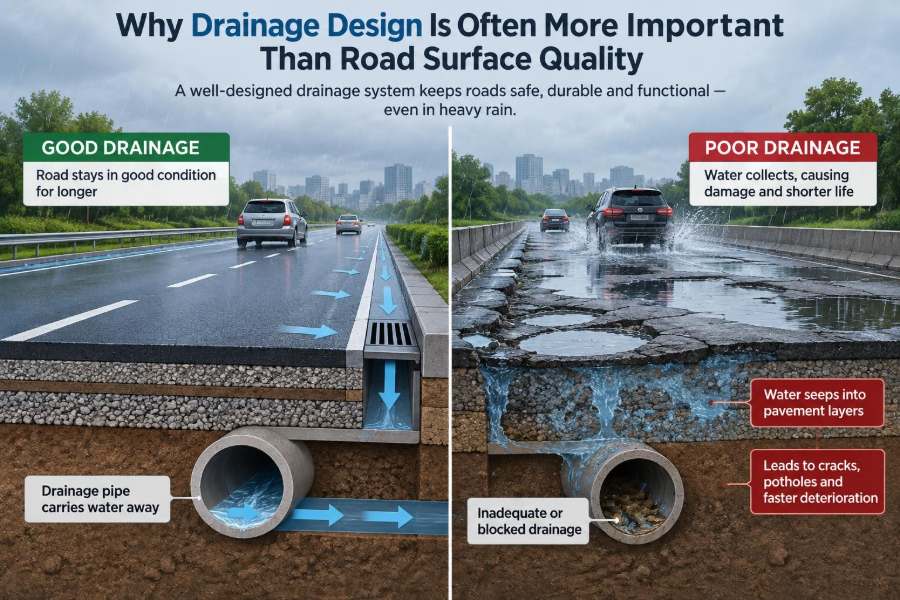

A newly paved road can look flawless on opening day: a smooth black surface, crisp lane markings, and a quiet ride. Then the first intense rainy season arrives. Water ponds at the kerb, seeps through a joint, softens the shoulder, and begins to undermine the pavement from below.
Drivers usually judge a road by its surface. Engineers cannot afford to do that alone. The visible layer matters for safety, comfort, noise, and durability, but it is only the upper part of a system that must carry traffic while staying dry enough to remain structurally sound.
That is why an older road with modest surfacing can sometimes perform reliably for decades, while an expensive resurfacing job can fail surprisingly early. The difference is often not the asphalt mix or the final roller pass. It is whether water has a dependable path away from the road.
Drainage design is not glamorous, and much of it disappears beneath soil, kerbs, pipes, and vegetation. Yet it controls many of the conditions that determine whether a pavement remains strong, safe, and maintainable.
🌧️ A Road Is More Than Its Top Layer
A road pavement is a layered structure. Depending on the project, it may include a wearing course, binder course, base, subbase, improved subgrade, and the natural ground beneath. Each layer has a different role, but all depend on suitable moisture conditions.
The surface is designed to shed rainfall. The lower layers distribute wheel loads and protect the subgrade, which is the prepared soil foundation. When water enters and remains in these layers, their stiffness and strength can change substantially.
Surface quality is therefore visible evidence of construction quality, but it is not the whole performance story. A pavement must manage water above it, within it, beside it, and below it.
💧 Why Water Changes Pavement Behavior
Many soils lose bearing capacity as their moisture content rises. Fine-grained soils, such as clays and silts, can be especially sensitive because water affects the bonds and suction that help soil particles resist deformation.
Unbound granular base and subbase layers also perform best when water can drain through or away from them. Saturated material may pump fines, lose interlock under repeated loading, or transmit water into weaker locations.
In asphalt pavements, water can contribute to stripping, where the bond between bitumen and aggregate is weakened. In concrete pavements, water below slabs can contribute to erosion of supporting material and faulting at joints. The exact mechanism varies, but the central risk is the same: water reduces the reliability of support.
🛣️ Surface Smoothness Cannot Compensate for a Weak Foundation
A smooth surface improves ride quality, but it does not repair a wet or poorly drained subgrade. New asphalt placed over a moisture-damaged foundation may initially hide cracking and unevenness. Traffic then reloads the same weakened layers, and the defects return.
Think of a road surface as the cover of a book. A strong cover is useful, but it cannot keep the book rigid if the pages and binding beneath it have become soaked and distorted.
This does not mean surface quality is unimportant. Texture, evenness, compaction, thickness, and material quality all matter. The practical lesson is that surface renewal without drainage diagnosis can be a short-lived treatment.
📐 Crossfall Is the First Drainage Decision
Crossfall, also called camber or cross slope, is the transverse slope that guides water from the traffic lanes toward a drainage edge. On a straight road, it is commonly formed as a crown at the center or as a single slope toward one side.
If crossfall is too flat, water moves slowly and can pond in shallow depressions. If it is too steep, driving comfort, vehicle stability considerations, accessibility, and erosion at the edge may become concerns. The appropriate value depends on surface type, geometry, rainfall, speed environment, and applicable local standards.
Small construction errors matter. A local low spot can hold water even when the design drawings show adequate overall slope. This is why profile control and drainage checks should be part of construction quality assurance.
🚧 Longitudinal Grade Keeps Water Moving
Crossfall gives water a sideways route, but longitudinal grade often determines whether it can continue toward an inlet, ditch, culvert, or safe outfall. Flat road sections are inherently more difficult to drain because water has little gravitational encouragement to travel along the kerb line.
Urban streets near intersections are common trouble spots. Changes in crossfall, driveway entrances, pedestrian crossings, utility covers, and kerb alignments can create small basins that were not obvious in plan view.
Designers should assess drainage in three dimensions, not simply place inlets at regular intervals. A pipe system may have ample capacity while the roadway still ponds because runoff cannot reach the inlet efficiently.
🕳️ Inlets Are Only Useful When Water Can Reach Them
Kerb inlets, grated gullies, and catch basins collect runoff from the road surface. Their effectiveness depends on location, hydraulic capacity, debris conditions, road slope, and the flow pattern approaching them.
An inlet placed just beyond a sag point may be too late if water accumulates before reaching it. An inlet on a steep grade may capture only part of the flow while the remainder bypasses it. In areas with leaves, litter, or sediment, partial blockage must be anticipated rather than treated as an unusual event.
Design generally needs a safe allowance for bypass flow and a defined route for excess water during storms that exceed normal design conditions. Water should not be forced toward buildings, vulnerable crossings, or unstable embankment slopes.
🌊 Surface Drainage and Subsurface Drainage Do Different Jobs
Surface drainage removes rainfall before it infiltrates the pavement or creates a driving hazard. It includes crossfall, kerbs, channels, inlets, swales, side ditches, and the downstream stormwater network.
Subsurface drainage manages water already present in the pavement structure or surrounding soil. It may include edge drains, drainage layers, filter materials, underdrains, outlets, and groundwater control measures.
Neither system substitutes perfectly for the other. A well-sloped asphalt surface still cannot solve high groundwater beneath the formation level. Conversely, a deep underdrain should not be used as an excuse for ponding water on the carriageway.
🪨 Permeable Layers Need a Real Outlet
A granular drainage layer can carry water laterally, but only if it is properly graded, protected from fine-soil intrusion, and connected to an outlet. Simply placing coarse aggregate below a pavement does not guarantee drainage.
Without a filter or separator, fine particles from the subgrade may migrate into the voids of a granular layer. Over time, the layer can clog and lose both drainage capacity and structural consistency.
This is where geotextiles and carefully designed filter criteria can be valuable. They must be selected for the soil, hydraulic conditions, installation method, and expected loading; a generic fabric choice is not automatically suitable for every site.
🌱 Ditches and Swales Are Working Infrastructure
Roadside ditches and vegetated swales are sometimes dismissed as basic earthworks, but they can be essential elements of rural and suburban drainage. They collect runoff, slow flow, convey water, and in some settings support infiltration or water-quality treatment.
Their performance depends on shape, grade, lining, vegetation, maintenance access, and a reliable downstream discharge point. A ditch that becomes filled with sediment or overgrown at culvert entrances may no longer drain the road effectively.
Where velocities are high, erosion protection may be needed. Where water stands for long periods, the designer must consider soil conditions, safety, mosquito concerns, and whether the ditch geometry is actually suitable for the intended function.
🧱 Kerbs Can Protect the Road or Trap the Water
Kerbs guide runoff toward inlets and help separate vehicles from footways. On urban roads, they can make surface drainage predictable. But a kerb also acts as a barrier: if inlets are too sparse, blocked, or poorly located, water may be trapped along the pavement edge.
Repeated ponding at the kerb line is more than a nuisance. It can infiltrate through cracks, joints, utility trenches, and the interface between pavement and kerb. It may also create splash, icing risk in cold conditions, and deterioration near the outer wheel path.
Details at kerb returns, driveway crossings, and pedestrian ramps deserve close attention because they often interrupt the natural flow path.
🔍 Water Finds Construction Weaknesses
Water rarely needs a large opening to enter a pavement. It can travel through cracks, poorly sealed joints, segregated asphalt, porous edges, utility reinstatements, and gaps around drainage structures.
Once inside, water may move laterally along layer interfaces. That means the visible distress can appear some distance from the original entry point. A crack at one location and a soft patch at another may be part of the same drainage problem.
Good drainage design therefore includes good detailing. Sealing interfaces, compacting trench backfill, protecting pavement edges, and making clean connections to drainage units are as important as drawing the main pipe route.
🚜 Utility Trenches Are Frequent Water Pathways
Utility installation often cuts across pavement layers and the subgrade. If backfill material, compaction, and drainage are not controlled, a trench can become a preferential path for water or a line of settlement.
A familiar symptom is a longitudinal depression above a utility trench. The cause may include inadequate compaction, but water entering the trench zone can aggravate settlement and soften the surrounding material.
Coordination matters. Road, drainage, water, power, telecommunications, and gas works should not be designed as isolated drawings. The more congested the corridor, the more carefully each crossing and connection must be resolved.
⚖️ Drainage Failures Often Appear as Structural Failures
Many common pavement defects have multiple possible causes. Alligator cracking may reflect fatigue under traffic loading, but trapped water and weak support can accelerate it. Rutting may be caused by mix instability, yet saturated layers can also deform under repeated wheel loads.
The table below is a diagnostic guide, not a substitute for investigation. Similar symptoms can arise from different combinations of loading, material quality, construction defects, and drainage conditions.
| Visible symptom | Possible drainage-related mechanism | Useful first check |
|---|---|---|
| Ponding near kerb | Low spot, inadequate inlet capture, blocked gully | Survey levels and inspect flow during rainfall |
| Edge cracking or breakup | Water entering shoulder or weak pavement edge | Check side drainage, edge support, and sealed interfaces |
| Recurring potholes | Infiltration weakens material beneath damaged surface | Inspect cracks, joints, and local drainage paths |
| Depression over trench | Water movement and weak trench backfill | Review trench detail and test support conditions |
| Slab pumping or joint faulting | Water and fines move beneath concrete slabs | Inspect joints, outlets, and base condition |
🚗 Drainage Is Also a Road Safety Issue
Standing water affects drivers long before it damages the pavement. It can reduce tire contact, create spray that obscures visibility, hide potholes, and increase the likelihood of hydroplaning when speed, tire condition, water depth, and surface texture combine unfavorably.
At pedestrian crossings and bus stops, poor drainage creates practical safety and accessibility problems. Water can collect where people wait, cross, or step from a vehicle, and winter conditions may turn persistent wet areas into ice hazards.
Drainage design should therefore consider the people using the corridor, not merely the maximum pipe flow. A technically adequate network that leaves water across a crossing is not functioning well from the user’s perspective.
❄️ Freeze–Thaw Makes Poor Drainage More Damaging
In climates with freeze–thaw cycles, water within pores, cracks, and soil can worsen deterioration. Freezing may expand water in confined spaces, while thawing can leave saturated soils temporarily weak.
Frost-susceptible soils can form ice lenses under particular moisture and temperature conditions, contributing to heave. When thaw arrives, reduced support can lead to deformation under traffic. Drainage cannot eliminate every frost problem, but controlling available water is a central part of managing the risk.
Outlets and ditches also need seasonal attention. A frozen or blocked outlet can make an otherwise sound drainage system ineffective at the moment it is most needed.
🏞️ Groundwater Requires a Different Perspective
Rainfall is not the only water source. Groundwater may rise seasonally, seep from cut slopes, or occur near the formation level because of local geology. In these situations, surface channels alone may do little to improve pavement support.
Subsurface investigation is essential before choosing a remedy. Boreholes, trial pits, observation wells, soil testing, and site reconnaissance can help identify whether moisture comes from rainfall infiltration, groundwater seepage, leaking utilities, or a combination.
Possible measures include underdrains, drainage blankets, cut-off drains, raised formation levels, or ground improvement. Each changes how water moves, so it must be designed with the wider site hydrology in mind.
🏗️ Cut Slopes and Embankments Need Water Control
Road drainage extends beyond the carriageway. Water entering a cut slope can trigger erosion, seepage, or instability depending on the soil and rock conditions. Water concentrated at the toe of an embankment can soften the foundation or erode protective material.
Catch drains above cut slopes can intercept runoff before it reaches the slope face. Toe drains, lined channels, culverts, and erosion-control systems may be needed where water must be collected and conveyed safely.
These are geotechnical as well as drainage decisions. A road can have an excellent asphalt surface and still be at risk if surrounding slopes are not protected from uncontrolled water.
🌉 Culverts Must Pass Water Without Creating New Problems
Culverts convey water beneath roads where natural drainage paths cross the alignment. Their location, inlet condition, outlet protection, cover, hydraulic capacity, and blockage vulnerability all influence performance.
An undersized or blocked culvert can cause upstream flooding and overtopping. An outlet that discharges at damaging velocity can erode the downstream channel or embankment. A poorly aligned culvert may collect sediment and debris more readily than expected.
Design requires hydrologic and hydraulic judgment, including consideration of catchment behavior and the consequences of exceedance. Exact design methods and return-period requirements vary by jurisdiction and project risk, so local criteria must govern.
🏙️ Urban Roads Have Less Room for Water
Dense urban corridors leave limited space for open channels, broad swales, or easy maintenance access. They also contain more impermeable surfaces: roofs, car parks, footways, and roads all generate runoff that may converge rapidly in the same network.
Street drainage must coexist with utilities, basements, transit infrastructure, trees, cycle lanes, crossings, and property entrances. This complexity makes early coordination especially valuable.
Green infrastructure can help where conditions permit. Bioretention areas, planted swales, permeable surfaces, and tree pits may slow or treat runoff, but they require suitable soils, overflow routes, maintenance plans, and protection from sediment during construction.
🌾 Rural Roads Face Different Drainage Risks
Rural roads often rely on side ditches, cross-drains, and natural watercourses rather than kerbed pipe networks. The system may be simpler in appearance, but it is exposed to sediment, vegetation growth, farm access crossings, animal activity, and changing land drainage patterns.
Shoulder erosion is a common warning sign. Once runoff cuts a channel beside the pavement, it can remove lateral support and create a drop-off hazard. Water may then enter the pavement edge and accelerate distress.
Regular inspection after major rainfall is particularly useful on rural networks because culvert blockage and ditch damage can develop quickly.
🧪 Materials Matter, but Context Matters More
A high-quality asphalt mixture, strong concrete, or well-graded aggregate improves the ability of a pavement to resist damage. However, materials are selected for a designed environment. Their expected performance changes when water exposure, drainage paths, and support conditions differ from assumptions.
For example, a dense asphalt mixture may reduce water ingress from above, but it cannot stop water rising from below. An open-graded drainage layer may move water efficiently, but it can fail if fines clog it or an outlet is absent.
Material choice and drainage design should be developed together. Treating either as a separate afterthought can create incompatible details.
📋 Construction Sequencing Can Protect or Ruin Drainage
Drainage systems are vulnerable during construction. Sediment can enter pipes and inlets, heavy equipment can crush unprotected drains, and temporary grades can direct muddy water into completed structures.
Temporary drainage deserves a real plan, especially on projects that pass through wet seasons. Water should be intercepted, conveyed, and discharged without eroding exposed earthworks or saturating prepared subgrade.
- Install and protect outlets before relying on drainage layers.
- Keep sediment controls functional until disturbed areas are stabilized.
- Verify pipe line and level before backfilling.
- Prevent construction traffic from damaging inlets, manholes, and drain outlets.
- Inspect low points after final paving, not only before it.
A drainage detail that looks correct on a drawing can still fail through poor sequencing, damaged components, or blocked outlets.
🧰 Maintenance Is Part of the Original Design
No drainage system is maintenance-free. Inlets collect litter, gullies accumulate sediment, ditches grow vegetation, culvert screens trap debris, and outlets can erode or become buried.
Designers should consider whether crews can safely inspect and clean each element. A deep chamber with difficult access or a culvert inlet hidden in dense vegetation may be technically buildable but operationally unreliable.
Maintainability is a design criterion, not merely an operations concern. The most elegant hydraulic solution has limited value if its critical components cannot be found, reached, or serviced.
🔎 Inspection Should Follow the Water Path
When investigating a drainage complaint, begin where water falls and trace its intended route to the final outfall. This simple approach often reveals breaks in the system that isolated inspections miss.
Useful observations include ponding locations, stain lines, debris marks, erosion, wet pavement edges, blocked grates, leaking joints, vegetation changes, and soft ground. Rainfall inspections are especially informative because they show actual flow paths rather than assumed ones.
For hidden conditions, engineers may use level surveys, CCTV pipe inspection, drainage records, cores, test pits, moisture measurements, deflection testing, or ground investigation. The appropriate method depends on the defect, traffic importance, and uncertainty involved.
🛠️ Repair the Cause Before Renewing the Surface
If a pavement is failing because of trapped water, resurfacing alone may only reset the visible condition. A more durable repair may require cleaning or replacing drains, correcting grades, reconstructing saturated layers, sealing infiltration paths, or improving edge support.
Consider a hypothetical street where potholes repeatedly form beside a kerb. Patching the holes may last a season, but if a blocked gully causes persistent ponding at the same point, the repair strategy should begin with restoring drainage and checking whether the underlying base has lost strength.
This approach may cost more initially, but it addresses the mechanism of failure rather than its most obvious symptom.
⚠️ Common Drainage Design Mistakes
Some mistakes recur because drainage components are small compared with the road itself, or because their importance becomes apparent only during heavy rain. The following issues deserve deliberate review:
- Assuming nominal crossfall guarantees local drainage without checking finished levels.
- Providing a drainage layer with no dependable outlet.
- Ignoring water from adjacent land, roofs, driveways, or higher ground.
- Using filters or geotextiles without considering clogging and soil compatibility.
- Locating inlets by spacing alone instead of actual flow paths.
- Discharging concentrated flow onto unprotected soil or unstable slopes.
- Designing structures that cannot be inspected and cleaned.
- Resurfacing recurring defects without investigating moisture and support conditions.
🧭 A Practical Design Workflow
Drainage is most effective when considered from the beginning of alignment and earthworks design. Late changes are often expensive because levels, utilities, structures, and property boundaries may already constrain the options.
- Understand the terrain, soils, groundwater, catchment, and downstream receiving system.
- Set road levels and crossfall so runoff has clear surface routes.
- Identify low points, crossings, slope interfaces, and locations vulnerable to concentrated flow.
- Develop surface and subsurface drainage as connected systems.
- Provide safe outlets, erosion protection, and exceedance routes.
- Coordinate with utilities, landscape, structures, and maintenance teams.
- Inspect constructed levels and test performance before handover.
The exact calculations and approvals depend on local practice, climate, and project category. The workflow remains useful because it keeps water movement visible throughout the design process.
💰 Lifecycle Value Is Different from Lowest Initial Cost
Drainage measures can appear costly because much of the work is buried and produces no immediate visual improvement. However, the cost comparison should include future patching, reconstruction, traffic disruption, safety complaints, erosion repair, and service-life loss.
That does not mean every road needs an elaborate drainage system. Overdesign can consume budget, create unnecessary maintenance burdens, and disturb more land than needed. The goal is proportionate design based on site conditions and the consequences of failure.
A modest but well-detailed ditch, outlet, and edge-drain system may offer far better value than a premium surface treatment placed over persistently wet ground.
📚 What Students and Young Engineers Should Notice
When looking at a road, train yourself to see the drainage story. Where would rainwater go from the centerline? Where does it collect? Can it enter the pavement? What happens after it reaches the kerb, ditch, pipe, or culvert?
Site visits are invaluable. Observe roads during or shortly after rainfall, while remaining safe and respecting access restrictions. Compare smooth, dry sections with distressed, wet sections and look for changes in levels, shoulders, drainage structures, soil, and surrounding land use.
Drawings teach intended behavior. Field observation teaches how details, maintenance, and weather affect real behavior. Strong civil engineering judgment grows from connecting the two.
🏁 The Core Principle: Keep the Structure Strong by Managing Water
Road surface quality remains essential. It provides the immediate driving interface and helps control water entry, skid resistance, ride, and wear. But pavement performance depends on the entire support system, not just the part visible from a vehicle.
Drainage design protects that system by removing runoff, limiting infiltration, controlling groundwater where necessary, preventing erosion, and directing excess water to places where it can be managed safely. It also supports safety, accessibility, slope stability, and maintainability.
The best road surface cannot reliably compensate for water that is allowed to weaken the structure beneath it. When drainage is planned, built, inspected, and maintained as core infrastructure, the pavement above has a much better chance of delivering its intended life.
Good roads do not merely carry traffic; they give water a controlled way to leave. That simple principle connects pavement durability, public safety, maintenance value, and sound civil engineering judgment. 🌧️🛣️💧