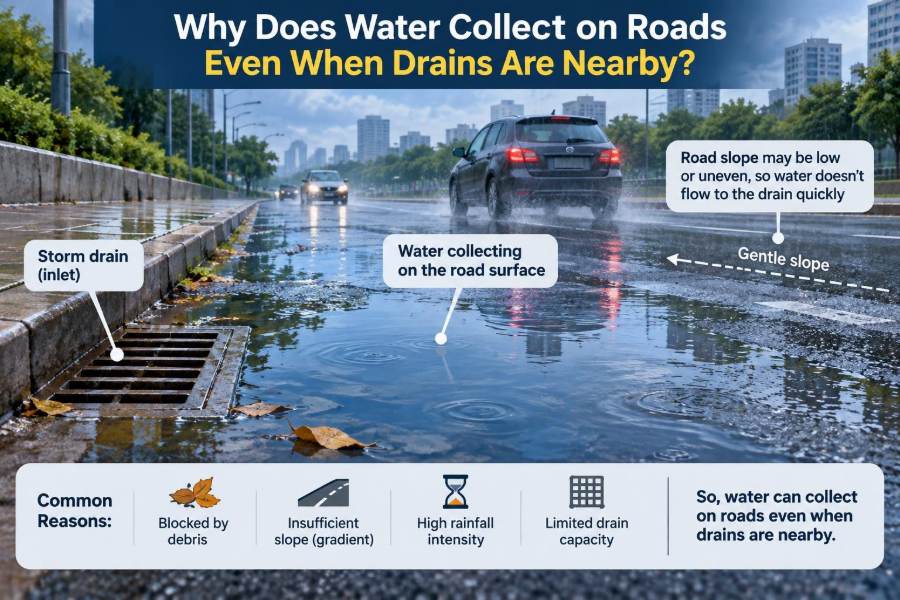

A sudden shower ends, traffic begins moving again, and yet a broad puddle remains beside the kerb. A drain may be only a few metres away, but water sits on the pavement, splashes pedestrians, and forces drivers to change direction.
It is tempting to assume that the drain is blocked or that too little drainage has been installed. Sometimes that is true. But standing water on a road is usually the visible result of several linked factors: surface shape, rainfall intensity, inlet location, pipe capacity, maintenance, and what lies beneath the pavement.
For road users, ponding is an inconvenience and a safety concern. For civil engineers, it is also evidence. The location, depth, and timing of a puddle can reveal how a drainage system and road surface are actually performing.
Understanding why water stays near a drain helps students read a site more critically and helps practitioners avoid treating every drainage complaint as a simple cleaning problem.
💧 A Drain Nearby Is Not the Same as a Drain Receiving Water
A drainage inlet can only remove water that reaches its opening. Water does not travel sideways across a road simply because a drain is nearby; it follows the local slope of the surface.
If the pavement contains a shallow depression, water will settle there until its depth becomes high enough to overflow the depression’s edge. The drain may sit close by but slightly uphill, behind a raised kerb line, or on the other side of a small ridge in the asphalt.
The first question is not “Where is the drain?” but “What path does water take to get there?”
📐 Road Crossfall Directs Water Toward the Edge
Most paved roads are built with a crossfall, also called cross slope or camber. This is the sideways tilt that encourages rainwater to move from the road surface toward the gutter and inlet.
On a two-way road, the crown is commonly near the centreline and the surface falls toward both edges. On a one-way carriageway, the whole surface may slope in one direction. If that intended slope is too flat, uneven, or reversed in a local area, runoff slows or collects.
A very small change in level can control where water ponds. That is why drainage performance depends on careful setting out and paving, not just the number of drains.
🛣️ Longitudinal Grade Keeps the Gutter Flowing
Water in the gutter also needs a downhill route along the road. This route is governed by longitudinal grade: the slope in the direction of travel.
Near the low point of a sag curve, at a flat intersection, or along a nearly level street, water can move slowly even when crossfall is adequate. The gutter then becomes a shallow channel with limited energy to carry flow toward the next inlet.
Designers pay particular attention to low points because they naturally collect runoff from both directions. A drain installed too far from the true low point may leave a persistent pond between the inlet and the depression.
🕳️ Local Depressions Create Small Basins
Roads do not need to be visibly damaged to hold water. A few millimetres of unevenness can form a local basin, especially where flow depths are shallow.
These depressions can arise during construction, after utility trench reinstatement, at lane joints, or through later settlement. In a hypothetical example, a patched strip may be only slightly lower than the surrounding surface, yet it can trap enough water to affect cyclists and pedestrians after every storm.
Surveying the surface with levels, a straightedge, or modern digital terrain methods can distinguish a local surface defect from a wider drainage-system issue.
🌊 Rainfall Can Arrive Faster Than an Inlet Can Capture It
Drainage systems are designed for a selected design storm, not for every possible burst of rain. During a very intense shower, water may reach an inlet faster than the grate and connected pipe can accept it.
This is called inlet capacity or capture capacity. Water flowing along the gutter may bypass the first inlet, continue downstream, and collect where the road geometry offers no easy escape.
Temporary ponding during an exceptional storm does not automatically prove a defective system. But frequent ponding during ordinary rainfall suggests that capacity, geometry, or maintenance deserves investigation.
🧲 Water Can Bypass an Inlet
Fast-moving gutter flow does not always turn sharply into a grate opening. Some water passes across or alongside the inlet, a process often called bypass.
Bypass is more likely when the road has a steep longitudinal slope, when an inlet is poorly aligned with the flow, or when a narrow grate has limited opening area. The water’s momentum carries it forward rather than into the opening.
Engineers may use additional inlets, different grate arrangements, or inlet placement before critical locations such as crossings and low points. The objective is to intercept flow before it becomes hazardous or reaches a sensitive area.
🍂 Debris Blocks Openings Before It Blocks Pipes
Leaves, litter, sediment, grass clippings, and road grit often accumulate at the face of a grate. Even if the pipe below is clear, this material can reduce the effective opening through which water enters.
Kerb inlets are particularly vulnerable when debris gathers in the gutter line. A grate may look broadly clear from above while a compacted layer at its upstream edge still prevents inflow.
Maintenance should therefore inspect the approach to an inlet, not merely lift the grate and look into the chamber. The flow path is part of the drainage asset.
🧱 Sediment Reduces the Capacity Below Ground
Once runoff enters a drainage system, it may pass through a gully pot or catch basin designed to retain sediment. Over time, accumulated silt reduces the available storage volume and can obstruct the outlet connection.
Fine material is common near unpaved verges, construction sites, deteriorating shoulders, and roads exposed to soil washed from adjoining land. If cleaning intervals do not reflect local conditions, a system can lose performance gradually.
This is one reason a drain may work well after maintenance but become ineffective months later. The problem is not always a failed design; it may be a mismatch between maintenance frequency and sediment load.
🚧 Construction Tolerances Matter More Than They Seem
Road drawings specify levels, slopes, and inlet positions, but construction must translate those values into a continuous finished surface. Small deviations can be unavoidable, yet their effect is greatest around kerbs, gullies, manholes, and low points.
An inlet set slightly high relative to the gutter can leave a lip that traps water upstream. Conversely, an inlet frame set too low may form a sharp depression that creates a maintenance and ride-quality issue.
Good quality control includes checking finished levels, not only the underlying layers. A well-designed drainage layout can underperform if the final asphalt profile does not match its intended drainage lines.
🪨 Settlement Changes a Road After It Opens
Road levels are not permanently fixed once construction ends. Settlement of fill, trench backfill, weak subgrade, or poorly compacted material can lower part of the pavement over time.
Utility trenches are common locations for this problem because their backfill may behave differently from surrounding ground. Repeated loading from traffic can make the differential settlement more visible.
A depression beside a recently reinstated water main is therefore not necessarily caused by inadequate drain spacing. The more direct remedy may be to repair and recompact the failed pavement area while confirming that the drain itself remains sound.
🧊 Pavement Deterioration Alters Surface Drainage
Cracking, rutting, ravelling, and potholes do more than affect ride comfort. They disrupt the smooth, continuous plane needed for shallow sheet flow.
Wheel-path rutting is especially relevant on heavily trafficked roads. It can form elongated channels that carry water along the lane rather than toward the gutter, or hold water where the rut has no outlet.
Water then accelerates pavement damage by entering cracks and weakening supporting layers. Drainage and pavement maintenance should be considered together because each problem can worsen the other.
🚗 Traffic Loads Can Turn Minor Unevenness Into Ponding
Heavy vehicles repeatedly load similar wheel paths. Where asphalt mixes, underlying layers, or support conditions are inadequate, permanent deformation can develop.
Initially, the deformation may be too slight to concern road users. During rain, however, the same shallow rut reveals itself as a strip of standing water. This can reduce tire contact and obscure lane markings.
The durable response is rarely just to add another inlet. Engineers need to identify whether the surface deformation is structural, material-related, or caused by water weakening the pavement foundation.
🏙️ Impervious Surfaces Produce More Runoff
Urban roads receive runoff not only from their own pavement but sometimes from roofs, parking areas, driveways, and adjacent hardstanding. These impervious surfaces allow little infiltration, so rainfall becomes surface runoff quickly.
Redevelopment can change where water reaches a street. A new paved forecourt, for example, may direct additional flow toward a road gutter that was originally intended to receive only roadway runoff.
Drain capacity should be reassessed when catchment conditions change. The visible puddle may appear on the road, while the cause begins on private or adjoining land.
🏗️ Kerbs, Driveways, and Crossings Interrupt the Gutter
The gutter is a drainage channel built into the road edge, but it is frequently interrupted. Driveway ramps, dropped kerbs, pedestrian crossings, bus stops, and raised tables can all alter its shape.
If a crossing is not detailed with a clear drainage route, water can collect at its approaches. This creates an accessibility problem for wheelchair users and people with limited mobility, even if the water depth is modest.
Drainage detailing must account for these interruptions. The road’s general slope may be correct while the local feature still creates a barrier to flow.
🔧 Utility Covers Can Become Unintended High Points
Manhole covers, valve boxes, and other utility frames must be adjusted to the finished road level. When they sit proud of the surrounding pavement, they can deflect shallow flow and create small upstream ponds.
When they sit low, water may collect around the frame and enter through imperfect seals. Repeated wetting can weaken nearby asphalt and enlarge the depression.
These defects are often highly localized, which makes them easy to miss in broad drainage calculations. Site inspection remains essential because hydraulic models cannot reliably represent every imperfect frame and patch.
🌬️ Wind, Leaves, and Seasonal Conditions Change Performance
A drainage inlet does not experience the same conditions throughout the year. Autumn leaf fall can rapidly cover grates, while dry periods may allow sediment and litter to build up before the next storm.
Wind can push floating debris into particular kerb lines and corners. In cold climates, ice or compacted snow may temporarily block inlets or alter surface flow paths.
Maintenance plans work best when they respond to predictable seasonal risks and local observations rather than following a rigid calendar alone.
🌧️ Outfall Conditions Can Hold Water Back
A road drainage pipe needs a place to discharge, often into a larger storm sewer, watercourse, storage system, or approved infiltration feature. If the receiving system is already full or under high water level, discharge from the road system can slow down.
This downstream influence is sometimes called backwater. Water may then rise in gullies and pipes, reducing the ability of road inlets to accept more flow.
The road drain can appear blocked even when the local pipe is clear. Diagnosing the issue may require inspection beyond the visible inlet and along the broader network.
🧰 Combined Sewers Face Different Pressures
In some older urban areas, stormwater and wastewater share a combined sewer. During heavy rain, this arrangement can face capacity constraints because both runoff and sanitary flow use the same network.
Modern drainage approaches often aim to separate these flows where feasible, but existing infrastructure cannot always be changed quickly or cheaply. Local road improvements must therefore consider the limits of the downstream system.
Connecting more surface runoff to a constrained combined sewer may solve a puddle at one location while increasing pressure elsewhere. Drainage design is a network problem, not just an inlet problem.
🌱 Infiltration Is Helpful Only Where Ground Conditions Allow It
Permeable pavements, swales, rain gardens, and infiltration trenches can reduce the amount of water reaching conventional drains. These measures can be valuable where soil, groundwater, contamination conditions, and available space are suitable.
They are not universal substitutes for pipes and inlets. Clay-rich soils may infiltrate slowly, high groundwater can limit storage, and accumulated sediment can reduce permeability without maintenance.
A sustainable drainage feature should be designed as a managed system with an overflow route. It must safely handle water when infiltration is slower than rainfall.
🧪 Drainage Failures Need Investigation, Not Guesswork
A useful investigation begins by observing when and where ponding occurs. Does it appear in light rain or only intense storms? Does it disappear soon after rainfall stops? Is it limited to one inlet, one lane, or an entire low-lying block?
Engineers may combine visual inspection with level surveys, gully cleaning records, CCTV inspection of pipes, and review of drainage drawings. Dye testing or controlled water testing can sometimes help trace a suspected flow path, subject to site and environmental controls.
The goal is to separate surface, inlet, pipe, and downstream causes before selecting a repair.
📏 Measuring Ponding Turns Complaints Into Useful Evidence
Photographs are valuable, but they should be supported by basic observations. Record the rain conditions if known, pond location, approximate spread, depth, duration, nearby inlet condition, and whether traffic changes the water movement.
For recurring locations, surveying the kerb line and road surface can reveal whether the inlet is above the local low point. A simple profile often explains a problem that was previously attributed to an unspecified “blocked drain.”
Safety matters during inspection. Personnel should not enter flowing water, open drainage structures without proper procedures, or work close to live traffic without appropriate traffic management.
🛠️ Cleaning Is Effective, but It Has Limits
Removing debris and sediment is often the quickest, least disruptive remedy. It restores inlet openings and gully storage without rebuilding the road.
However, cleaning cannot correct an inlet that is set too high, a road surface that has settled, or a pipe system constrained by its outfall. Repeated cleaning at the same troublesome location should trigger a review of why material is accumulating or why flow bypasses the inlet.
Maintenance restores designed performance; it cannot create performance that the geometry or capacity never provided.
🏗️ Surface Regrading Can Restore the Flow Path
Where ponding is caused by local unevenness, milling and resurfacing may be more appropriate than adding drainage hardware. The repair should restore a continuous route from the pavement to the gutter and inlet.
Regrading requires care at doors, driveways, kerbs, utility covers, and adjacent lanes. Simply placing a thin asphalt layer can shift water toward a new low point if levels are not checked across the whole local area.
In severe cases, reconstruction of the pavement layers may be needed where settlement or structural failure has caused the depression.
➕ Additional Inlets Must Be Placed Strategically
Adding an inlet can reduce gutter flow and ponding, but only if it is connected to adequate downstream capacity and located where water naturally converges.
Useful locations often include upstream of pedestrian crossings, before low points, and along long gutter runs where bypass becomes likely. Inlets should also remain accessible for cleaning and should not create hazards for cyclists or pedestrians.
More inlets are not always better. Each adds construction cost, maintenance needs, and potential utility conflicts. Good placement is usually more valuable than indiscriminate quantity.
🚶 Ponding Is an Accessibility and Safety Issue
Standing water can hide potholes, reduce skid resistance, splash pedestrians, and force cyclists away from the kerb. At crossings, it can prevent people from reaching push buttons or tactile paving without stepping into water.
For drivers, deeper ponding can affect visibility and vehicle control. The risk depends on depth, speed, traffic type, pavement texture, and the presence of underlying defects; it should not be reduced to a single rule for all roads.
Prioritizing repairs near schools, transit stops, crossings, and high-speed routes can deliver a larger safety benefit than responding only to the largest visible puddles.
⚖️ Drainage Design Balances Competing Needs
Road drainage is not designed in isolation. Steeper crossfall drains water efficiently but can affect comfort, accessibility, and the interface with buildings and side roads. Large grates capture more flow but may create concerns for cyclists, debris handling, and maintenance.
Similarly, storing water in sustainable drainage features can reduce peak runoff, but it requires space and long-term care. Underground pipes save surface space yet can be costly and difficult to inspect.
Sound engineering acknowledges these trade-offs and selects measures suited to the road’s use, climate, ground conditions, and surrounding drainage network.
📝 Common Mistakes When Diagnosing Road Puddles
- Blaming the nearest drain: the local low point may lie elsewhere.
- Assuming every puddle means a blocked pipe: inlet bypass, poor grade, or settlement may be the real cause.
- Adding an inlet without checking the outlet: downstream restrictions can remain unchanged.
- Ignoring adjacent catchments: runoff from property or parking areas can overload a gutter.
- Repairing only the surface: recurring settlement may indicate a deeper support or utility-trench problem.
A structured diagnosis avoids repeated, short-lived repairs and directs limited maintenance budgets toward the actual mechanism of failure.
🔍 A Practical Site-Observation Checklist
When assessing a recurring ponding location, follow the water from the pavement toward the network rather than starting inside the nearest drain.
- Identify the visible high and low points on the road and gutter.
- Check whether debris blocks the approach to the inlet.
- Look for rutting, patches, cracks, settlement, and raised frames.
- Observe whether flow enters, bypasses, or backs out of the inlet.
- Consider runoff arriving from nearby slopes, roofs, or paved areas.
- Review whether the issue occurs only in severe storms or in routine rainfall.
This sequence does not replace a formal design review, but it gives students and practitioners a disciplined way to frame the problem.
🎯 The Core Principle: Water Follows Levels and System Limits
Water collects on roads near drains when its route is interrupted or when the drainage system cannot accept it quickly enough. The interruption may be a shallow depression, a blocked inlet, a broken gutter line, a poorly placed grate, or a downstream restriction.
The most effective response matches the cause: clean debris, restore surface levels, repair settlement, improve inlet capture, increase capacity, or manage runoff before it reaches the road. These actions are related, but they are not interchangeable.
Good road drainage depends on a continuous path from rainfall on the surface to a safe, functioning outlet.
A nearby drain is only one part of that path. When engineers inspect the pavement shape, the inlet, the pipe network, and the wider catchment together, a familiar roadside puddle becomes a solvable drainage problem rather than a recurring mystery. 🌧️🛣️💧