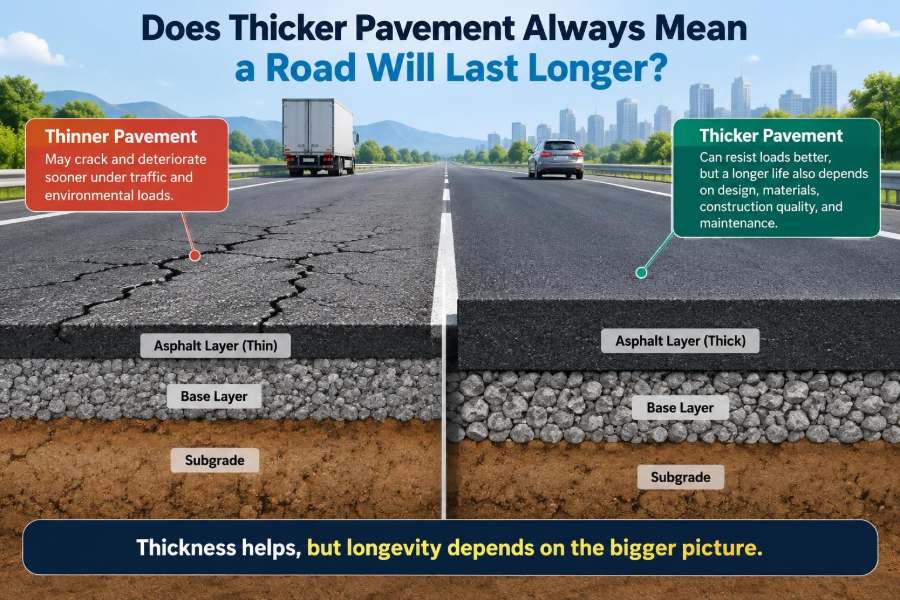

A newly resurfaced road can look impressively solid: deep black asphalt, crisp lane markings, and a pavement layer that appears far thicker than the road beside it. It is natural to assume that the thicker one will last longer.
Sometimes it will. A pavement that is too thin for its traffic and foundation is likely to crack, rut, or deflect early. But thickness alone does not tell the whole story.
Roads behave less like a single slab of material and more like a layered system. A strong surface placed over weak, wet, poorly compacted ground can fail surprisingly quickly, while a carefully designed thinner pavement can give dependable service for many years.
For students, designers, contractors, and road users, this distinction matters. It explains why pavement design is an exercise in matching materials, loads, drainage, construction quality, and future maintenance—not simply adding more asphalt or concrete.
🛣️ The short answer: thickness helps, but it is not enough
Increasing pavement thickness generally reduces stress and strain in the layers below a wheel load. That can improve resistance to fatigue cracking, permanent deformation, and other structural failures.
However, a road lasts longer only when its thickness is appropriate for the conditions. If water enters the structure, the subgrade is weak, the materials are unsuitable, or construction is poorly controlled, extra thickness may provide far less benefit than expected.
The durable road is not necessarily the thickest road; it is the road whose entire structure is suited to its site and use.
🏗️ A pavement is a layered structural system
Most roads are built in layers, each with a different job. The surface must provide a safe, smooth, durable riding course, while lower layers spread wheel loads before they reach the natural soil.
In a typical flexible pavement, the upper layer is asphalt concrete. Beneath it may be an asphalt base, granular base, subbase, and finally the compacted subgrade—the prepared natural soil or fill.
- Surface course: resists traffic wear, provides texture, and helps shed water.
- Base and subbase: distribute loads and provide stable support.
- Subgrade: forms the foundation for every layer above it.
A problem in any lower layer can appear at the surface. That is why a road cannot be judged solely by the visible asphalt thickness.
⚖️ What “thicker” can actually mean
When people say a pavement is thicker, they may mean a thicker asphalt surface, a thicker granular base, a deeper total pavement structure, or a thicker concrete slab. These are not interchangeable choices.
For example, adding asphalt may improve fatigue performance and ride quality, but it may not solve a drainage problem beneath the base. Adding well-draining granular material may improve support in another project, yet it is not a substitute for a sound subgrade where heavy trucks are expected.
Designers therefore consider both total thickness and the thickness, stiffness, and quality of each individual layer.
🚚 Traffic loading is more than vehicle count
A quiet residential street and a freight route may carry a similar number of vehicles in a day, but their pavement demands can be completely different. Heavy axle loads cause much greater structural damage than passenger cars.
Repeated loading is also critical. Pavement deterioration develops from millions of load applications, not only from one unusually heavy truck. The design traffic estimate must account for expected truck volume, axle configurations, lane distribution, and traffic growth over the design period.
Where truck traffic is underestimated, a pavement that seemed adequately thick at opening can rut or crack far earlier than planned.
🔄 Repetition creates fatigue damage
Each wheel pass bends a flexible pavement slightly. When tensile strains near the bottom of asphalt layers are repeated often enough, small cracks can begin and eventually connect into fatigue cracking.
This is often seen as interconnected, alligator-like cracking in wheel paths. The visible pattern is a late-stage symptom; the structural weakening started earlier beneath the surface.
Additional thickness can reduce bending strain, which is why it is valuable on heavily trafficked roads. Yet fatigue resistance also depends on asphalt mixture properties, bonding between layers, temperature, and uniform support below.
🧱 The subgrade sets the starting point
The subgrade is the soil platform supporting the pavement. Its strength can vary sharply along a project because of soil type, moisture, fill placement, buried services, organic material, or local drainage conditions.
A weak clay subgrade may deform under traffic or lose strength when wet. A dense, well-drained granular subgrade can provide much more reliable support. Pavement thickness must respond to those conditions.
Placing a thick pavement over untreated soft ground may only delay distress. If the soil continues to move or consolidate, the upper layers may crack and settle with it.
💧 Water is often the hidden durability problem
Water can weaken unbound granular layers and moisture-sensitive soils, contribute to stripping in asphalt mixtures, and accelerate damage through pumping or erosion of fine particles. It can enter through cracks, joints, edges, utility cuts, and poorly sealed shoulders.
A road can have a generous structural thickness and still fail prematurely if water remains trapped within it. This is especially likely where the water table is high or surface drainage is poor.
Keeping water out, moving water away, and preventing moisture from being trapped are central pavement-design tasks.
🌧️ Drainage is a structural feature, not an accessory
Good drainage begins at the surface. Crossfall, crown shape, kerbs, inlets, side ditches, and shoulders should direct rainfall away before it infiltrates.
Subsurface drainage may also be needed where water is likely to accumulate in the base or subgrade. Depending on the site, this can include drainage layers, edge drains, filter materials, or separation geotextiles.
Drainage details must remain functional after construction. A clogged outlet or blocked ditch can undermine an otherwise sound pavement system.
🧪 Material quality changes the value of thickness
Thickness is only as useful as the material placed in that thickness. Asphalt mixtures need appropriate aggregate gradation, binder content, air-void structure, and resistance to the temperatures and traffic loads they will experience.
Granular bases need suitable strength, cleanliness, gradation, and compaction. Materials contaminated with excess fines may hold water and lose stability, even if the layer meets its intended thickness.
Two 100 mm layers can perform very differently if one is well-designed and well-produced while the other is segregated, poorly compacted, or made with marginal aggregate.
🔥 Asphalt is sensitive to temperature and loading rate
Asphalt is viscoelastic: it behaves partly like an elastic solid and partly like a viscous material. Its stiffness changes with temperature and the speed of loading.
In hot conditions or under slow, heavy traffic, asphalt can become more vulnerable to rutting. In cold conditions, it can become stiffer and more prone to thermal cracking. A thicker layer does not automatically correct an asphalt mix that is poorly suited to the local climate.
Mixture selection, binder grade, aggregate structure, and compaction work together with thickness to control performance.
🪨 Aggregate interlock supports the road
Unbound base layers carry load efficiently when well-graded aggregate particles interlock and remain confined. Their performance depends on particle shape, gradation, moisture, density, and lateral restraint.
If a base becomes saturated, contaminated, or inadequately compacted, particles can rearrange under traffic. The resulting deformation may show at the surface as ruts, depressions, or cracking.
Adding more asphalt above a moving base is rarely the most efficient first response. The cause beneath should be investigated.
🧰 Compaction cannot be replaced by extra material
Compaction removes air voids from asphalt and increases density in granular and soil layers. Proper density improves strength, stability, moisture resistance, and layer-to-layer support.
A loose layer can settle under traffic after the road opens. In asphalt, inadequate compaction can leave connected air voids that allow water and air to accelerate aging and damage.
Extra thickness placed at poor density is not equivalent to a thinner layer placed correctly. Field density checks, rolling patterns, temperature control, and proof-rolling are therefore practical quality controls, not paperwork.
📏 Uniformity matters as much as average thickness
A pavement may meet its average thickness target while containing local thin spots. Those weak locations attract higher strains and can become the first areas to crack or deform.
Non-uniform support has a similar effect. A stiff area beside a soft trench backfill, for example, can create differential movement and a recurring crack line.
Reliable construction aims for consistent thickness, density, and support across the full lane width and project length—not merely a satisfactory average test result.
🧩 Layer bonding determines whether asphalt acts together
Asphalt lifts are intended to work as a composite structure. A properly applied tack coat and clean interface help adjacent layers transfer shear forces and bend together under traffic.
If layers slip or debond, the pavement may behave as separate thinner layers. This can lead to slippage cracking, shoving near braking zones, or reduced structural capacity.
Simply adding a thick overlay without ensuring a sound, bonded interface may leave a significant weakness hidden below the new surface.
🛞 Rutting has more than one cause
Ruts are longitudinal depressions in wheel paths. They can originate in the asphalt surface, in the granular base, or in the subgrade, and the repair should match the origin.
| Likely location | Typical mechanism | Useful response |
|---|---|---|
| Asphalt layer | Mixture shear deformation under heat and heavy loads | Improve mix stability and replace deformed asphalt |
| Base or subgrade | Weak, wet, or inadequately compacted support | Repair lower layers and address drainage |
| Surface irregularity | Construction profile or localized settlement | Investigate profile and underlying cause before overlaying |
A thicker asphalt layer may help in some cases, but it can also bury a lower-layer problem until it returns.
🕸️ Cracks are clues, not just surface defects
The shape and location of cracking can indicate what is happening within a pavement. Alligator cracking commonly points to repeated structural loading; longitudinal cracks may relate to joints, wheel paths, or widening interfaces; transverse cracks may reflect thermal movement or reflective cracking.
Crack sealing can be a useful preservation measure when the pavement remains structurally sound. It is not a structural repair for widespread fatigue cracking caused by failed support.
Engineers should diagnose before selecting a treatment. Treating every crack with the same surface fix wastes material and can postpone necessary rehabilitation.
🧊 Freeze-thaw conditions add another design challenge
In cold regions, water in susceptible soils can form ice lenses and lift parts of the pavement, a process known as frost heave. When thawing occurs, the saturated soil may temporarily lose strength.
Thickness can help distribute loads during weak thaw periods, but drainage, frost-susceptible soil removal, insulation strategies, and appropriate materials may also be needed. Local climate and groundwater conditions determine the right approach.
A pavement design suitable for a warm, dry setting should not be copied blindly into a cold region with seasonal freezing.
🌡️ Climate affects more than freeze-thaw
High temperatures, intense rainfall, long wet seasons, coastal moisture, and large daily temperature swings all influence pavement performance. Climate also affects construction windows: asphalt compaction becomes difficult if material cools too quickly, while wet earthworks can prevent stable subgrade preparation.
Future climate conditions may introduce uncertainty, particularly where rainfall patterns, extreme heat, or flooding risks are changing. Designers should use the best applicable local guidance and consider resilience where consequences of failure are high.
🚧 Construction staging can create weak points
Roads are often built in stages to maintain traffic, accommodate utilities, or manage funding. Each stage creates interfaces that require careful treatment.
Common vulnerabilities include longitudinal joints, temporary drainage changes, exposed subgrade, trench reinstatements, and traffic running on incomplete layers. Heavy construction traffic can damage a prepared foundation before the final pavement is placed.
Good staging protects the work already completed. It also ensures that temporary measures do not become permanent defects.
🏘️ Utility cuts challenge pavement longevity
Water, sewer, gas, and telecommunications work can require trenches through an otherwise sound road. The repaired strip may settle if backfill is not properly selected and compacted.
The visible result is often a longitudinal dip, cracking along trench edges, or a rough ride. In wet ground, the trench can also become a preferential path for water movement.
Strong reinstatement specifications, compatible materials, compaction control, and restoration of drainage are essential. A thick original pavement cannot compensate for a poorly restored excavation.
🛤️ Flexible and rigid pavements use thickness differently
Flexible pavements, usually asphalt-based, distribute load through several layers and deform slightly under traffic. Their performance is strongly linked to the combined quality of the asphalt, base, and subgrade.
Rigid pavements use concrete slabs that spread loads over a wider area because concrete has high flexural stiffness. Slab thickness matters, but joint design, load transfer, subbase support, curing, and prevention of pumping also matter greatly.
Neither system is automatically longer-lasting. The appropriate choice depends on traffic, materials, climate, construction capability, maintenance strategy, and project constraints.
🔍 Investigation should come before choosing a repair
A road that is rough or cracked does not always need the same treatment. Engineers commonly combine visual surveys with records of traffic and maintenance, drainage inspections, coring, deflection testing, and sampling of materials where appropriate.
These investigations help separate surface aging from structural failure. For example, a weathered but structurally sound asphalt surface may benefit from preservation, while deep fatigue cracking may require reconstruction of failed layers.
There is uncertainty in every assessment because subsurface conditions vary. The goal is not perfect prediction; it is a defensible decision based on the best available evidence.
🧱 Overlays work best on a sound foundation
An asphalt overlay adds thickness and can restore ride quality, improve skid resistance, and increase structural capacity. It is often an efficient rehabilitation option when the underlying pavement is stable enough to support it.
But overlays can reflect existing cracks, especially when the underlying cause remains active. They can also alter kerb heights, drainage paths, bridge clearances, and access levels if repeated without planning.
Before overlaying, designers should address localized base failures, drainage deficiencies, and unsuitable surface conditions. Milling may be used to remove distressed material and maintain geometry.
♻️ Recycling can be durable when properly engineered
Reclaimed asphalt pavement and in-place recycling techniques can conserve aggregate, reduce hauling, and rebuild distressed layers. Their performance depends on correct characterization of existing materials, mixture design, depth control, moisture management, and compaction.
Recycling is not a shortcut around diagnosis. If a road has unstable subgrade or chronic drainage problems, those conditions still need treatment.
When matched to the project, recycling can form part of a practical, resource-conscious pavement strategy.
💰 The thickest design may not be the best investment
More material increases initial cost, construction time, haulage, and environmental impacts. It may be justified on a major freight corridor, but unnecessary thickness on a lightly trafficked road can divert funds from drainage, maintenance, or other needed works.
Conversely, choosing an under-designed pavement to reduce initial cost can lead to frequent repairs, traffic disruption, and higher costs over its life. The relevant question is value across the service life, not the lowest opening-day price.
Life-cycle planning considers construction, preservation, rehabilitation, user disruption, and expected performance together.
🧹 Maintenance preserves capacity; it does not create it
Routine actions such as clearing drains, sealing cracks, maintaining shoulders, repairing potholes promptly, and keeping water away from edges can slow deterioration. These tasks are especially effective before widespread structural damage develops.
Preventive maintenance cannot turn a severely under-designed pavement into a strong one. Still, neglecting small defects allows water and traffic to enlarge them until rehabilitation becomes far more extensive.
A well-designed road needs maintenance, and a well-maintained road still needs adequate original design.
⚠️ Common assumptions that lead to poor decisions
- “A thicker wearing course fixes weak soil.” It may delay symptoms, but unstable subgrade requires its own solution.
- “If the surface is smooth, the pavement is healthy.” Structural damage can develop below a smooth overlay.
- “All cracks should be covered immediately.” The crack pattern and cause should guide treatment.
- “More compaction is always better.” Materials require compaction within suitable moisture and temperature ranges; improper rolling can also cause problems.
- “One standard section suits every road.” Traffic, soils, drainage, and climate vary along and between projects.
🧭 A practical design mindset
Good pavement design starts with questions rather than a preset thickness. What loads will the road carry? How variable is the subgrade? Where will water go during a major storm? Which materials are locally available and controllable? How will the road be maintained?
The answers guide the structural section, drainage features, material specifications, construction controls, and preservation plan. Design methods and agency standards provide essential frameworks, but they must be applied to actual site conditions.
For students, the key habit is to connect every layer and detail to a failure mechanism. For practitioners, the key is to verify that those details survive construction and operation.
✅ The core principle: match the pavement to the problem
Thickness is a powerful design variable because it reduces damaging stresses and strains. It is indispensable where traffic is heavy, support is limited, or long service is required.
Yet it is only one variable in a connected system. Water management, subgrade preparation, material selection, compaction, layer bonding, climate, traffic loading, and timely maintenance all influence whether that thickness delivers its intended life.
When a road fails, the most useful question is not simply “How much thicker should it be?” It is “What mechanism is causing the failure, and which part of the pavement system must change?”
Thicker pavement can last longer, but lasting roads are created by balanced design, sound construction, and disciplined maintenance working together. That is the difference between adding material and building durable infrastructure. 🛣️💧🔧