
A newly paved driveway can look perfect on the day it is finished. Months later, a shallow dip appears where a vehicle regularly parks, rainwater begins collecting in the low spot, and cracks spread across the surface. The visible problem is at the top, but its cause may be several layers below.
The same principle applies to roads, building pads, embankments, pipelines, retaining walls, and rail corridors. Construction materials cannot perform reliably when the soil supporting them is loose, uneven, or too wet to carry load as intended.
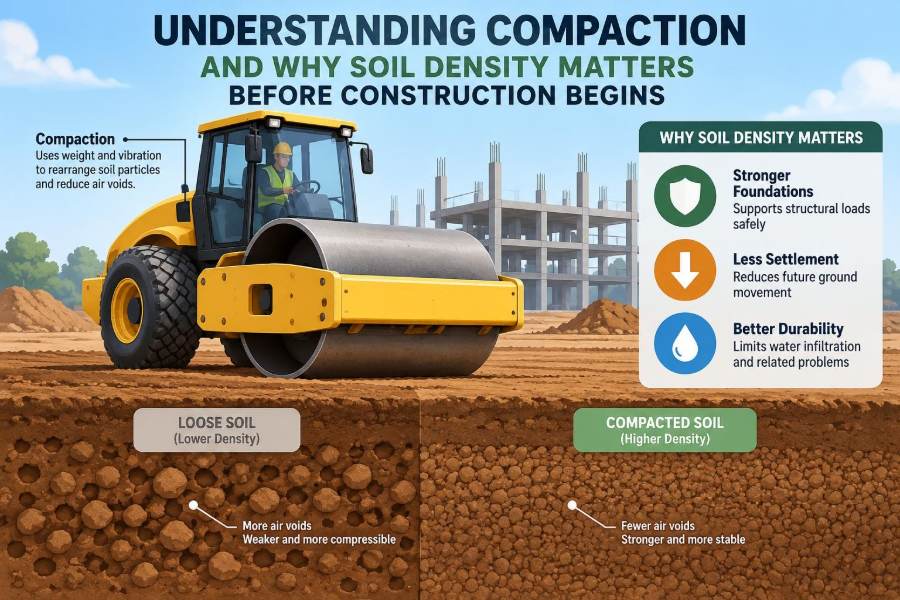
Compaction is the controlled process of making soil denser by reducing the air-filled spaces between particles. It is one of the least visible construction activities, yet it strongly influences settlement, strength, drainage behavior, and long-term maintenance.
Before concrete is poured or asphalt is placed, civil engineers need to understand what lies beneath. Soil density is not merely a test value on a report; it is a practical indicator of whether the ground has been prepared to do its job.
🏗️ What Compaction Means in Civil Engineering
Soil is made of mineral particles, water, air, and sometimes organic material. In a loose soil mass, particles have relatively large voids between them. Compaction rearranges those particles into a closer configuration, mostly by driving out air.
This differs from simply pressing the ground until it looks smooth. Effective compaction requires an appropriate soil condition, suitable equipment, sufficient energy, and verification that the desired density has actually been achieved.
🧱 Why Density Controls Construction Performance
Denser soil generally has more particle-to-particle contact. That contact helps the material resist deformation when loads from a pavement, footing, wall, or embankment are transferred into the ground.
Density alone does not describe every engineering property, but it is a useful construction-control measure because it is closely related to stiffness, strength, and expected settlement for a given soil and moisture condition. A uniform compacted layer is often as valuable as a high-density layer.
🌬️ The Difference Between Compaction and Consolidation
Compaction and consolidation are often confused because both can reduce soil volume. Their mechanisms and timescales are different.
Compaction is usually rapid and mechanical: rollers, rammers, or vibratory equipment expel air from fill during construction. Consolidation is a time-dependent process in saturated fine-grained soils, where water gradually drains from pores under sustained load.
A clay foundation beneath a new embankment may consolidate for a long time even when the embankment fill itself was compacted properly. Good construction practice must consider both processes.
🔬 Soil Phases: Particles, Water, and Air
A helpful way to picture soil is as a three-part system. The solid skeleton is formed by soil grains; the spaces between grains contain water, air, or both. Those spaces are called voids.
During ordinary earthwork compaction, air is easier to remove than water. This is why moisture has such a strong effect on results. A soil that is too dry may resist rearrangement, while a soil with too much water can become unstable under the equipment.
📏 Dry Density Is the Key Field Comparison
Field soil contains varying amounts of water, so its total or “wet” weight can be misleading. Compaction specifications commonly use dry density: the mass of soil solids per unit volume after the contribution of water has been accounted for.
Using dry density allows the field condition to be compared meaningfully with a laboratory reference test. The moisture content is still measured because the same dry density can be difficult—or impossible—to reach at an unsuitable water content.
💧 Moisture Content Changes Everything
Adding some water to dry soil can make compaction easier. Water acts as a thin lubricant between particles, allowing them to slide and pack more efficiently when energy is applied.
Past a certain point, additional water fills voids and develops pore-water pressure under loading. The soil may pump, rut, and lose stability rather than densify. A roller passing repeatedly over such material can make the surface look sealed while the layer below remains weak.
🎯 Optimum Moisture Content Explained
For a specified laboratory compaction effort, there is typically a moisture content at which a soil reaches its highest dry density. This is called the optimum moisture content, or OMC.
OMC is not a universal moisture value for a soil. It changes with soil type and with the laboratory method used to apply compaction energy. Field conditions also vary, so project specifications usually define an acceptable moisture range rather than expecting one exact number.
🧪 The Laboratory Compaction Curve
A standard laboratory compaction test prepares identical soil samples at different moisture contents and compacts each sample using a prescribed method. Plotting moisture content against dry density produces a compaction curve.
The peak of that curve provides the maximum dry density for that test method and its corresponding optimum moisture content. This reference gives field teams a target that is practical to inspect, rather than relying on appearance or roller passes alone.
📊 Relative Compaction and Project Specifications
Many earthwork specifications express acceptance as a percentage of a laboratory maximum dry density. This percentage is commonly called relative compaction.
For example, a project may require a field dry density equal to or above a stated percentage of the relevant laboratory maximum. The required value is selected by the designer or agency for the material and application; it should not be assumed to be the same for landscaping fill, structural fill, and pavement subgrade.
| Application | Typical concern | Why compaction control matters |
|---|---|---|
| Building pad | Differential settlement | Helps provide more uniform support beneath foundations and slabs |
| Road subgrade | Rutting and cracking | Creates a firmer platform for base and pavement layers |
| Embankment | Slope deformation | Improves fill integrity and reduces uncontrolled settlement |
| Utility trench backfill | Surface settlement | Limits depressions that can damage pavements and services |
🪨 Soil Type Determines the Best Approach
Soils do not respond to compaction in the same way. Particle size, gradation, plasticity, particle shape, and moisture condition all influence which method is efficient.
Well-graded granular soils contain a range of particle sizes, allowing smaller grains to occupy spaces between larger ones. Uniform sand, highly plastic clay, organic soil, and demolition debris require different expectations and controls.
🏖️ Granular Soils Respond to Vibration
Sands and gravels are often compacted effectively with vibration. The vibration briefly reduces frictional resistance between grains, helping them settle into a denser arrangement.
Vibratory rollers are common on granular fills, but their effectiveness still depends on lift thickness and moisture. Very dry sand, saturated material, or a layer that is too thick can respond poorly despite repeated passes.
🧲 Cohesive Soils Need Kneading Action
Clay-rich soils have fine particles that adhere to one another and are strongly affected by water. They often respond better to kneading, pressure, and remolding than to vibration alone.
Padfoot or sheepsfoot rollers create concentrated pressure and manipulate the soil through the layer. The resulting surface can appear rough during early passes; that appearance is not necessarily a defect if the layer is progressing toward the specified condition.
🚜 Matching Equipment to the Material
Common compaction equipment includes smooth-drum rollers, vibratory rollers, pneumatic-tire rollers, padfoot rollers, plate compactors, and tamping rammers. Each delivers energy differently through static weight, vibration, impact, kneading, or a combination of actions.
- Smooth drums are useful for finishing and for some granular layers.
- Pneumatic-tire rollers apply overlapping pressure and kneading action.
- Plate compactors suit confined areas and granular material.
- Rammers are useful in narrow trenches and around structures.
Equipment selection should follow the approved earthwork plan, trial sections, and material behavior—not simply what happens to be available on site.
📚 Lift Thickness Is Not a Minor Detail
A lift is one placed layer of fill before it is compacted. If a lift is too thick, energy from the roller may densify the upper zone while leaving the bottom relatively loose.
Thin lifts take more time, but they make compaction energy more likely to reach the full depth. The allowable loose lift thickness depends on the material, roller, equipment settings, and project requirements.
🔁 Passes Help, but More Is Not Always Better
A roller pass is one traversal of equipment over an area, usually counted according to a project-defined coverage pattern. A sufficient number of passes is needed to apply energy consistently across the layer.
However, passes are a process indicator, not proof of compliance. Some soils reach a practical density plateau, while excessive rolling can crush fragile aggregate, create surface laminations, or cause wet fine-grained soil to pump.
🛣️ Building a Stable Road Foundation
Road pavements distribute traffic loads through multiple layers, but they still depend on the subgrade below. A weak or variable subgrade can allow local deflection, which concentrates stresses in the base and surface layers.
Consider a hypothetical access road built over patchy fill. If one area is compacted adequately and another is loose, trucks may create a depression in the weaker zone. Water then ponds there, further softening the support and accelerating pavement distress.
🏠 Foundation Pads and Differential Settlement
Foundation problems are not always caused by inadequate bearing strength everywhere. Often, the greater concern is differential settlement: one part of a building settles more than another.
Compacted engineered fill can provide a more predictable platform when it is placed in controlled lifts and inspected. It does not eliminate the need for geotechnical investigation; the underlying natural soil, groundwater, foundation loads, and fill extent still govern the final design.
🚰 Trenches Need Careful Backfilling
Utility trenches are difficult because space is limited and pipes, conduits, and structures can be damaged by unsuitable equipment or aggressive compaction. Yet leaving trench backfill loose can cause settlement beneath sidewalks, roads, and landscaped areas.
Work is commonly staged from bedding and side support around the utility to initial backfill and then upper backfill. Material type, moisture, lift thickness, and compactor size must be coordinated so that density is achieved without displacing or crushing the installed service.
⛰️ Embankments Depend on Uniform Layers
An embankment is constructed fill that raises ground level for a road, railway, levee, or development platform. Its performance depends on the properties of each layer and on how those layers interact.
Loose pockets, abrupt changes in material, wet seams, and poorly bonded lift interfaces can create zones of different stiffness and seepage behavior. On slopes, drainage and erosion protection are also essential; compaction alone cannot solve every embankment risk.
🌧️ Water Can Be Both Tool and Threat
Water added in a controlled amount can bring dry soil closer to a workable moisture range. This is why water trucks and mixing equipment are common in earthwork operations.
Rain, groundwater seepage, and poor drainage can have the opposite effect. If the material becomes too wet, construction may need to pause while it dries, is aerated, is blended with acceptable material, or is otherwise treated according to the project plan.
🧫 Field Density Testing Verifies the Work
Visual inspection can identify obvious issues such as rutting, loose zones, or inconsistent material, but it cannot reliably establish dry density. Field testing provides the evidence needed to compare completed work with the specification.
Methods may include nuclear density gauges, sand-cone testing, drive-cylinder methods where suitable, or other approved procedures. Each has limitations related to soil type, calibration, test location, and operator practice, so testing programs need qualified personnel and project-specific procedures.
📍 Test Locations Must Represent the Layer
A passing test in one location does not prove an entire large lift is uniform. Quality control plans identify testing frequency and locations based on the area, material volume, criticality of the work, and observed variability.
Testing should not be treated as a search for convenient passing spots. Random or systematic coverage, together with attention to transitions near structures, edges, and changes in material source, gives a more credible picture of the finished layer.
🧭 Quality Control and Quality Assurance Have Different Roles
Quality control is the contractor’s day-to-day effort to manage material, moisture, lift thickness, equipment, and compaction operations. It allows problems to be corrected while work is in progress.
Quality assurance is the independent or owner-side verification that specified requirements are being met. The exact contractual arrangement differs by project, but both functions support traceable, defensible construction records.
⚠️ Warning Signs of Poor Compaction
Some signs deserve immediate investigation, especially when they recur across a layer. They do not diagnose every cause by themselves, but they indicate that continuing without adjustment may be risky.
- Deep roller ruts, pumping, or visible movement under equipment
- Dusty, loose material that will not tighten under normal passes
- Soft spots revealed by proof rolling or construction traffic
- Segregated aggregate, with coarse particles separated from fines
- Unexpected variation in field moisture or density test results
- Settlement near trenches, pavement edges, or interfaces with structures
🧰 Common Mistakes on Earthwork Projects
A frequent mistake is compacting by habit: using a fixed number of roller passes without checking moisture, layer thickness, or results. Another is placing new material over a soft, wet, or frozen surface without preparing the underlying layer.
Other avoidable problems include mixing unsuitable soils into structural fill, failing to scarify a smooth lift before placing the next one where bonding is needed, and assuming a dry crust means the entire layer is dry. Good earthwork is repetitive by design, but it should never be automatic.
🛠️ What to Do When a Test Fails
A failed density or moisture result is information, not simply paperwork trouble. The response should begin by identifying whether the issue is local or widespread and whether moisture, material, lift thickness, equipment, or test procedure is the likely cause.
- Pause placement in the affected area if continued work could bury the problem.
- Check moisture condition and compare it with the approved target range.
- Scarify, aerate, add water, blend, or remove and replace material as appropriate.
- Recompact using suitable equipment and coverage.
- Retest after the corrective work and document the outcome.
The project engineer or geotechnical professional should guide decisions where conditions differ materially from the design assumptions.
🧪 Stabilization Is Not a Substitute for Judgment
Some difficult soils can be improved using lime, cement, fly ash where permitted, geosynthetics, or imported granular material. These approaches may improve workability, strength, or moisture resistance when properly designed and constructed.
They are not interchangeable remedies. Chemical treatment requires compatibility assessment and controlled mixing; geosynthetics require correct selection and installation; imported fill needs the same placement and compaction control as any other material.
🌱 Environmental and Site Constraints Matter
Compaction affects more than structural performance. Heavy equipment can compact soils outside the construction footprint, reducing infiltration and harming areas intended for landscaping or tree protection.
Dust, sediment runoff, vibration, noise, and fuel use also need management. The aim is targeted densification where the design needs support, not indiscriminate compaction across the site.
🧑🔧 Communication Keeps the Process Reliable
Earthwork involves operators, survey crews, inspectors, laboratory technicians, superintendents, designers, and suppliers. Problems often arise when one group changes material source, lift thickness, or water application without the others understanding the effect.
Clear daily communication about weather, test results, equipment settings, material deliveries, and areas released for the next lift prevents small inconsistencies from becoming buried defects.
🗂️ Records Matter Long After the Roller Leaves
Compaction records can include laboratory test references, borrow-source information, lift limits, moisture observations, field test results, corrective actions, and inspection reports. These records demonstrate how the earthwork was controlled.
They are also useful when later design changes, maintenance questions, or investigations arise. A well-documented fill area is easier to evaluate than one supported only by memory and a final grade drawing.
🧠 The Core Principle: Prepare the Ground for the Load
Compaction is not about making soil as hard as possible in every circumstance. It is about creating the specified density, moisture condition, and uniformity needed for the intended structure and material.
The reliable sequence is straightforward: characterize the soil, establish a laboratory reference where required, place manageable lifts, control moisture, select suitable equipment, verify results, and correct deficiencies before covering the work. When that sequence is followed, the layers beneath a project become a dependable part of its structural system rather than an unknown source of movement.
Before construction can safely build upward, it must first create uniform, well-controlled support downward into the ground. That quiet preparation is what helps pavements stay smoother, foundations perform more predictably, and infrastructure serve for the long term. 🌉🚜🌍