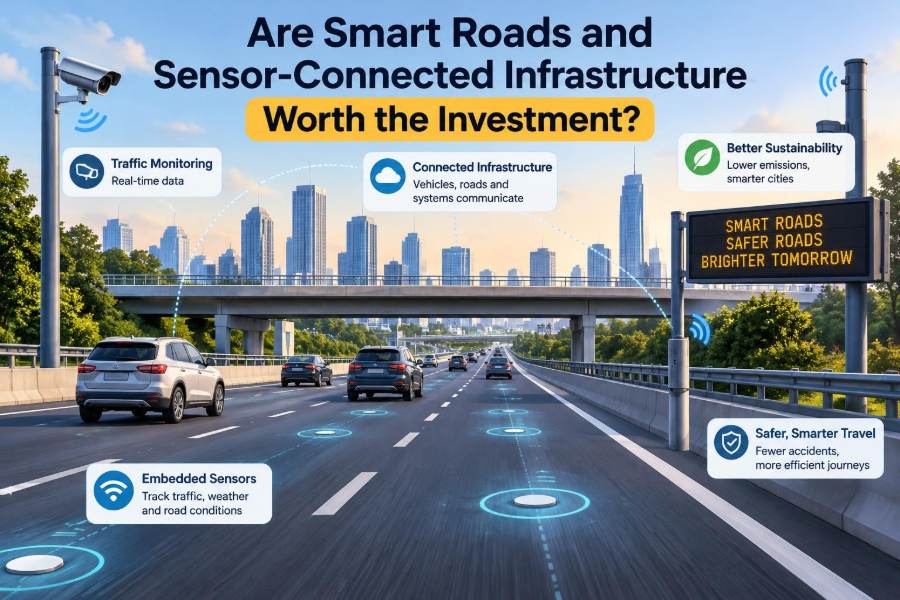

A commuter approaches a bridge during heavy rain. Nothing looks unusual from the driver’s seat: traffic is moving, the pavement is wet, and a warning sign recommends a lower speed. Behind that simple message may be a network of weather sensors, cameras, pavement monitors, and software deciding whether a hazard is developing.
For the road user, this can feel like an obvious improvement. For the agency responsible for thousands of lane-kilometres, culverts, signals, tunnels, and bridges, it raises a harder question: does gathering more data actually produce better decisions?
Smart roads and sensor-connected infrastructure promise earlier warnings, more targeted maintenance, smoother traffic operations, and safer work zones. They also require capital funding, reliable communications, cybersecurity controls, skilled staff, and a plan for data that will keep arriving long after the ribbon-cutting.
The investment is not automatically worthwhile because a device is innovative. Its value depends on whether it solves a defined operational problem better than simpler alternatives.
🛣️ What Makes Infrastructure “Smart”?
Smart infrastructure combines physical assets with sensing, communications, data processing, and decision-making. The asset may be a road, bridge, retaining wall, stormwater system, tunnel, railway crossing, or streetlight network.
A sensor alone does not make an asset smart. A useful system has a full chain: it measures a condition, transmits information, turns it into an understandable alert or recommendation, and supports an action by an operator, maintenance crew, automated controller, or road user.
For example, a water-level sensor in a flood-prone underpass becomes valuable when it triggers a verified closure warning before vehicles enter dangerous water.
📡 The Basic System Architecture
Most connected infrastructure systems contain five layers. Understanding them helps engineers see where cost, risk, and failure can occur.
- Sensing: devices measure strain, vibration, moisture, temperature, vehicle presence, flow, or other conditions.
- Connectivity: fibre, cellular, radio, satellite, or local networks move the data.
- Data platform: software stores, filters, visualizes, and combines information.
- Analytics: rules, models, or algorithms identify patterns and exceptions.
- Action: a signal changes, a crew is dispatched, a warning appears, or an inspection is scheduled.
The weakest layer can limit the whole system. Accurate sensors are of little use if communications fail in storms or if nobody is responsible for responding to alerts.
🔍 The Problems Sensors Can Actually Solve
The strongest business cases begin with a specific uncertainty. Is a bridge expanding more than expected? Does a recurring wet-weather queue form before operators can see it? Which pump station is approaching failure?
Sensor systems are especially useful where conditions change rapidly, inspections are difficult or hazardous, and the consequences of delayed awareness are high. They are less persuasive when the information will not change a decision.
A practical test is simple: what action would be different if this data arrived tomorrow? If the answer is unclear, the project may be collecting data rather than managing an asset.
🌉 Structural Health Monitoring for Bridges
Structural health monitoring uses instruments such as strain gauges, accelerometers, tilt sensors, displacement sensors, and temperature sensors to observe how a structure behaves. It does not replace competent inspection; it can make inspection more targeted.
Bridge response naturally changes with temperature, traffic loading, wind, and seasonal effects. Engineers must distinguish those expected changes from patterns that warrant closer examination. Raw sensor movement is not, by itself, evidence of damage.
Monitoring is often most defensible on complex, heavily used, difficult-to-access, or consequence-critical structures. A small standard bridge may be better served by sound inspection practices and timely repair.
🚦 Smarter Traffic Operations
Traffic detectors, connected signals, travel-time data, and camera systems can help agencies understand how demand varies across time and location. Signal timing can then be adjusted using current conditions rather than a schedule that assumes every day behaves alike.
Adaptive signal control is not magic congestion removal. At a constrained intersection, it reallocates limited green time. If all approaches are overloaded, it may improve coordination and reduce wasted time without eliminating the underlying capacity problem.
Its practical advantage is responsiveness: detecting an unusual queue, adjusting a diversion route, or giving priority to transit vehicles and emergency responders where policy permits.
🌧️ Weather, Flooding, and Surface Hazards
Road weather information systems can combine pavement temperature, air temperature, precipitation, wind, visibility, and surface condition. Operators use these inputs to plan anti-icing, issue warnings, or identify conditions suitable for ploughing and treatment.
In flood-prone corridors, rainfall, water-level, and drainage sensors can provide early situational awareness. They should be paired with physical protections such as barriers, signs, drainage maintenance, and clear closure procedures.
Technology cannot make a low-lying road safe to cross in floodwater. Its role is to recognize conditions faster and support a timely, credible response.
🚧 Connected Work Zones
Work zones are dynamic environments where lane arrangements, queues, worker locations, and speeds can change during a shift. Portable sensors and connected signs can warn drivers of stopped traffic ahead, excessive approach speeds, or changing lane conditions.
These systems may also help contractors and agencies document whether temporary traffic control is operating as intended. That information can reveal repeated queue locations or times when additional measures are needed.
However, a digital warning is not a substitute for proper work-zone design. Clear tapers, appropriate signing, barriers, lighting, and safe worker access remain fundamental.
🕳️ Monitoring Underground Assets
Water mains, sewers, tunnels, and utility corridors are difficult to inspect because much of their condition is hidden. Flow, pressure, acoustic, level, gas, and groundwater sensors can reveal operating anomalies between scheduled inspections.
A sudden pressure pattern may suggest a leak, while abnormal pump cycling may indicate blockage or equipment wear. These are prompts for investigation, not automatic diagnoses.
Underground monitoring is most useful when it is tied to asset records, maintenance history, and consequence of failure. A sensor reading without location accuracy or network context can create confusion rather than insight.
🧠 From Data to a Decision
Infrastructure agencies can easily collect more data than staff can interpret. The useful output is rarely a dashboard full of colourful charts; it is an exception that tells someone what needs attention and why.
Thresholds are a common starting point. For instance, an alert may be issued if water depth exceeds a defined level or if a bridge response deviates materially from its expected temperature-adjusted range.
More advanced analytics can identify trends, but transparent rules are often safer for early deployment. Operators need to understand what an alert means, how reliable it is, and what response is expected.
🧪 Why Baseline Data Matters
A system needs a baseline: measurements made while the asset is known, or reasonably assumed, to be behaving normally. This baseline captures daily and seasonal variation.
Without it, a high vibration reading may be mistaken for distress when it simply reflects heavy vehicle loading, wind, or temperature. Establishing the baseline can take time, which should be included in project planning.
Engineers should also document changes to the asset and its surroundings. Resurfacing, repairs, nearby construction, altered traffic patterns, and sensor replacement can all affect the data record.
⚙️ Predictive Maintenance: Useful but Limited
Predictive maintenance uses condition and operating data to estimate when intervention may be needed. The aim is to move beyond fixed intervals where appropriate, reducing unnecessary work while avoiding avoidable failure.
It works best for equipment with measurable degradation patterns, such as pumps, motors, bearings, or movable bridge components. It is more difficult for failures driven by rare events, hidden defects, or changing environmental conditions.
Prediction should inform maintenance judgement, not overrule it. A model trained on incomplete records can produce confident-looking but unreliable recommendations.
💰 Where the Cost Really Sits
The purchase price of sensors is only one part of lifecycle cost. Agencies must budget for design, installation, power, communications, software licences or hosting, calibration, repairs, cybersecurity, training, data governance, and eventual replacement.
Field equipment is exposed to vibration, moisture, road salt, heat, impact, and vandalism. A low-cost device that requires frequent site visits may cost more over its life than a more robust alternative.
Business cases should compare whole-life costs with realistic avoided costs: reduced closures, fewer emergency repairs, better crew deployment, lower exposure to hazardous inspection, or improved reliability.
📊 Comparing Value by Use Case
| Use case | Potential value | Key condition for success |
|---|---|---|
| Bridge monitoring | Earlier investigation and better inspection targeting | Clear interpretation of environmental effects |
| Flood-warning systems | Faster closures and improved public warning | Reliable response procedures and maintained barriers |
| Adaptive signals | Better use of existing junction capacity | Quality detection and regularly reviewed objectives |
| Pump monitoring | Reduced unplanned outage risk | Maintenance team can act on alerts |
| Connected work zones | Better queue awareness and driver warning | Sound physical traffic control design |
The table illustrates why there is no universal answer. Value comes from the interaction between asset criticality, response capability, and operational need.
📍 Asset Criticality Should Guide Spending
Not every asset deserves the same level of monitoring. Criticality considers the consequences if an asset fails or is unavailable: safety, network disruption, service loss, environmental harm, repair difficulty, and social impact.
A sensor network may be justified for a major tunnel pump system with limited redundancy. The same investment may be difficult to justify for a low-consequence asset that crews can inspect easily.
Risk-based prioritization prevents technology from being distributed simply because it is available or politically attractive.
🔌 Power and Connectivity Are Design Decisions
Remote installations need dependable power. Grid connections may be practical in urban areas; solar, batteries, or energy harvesting may suit some remote locations, but each introduces design limits and maintenance needs.
Communications must also match the use case. A safety-related alert may need low latency and high availability, while periodic pavement-temperature reporting may tolerate delayed transmission.
Designers should assess coverage, signal obstruction, backup power, data costs, and what happens when the network fails. “Offline mode” is not an afterthought; it is part of safe operation.
🔐 Cybersecurity Is Part of Physical Safety
Connected signals, pumps, gates, and monitoring platforms expand the digital attack surface of infrastructure. Cybersecurity therefore belongs in engineering requirements, procurement, commissioning, and ongoing maintenance.
Useful controls include access management, network segmentation, encrypted communications where appropriate, software patching plans, logged changes, and vendor support arrangements. The exact approach should reflect system criticality.
A common mistake is treating cybersecurity as an IT issue added after installation. If a digital system can influence physical operations, its security has physical consequences.
🧍 Privacy and Public Trust
Roadside cameras, Bluetooth or Wi-Fi detection, and vehicle-connected systems can raise privacy questions. Agencies should collect only the data needed for the stated purpose and establish rules for access, retention, aggregation, and disclosure.
Public trust improves when agencies explain what is being collected, what is not being collected, and how the data supports safety or operations. Technical capability does not automatically justify collection.
Privacy-aware design is also practical: minimizing identifiable data can reduce storage, legal, and cyber risk.
🧰 Interoperability Prevents Vendor Lock-In
Infrastructure remains in service for decades, while sensors and software platforms evolve quickly. Proprietary formats and tightly coupled equipment can make future upgrades expensive and limit competition.
Procurement documents should address data ownership, export formats, application interfaces, documentation, replacement compatibility, and responsibilities when a supplier’s product is retired.
Open standards are not a cure for every integration problem, but planning for interoperability gives an owner more control over the long-term system.
👷 People Still Run the System
Sensor-connected infrastructure changes work; it does not remove the need for people. Operators must interpret alerts, inspectors must verify conditions, technicians must maintain devices, and managers must set priorities.
Training should cover normal operation, alarm response, false alarms, communications failures, escalation routes, and recordkeeping. A dashboard handed to an already busy team without a revised workflow is likely to be ignored.
Successful programs define ownership clearly. Every important alert needs a named role, a response timeframe, and an escalation path.
⚠️ False Alarms and Missed Events
Thresholds that are too sensitive create alarm fatigue: staff begin to disregard frequent alerts. Thresholds that are too loose can miss conditions that deserved attention.
This balance should be tuned using operating experience. Teams should review alerts after events, record whether the response was appropriate, and adjust rules carefully rather than chasing a perfect setting.
Critical systems also need a plan for sensor failure. A missing reading must be distinguishable from a normal condition, and fallback inspection or operating procedures must be available.
🧱 Technology Cannot Repair Deferred Maintenance
Sensors can identify deterioration, but they do not provide funding, crews, materials, or closure windows to address it. Installing monitoring on an asset with known defects can be sensible, yet it must not become a reason to postpone necessary intervention indefinitely.
The same principle applies to drainage, pavement, and traffic operations. Better visibility is valuable only when paired with the ability to act on what is seen.
Smart infrastructure should strengthen an asset management program, not distract from basics such as inventory accuracy, inspection quality, drainage upkeep, and preventive maintenance.
🏗️ Designing for Maintainability
Devices should be reachable without exposing workers to unnecessary traffic, height, confined-space, or electrical hazards. Placement affects data quality, but it also affects calibration, cleaning, replacement, and troubleshooting.
Engineers should ask early: Can a technician safely replace this sensor? Is there space for access equipment? How will the cable, enclosure, or antenna survive the environment? What is the maintenance interval?
Designing for maintainability is a major difference between a successful pilot and a reliable long-term deployment.
🧭 Start with a Pilot, Not a Technology Shopping List
A pilot is most useful when it tests a narrow, meaningful operational hypothesis. For example: can water-level monitoring reduce the time required to close a repeatedly flooded underpass?
Define the current process, the desired improvement, who responds, what data is required, and what would count as a successful result. Include expected limitations, such as bad weather communications or manual verification needs.
A pilot that merely demonstrates a sensor can transmit data proves very little. The real test is whether the organization can use that data reliably in day-to-day operations.
📏 Set Measures Before Deployment
Evaluation measures should match the problem. They might include alert availability, data completeness, time from detection to response, unnecessary callouts, inspection efficiency, closure duration, or equipment downtime.
Measures must be interpreted with context. A reduction in alerts may mean fewer hazards, but it may also mean failed communications or an overly high threshold.
Predefined measures reduce the temptation to declare success based on attractive dashboards rather than meaningful operational performance.
🗂️ Integrate with Asset Management
Condition data is more valuable when connected to an asset register, inspection records, work orders, drawings, and maintenance history. This creates a traceable link between an observation and a decision.
For example, repeated abnormal pump behaviour should lead to a work request, investigation record, repair outcome, and updated maintenance knowledge. Otherwise, the same issue may reappear as a new alert with no institutional memory.
Data governance matters here: define identifiers, data quality checks, retention periods, and who can alter records.
🏙️ Equity and Network-Wide Priorities
Highly visible corridors can attract technology investment while lower-income, rural, or less politically prominent areas continue to face basic maintenance deficits. Agencies should consider who benefits from a deployment and whether it diverts resources from essential services.
Connected systems can support equity when used to improve transit reliability, flood warning, accessible crossings, or emergency response in underserved areas. They can also reinforce inequity if investment follows only high-revenue or high-profile locations.
Good prioritization combines technical risk with public-service objectives, not just novelty or traffic volume.
🧾 Procurement Questions Engineers Should Ask
Before selecting a solution, owners should require clear answers about performance, lifecycle support, and accountability.
- What decision will the system improve, and who owns that decision?
- How are accuracy, uptime, calibration, and communications performance verified?
- Who owns the data, and can it be exported in usable formats?
- What happens if the platform, network, or vendor service becomes unavailable?
- What maintenance tasks, skills, spare parts, and recurring costs are expected?
- How will cybersecurity updates and vulnerabilities be managed?
These questions move procurement away from feature lists and toward operational value.
🔮 Automation Requires Conservative Boundaries
Some systems can automatically adjust signals, activate warning signs, or control equipment. Automation can be appropriate for well-understood, reversible actions with robust safeguards.
Higher-consequence actions require more caution, independent checks, and clear human oversight. An incorrect automatic response can create a new hazard even when the underlying sensor worked as designed.
Engineers should define operating boundaries, safe default states, manual override arrangements, and post-event review procedures before automation is enabled.
✅ So, Are Smart Roads Worth the Investment?
They can be, but only when the investment is proportionate to the problem. The strongest cases involve critical assets, fast-changing conditions, costly uncertainty, and a realistic ability to respond.
A modest system that reliably helps crews close a flooded road, inspect a suspect bridge component, or maintain a vital pump can deliver more value than an elaborate platform with no defined workflow. Conversely, technology deployed without maintenance, governance, staff capacity, and lifecycle funding can become an expensive source of unreliable data.
The core principle is straightforward: invest in connected infrastructure to improve a specific decision and response, not simply to make an asset appear more advanced.
Smart roads are worth funding when their information leads to safer, faster, and more accountable action across the full life of the asset. The sensor is only the beginning; the engineering value lies in what happens next. 🌉📡🛠️