
A newly paved driveway looks solid on the day it is finished. A few seasons later, a shallow dip appears near the garage, rainwater collects in it, and cracks begin spreading across the surface. The pavement did not simply “wear out”; the ground beneath it may have moved because it was not prepared well enough.
The same principle applies on a far larger scale beneath roads, building slabs, retaining walls, embankments, pipelines, and foundations. Construction loads do not disappear when they reach the ground. They pass into the soil, where loose particles, water, and air must respond to the pressure.
Soil compaction is the controlled process of making soil denser before construction proceeds. It is easy to picture as squeezing air from a sponge, although real soil behavior is more complex: moisture, particle size, clay content, lift thickness, and equipment all influence the result.
Dense soil is not automatically “good” in every setting. But where engineered fill or supporting ground must carry loads predictably, proper compaction is one of the most practical ways to limit settlement, improve strength, and reduce costly repairs later.
🏗️ What Soil Compaction Actually Means
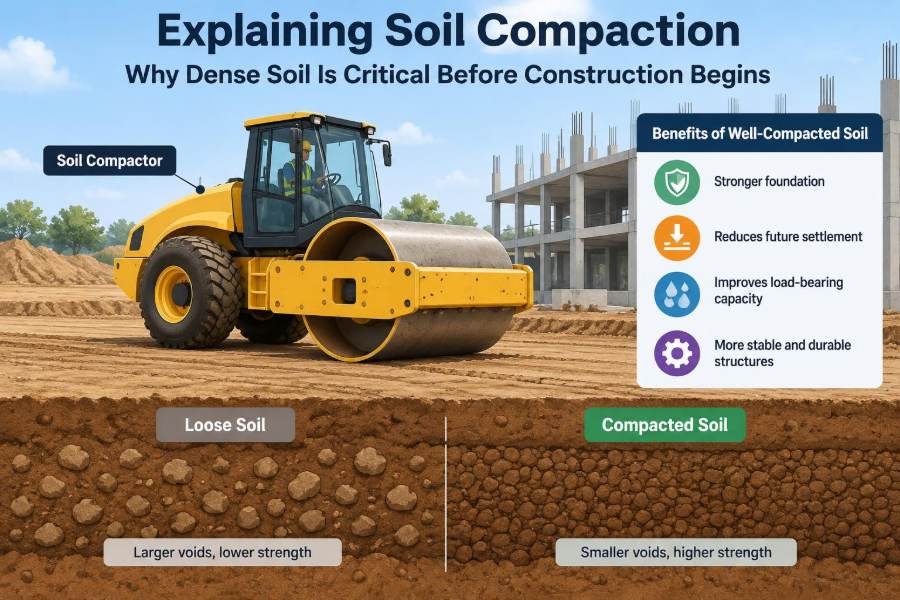
Soil compaction is the densification of soil by mechanical effort. Rollers, rammers, vibratory plates, or other equipment rearrange particles into a tighter arrangement, reducing the volume of air-filled voids between them.
It is not simply pressing down the ground surface until it looks smooth. Effective compaction must occur through the full thickness of each placed layer, often called a lift, and must meet the requirements set by the project’s geotechnical and construction specifications.
🧱 Why Construction Starts with the Ground
Every structure transfers load to the soil. A house foundation may distribute load through footings or a slab; a highway distributes wheel loads through pavement layers; an earth dam relies on compacted fill throughout its body.
If the supporting soil changes volume unevenly, the structure above can crack, tilt, rut, leak, or lose intended drainage. Compaction does not solve every ground problem, but it creates a more uniform and predictable starting condition.
🔬 Soil Particles, Voids, Air, and Water
Soil is a three-phase material made of solid particles, water, and air. The spaces between particles are called voids. In loose soil, many voids contain air; under compactive effort, particles shift closer together and much of that air is expelled.
Water behaves differently from air. Air can be compressed and pushed out relatively easily, while water is much less compressible. That difference explains why moisture condition has such a major effect on field compaction.
📏 Density Is the Measurable Goal
Engineers commonly describe compaction in terms of dry density: the mass of soil solids per unit volume, excluding the mass of water. Dry density makes it possible to compare soil placed at different moisture contents.
A field result is usually compared with a laboratory reference value for the same soil. Specifications may require a target degree of compaction in critical zones, but the selected target and test procedure depend on the material, structure, agency requirements, and design intent.
💧 Why Moisture Content Changes Everything
Dry soil can be difficult to compact because particle friction resists rearrangement. Adding a controlled amount of water creates a lubricating effect, allowing particles to slide into denser positions under the same equipment.
Too much water creates another problem. Pore spaces become increasingly occupied by water, the soil may deform rather than densify, and equipment can pump or rut the surface. Clayey material can become soft and unstable when worked wet.
🎯 Understanding Optimum Moisture Content
For a given soil and a given laboratory compaction energy, there is generally a moisture content at which the greatest dry density is achieved. This is called the optimum moisture content.
It is not a universal moisture value, and it is not a promise that field work will be easy. Different soils and test methods produce different curves. Still, the concept gives construction teams a practical target range: material placed too dry may need water, while overly wet material may need drying, blending, or replacement.
🧪 The Laboratory Compaction Curve
Laboratory compaction testing establishes the relationship between moisture content and dry density for a sampled soil under a specified effort. The resulting curve helps define the maximum laboratory dry density and its associated optimum moisture content.
Field specifications often refer to this laboratory benchmark. The lab test does not replicate every piece of site equipment or every weather condition, but it provides a consistent basis for acceptance and quality control.
🌍 Soil Type Controls the Strategy
Not all soil responds to the same method. Coarse, free-draining granular materials such as clean sand and gravel usually respond well to vibration. Fine-grained soils containing silt or clay often respond better to kneading and impact action.
Organic soils, peat, debris-containing fill, and highly variable materials deserve particular caution. Compaction equipment cannot turn unsuitable material into reliable engineered support simply by making more passes over it.
🪨 Granular Soils and Vibration
Sand and gravel particles can rearrange efficiently when vibration reduces friction between grains. Vibratory smooth-drum rollers and plate compactors are common tools where the material is sufficiently granular and the layer thickness is appropriate.
However, a surface that feels firm is not proof of full-depth density. Thick lifts, segregated material, or vibration settings that do not suit the material can leave weaker zones below a deceptively neat surface.
🧲 Cohesive Soils Need Kneading Action
Clay particles are very small and can bond together, particularly when moisture conditions are unfavorable. Sheepsfoot or padfoot rollers apply concentrated contact pressure and kneading action, helping break up clods and compact cohesive fill in thinner lifts.
For clay, moisture control is often more critical than adding more roller passes. A wet clay layer may show surface movement and pumping instead of meaningful densification, while very dry clods may resist breakdown and leave voids between them.
🚜 Matching Equipment to the Material
Equipment selection should follow the soil, the work area, the lift thickness, and the required result. Large rollers can be efficient over broad embankments, while trenches, corners, and confined areas often require smaller equipment.
| Equipment | Typical useful action | Common application |
|---|---|---|
| Vibratory smooth-drum roller | Vibration and static weight | Granular base, sand, gravel |
| Padfoot roller | Kneading and concentrated pressure | Cohesive fill and clayey soils |
| Pneumatic-tire roller | Pressure with kneading effect | Selected fills and pavement work |
| Plate compactor | Vibration in tight spaces | Small granular areas and trenches |
| Rammer | Impact force | Confined cohesive or mixed soils |
This table is a starting point, not a substitute for a project-specific compaction plan. Soil variability can change the best choice from one part of a site to another.
📚 Lift Thickness Is Not a Minor Detail
A lift is the loose thickness of soil spread before compaction. If a lift is too thick, compactive energy may densify the upper portion while leaving the lower portion loose.
Appropriate lift thickness depends on the soil and equipment. Site teams should follow the approved method and verify performance through testing rather than assuming that a larger machine can compact any depth in one pass.
🔁 Why Roller Passes Must Be Controlled
A roller pass is one coverage of a strip by compaction equipment. Too few passes can leave density below target; excessive passes may waste time, crush fragile aggregate, or in some conditions cause surface degradation.
Field trials are useful because they reveal the combination of lift thickness, moisture condition, equipment settings, travel speed, and number of passes that achieves the required density consistently. This is more dependable than relying only on an operator’s intuition.
🏠 Settlement: The Problem People Eventually See
Settlement is downward movement of ground or a structure as soil compresses, consolidates, or shifts. Loose fill beneath a slab may settle after the building is occupied, creating cracks, uneven floors, or doors that no longer close properly.
Settlement can also occur in well-compacted ground because of deeper compressible layers, changing groundwater conditions, or loads beyond the design assumptions. Compaction specifically reduces the avoidable settlement associated with poorly placed fill near the surface.
🛣️ Pavements Depend on a Stable Subgrade
Roads and parking areas are layered systems. Asphalt or concrete is supported by base layers and, ultimately, by the subgrade—the prepared natural soil or fill below them.
A weak or variable subgrade can allow repeated traffic loads to create rutting, cracking, and differential movement. Good compaction does not eliminate the need for drainage, suitable aggregate, and sound pavement design, but it helps those layers perform as intended.
🏢 Foundations Need Uniform Support
Foundation problems are often associated with differential settlement, meaning one part of a structure moves more than another. Uniformly compacted engineered fill reduces one common source of that uneven support.
Before placing a foundation on fill, designers need to know what the fill is, how it was placed, and whether it was tested. Uncontrolled fill may contain variable soil, construction debris, organics, or undocumented loose zones that make future behavior difficult to predict.
🌧️ Compaction and Drainage Work Together
Dense soil can reduce permeability, meaning water moves through it more slowly. This can be desirable in certain earthworks, such as low-permeability barriers, but it can create drainage challenges around buildings and pavements if water has nowhere else to go.
Good site preparation considers both strength and water. Surface grading, drains, filter layers, free-draining backfill, and erosion control may all be needed. Compaction should support the drainage design, not accidentally block it.
🧱 Retaining Walls Need Carefully Compacted Backfill
Backfill behind a retaining wall must be placed in controlled lifts. Poorly compacted backfill can settle, pulling down pavements or landscaping above the wall and changing drainage paths.
Compacting too aggressively immediately beside a wall can also be risky because heavy equipment may impose lateral forces the wall was not designed to resist at that construction stage. Equipment type, distance from the wall, and sequence should follow the design and contractor’s approved procedures.
🚰 Trenches Are a Frequent Weak Point
Utility trenches interrupt otherwise stable ground. After pipes or cables are installed, the trench must be backfilled and compacted in layers without damaging the utility or leaving a future settlement channel.
A familiar hypothetical example is a road patched after water-main work. If trench backfill is not properly compacted, the patch can settle below the surrounding pavement, creating a long depression that collects water and receives repeated traffic impacts.
🧰 Quality Control Begins Before Rolling
Reliable compaction starts with material review. The team should confirm that the fill is the approved material, remove oversized debris or organics where required, and ensure the surface below the new lift is acceptable.
Preparation also includes moisture conditioning, spreading material uniformly, and preventing contamination between incompatible soils. Rolling cannot correct poor material handling after the fact.
📍 Field Density Testing Verifies the Work
Inspection and testing determine whether the placed soil meets the project requirement. Depending on the project and soil, field density and moisture may be checked using methods such as sand-cone testing, drive-cylinder methods, or calibrated electronic gauges operated under appropriate procedures.
Test locations should represent the work rather than only convenient spots. A passing result near one edge does not prove that an entire broad lift, trench, or embankment is uniformly compacted.
🗂️ Documentation Makes Hidden Work Traceable
Once concrete, pavement, or landscaping covers fill, the compaction process is no longer visible. Records provide evidence of what material was placed, where it was used, which lift was tested, the moisture and density results, and whether any corrective work was completed.
This documentation helps the owner, engineer, contractor, and future maintenance teams understand what lies below the finished surface. It is particularly valuable when a later issue needs investigation.
⚠️ The Danger of Compacting Soil Too Wet
Wet soil may look smooth after equipment passes over it, but appearance can be misleading. Under load, excess pore water can prevent effective particle contact and cause the soil to move laterally or pump upward.
Possible responses include aerating and drying the soil, blending it with drier suitable material where permitted, improving drainage, postponing placement, or replacing the material. The right response depends on the soil type and project requirements; adding dry material without evaluation can create new inconsistencies.
☀️ The Challenge of Soil That Is Too Dry
Very dry fine-grained soil can form hard clods that resist breakdown. The voids between clods may remain even when the surface appears compacted, reducing uniformity and potentially allowing later moisture changes to alter the material.
Controlled water addition and thorough mixing can help bring material closer to its workable moisture range. Water should be distributed evenly; isolated wet spots can create soft pockets while adjacent soil remains too dry.
👀 Surface Appearance Is Not Acceptance
A smooth roller finish, firm footprints, or the absence of visible ruts can provide useful observations, but none is a complete acceptance test. Subsurface defects may remain invisible, especially in thick lifts.
Conversely, a rough surface is not automatically a failed layer. Soil type and equipment leave different surface textures. The specification, test results, and experienced engineering judgment should guide the decision.
🚧 Common Compaction Mistakes on Site
- Placing lifts thicker than the approved method can densify.
- Using the same equipment for every soil type without checking performance.
- Adding water without mixing it through the full lift.
- Testing too infrequently or only in easily accessible locations.
- Compacting over frozen, organic, muddy, or otherwise unsuitable material.
- Covering a failed lift rather than correcting it while it is accessible.
These mistakes are often driven by schedule pressure, but they can transfer risk into the completed structure. Reworking exposed soil is generally simpler than excavating beneath finished pavement or a building.
🧭 When Compaction Alone Is Not Enough
Some sites contain soft clay, loose saturated sand, collapsible soil, expansive clay, uncontrolled fill, or deep organic deposits. Surface compaction may improve a shallow layer without addressing the underlying geotechnical concern.
Depending on the investigation and design, solutions may include excavation and replacement, stabilization with approved additives, geosynthetics, drainage measures, deep foundations, ground improvement, or revised structural design. These are engineering decisions, not routine field substitutions.
🌡️ Weather Can Change the Plan
Rain can push moisture beyond the workable range, while hot and windy conditions can dry exposed fine-grained soil quickly. Freezing temperatures introduce further concerns because frozen soil and ice lenses should not be treated as acceptable compacted fill.
Good construction planning allows for weather-related adjustments. Covering stockpiles, sequencing smaller work areas, monitoring moisture, and pausing when conditions are unsuitable can protect both productivity and quality.
🧑🔧 Roles on a Well-Run Compaction Operation
Compaction quality is shared work. Equipment operators control passes and observe soil response; labor crews spread and condition material; inspectors and testing technicians verify results; engineers interpret specifications and resolve unusual conditions.
Clear communication matters when conditions change. If a technician finds low density or excessive moisture, the response should identify the cause—lift thickness, water content, equipment, material variability, or underlying instability—rather than merely repeating the same unsuccessful process.
🧠 A Practical Sequence for Engineered Fill
- Confirm that the receiving surface and proposed fill material are acceptable.
- Place soil in a controlled, uniform lift.
- Adjust moisture toward the approved workable range and mix thoroughly.
- Compact with equipment suited to the material and confined conditions.
- Perform required field tests and visual checks.
- Correct deficient areas before placing the next lift.
- Record results so the completed work can be traced.
The exact procedure varies by project, but the sequence captures an essential idea: each layer must be accepted before it becomes hidden by the next one.
🔍 Reading a Specification Carefully
Compaction specifications may identify the required density, laboratory reference method, acceptable moisture range, maximum lift thickness, testing frequency, and locations needing special treatment. They may also distinguish between structural fill, landscape fill, trench backfill, and pavement subgrade.
Requirements should not be copied blindly from one project to another. A requirement suitable for a highway embankment may not suit a shallow utility trench, and a low-permeability clay liner has different goals from a free-draining aggregate base.
🌱 Compaction Has Environmental and Site Limits
Compaction is desirable beneath designed structures, but indiscriminate compaction can harm landscapes. Compacted soil in planting areas may limit root growth, reduce infiltration, and increase runoff.
Construction plans should protect areas intended for vegetation and avoid unnecessary equipment traffic there. The goal is not maximum density everywhere; it is the right density in the right location.
✅ The Core Principle: Dense, Uniform, Verified Ground
Effective soil compaction is not about making the ground look hard. It is a controlled engineering process that combines suitable material, appropriate moisture, compatible equipment, manageable lift thickness, and field verification.
Its greatest value is predictability. Properly compacted fill provides more consistent support, reduces the likelihood of avoidable settlement, and helps pavements, foundations, utilities, and earth structures perform closer to their design assumptions.
Before construction can safely rise upward, the ground below must be prepared as a dependable part of the structure itself. That work is usually hidden when the project is complete, yet its quality remains visible for years in the stability of everything built above it. 🌉🚜🌍