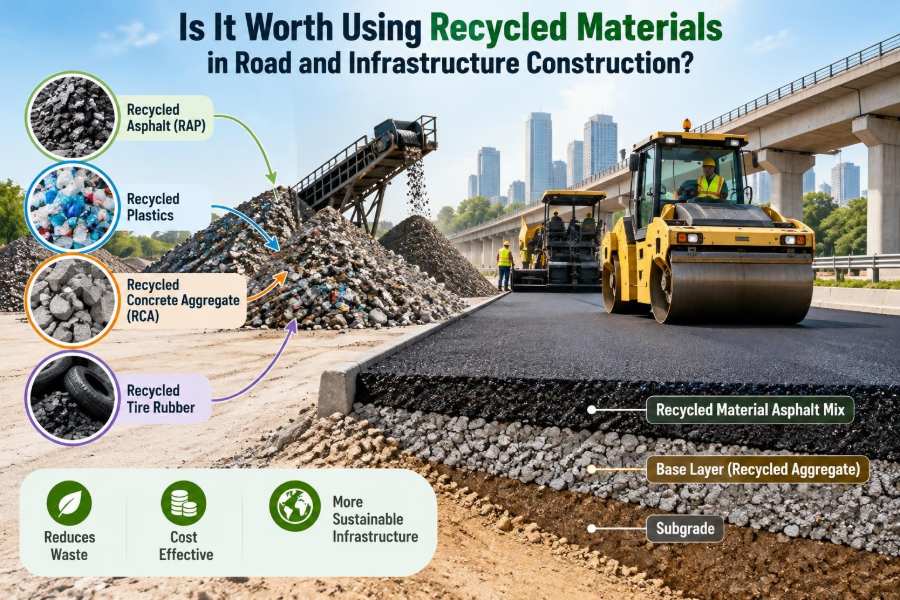

A road rehabilitation project often begins with a familiar sight: milled asphalt piled beside the carriageway, broken concrete awaiting removal, and trucks bringing in new aggregate. For decades, the default assumption was simple—old material leaves the site, new material replaces it.
That assumption is changing. Contractors and agencies increasingly ask whether those old materials can become part of the next pavement, drainage layer, retaining wall, or embankment instead of becoming waste.
The question is not whether recycled materials are automatically “green.” A road still has to carry traffic safely, drain water, resist weather, and remain maintainable for years. The useful question is whether a particular recycled material can meet those requirements more effectively than a virgin alternative.
For civil engineers, the answer depends on material quality, processing, design, specifications, haul distance, risk control, and the intended use. Recycled materials can be an excellent engineering choice—but only when they are selected and managed as engineered materials rather than cheap substitutes.
🧱 What Counts as a Recycled Construction Material?
In infrastructure work, a recycled material is one recovered from a previous product, structure, industrial process, or construction activity and prepared for another use. It may be processed on site, at a specialist plant, or through a local supplier.
The term covers several very different materials. Their origin alone does not determine whether they are suitable; their physical properties, chemical characteristics, consistency, and proposed application do.
- Reclaimed asphalt pavement (RAP): milled or excavated asphalt from existing roads.
- Recycled concrete aggregate (RCA): crushed concrete, usually containing original aggregate and adhered cement mortar.
- Recycled glass: processed glass used in selected granular or asphalt applications.
- Industrial by-products: materials such as certain slags or ash-based products, where permitted and properly characterized.
- Recycled plastics and rubber: products used in specialized pavement, drainage, geosynthetic, or street-furniture applications.
🛣️ Why Roads Are a Major Opportunity
Road projects consume large volumes of aggregate, asphalt mixture, cementitious materials, and fill. Even a modest reduction in virgin material demand can therefore have practical consequences for quarrying, truck movements, stockpiling, and disposal capacity.
Road construction also creates a valuable feedstock. Pavement renewal regularly produces asphalt millings and concrete rubble that can be crushed, screened, and returned to the construction cycle.
This makes roads unusually suited to circular material use. The same project corridor may supply material through rehabilitation and consume it in new base layers, shoulders, temporary works, or asphalt production.
♻️ Reuse, Recycling, and Recovery Are Not the Same
These terms are often used interchangeably, but they describe different levels of processing. Reuse keeps a material in a similar form, such as reusing sound paving blocks or steel beams. Recycling processes material into a new usable product, such as crushing concrete for aggregate.
Recovery is broader and may include obtaining value from a material in ways that do not preserve its original function. For design and procurement, this distinction matters because each route has different testing needs, quality controls, and environmental implications.
Using excavated soil as engineered fill, for example, may avoid disposal, but it is not equivalent to manufacturing high-quality aggregate. Its suitability depends on grading, moisture sensitivity, strength, contamination status, and compaction behavior.
🔄 The Circular Economy Case
A circular approach aims to retain the value of materials for longer. In infrastructure, that means first considering whether existing assets can be maintained, then whether components can be reused, and finally whether materials can be recycled into appropriate new applications.
Recycling is not automatically the highest-value option. If a pavement can be preserved through timely surface treatment, that may avoid the energy and disruption of full reconstruction. If demolition is unavoidable, recovering aggregate or asphalt is often preferable to sending usable material to landfill.
The engineering goal is not to recycle everything. It is to place each material at the highest practical and safe use consistent with project performance requirements.
🚛 Lower Haulage Can Change the Project Equation
Material transport is a major practical issue in roadworks. Virgin aggregate may come from a distant quarry, while disposal sites may also be far from the project. Local recycling can reduce truck trips in both directions.
However, “recycled” does not automatically mean “local.” A recycled product hauled a long distance, reprocessed repeatedly, or kept in poorly managed stockpiles may offer less benefit than a nearby virgin source. Project teams should compare actual supply routes rather than make assumptions based on labels.
Haulage also affects programme risk. A reliable on-site or nearby recycled supply can reduce dependence on constrained quarry output, but only if processing capacity and quality assurance are established before construction starts.
🌍 Environmental Value Needs a Whole-Life View
Environmental decisions should consider the full material pathway: extraction, crushing or processing, transport, installation, maintenance, and end-of-life options. This is commonly called a life-cycle perspective.
Recycled aggregate may reduce demand for newly quarried stone and reduce waste disposal. Reclaimed asphalt can preserve both aggregate and some of the binder already invested in the pavement. These are meaningful potential advantages.
Yet there can be trade-offs. Additional treatment, contamination controls, stabilizing agents, or longer transport can reduce the advantage. The strongest environmental claim is therefore project-specific: use the available evidence to compare realistic alternatives, not idealized ones.
💰 Cost Is More Than the Purchase Price
A recycled material may have a lower unit price than a virgin alternative, but that does not settle the commercial decision. Costs can shift into testing, processing, storage, moisture control, plant modifications, design review, and quality inspection.
Conversely, an apparently higher-priced recycled product may avoid tipping fees, reduce imported aggregate, shorten haul routes, or protect the programme from supply shortages. The relevant comparison is the installed, verified cost of meeting the required performance.
Procurement teams should avoid treating recycled content as a separate environmental add-on. It should be evaluated alongside productivity, durability, maintenance needs, traffic management, and supply resilience.
🧪 Material Characterization Comes First
Before specifying a recycled material, engineers need to know what it is. Visual inspection is useful, but it cannot replace representative sampling and testing. A stockpile can look uniform while varying significantly in grading, moisture, contaminants, or strength.
Characterization commonly examines particle-size distribution, density, water absorption, abrasion resistance, fines content, chemical composition where relevant, and possible contaminants. The tests selected should match the intended use.
For example, a granular subbase may require confidence in grading, compaction, bearing behavior, and drainage. A material intended for asphalt needs tighter control over aggregate properties, binder behavior, and mixture performance.
📏 Gradation Controls How Granular Layers Behave
Gradation describes the distribution of particle sizes in a material. A well-graded aggregate contains a controlled range of sizes that can pack efficiently, while an excessively uniform or poorly controlled material may compact differently and create more voids.
Recycled concrete aggregate can include angular particles, residual mortar, and a higher proportion of fines than a comparable virgin aggregate. These features may be manageable, but they affect water demand, compaction effort, permeability, and stiffness.
Engineers should specify grading limits, sample stockpiles regularly, and consider segregation during handling. A material that meets a grading target at the plant can change during transport and placement if stockpiling is poorly managed.
💧 Moisture and Drainage Cannot Be Afterthoughts
Many recycled granular materials absorb more water than dense virgin stone because of porous mortar, adhered fines, or irregular particle texture. This can make the moisture condition at compaction more variable.
If crews use a compaction approach developed for a different material, the layer may be too dry, too wet, or unevenly compacted. That can affect stiffness and long-term pavement support.
Drainage design also matters. Water trapped in pavement layers weakens many unbound materials and can accelerate deterioration under repeated wheel loads. The recycled material must be compatible with the layer’s drainage function, filter requirements, and surrounding soils.
🛢️ Reclaimed Asphalt Pavement Is a High-Value Resource
RAP contains aggregate coated with aged asphalt binder. When managed well, it can replace part of the aggregate and binder demand in new asphalt mixtures, or it can be used in suitable unbound applications.
The principal challenge is variability. Different pavement layers, previous maintenance treatments, milling depths, and stockpile practices can produce RAP with different binder contents and aggregate gradations. Excessive variability makes mix design and plant production harder to control.
Separating RAP by source or quality, processing it to a consistent size, and protecting stockpiles from contamination are often more valuable than simply maximizing the amount used.
🔥 Asphalt Recycling Depends on Binder Behavior
Asphalt binder hardens as it ages. Adding RAP to a new mixture introduces this aged binder, which can affect stiffness, cracking resistance, workability, and compaction temperature.
Higher RAP use may require careful binder selection, mixture design, production control, or an approved rejuvenating approach. A rejuvenator is intended to improve binder workability or restore selected properties, but it is not a universal fix and must be evaluated within the complete mix.
Plant capability matters too. Feeding, heating, and blending RAP incorrectly can create uneven temperatures or excessive emissions. The correct percentage is therefore not a single universal number; it depends on the materials, plant, climate, traffic loading, and governing specification.
🏗️ Recycled Concrete Aggregate Performs Differently
RCA is not simply crushed stone. It typically consists of original aggregate particles with attached cement paste or mortar. That residual mortar often makes RCA more porous and more absorbent than virgin aggregate.
These characteristics can be acceptable—and useful—in applications such as selected fill, capping, subbase, and base courses when the material meets the project requirements. But they need explicit consideration in mix water control, density expectations, durability assessment, and drainage design.
RCA may also contain small amounts of brick, asphalt, wood, gypsum, reinforcement fragments, or soil if demolition and processing are poorly controlled. Source separation and removal of unsuitable constituents are central to reliable performance.
⚗️ Chemical Compatibility Can Govern Suitability
Physical strength alone does not establish suitability. Some materials can create chemical or environmental concerns depending on their source, surrounding soils, groundwater conditions, and proposed use.
Potential issues include soluble salts, sulfates, organic contaminants, or leachable constituents. Certain recycled products may be acceptable in one location but unsuitable near sensitive groundwater, utilities, metal structures, or concrete elements.
Where a risk is plausible, engineers should use an appropriate assessment route under the applicable local regulations and project specifications. Do not assume that a material accepted on a previous job is automatically acceptable on a new site.
🧰 Where Recycled Materials Usually Fit Best
The best application is the one that matches material properties to function. Not every recycled material needs to enter the most demanding structural layer to deliver value.
| Application | Potential recycled inputs | Key engineering checks |
|---|---|---|
| Embankment and general fill | Processed excavated material, selected crushed concrete | Compaction, moisture sensitivity, contamination, settlement |
| Subbase or capping | RCA, processed demolition aggregate, suitable RAP blends | Gradation, bearing capacity, drainage, durability |
| Asphalt mixtures | RAP, recycled glass in approved uses, selected recovered additives | Mix design, binder behavior, plant control, surface performance |
| Drainage and landscaping works | Approved recycled aggregate, recycled plastic products | Hydraulic function, filter compatibility, chemical suitability |
Early projects often succeed by starting with applications where the performance demand is clear and the quality controls are achievable.
🏙️ Urban Projects Offer Useful Material Loops
Urban reconstruction frequently produces concrete from sidewalks, curbs, slabs, and small structures while requiring new granular layers for streetscape and utility reinstatement. This can create an efficient local loop if space and logistics allow.
Consider a hypothetical streetscape scheme: removed concrete is crushed, screened, tested, and used in approved subbase beneath new footways. Virgin aggregate is reserved for applications with tighter requirements. The project reduces disposal movements without asking the recycled aggregate to perform a role it was not designed for.
The constraint is often space. Dense sites may lack room for safe processing and separate stockpiles, so off-site recycling may be the better controlled option.
🌉 Structural Concrete Requires a Higher Bar
Using recycled aggregate in structural concrete is possible in some circumstances, but it requires more caution than using it in unbound pavement layers. Concrete performance depends on strength, durability, shrinkage, permeability, workability, and compatibility with the specified exposure conditions.
Recycled aggregate can change water absorption and mixture behavior. Contaminants or weak constituents may have a greater consequence in structural applications than in fill or subbase.
Designers should follow applicable concrete standards and project requirements, use qualified suppliers, and rely on trial mixes and verification testing where recycled aggregate is proposed. It is not a material choice to approve casually because it has worked in a road base.
🧱 Stabilization Can Expand Useful Applications
Some recycled materials do not meet unbound layer requirements on their own but can become suitable when stabilized with a binder. Stabilization may improve strength, reduce moisture sensitivity, or control deformation.
Common binders include cement, lime, or other approved hydraulic materials, chosen according to the material and desired performance. The process needs mix design, controlled dosing, curing requirements, and a clear understanding of cracking risk.
Stabilization is not automatically a sustainable answer. It adds materials and can make future recycling more difficult. It should be selected when it provides a justified performance benefit, not as a substitute for understanding the source material.
🧾 Specifications Can Enable or Block Good Decisions
Prescriptive specifications may unintentionally exclude recycled materials by requiring a named virgin source or a narrow historic material description. Performance-based specifications can be more flexible, setting measurable criteria such as strength, grading, durability, deformation resistance, or environmental acceptability.
Flexibility must not mean vague requirements. A good specification identifies the intended function, acceptable test methods, sampling frequency, permitted constituents, and acceptance limits.
Clear requirements give contractors confidence to invest in processing and quality control. They also give clients a defensible basis for rejecting material that does not meet the agreed standard.
🔍 Quality Assurance Is the Difference Between Confidence and Hope
A recycled-material strategy needs a documented quality plan. It should cover source approval, incoming inspection, processing controls, stockpile management, sampling, laboratory testing, delivery records, and actions when results fall outside limits.
Traceability is particularly valuable. If a layer later shows unexpected behavior, the team should be able to identify the material source, production period, test results, and placement location.
On-site checks remain essential. Even a compliant delivery can be compromised by mixing with soil, standing water, poor spreading, or inadequate compaction. Quality is created through the entire chain, not by a single laboratory certificate.
📦 Stockpile Management Prevents Avoidable Failures
Stockpiles are not passive storage. Poorly formed piles can segregate coarse and fine particles, collect water, pick up soil, or mix materials from different sources. These problems are especially damaging when a project relies on consistent recycled aggregate.
Good practice includes a clean, firm storage area; physical separation between grades; controlled loading methods; drainage around the stockpile; and clear identification of material status. Material awaiting test results should not be mixed with approved product.
For RAP, protecting the stockpile and minimizing uncontrolled variation helps the asphalt plant produce a more consistent mix. For RCA, preventing contamination with gypsum, timber, and soil can be as important as crushing quality.
🚧 Construction Practice Still Determines Pavement Performance
A well-designed recycled material can fail if it is placed badly. Layer thickness, moisture conditioning, compaction equipment, rolling pattern, edge support, and weather all affect the finished result.
Field trials can be valuable when crews are unfamiliar with a material. A trial section helps establish practical moisture ranges, roller passes, achievable density, and surface behavior before full production begins.
Do not rely only on a density value. The team should also observe proof-rolling response, uniformity, layer thickness, rutting during construction, and any soft areas. These observations often reveal problems that a single test point misses.
⚠️ Contamination Is a Technical and Commercial Risk
Mixed demolition waste is not the same as engineered recycled aggregate. Uncontrolled debris may contain wood, plastic, plasterboard, insulation, metal, or hazardous substances. These can compromise compaction, create voids, degrade over time, or introduce environmental liabilities.
Source-controlled material is easier to use with confidence. Concrete from a known demolition stream is generally more predictable than a mixed load with uncertain history.
Contracts should define rejection criteria and responsibility for unsuitable loads. Discovering contamination after placement is far more disruptive than identifying it at the gate or processing plant.
🧭 Local Conditions Decide Much of the Answer
The same material can be a strong option in one region and a poor choice in another. Local quarry availability, landfill restrictions, recycling facilities, fuel costs, climate, groundwater sensitivity, traffic loading, and standards all influence the decision.
Freeze-thaw exposure, prolonged wet seasons, expansive subgrades, coastal salts, and heavy freight traffic may impose requirements that differ sharply from those on a lightly trafficked urban street. Material selection must respond to the project environment, not to a generic sustainability target.
Local knowledge also matters for supply reliability. A nearby recycler with stable processing and documented quality may be preferable to a theoretically superior product with uncertain availability.
📊 A Practical Decision Framework
Before committing to recycled materials, project teams can work through a simple sequence:
- Define the required function of the layer or component.
- Identify available recycled and virgin material options within realistic haul distances.
- Characterize candidate materials using representative samples.
- Check specification, regulatory, and environmental constraints.
- Compare installed cost, programme effects, and expected whole-life performance.
- Set processing, quality assurance, and traceability requirements.
- Use trials or staged implementation where uncertainty remains.
This framework shifts the conversation from “Can we use recycled content?” to “Which material solution meets the project need with acceptable risk?”
🧑🔧 Roles Across the Project Team
Successful use of recycled materials is not solely the contractor’s responsibility. Clients set objectives and procurement conditions. Designers define performance needs. Material suppliers control production. Contractors manage handling and placement. Inspectors verify compliance.
Problems often arise when these roles are disconnected. A designer may approve a recycled aggregate in principle while procurement selects an unverified source, or a contractor may receive a compliant product but lack a workable compaction procedure.
Early collaboration helps align the specification with what the market can reliably supply. It also allows risks to be resolved before they become site delays.
🧠 Common Mistakes to Avoid
Several mistakes recur when recycled materials are introduced without enough planning:
- Assuming all recycled aggregate has the same properties.
- Choosing solely on purchase price or recycled-content percentage.
- Applying virgin-material compaction assumptions without trials.
- Ignoring water absorption, drainage, and seasonal moisture conditions.
- Allowing uncontrolled stockpile mixing or contamination.
- Using a material in a higher-risk application without appropriate testing.
- Writing specifications that encourage recycled content but provide no acceptance criteria.
None of these are arguments against recycling. They are reminders that resource efficiency and technical discipline must operate together.
🔮 Innovation Is Promising, but Validation Remains Essential
New approaches continue to emerge, including improved RAP processing, lower-temperature asphalt production, recycled-plastic products, advanced sorting, and digital material traceability. These can expand options for infrastructure projects.
Innovation should still be tested against the actual duty of the asset. A novel additive may improve one laboratory property while creating unanswered questions about construction handling, long-term durability, repairability, or end-of-life recovery.
Pilot sections, independent verification where appropriate, and measured performance monitoring are sensible ways to learn without placing an entire network at unnecessary risk.
✅ So, Is It Worth Using Recycled Materials?
In many road and infrastructure applications, yes. Recycled materials can reduce waste, preserve virgin resources, shorten supply chains, and provide sound technical performance. RAP and processed concrete aggregate are particularly familiar examples when they are properly characterized and matched to suitable uses.
But the value does not come from the word “recycled.” It comes from disciplined engineering: understanding the material, defining the required performance, controlling variability, and verifying the completed work.
The core principle is simple: use recycled materials where their demonstrated properties meet the project’s functional, durability, environmental, and quality requirements—not merely where they make a sustainability claim look attractive.
Roads and infrastructure can become more resource-efficient without lowering the standard of construction. The strongest projects treat recovered materials as valuable inputs that deserve the same careful design, testing, handling, and inspection as any virgin product. 🌉♻️🛣️