
A newly paved rural road begins to rut after one wet season. A gravel access track develops deep wheel paths where delivery trucks pass. Along a canal bank, soil slowly disappears after each storm. These problems may look unrelated, but each involves an unstable relationship between soil, water, and load.
Concrete, asphalt, stone, and pipework receive most of the attention on civil engineering projects. Yet a thin engineered fabric placed beneath or around these materials can strongly influence whether the system drains, holds its shape, and remains serviceable.
That fabric is called a geotextile. It is not a universal cure for weak ground or poor drainage, but when selected and installed for the right function, it can prevent soil loss, preserve aggregate layers, and make earthworks more dependable.
Understanding where geotextiles help—and where they do not—is useful for students designing their first pavement section and for practitioners investigating recurring site failures.
🧵 What a Geotextile Actually Is
A geotextile is a permeable polymer textile used in contact with soil, rock, or other geotechnical materials. Most are manufactured from polypropylene or polyester, chosen because these polymers can resist degradation in many buried environments.
They are commonly supplied in rolls and installed as sheets, but their role is defined less by their appearance than by what they are meant to do in a system. A fabric beneath crushed stone, for example, may separate soil from aggregate, filter water, or reinforce a weak formation.
Geotextiles belong to the broader family of geosynthetics, which also includes geogrids, geomembranes, geocells, and geocomposites. These products can work together, but they should not be treated as interchangeable.
🔍 The Five Core Functions
A useful starting point is to identify the required function before choosing a product. A single geotextile can sometimes perform more than one function, but one requirement usually governs the design.
- Separation: keeps dissimilar materials, such as subgrade soil and granular base, from mixing.
- Filtration: permits water flow while retaining the soil particles that need to remain in place.
- Drainage: carries water within or along the plane of the textile.
- Reinforcement: contributes tensile resistance and improves load distribution in weak-ground applications.
- Protection: cushions vulnerable materials, particularly geomembranes, against puncture or abrasion.
Confusion between these functions is a frequent source of poor specifications. A product selected for high tensile strength may have unsuitable openings for filtration, while a fine filter fabric may not survive severe installation damage.
🧶 Woven and Nonwoven Fabrics
Woven geotextiles are made by interlacing yarns in a regular pattern. They often provide relatively high tensile strength and low elongation, qualities that can suit separation and reinforcement beneath roads or working platforms.
Nonwoven geotextiles are formed by bonding fibers mechanically, thermally, or chemically. Needle-punched nonwovens are common in drainage and filtration work because their three-dimensional fiber structure can provide good permeability and cushioning.
The distinction is not a shortcut for design. Some woven products filter effectively, and some nonwovens have substantial strength. The project’s hydraulic conditions, loads, soil gradation, and installation demands must drive the choice.
🪨 Separation Beneath Unpaved Roads
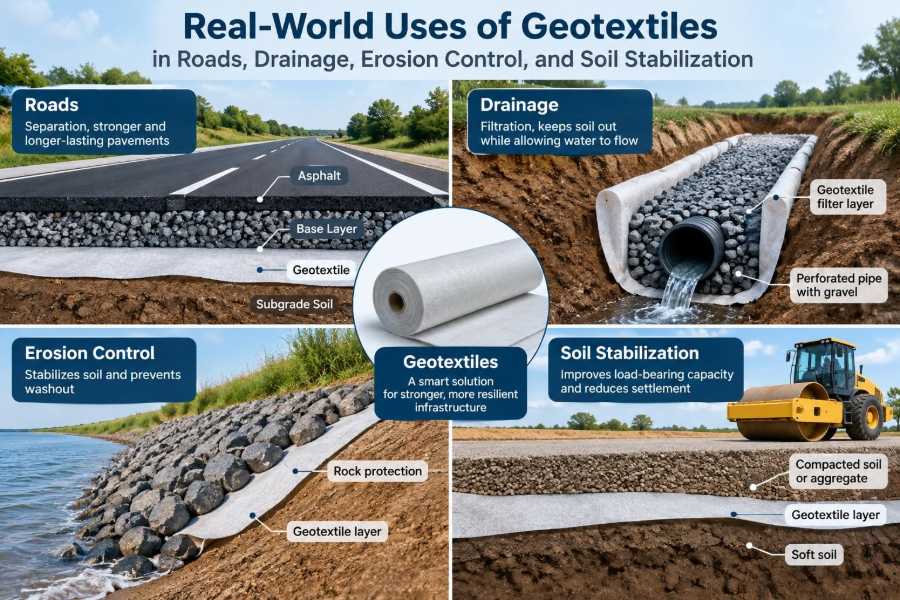
On a gravel road built over soft or wet subgrade, repeated traffic pushes aggregate downward while fine soil migrates upward into the stone. The base course loses thickness and interlock, and the surface begins to deform.
A separator geotextile placed at the interface helps keep the aggregate layer distinct from the subgrade. The aggregate can then perform its intended load-spreading role rather than gradually becoming contaminated with fines.
This is especially valuable for forestry roads, farm tracks, construction haul routes, and low-volume access roads. It does not eliminate the need for adequate aggregate thickness; it helps preserve the thickness that was placed.
🚚 Improving Construction Working Platforms
Temporary working platforms are often required for cranes, piling rigs, earthmoving equipment, and material deliveries. On weak soils, machine loads can cause bearing failure, deep rutting, or contamination of the platform stone.
A geotextile separator is often used beneath the granular platform. In some cases, a geogrid is added to provide stronger reinforcement and aggregate confinement, because a geotextile alone may not supply enough tensile stiffness for demanding loading conditions.
The design must consider equipment load, traffic repetitions, subgrade strength, groundwater, and the consequences of failure. Calling every fabric layer “reinforcement” without evaluating its mechanical contribution can create unsafe assumptions.
🛣️ Protecting Pavement Foundation Layers
Flexible pavements depend on a stable sequence of layers: subgrade, subbase, base, and surfacing. When fine subgrade particles enter an unbound granular layer, its drainage and stiffness may decline, leaving the pavement more vulnerable to deformation.
Geotextile separation is most useful where the subgrade is fine-grained and the pavement is exposed to moisture and traffic. It is commonly considered beneath granular layers rather than placed casually between every pavement course.
For a paved road, the fabric should be part of an integrated pavement design. Drainage outlets, edge restraint, material quality, compaction, and pavement thickness remain essential.
💧 Filtration: Let Water Pass, Keep Soil Put
A filter must solve two competing problems. Its openings must be open enough to allow water to pass without excessive pressure buildup, yet controlled enough to prevent damaging movement of soil particles.
This relationship is often described through retention and permittivity. Retention concerns whether the geotextile holds back soil; permittivity describes the ease of water flow through the fabric in the direction normal to its plane.
Good filtration is not always equivalent to trapping every fine particle. In some soils, a stable filter zone develops at the interface, allowing limited particle rearrangement while preventing continued erosion.
🌧️ Wrapping French Drains and Trench Drains
A conventional French drain contains perforated pipe surrounded by clean stone. Water enters the stone voids, flows into the pipe, and is conveyed away. Without a suitable filter, surrounding soil can migrate into the stone and progressively clog the drainage system.
Nonwoven geotextile is often used to wrap the stone envelope or line the trench, depending on the detail and construction method. The exact arrangement should maintain hydraulic access to the drain and avoid creating folds or gaps where soil can enter.
Drainage failures are often blamed on the pipe, but clogging can originate in the filter layer, the stone selection, or a missing discharge route. Water must have somewhere to go after it enters the system.
🏞️ Subsurface Drainage Behind Retaining Structures
Retaining walls and reinforced slopes require careful control of water pressure. Water trapped behind a wall can raise lateral loads and contribute to movement, cracking, or instability.
A drainage aggregate zone behind the wall may be separated from retained soil by a geotextile filter. The aim is to let pore water reach the drainage layer while limiting soil migration into its voids.
The fabric cannot compensate for absent outlet pipes, blocked weep holes, poor backfill compaction, or a wall designed without appropriate drainage assumptions. It is one component in a water-management system.
🕳️ Drainage Versus Filtration
These terms are related but not identical. Filtration describes water crossing through a geotextile, while drainage describes water moving within the plane of a material.
A typical geotextile can provide some in-plane flow capacity, called transmissivity. However, when a project requires significant collection and conveyance of water over distance, a geocomposite drain, drainage board, or designed gravel drain may be more suitable.
Compression matters. The water-flow capacity of a geotextile can reduce when it is squeezed between soil and structure, so unconfined laboratory values should not be assumed to represent field conditions.
🌊 Erosion Control on Slopes
Rainfall striking bare soil detaches particles, while runoff carries them downhill. On a newly cut embankment or fill slope, this can form rills and gullies before vegetation becomes established.
Geotextiles and related erosion-control textiles can reduce surface erosion by protecting soil from raindrop impact, slowing shallow runoff, and helping seed or topsoil remain in place. The appropriate product depends on slope angle, soil type, rainfall exposure, anticipated flow, and whether vegetation is expected to provide long-term protection.
A lightweight temporary blanket is not designed to resist concentrated flow in a steep drainage channel. Matching the product to the hydraulic setting is critical.
🌱 Supporting Vegetated Slopes
On many slopes, vegetation is the intended long-term erosion-control measure. Roots bind near-surface soil, foliage softens raindrop impact, and stems slow runoff.
Biodegradable blankets made from natural fibers may be appropriate where temporary support is needed until plants establish. Permanent synthetic turf-reinforcement mats may be used where vegetation needs assistance under more demanding flow conditions.
Site preparation still determines success. Seed selection, soil condition, season, irrigation where practical, and protection from washout all matter. Covering poor soil with a mat does not ensure a healthy vegetated slope.
🏝️ Protecting Shorelines and Channel Banks
Along rivers, canals, reservoirs, and coastlines, flowing water and waves can remove bank material. If armor stone is placed directly on fine soil, water movement through the stone may carry the underlying soil out through voids, causing settlement of the armor layer.
A robust filter geotextile beneath riprap can retain the bank soil while allowing water pressure to dissipate. The fabric must withstand placement of angular rock and long-term contact stresses.
Bank protection should be designed for the actual hydraulic environment. Flow velocity, turbulence, wave action, drawdown, toe scour, and changing channel alignment can all govern performance.
🪵 Erosion Control Around Culverts and Outfalls
Water leaving a culvert or pipe can have enough energy to scour an outlet channel quickly. Rock aprons, stilling arrangements, and lined channels are common ways to dissipate that energy.
Geotextile beneath outlet riprap prevents underlying soil from washing into the rock layer. It does not reduce velocity by itself; the stone size, apron length, outlet geometry, and downstream conditions control the energy-management task.
At inlets, geotextiles may also be used as part of temporary sediment-control measures during construction. These measures need regular inspection because sediment accumulation and storm damage can change their performance.
🏗️ Stabilizing Soft Subgrades
Soft subgrades are common in areas with saturated clay, organic soil, loose silt, or recently placed fill. When loaded, they may deform substantially, making it difficult to build a stable platform.
A high-strength geotextile can improve constructability by separating materials and, in suitable designs, mobilizing tensile resistance as the ground deforms. This may improve load distribution and reduce loss of aggregate into the subgrade.
There are limits. Very weak or highly variable ground may require excavation and replacement, staged construction, vertical drains, piles, geogrids, geocells, or another ground-improvement approach. The fabric is not a substitute for a site investigation.
📐 The Reinforcement Mechanism
Soil is strong in compression but weak in tension. A geotextile can carry tensile forces after deformation develops, much like a tensioned layer supporting a load across a soft area.
In unpaved roads, reinforcement can involve membrane action, lateral restraint of aggregate, and improved stress distribution. The relative importance of each mechanism depends on product stiffness, interface friction, layer geometry, traffic, and subgrade condition.
Designers should distinguish strength from stiffness. A fabric may have a high ultimate tensile strength but stretch considerably before developing useful resistance, which may be unsuitable where rut depth must remain limited.
🧱 Reinforced Soil Slopes and Walls
Geotextiles can be placed in horizontal layers within compacted fill to create reinforced soil slopes, steepened embankments, and mechanically stabilized earth structures. The layers interact with soil through friction and interlock, helping form a reinforced mass.
This application demands engineering design of internal stability, external stability, drainage, foundation conditions, facing details, and long-term durability. It is not comparable to laying a fabric under a gravel path.
Construction quality is especially important. Incorrect layer spacing, inadequate embedment length, poorly compacted fill, or damage during placement can compromise the intended reinforced-soil behavior.
🛡️ Protecting Geomembranes in Containment Systems
Geomembranes are low-permeability sheets used where liquid containment is required, such as some ponds, landfills, and industrial containment areas. Their performance can be affected by puncture from angular stone, rough subgrade, or construction traffic.
Nonwoven cushion geotextiles are often placed adjacent to a geomembrane to spread localized contact stresses. They may be installed above, below, or on both sides of the membrane depending on the system detail.
Protection design should consider the actual materials and loads. A smooth sand layer, carefully prepared subgrade, or protective board may also be needed; a fabric is not automatically sufficient against every sharp object or high contact pressure.
🧪 Key Properties Engineers Specify
Geotextile data sheets contain numerous test values. The values that matter depend on the function, so a specification should connect each requirement to a site condition or design check.
| Property | Why it matters | Typical relevance |
|---|---|---|
| Apparent opening size | Indicates the scale of openings that affects soil retention | Filters and drainage interfaces |
| Permittivity | Describes water flow through the fabric | Filters behind drains, walls, and riprap |
| Transmissivity | Describes in-plane water flow capacity | Drainage layers and geocomposites |
| Tensile strength and elongation | Indicate load resistance and deformation behavior | Separation, reinforcement, installation survival |
| Puncture and tear resistance | Indicate resistance to localized damage | Rocky subgrades, aggregate placement, protection |
No single number establishes suitability. For example, a product with good puncture resistance may still have an inappropriate pore structure for a fine, erodible soil.
🧭 Start With Soil and Water Conditions
Selection begins with knowing the material on each side of the geotextile. Grain-size distribution, plasticity, density, moisture condition, organic content, and susceptibility to internal erosion can influence filtration and separation behavior.
Water conditions deserve equal attention. Is water moving slowly toward a drain, flowing along a channel, fluctuating with tides, or rising seasonally from groundwater? The hydraulic gradient and flow direction affect the required filter performance.
Where conditions are uncertain or consequences are high, field investigation and project-specific geotechnical advice are more reliable than copying a product choice from an unrelated detail.
📦 Survivability During Installation
A carefully selected fabric can fail before the project is complete if it is torn by angular aggregate, punctured by protrusions, or dragged across a rough formation. This is called installation damage, and it can be more severe than long-term service stresses in some projects.
Heavy rock placement, deep lifts, aggressive compaction, and repeated construction traffic increase the risk. The required survivability class should reflect the construction method, not only the completed structure.
Good preparation helps: remove sharp debris where feasible, avoid direct vehicle turning on exposed fabric, and place cover material in a controlled manner. Repairs should extend well beyond the damaged area and follow the project detail.
📏 Overlaps, Seams, and Anchoring
Roll widths are finite, so overlaps or seams are unavoidable. Their required size and strength depend on the application, subgrade softness, placement method, hydraulic loading, and risk of fabric displacement.
For simple separation under granular fill, overlaps may be specified to accommodate construction movement. For reinforced structures or demanding filtration applications, sewn seams or other engineered joining methods may be necessary.
On slopes, anchoring trenches and secure terminations prevent the fabric from being pulled downhill or undermined at the crest. A geotextile that is continuous on paper but opens at its joints cannot perform as intended.
🚜 A Practical Installation Sequence
Procedures vary by application, but a reliable field sequence is straightforward: prepare the formation, place the fabric without excessive tension, secure joints, cover it promptly, and inspect the work before it disappears beneath later layers.
- Trim and proof the subgrade as required, removing obvious debris and soft pockets identified for treatment.
- Unroll the geotextile in the specified direction and keep it reasonably flat without stretching it drum-tight.
- Provide specified overlaps, seams, and anchorage; avoid unsupported wrinkles that can fold under aggregate.
- Place cover material from the edge or from a method that does not damage the exposed sheet.
- Maintain the required cover thickness before heavy equipment crosses the area.
Site teams should follow the project specification and manufacturer handling guidance. Details such as roll orientation and placement direction can matter on soft ground.
⚠️ Common Mistake: Using Fabric as a Patch for Bad Drainage
When a road stays wet, adding geotextile beneath more stone can be helpful only if the system has a way to drain. If ditches are blocked, cross-drainage is absent, or groundwater is continually feeding the formation, the underlying problem remains.
Water weakens many soils and reduces the effective stress that helps granular layers carry load. A separator can preserve layer separation, but it cannot magically lower a water table or create an outlet.
Before specifying fabric, trace the water: where it comes from, where it accumulates, and where it can safely leave.
⚠️ Common Mistake: Ignoring Clogging Risk
Filter clogging can occur when particles lodge in openings, when biological growth develops, or when chemical precipitates form in particular environments. Fine soils with challenging gradations may require more careful assessment than a simple opening-size comparison.
A filter should be evaluated as part of a soil-filter-water system. Local soils, hydraulic gradients, and loading conditions can make a generic “one fabric fits all” detail unreliable.
Where long-term drainage is critical, designers may consider graded granular filters, geocomposites, cleanout access, or other measures alongside a geotextile.
⚠️ Common Mistake: Confusing Geotextiles With Geogrids
Geogrids are open-grid polymer structures primarily used for reinforcement and aggregate interlock. Geotextiles are continuous permeable fabrics that are often selected for separation and filtration.
In a weak-road application, a geotextile may prevent subgrade fines from contaminating the base, while a geogrid may improve aggregate confinement. Some designs use both because their functions are complementary.
Substituting one for the other without revisiting drainage, separation, aperture size, and mechanical behavior is a design change, not a harmless material swap.
🕰️ Durability and Long-Term Performance
Buried geotextiles are generally protected from ultraviolet light, but long-term performance can still be affected by oxidation, chemical exposure, temperature, abrasion, creep, and sustained loading. The relevant concern depends on the application.
For reinforcement, long-term tensile behavior and creep are particularly significant. For filters and separators, survivability, clogging resistance, and the persistence of hydraulic properties may govern.
Exposure before installation should also be controlled. Rolls left uncovered in sunlight and weather for extended periods may not retain their intended condition, especially if storage guidance is ignored.
✅ Inspection and Quality Control
Inspection should confirm more than the roll label. Verify the product type, required properties, roll condition, placement location, overlap direction, seam quality where applicable, and repairs to damage.
Photographs and simple location records are valuable because the geotextile is concealed once covered. They provide evidence of installation and help future investigators understand what lies beneath a road, drain, or slope.
For larger or higher-risk projects, quality assurance may include material certification review and testing under the project’s stated requirements. The acceptance process should be defined before material arrives on site.
💰 Where Geotextiles Deliver Value
The economic value of a geotextile is usually not that the roll itself is inexpensive. Its value comes from avoiding premature aggregate contamination, reducing rework, supporting a thinner or more constructible granular layer where justified by design, and extending serviceability.
They can be especially effective where imported aggregate is costly, access is difficult, or excavation of weak soil would be disruptive. Conversely, using a premium fabric where simple grading and drainage correction would solve the problem is not efficient engineering.
Life-cycle thinking is useful: consider installation quality, inspection access, future maintenance, and the consequence of a hidden filter or separator failing over time.
🧩 A Simple Project Selection Framework
Before writing a specification, define the failure mode. Is aggregate mixing with soil? Is water carrying fines into a drain? Is runoff eroding a slope? Is the formation too weak for construction traffic?
Then connect the failure mode to the primary function, evaluate soil-water-load conditions, and choose a product with appropriate hydraulic and mechanical properties. Finally, detail its installation so that the field arrangement matches the design assumption.
- Define the problem and performance objective.
- Identify the primary geotextile function.
- Assess soil, water, loading, and construction conditions.
- Select properties rather than relying on product name alone.
- Specify placement, joints, cover, inspection, and repair requirements.
🎓 The Core Takeaway for Civil Engineers
Geotextiles are best understood as interface materials. They manage what happens where soil meets stone, water meets soil, or a vulnerable liner meets a rough surface.
The most successful applications are not based on a vague instruction to “add fabric.” They begin with a clear mechanism: separate layers, filter water, drain a zone, reinforce weak ground, or protect a membrane. From there, material properties and construction details can be selected rationally.
That approach turns a thin layer of fabric into a purposeful part of the civil engineering system rather than an afterthought hidden beneath the ground.
When geotextiles are matched to the soil, water, loads, and installation method, they help civil works remain stable, drain effectively, and use materials more intelligently. 🌉💧🧵