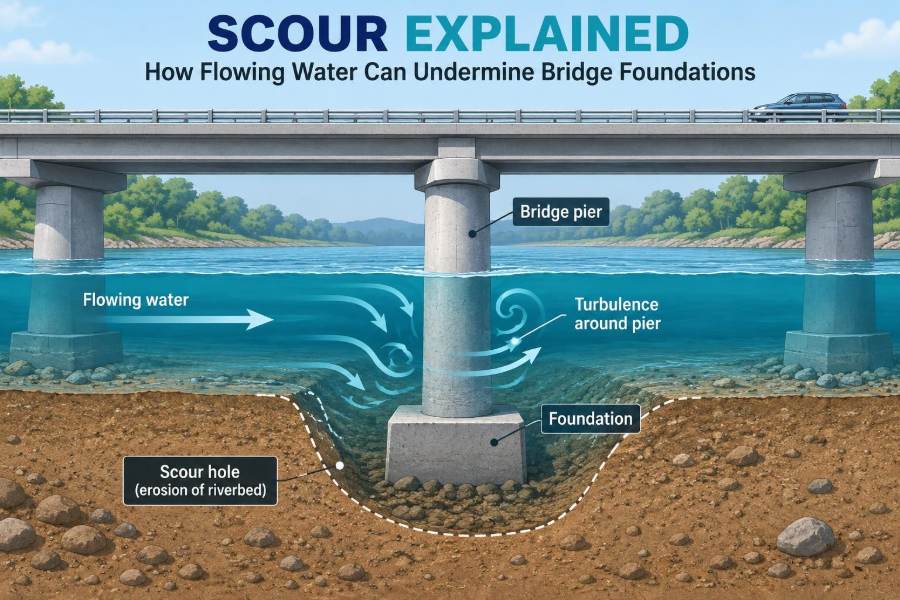

A bridge can look completely sound from the roadway while its greatest problem is developing out of sight, below the waterline. After a flood, motorists may see only a higher, muddier river. Engineers may be concerned about something far less visible: whether the riverbed around a pier or abutment has been carried away.
This process is called scour. It is a leading hydraulic hazard for bridges because flowing water can remove the soil or rock that transfers foundation loads safely into the ground.
The risk is not limited to spectacular floods or very old bridges. A modest channel shift, a constriction created by debris, or repeated high flows can alter conditions at a foundation that was once stable.
Understanding scour means connecting fluid movement, river behavior, soil response, and structural load paths. That connection helps engineers design better crossings, inspect them intelligently, and decide when a bridge needs protection, monitoring, or closure.
🌊 What Scour Actually Means
Scour is the erosion and removal of bed or bank material by flowing water. At a bridge, the term usually refers to lowering of the streambed near foundations, especially piers and abutments.
It is not simply “erosion somewhere near the bridge.” The critical question is whether material is removed from a location needed to support the structure. If enough soil is lost, a footing may become exposed, a pile may lose lateral support, or a foundation may be loaded in a way it was not intended to resist.
🏗️ Why Foundation Support Depends on Soil
Bridge loads travel from the deck to girders, bearings, piers or abutments, and finally into foundations. Those foundations depend on surrounding ground for vertical bearing, lateral restraint, or both.
A shallow footing spreads load across near-surface soil. Deep foundations, such as driven piles or drilled shafts, transfer load deeper into the ground, but they can still be vulnerable when scour removes the upper soil that braces them against sideways movement.
Scour does not have to expose an entire foundation to create a problem. Partial loss of support can change stiffness, increase bending demands, and make a system more sensitive to flooding, debris impact, or vessel collision.
💧 How Moving Water Picks Up Sediment
Water flowing over a channel bed applies a dragging force called boundary shear stress. When that force exceeds the resisting forces holding sediment particles in place, particles begin to move.
Fine silt and sand can be mobilized relatively easily. Gravel, cobbles, and rock generally require stronger flow, though individual particles, weak rock, or loose joints may still be displaced under severe conditions.
Think of a river as having a sediment budget. Flow can carry material into a reach, through it, or out of it. Scour occurs where the local flow has more erosive capacity than the available bed material can resist.
⚡ Velocity Matters, but It Is Not the Whole Story
Higher velocity often means greater potential for erosion, which is why flood flows deserve attention. Yet a single average velocity does not describe what happens at a foundation.
Local acceleration, turbulence, flow direction, water depth, bed composition, and duration all matter. A short burst of fast water may behave differently from sustained moderate flow, especially where material is loose and readily transported.
Engineers therefore examine hydraulic conditions across a bridge opening rather than treating the river as a uniform pipe.
🌀 Local Scour at Bridge Piers
A pier obstructs flow. Water slows immediately upstream, accelerates around the sides, and separates downstream. Near the bed, the approaching flow is deflected downward around the pier, producing a rotating horseshoe vortex.
That vortex can excavate a hole around the pier, known as a scour hole. Additional vortices in the wake can transport loosened sediment away, allowing the hole to deepen or expand.
The precise shape changes during a flood. Sand-bed channels may form and refill holes quickly, while coarser beds or cohesive soils can respond differently. The important design issue is the greatest credible loss of support during the event, not only the bed elevation observed afterward.
🧱 Contraction Scour Through a Narrower Opening
Contraction scour occurs when flow is forced through a reduced cross-sectional area. The bridge opening itself, approach embankments, floodplain encroachment, or natural channel narrowing can concentrate flow.
As the flow accelerates, the channel bed may degrade across a broad area rather than only beside one pier. This can affect multiple foundations at once and may also alter the channel upstream and downstream.
A bridge need not appear visually narrow to create contraction effects. During a flood, portions of the floodplain may be blocked by roadway embankments, changing how water is distributed through the crossing.
🏞️ Long-Term Channel Degradation
Some rivers gradually lower their beds over years or decades because sediment supply, watershed conditions, channel controls, or human activities have changed. This general lowering is called degradation.
Unlike a local scour hole, degradation can reduce the ground level along an extended reach. A foundation originally embedded below the bed may progressively become closer to exposure even without one exceptional flood.
Bridge assessments need to separate this long-term trend from event-based scour. A safe design considers both, because they can combine.
🌿 Lateral Migration and Bank Erosion
Rivers naturally adjust their planform. In a meandering channel, flow often attacks the outside of a bend, while sediment deposits along the inside. Over time, the channel can migrate toward an abutment, approach road, or pier.
Bank erosion is therefore part of scour risk, particularly at skewed crossings or bridges near bends. An abutment placed outside the main channel at construction may later become exposed to concentrated flow.
Vegetation can improve bank resistance, but it is not a universal solution. Roots, soil type, flood duration, and the severity of hydraulic attack determine whether a vegetated bank remains stable.
🪨 The Riverbed Material Changes the Problem
Sand-bed streams commonly show rapid, mobile-bed behavior. Dunes and bars can move through a reach, temporarily lowering or raising the bed near foundations.
Gravel and cobble beds may appear robust, but flood flows can rearrange them, and a coarse surface layer may conceal finer material beneath. Cohesive clay can resist erosion longer than sand, yet once erosion begins, the response may be difficult to predict from appearance alone.
Rock is not automatically immune. Weathered, fractured, or thinly bedded rock can be eroded through plucking, abrasion, or removal of weaker seams.
🧩 Clear-Water and Live-Bed Scour
Two useful concepts describe sediment conditions approaching a pier. In clear-water scour, the approaching flow is not carrying enough bed material to replace sediment removed around the foundation. The scour hole can deepen until local conditions reach an equilibrium.
In live-bed scour, sediment is already moving along the channel bed. The bed and scour hole may fluctuate as sediment passes through the reach.
The distinction helps engineers interpret observed conditions and select analysis methods. In the field, real rivers can shift between these behaviors as discharge changes.
📐 Why Pier Shape and Alignment Matter
A streamlined pier nose generally creates less severe flow separation than a blunt geometry of similar width. The effective width presented to the flow is especially important.
When flow approaches a pier at an angle, the obstruction is effectively wider and more complex. Skew can increase vortex strength and make scour asymmetric, concentrating it on one side of the foundation.
Designers also consider pier spacing, debris potential, and the alignment of the entire bridge. A well-shaped pier cannot fully compensate for a crossing that directs flow into it at an unfavorable angle.
🧱 Abutments Face a Different Hydraulic Challenge
Abutments terminate the bridge deck and retain the approach fill. During high water, they can obstruct floodplain flow and force water through the bridge opening or around the end of the approach embankment.
Scour at abutments may involve a combination of local vortices, contraction effects, and bank erosion. The geometry of the embankment, floodplain roughness, and overflow paths can be as influential as the main-channel velocity.
This is why an inspection focused only on main-channel piers can miss meaningful vulnerability at the bridge ends.
🌧️ Floods Are the Critical Test, Not Normal Flow
Most visible scour damage develops during elevated flows, when water depth and velocity rise together. Floodwater can also carry logs, vegetation, sediment, and floating debris that alter the bridge opening.
The maximum scour depth may occur before peak discharge, near the peak, or during changing flow conditions. After water recedes, some sediment may deposit back into a scour hole, concealing how deep it became.
That makes post-flood appearance useful but incomplete. Where risk is significant, agencies may combine visual inspection with sounding, surveys, monitoring instruments, and hydraulic evaluation.
🪵 Debris Can Transform a Flow Pattern
Logs and other debris can accumulate on piers, rails, or low chords. This reduces the effective opening, raises local water levels, and redirects flow around the obstruction.
A debris raft can increase local velocities and worsen pier scour. It can also create unbalanced loading or contribute to overtopping of approaches, which may cause separate erosion problems.
Debris management is not simply a maintenance concern. At debris-prone sites, engineers need to account for plausible blockage and provide access or operational plans for safe removal when conditions allow.
🔍 What Inspectors Look for After High Water
Inspections begin with safe access and a record of flood conditions. Inspectors look for exposed footings, undermined slopes, displaced riprap, new bars, bank retreat, debris accumulations, cracking in approach pavement, and unusual settlement.
Underwater observations may require divers, sonar, probing, or bathymetric surveying. Each method has limits: turbid water reduces visibility, sonar needs careful interpretation, and probes give point information rather than a complete bed surface.
- Compare observed bed elevations with prior surveys where available.
- Document scour-hole location, depth, and extent rather than only its deepest point.
- Check whether protective material remains properly keyed into the bed and banks.
- Escalate unusual findings to qualified bridge and hydraulic engineers.
📡 Monitoring Helps When Conditions Change Fast
At some high-risk bridges, monitoring systems can track water level, flow indicators, foundation movement, or bed elevation. Fixed instruments, portable sonar, and remote data systems can support decisions during floods.
Monitoring is valuable because it supplies information while the event is happening, when a scour hole may be deepest. It does not eliminate engineering judgment: sensors can fail, shift, foul with debris, or measure only a small part of a complex channel.
A useful monitoring plan defines who receives alerts, what thresholds trigger action, and how the information will be verified.
🧮 Estimating Scour Is an Engineering Assessment
Scour evaluation generally combines site data, hydraulic analysis, foundation information, and an understanding of channel behavior. Engineers estimate water-surface elevations, velocities, flow distribution, sediment conditions, and potential channel change for selected design or check events.
Empirical equations and physical principles can estimate local and contraction scour, but their output is not a guaranteed future depth. Natural channels are variable, and model results depend strongly on the quality of geometry, flow, and material data.
Good practice treats computed values as part of a risk-based engineering decision, checked against field evidence, past performance, geomorphic context, and conservative assumptions where appropriate.
🗺️ Site Investigation Sets the Quality of the Answer
A sound analysis starts with reliable information. Survey data should capture the channel, floodplain, bridge geometry, and foundation elevations. Subsurface exploration identifies soil and rock conditions that cannot be inferred reliably from a surface view.
Historical photographs, maintenance records, flood observations, and older surveys can reveal migration, degradation, or recurring debris problems. A single survey is a snapshot; a sequence of observations tells a story about change.
Uncertainty should be documented rather than hidden. Unknown foundation depth or an unverified bed layer may control the urgency of further investigation.
🛡️ Riprap Protects Only When Properly Designed
Riprap is a layer of durable stone placed on a bed or bank to resist erosive flow. It is commonly used near abutments, piers, guide banks, and approach slopes.
Effective riprap requires appropriate stone size, layer thickness, gradation, filter compatibility, and toe embedment. A stone blanket placed directly on erodible soil without a suitable filter can allow fine material to wash out beneath it, causing settlement or failure.
Riprap can also be displaced if flow is stronger than anticipated or if its edges are not keyed into stable ground. It should be inspected after major events, not assumed to remain effective indefinitely.
🧺 Filters and Geotextiles Prevent Hidden Soil Loss
A filter layer allows water to pass while retaining underlying soil particles. Filters may use carefully graded granular material or geotextiles selected for the site conditions.
The filter is often the difference between armor that works and armor that masks internal erosion for a time. Its design must consider soil gradation, hydraulic loading, constructability, and long-term durability.
Geotextiles are useful in many applications, but they need protection from puncture, ultraviolet exposure where relevant, and installation damage. They are components of a system, not a substitute for adequate rock size or embedment.
🧱 Foundation Depth Is a Primary Defense
One direct way to address scour is to place foundations deep enough that anticipated erosion does not remove essential support. Deep foundations may extend through vulnerable strata into more competent material or derive sufficient capacity below the predicted scour level.
However, deeper is not automatically simpler or cheaper. Construction access, drivability, rock conditions, lateral loads, group effects, and settlement all influence the final design.
The key is to evaluate the foundation after assumed scour has occurred. A pile or shaft that is satisfactory in intact soil may require a different structural check when upper soil support is removed.
🔧 Retrofitting an Existing Bridge
When an assessment identifies vulnerability, the appropriate response depends on the mechanism and urgency. Options can include added riprap, guide banks, grade-control measures, foundation extensions, pile jackets, structural strengthening, channel improvements, or enhanced monitoring.
Temporary countermeasures may be appropriate while a permanent repair is designed, but they must not introduce a new hydraulic problem. For example, a protection measure that deflects high-velocity flow toward another foundation can shift rather than solve the risk.
Retrofitting requires coordination among bridge, geotechnical, hydraulic, environmental, and construction specialists. River work is constrained by flow conditions, access, permitting, and ecological considerations.
🚧 Operational Decisions During a Flood
Bridge owners need a plan before severe weather arrives. The plan may include trigger levels for site observation, inspection procedures after overtopping or debris accumulation, detour arrangements, and authority to restrict traffic.
Closing a bridge is a consequential decision, particularly on an emergency route. But waiting for visible structural distress can be unsafe because foundation damage may occur beneath opaque floodwater.
Operational thresholds should be site-specific and based on the known vulnerability, available data, and the ability to inspect safely. No universal water level can define scour danger at every crossing.
⚠️ Common Misconceptions About Scour
- “The bridge survived past floods, so it is safe.” Channel geometry, debris, bed elevation, and flood characteristics can change between events.
- “A deep foundation cannot scour.” Deep foundations may still lose lateral confinement or experience larger unsupported lengths.
- “If the bed looks normal after the flood, no scour occurred.” Partial refilling can hide the maximum scour depth reached during high flow.
- “Riprap always solves the problem.” Poorly sized, placed, filtered, or maintained rock can fail or transfer erosion elsewhere.
📊 A Practical Scour-Risk Framework
Scour risk is best viewed as the interaction of hazard, vulnerability, and consequence. A high-energy channel does not automatically create the highest priority if foundations are robust and consequences are limited; conversely, a modest channel can warrant close attention where support is shallow and the route is critical.
| Question | Why it matters |
|---|---|
| How can flow concentrate at this crossing? | Identifies contraction, skew, bend effects, and debris-related hazards. |
| What material supports the foundations? | Determines how readily the bed or bank may erode and what support may be lost. |
| How deep and what type are the foundations? | Defines the structure’s ability to tolerate predicted scour. |
| Is the channel changing over time? | Reveals degradation, migration, aggradation, and evolving exposure. |
| What happens if the bridge is compromised? | Guides inspection frequency, monitoring, retrofit priority, and emergency planning. |
👷 Design Requires Collaboration Across Disciplines
Hydraulic engineers evaluate flow and scour mechanisms. Geotechnical engineers characterize soil and rock behavior. Structural engineers verify that foundations and substructures remain adequate under post-scour conditions.
Geomorphologists, environmental specialists, surveyors, inspectors, maintenance teams, and construction personnel also contribute essential site knowledge. The most reliable decisions arise when observations from the field can challenge assumptions in the calculations.
For students, scour is a useful reminder that civil engineering systems rarely fit neatly within one specialty.
📚 What Students Should Learn to Recognize
When reviewing a bridge over water, ask where the flow goes during both ordinary and flood conditions. Look for narrowed openings, bends, exposed roots, debris lines, fresh bank scars, displaced stone, and differences between the apparent channel and the wider floodplain.
Then ask what lies below the water: shallow footings, piles, shafts, rock, loose alluvium, or unknown conditions. These questions do not replace formal analysis, but they build the observational habits needed for sound engineering judgment.
A useful mental model is simple: water changes the ground, and the ground supports the bridge. Every scour assessment explores that relationship in detail.
✅ The Core Principle: Preserve Support During Flow
Scour is not merely a river-maintenance issue or an underwater inspection item. It is a foundation-performance issue created by changing hydraulic conditions.
Safe bridges account for how water can accelerate, swirl, concentrate, carry sediment, redirect around obstructions, and reshape a channel over time. They also account for uncertainty through investigation, conservative evaluation where justified, inspection, and planned response.
The central goal is to ensure that a bridge retains reliable foundation support when the river is at its most demanding, not just when the water is calm.
Flowing water can quietly alter the ground beneath a bridge, so resilient design and inspection must treat the riverbed as an active part of the structural system. 🌉🌊🛠️