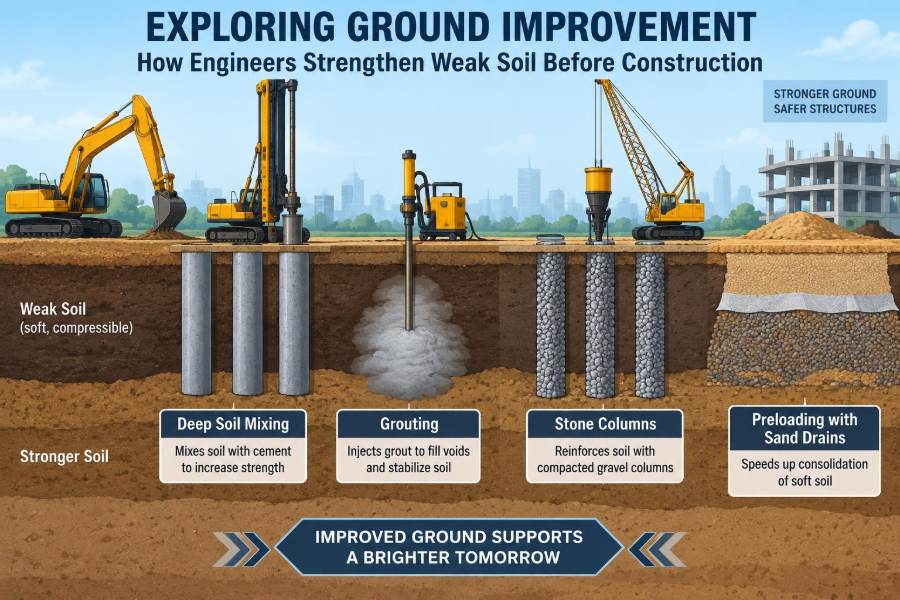

A new building can have an elegant frame, deep foundations, and carefully detailed finishes—yet its long-term performance still depends on something no one sees after completion: the ground beneath it.
Consider a warehouse proposed on soft clay, a road embankment crossing a former marsh, or a housing development planned over loose sandy fill. If construction starts without understanding and improving that ground, floors may settle unevenly, pavements may crack, and buried services may distort.
Engineers do not simply “make soil stronger” in one universal way. They investigate what is weak, decide what performance is needed, and select a technique that changes the soil’s density, drainage, stiffness, strength, or stress condition.
Ground improvement is therefore a practical bridge between difficult sites and safe construction. It can make development possible where replacing all weak soil or relying on very deep foundations would be disruptive, expensive, or technically unsuitable.
🌍 What Ground Improvement Means
Ground improvement is the deliberate modification of soil or rock so it performs better for an intended project. The required improvement may involve increasing bearing capacity, limiting settlement, controlling seepage, reducing liquefaction susceptibility, or creating a stable working platform.
It differs from simply placing a thicker foundation. Foundations transfer structural loads into the ground; ground improvement changes the ground itself so that it can receive those loads more reliably.
The term covers a wide family of methods, from compacting shallow fill with rollers to creating columns of treated soil many metres below grade.
🏗️ Why Weak Soil Creates Construction Problems
Soil is not a uniform manufactured material. Its behavior depends on particle size, water content, density, stress history, layering, and drainage. A deposit that looks firm at the surface may contain compressible clay, organic material, loose sand, or uncontrolled fill below.
When a new structure adds load, soil particles rearrange and pore water may be squeezed out. This can cause movement that is small and uniform, or uneven enough to damage a structure.
- Low bearing capacity: soil may shear or deform under foundation pressure.
- Excessive settlement: a building or embankment may sink beyond acceptable limits.
- Differential settlement: different parts move by different amounts, causing cracking and distortion.
- Instability: slopes, excavations, or embankments may fail.
🧱 Bearing Capacity Is More Than “How Much Weight”
Bearing capacity is the pressure soil can support without a shear failure or unacceptable deformation. Imagine pressing a shoe into wet ground: a wider sole spreads the load, while a narrow heel concentrates it and sinks more easily.
Foundation engineers consider the width and depth of a foundation, soil strength, groundwater conditions, and the consequence of movement. A soil may avoid a dramatic bearing failure yet still settle too much for a sensitive building, machine base, or railway track.
This is why a design checks both ultimate capacity and serviceability, meaning performance during normal use.
📉 Settlement: The Often Hidden Design Driver
Settlement is downward movement caused by loading. In granular soils, it may occur quickly as particles rearrange. In saturated clay, settlement can continue over a long period because water must slowly drain from tiny pores before the soil skeleton carries more load.
Uniform settlement is not automatically harmless, but structures can often tolerate it better than differential settlement. A uniformly settling warehouse slab may remain usable, while a smaller difference between two column bases can introduce damaging forces into beams and walls.
Ground improvement frequently aims to reduce both the amount of settlement and the time it takes to occur.
💧 Groundwater Changes the Equation
Water within soil pores affects the stress carried by soil grains. High groundwater can reduce effective stress, complicate excavation, soften some fine-grained soils, and create seepage pressures.
For coarse sands and gravels, drainage is usually rapid. For clays and silts, drainage is much slower, so loading may generate excess pore-water pressure that temporarily reduces strength.
A groundwater level observed in one borehole on one day is not the complete story. Engineers consider seasonal variation, tidal influence near coasts or rivers, perched water, and the effects of nearby pumping or drainage works.
🔎 Site Investigation Comes Before Treatment
No sensible ground-improvement design begins with a preferred machine or method. It begins with a ground investigation: collecting information about the site’s strata, groundwater, properties, variability, contamination, and geological history.
Investigation may include boreholes, trial pits, in-situ penetration tests, cone penetration testing, geophysical surveys, and laboratory tests on samples. Each tool has limitations, so engineers interpret them together rather than treating a single result as a complete answer.
Older maps, aerial photographs, previous site records, and discussions with local authorities can also reveal former quarries, filled ponds, industrial uses, or buried obstructions.
🧪 Soil Classification Guides the Choice
Ground-improvement methods work because of particular soil behavior. A technique effective in clean sand may be ineffective in soft organic clay, while a treatment that works well in clay may be unnecessary for dense gravel.
| Ground condition | Typical concern | Often considered approaches |
|---|---|---|
| Loose clean sand | Low density, settlement, liquefaction potential | Vibrocompaction, dynamic compaction, densification |
| Soft saturated clay | Low undrained strength, slow settlement | Preloading, vertical drains, columns, mixing |
| Uncontrolled fill | Variable composition and voids | Removal, replacement, compaction, grouting |
| Organic soil or peat | High compressibility and decomposition | Removal, staged loading, lightweight fill, deep solutions |
The table is only an early screening guide. Layer thickness, access, environmental constraints, and structural loads can change the final decision.
🗺️ Defining the Improvement Zone
Engineers must determine not only whether soil needs improvement, but also where and how deep treatment must extend. The influence zone below a loaded foundation grows with foundation size and loading pattern.
A shallow slab may require treatment over a broad area near the surface. A heavily loaded tank or bridge abutment may influence deeper layers. Treating only the upper weak layer can be insufficient if compression continues in softer material below.
Plan dimensions matter too. Treatment may need to extend beyond a footing edge so that stress does not concentrate at a sharp boundary between improved and untreated ground.
🚜 Removal and Replacement: The Direct Option
Excavating unsuitable soil and replacing it with engineered granular fill is one of the clearest solutions when the weak material is shallow and accessible. The replacement fill is placed in controlled layers and compacted to a defined specification.
This method provides visible quality control and can remove contaminants or organic material when disposal routes are appropriate. It becomes less attractive as excavation gets deeper, groundwater becomes difficult to control, or adjacent structures limit safe slopes and shoring.
“Dig it out” is not automatically simple. Excavation can destabilize nearby ground, create dewatering demands, and generate substantial haulage and disposal impacts.
🛞 Surface Compaction for Engineered Fill
Rollers, rammers, and plate compactors densify fill placed near the surface. Compaction reduces air voids, improves particle interlock, and generally increases stiffness and strength.
Good compaction depends on material type and moisture condition. Granular fill often responds well to vibration. Fine-grained soils may need moisture adjustment and kneading action; soil that is too wet can become difficult to compact effectively.
Field density testing, proof rolling, and inspection help verify that the placed material meets project requirements. A smooth-looking surface is not evidence of adequate compaction below it.
🔨 Dynamic Compaction for Deeper Loose Ground
Dynamic compaction uses repeated drops of heavy weights from controlled heights to densify loose ground. The impact sends energy into the soil, rearranging particles and reducing voids over a depth that depends on soil conditions and the treatment energy.
It can be useful over large open sites with loose fill or granular soils. However, it produces vibration, noise, and surface craters that require subsequent levelling and compaction.
Nearby utilities, heritage structures, occupied buildings, and sensitive equipment may rule it out. Monitoring vibration and ground response is essential rather than optional.
🌀 Vibrocompaction in Clean Granular Soils
Vibrocompaction uses a vibrating probe, commonly called a vibroflot, to densify loose sands and gravels. Water or air assistance may help the probe penetrate, while vibration encourages particles to settle into a denser arrangement.
The method generally depends on the soil having enough free-draining granular material to rearrange. A high proportion of fines can restrict drainage and prevent the desired densification.
Successful treatment is normally verified with post-treatment testing at representative locations. Probe depth alone does not prove that the target density or stiffness was achieved.
🪨 Stone Columns and Granular Inclusions
Stone columns are vertical zones of compacted gravel or crushed stone installed in weak soil. They can reinforce the ground, reduce settlement, and provide drainage paths that help soft cohesive soils consolidate faster.
They work as a composite ground system: load is shared between the stiffer columns and surrounding soil. The design must account for the possibility of column bulging, especially in very soft clay with limited lateral support.
Installation displacement may improve some soils, but it may also disturb sensitive ground or affect nearby structures. Column diameter, spacing, installation method, and a load-transfer platform above the columns all influence performance.
🧩 Rigid Inclusions for Heavier Loads
Rigid inclusions, such as grouted columns or low-mobility concrete elements, are used where greater stiffness is needed than stone columns can provide. They transfer a significant portion of load toward deeper competent strata while supporting an engineered load-transfer layer above.
Although they resemble piles, their design philosophy can differ. The raft, embankment, or slab and the improved ground are designed to work together rather than treating every inclusion as an isolated structural pile.
This option can suit heavy embankments and building platforms, but it requires careful analysis of load distribution, installation tolerances, and connection details.
🌊 Preloading Lets Settlement Happen Early
Preloading means placing temporary fill, called surcharge, over soft ground before final construction. The temporary load causes consolidation and settlement in advance, so less movement remains after the permanent works are built.
It is often effective where time and space are available, such as port areas, industrial yards, and road embankments. Settlement plates, piezometers, and survey points are used to track how the ground responds.
Preloading is not a shortcut to omit analysis. Too much loading too quickly can cause instability in soft clay, so staged placement may be necessary.
🧵 Vertical Drains Accelerate Consolidation
Prefabricated vertical drains are slender strips installed through soft saturated clay. They shorten the drainage path that pore water must travel during preloading, accelerating consolidation.
Instead of draining only vertically to a distant surface, water can move laterally toward nearby drains and then upward or downward through drainage layers. This can greatly reduce waiting time compared with surcharge alone, though performance depends on soil permeability and installation quality.
Drains do not inherently make clay stronger the moment they are installed. Their value comes from facilitating controlled consolidation under loading.
🧫 Deep Soil Mixing Creates Treated Masses
Deep soil mixing mechanically blends in-place soil with binders such as cementitious materials to form improved columns, panels, or blocks. The treatment can increase strength and stiffness and reduce permeability, depending on the soil and binder system.
It is especially useful where excavation is impractical and where engineers need shaped treatment zones beneath structures, retaining works, or seepage barriers. The chemistry is site-specific: organic content, sulfate conditions, water content, and soil mineralogy can affect results.
Trial mixes and strength testing are therefore central parts of design, not merely construction checks.
💉 Grouting Fills Voids or Alters Flow Paths
Grouting involves injecting a fluid material into the ground. Its purpose may be to fill voids, bind particles, reduce permeability, compensate for settlement, or control water inflow.
Permeation grouting aims to enter existing pore spaces without substantially moving the soil. Compaction grouting uses a stiff grout that displaces and densifies surrounding ground. Other systems create fractures or chemical bonds under carefully controlled conditions.
Grouting can be valuable in constrained locations, but predicting grout spread in variable ground is challenging. Pressure, volume, ground movement, and nearby services require close control.
🧱 Geosynthetics Reinforce the Ground Surface
Geotextiles, geogrids, and geocells are polymeric products used within soil layers. A geogrid can provide tensile reinforcement where soil alone has little tensile strength, while a geotextile may separate soft subgrade from aggregate and allow drainage.
For example, a reinforced granular platform can bridge short weak zones and improve construction access for plant. It does not magically turn deep soft clay into competent bearing material; its role must match the loading and deformation problem.
Correct overlap, anchorage, protection from installation damage, and fill placement are practical details that strongly affect performance.
🪶 Lightweight Fill Reduces the Load Applied
Sometimes the most effective improvement is to reduce the load rather than greatly strengthen the soil. Lightweight fills can reduce stress on weak ground beneath road approaches, embankments, and landscaped areas.
Options may include lightweight aggregate, expanded polystyrene blocks in appropriate protected applications, or carefully engineered cellular materials. Their behavior under water exposure, buoyancy, fire requirements, durability, and construction traffic must be evaluated.
This is a useful reminder that geotechnical design is about managing the whole soil-structure system, not always maximizing soil strength.
🌐 Liquefaction Risk Requires a Different Lens
During strong earthquake shaking, loose saturated granular soils can generate increased pore-water pressure and temporarily lose much of their effective stress. This phenomenon, called liquefaction, can lead to settlement, lateral spreading, and loss of support.
Where seismic hazard and susceptible soil coexist, densification, drainage, reinforcement, or foundation changes may be considered. The appropriate solution depends on site-specific seismic assessment, groundwater conditions, and the importance of the asset.
Ground improvement for liquefaction is not based only on ordinary bearing capacity. The cyclic loading response of the soil must be considered.
🛣️ Roads, Railways, and Embankments Have Their Own Needs
Linear infrastructure crosses changing ground conditions over long distances. A treatment that is economic for a compact building footprint may be impractical for kilometres of roadway or railway formation.
Engineers often balance treatment depth, staged embankment construction, drainage, geosynthetic reinforcement, lightweight fill, and alignment adjustments. Differential settlement is particularly important because it creates roughness and maintenance demands.
Construction sequencing matters: a stable completed embankment can still fail during rapid placement if pore pressures rise faster than the soft foundation soil can dissipate them.
🏢 Building Foundations and Improved Ground
Ground improvement can support shallow footings, rafts, slabs, and sometimes combined systems with deeper foundations. The chosen approach should reflect the building’s load pattern and tolerance for movement.
A single-storey distribution warehouse may accept a different settlement profile from a hospital with sensitive equipment or a tall building with concentrated core loads. Floor slabs, utility connections, façade systems, and drainage falls can all be affected by ground movement.
Coordination between geotechnical, structural, civil, and construction teams prevents a treatment design from being undermined by later changes in column loads, finished levels, or excavation depth.
📐 Performance Criteria Must Be Measurable
A specification stating “improve the ground” is incomplete. Designers should identify measurable acceptance criteria: target strength or stiffness, allowable settlement, factor of safety against instability, permissible groundwater flow, or limits on variability.
The criteria should align with how the method works. For example, verification of deep mixing may involve binder records, column geometry checks, and sampled strength testing. Densification may be checked using post-treatment in-situ tests.
Clear criteria help contractors propose workable methods while giving the project team an objective basis for acceptance.
✅ Verification Is Part of the Engineering, Not Paperwork
Verification confirms whether the installed treatment achieved its intended performance. It may include trial areas, test loading, cone penetration tests, boreholes, settlement monitoring, vibration records, grout logs, or instrumentation readings.
Testing locations and frequencies need planning. Testing only the most accessible locations can miss weak zones, particularly on sites with variable fill or changing geology.
Results should be interpreted in context. A test value is meaningful only when its depth, method, calibration, local soil type, and relationship to the design parameter are understood.
📊 Observational Methods Manage Uncertainty
Ground is naturally variable, and models cannot capture every detail. The observational method manages this uncertainty by defining expected behavior, monitoring it during construction, and preparing actions if measured responses approach trigger levels.
For a staged embankment, this may involve monitoring settlement and pore-water pressure before placing the next lift. If measurements indicate slower consolidation or reduced stability margin, the programme can be adjusted.
This is not simply “wait and see.” It requires agreed instruments, thresholds, responsibilities, response actions, and enough time to act on the data.
⚠️ Common Mistakes in Ground Improvement Projects
Many problems arise not from an inherently poor method but from using a reasonable method with incomplete information or weak construction control.
- Assuming a few investigation points represent highly variable made ground.
- Selecting equipment before defining the required performance.
- Ignoring groundwater and drainage paths during excavation or treatment.
- Stopping treatment at an arbitrary depth rather than the relevant influence zone.
- Using acceptance tests that do not measure the design objective.
- Failing to protect completed improvement from later excavations, wet weather, or heavy construction traffic.
Early collaboration between designer, specialist contractor, and site team helps expose these issues before they become expensive field changes.
🌱 Environmental and Community Considerations
Ground-improvement works can affect more than the construction footprint. Excavated soil may require characterization and responsible disposal. Vibration, noise, dust, spoil, groundwater changes, and truck movements can affect neighbours and local ecosystems.
Some techniques minimize excavation and imported fill but use binders or energy-intensive equipment. Others use natural granular materials but generate more haulage. There is no universally low-impact option.
A balanced assessment considers material use, carbon implications, local disturbance, water management, reuse potential, and the durability of the completed asset.
🧭 Selecting a Method Is a Multi-Constraint Decision
Cost matters, but it should not be assessed as a single installation price. A method with a lower unit rate may need more programme time, larger working areas, extra monitoring, or more extensive foundations.
Selection usually weighs:
- soil profile, groundwater, and geotechnical risks;
- required bearing, settlement, and stability performance;
- site access, headroom, noise, vibration, and neighbour constraints;
- construction programme and seasonal conditions;
- available materials, plant, and specialist capability; and
- whole-life durability and inspection needs.
The best solution is often a combination: removal of shallow unsuitable fill, reinforced working platforms, localized inclusions, and careful drainage design.
👷 Construction Safety Cannot Be Separated from Geotechnics
Weak ground affects plant stability, excavation safety, crane positioning, haul routes, and temporary works. A treatment scheme may create a safer permanent foundation while still requiring careful management during installation.
For example, surcharge placement changes loads progressively, deep mixing uses heavy rotating equipment, and grouting introduces pressurized systems. Site-specific risk assessment and competent supervision are essential.
Temporary conditions deserve the same engineering attention as completed works. Many geotechnical incidents occur during transitions: excavation, dewatering, staged loading, or removal of temporary support.
🔄 A Hypothetical Project Example
Imagine a proposed logistics building on a site containing several metres of variable fill over soft clay. The building requires a level slab, loading bays, and columns with higher concentrated loads.
An investigation might show that shallow replacement alone would not control longer-term clay settlement. The design team could compare preloading with drains, stone columns beneath broad floor areas, and rigid inclusions beneath heavily loaded zones.
A practical final scheme might use different measures in different areas, verified by trial installation and post-treatment testing. This is hypothetical, but it reflects a common principle: the site rarely demands one identical solution everywhere.
🎓 Skills Students and Early-Career Engineers Should Build
Understanding ground improvement requires more than memorizing method names. Learn to read borehole logs, distinguish drained from undrained behavior, and ask what failure or movement mechanism must be controlled.
Develop the habit of tracing the load path: from structure, through foundation or slab, into treated and untreated soil. Then trace the water path as well, because drainage often controls time-dependent response.
On site, observe practical details. Working platform condition, spoil, grout records, weather, instrumentation, and equipment setup can reveal whether the real ground is behaving as expected.
🔑 The Core Principle: Match the Method to the Mechanism
Ground improvement succeeds when the treatment addresses the actual reason the ground is unsuitable. Loose sand may need densification; soft saturated clay may need drainage, staged loading, or reinforcement; variable fill may need removal, compaction, or carefully targeted treatment.
It also succeeds when design, installation, and verification form one continuous process. A sophisticated analysis cannot compensate for poor field control, and an experienced contractor cannot compensate for an unclear performance objective.
The lasting lesson is that soil is part of the structure’s support system. Treating it thoughtfully gives foundations, pavements, embankments, and utilities a more predictable platform for decades of service.
Strong construction begins with understanding the ground, then improving only what the project truly needs. 🌉🧱🌍