
Most drivers recognize the uneasy moment at a busy four-way intersection: a left-turning vehicle edges forward, a pedestrian waits at the curb, one driver sees a yellow signal, and another accelerates to clear the junction. Several movements are competing for the same space at the same time.
When a crash happens in that setting, it can involve a right-angle impact or a head-on turning conflict. These collision types can transfer large amounts of energy to vehicle occupants, cyclists, and pedestrians.
A roundabout changes the question drivers must answer. Instead of deciding whether to cross opposing traffic, they slow down, look for an acceptable gap, and merge into traffic circulating in one direction.
That does not make every roundabout appropriate or every trip effortless. But when it is properly selected, designed, and operated, a roundabout can reduce the opportunities for the most severe kinds of traffic conflicts.
🚦 The Safety Problem at Conventional Intersections
A conventional intersection allows many movements to occur: through traffic, left turns, right turns, pedestrian crossings, and sometimes bicycle movements. Signal timing or stop-control rules organize those movements, but the geometry still creates locations where paths cross.
The greatest concern is not simply the number of crashes. Civil engineers also examine crash severity: the likelihood that a conflict produces a serious injury or fatal outcome. Impact angle and vehicle speed strongly influence that outcome.
🔀 What Engineers Mean by a Traffic Conflict
A traffic conflict is a situation in which two road users would collide unless one changes speed, direction, or both. It is broader than a reported crash and can include a hard brake, a sudden evasive turn, or a near miss.
Observing conflicts helps engineers understand risk before a crash history becomes long enough to reveal a pattern. A location with frequent harsh braking may be signaling confusing priority, insufficient sight distance, or approach speeds that are too high.
⭕ The Basic Roundabout Arrangement
A roundabout is a circular intersection where entering drivers yield to traffic already circulating. Vehicles travel counterclockwise in right-hand-traffic countries and clockwise in left-hand-traffic countries.
Its central island, curved entries, splitter islands, and circulating roadway are not decorative features. Together, they guide drivers into lower-speed paths and eliminate direct crossing through the center of the intersection.
🛑 Why Entry Yield Control Changes the Decision
At a stop-controlled intersection, a driver may wait and then attempt to cross several lanes of moving traffic. At a signalized intersection, a driver may receive a green indication but still face a judgment-heavy turn across opposing vehicles.
At a roundabout, the entering driver usually looks primarily to the circulating stream and yields before merging. This narrows the decision from “Can I cross all these movements?” to “Is there a safe gap to enter?”
✂️ Fewer Crossing Paths, Fewer Dangerous Opportunities
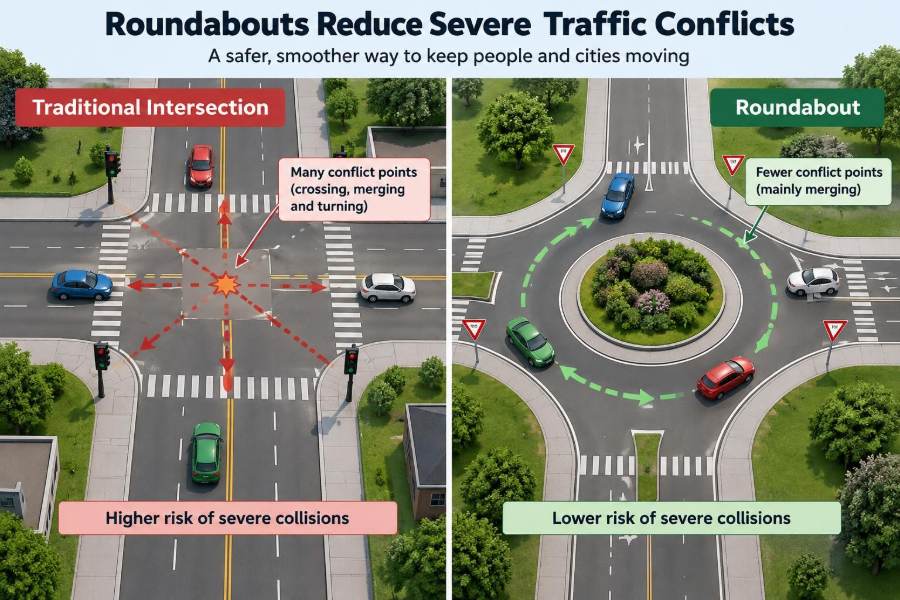
Every permitted movement through an intersection creates potential conflict points. Traditional four-leg intersections have many crossing, merging, and diverging interactions, especially where left turns are allowed.
Roundabouts largely replace crossing movements with merging and diverging movements. That shift matters because vehicles tend to meet at shallower angles, rather than at the near-perpendicular angles associated with severe side-impact crashes.
💥 Why Right-Angle Crashes Are So Harmful
In a right-angle collision, often called an angle or “T-bone” crash, the front of one vehicle strikes the side of another. Vehicle sides generally offer less crush space than the front and rear, even though modern side-impact protection has improved.
These crashes also often occur when one vehicle is traveling at a substantial approach speed. A roundabout’s geometry is intended to prevent drivers from carrying that speed directly through a perpendicular crossing path.
↩️ Left Turns Become Circulating Movements
A conventional left turn can require a driver to judge gaps in opposing through traffic, watch for pedestrians, and react to signal changes. Misjudging even one part of that sequence can produce a high-consequence conflict.
At a roundabout, a driver making what would have been a left turn enters, circulates around the central island, and exits at the desired leg. The movement takes longer in distance, but it avoids crossing the opposing stream head-on.
🐢 Speed Management Is Built into the Geometry
Signs alone ask drivers to reduce speed; geometry makes high speed physically uncomfortable or impractical. A properly designed roundabout uses deflection, meaning the entering vehicle must follow a curved path rather than a straight line.
Entry curvature, island placement, and lane arrangement influence the speed a driver can reasonably maintain. This is a central safety principle: reduce the speed before potential paths come close together.
📉 Lower Speeds Reduce Crash Energy
Kinetic energy increases with the square of speed. In practical terms, a relatively modest increase in speed can create a much larger increase in energy that vehicles, restraints, and human bodies must absorb during a crash.
Lower operating speeds do not eliminate injury risk. They can, however, make a collision more likely to be survivable and give drivers more time to perceive, decide, and react.
🧭 Deflection Prevents Straight-Line Running
Deflection is the intentional bending of a vehicle’s path at the entry. If the approach alignment and central island allow a driver to travel almost straight through, the roundabout may not achieve the low-speed behavior its safety concept depends on.
Designers evaluate the fastest practical path through the intersection, not merely the painted centerline. Drivers do not always track perfectly in the middle of a lane, particularly when the roadway is wide or lightly trafficked.
🚗 A Comparison of Common Conflict Types
| Movement interaction | Typical conventional-intersection risk | Roundabout effect |
|---|---|---|
| Perpendicular through movements | Can create high-speed right-angle crashes | Direct crossing is removed |
| Left turn across opposing traffic | Requires gap acceptance across a conflicting stream | Converted to entry, circulation, and exit |
| Rear-end approach conflict | Can occur near queues or changing signals | May still occur, but lower approach speeds can help |
| Merge and diverge movements | Present in channelized junctions | Remain, generally at lower speeds and shallower angles |
The table describes tendencies, not guarantees. Actual safety depends on local geometry, traffic composition, visibility, maintenance, and driver behavior.
👁️ Sight Distance Must Support the Yield Decision
Drivers approaching a roundabout need enough visibility to recognize the intersection, understand its layout, see pedestrians where relevant, and observe circulating vehicles in time to yield. Landscaping, signs, walls, and parked vehicles can affect those sight lines.
More visibility is not always better if it encourages excessive speed. The goal is appropriate sight distance: enough information for safe decisions without creating a visual corridor that invites fast, straight-through driving.
🪧 Early Recognition and Clear Signing
A driver who realizes too late that a roundabout is ahead may brake abruptly or choose the wrong lane. Advance warning signs, pavement markings, lane-use signs, lighting, and conspicuous splitter islands help make the intersection recognizable.
This need is especially important where a new roundabout replaces a familiar signalized junction. During the transition period, agencies may use additional temporary signs and public communication while drivers adapt.
🧱 The Central Island Has a Functional Role
The central island separates opposing movements and provides the object around which traffic circulates. Its size and shape influence entry deflection, circulating speed, and the ability of larger vehicles to navigate the junction.
For compact roundabouts, the island may include a traversable truck apron: a raised, textured area that long vehicles can use with their rear wheels when necessary. Passenger cars should generally remain on the normal circulating lane.
🚚 Designing for Trucks Without Designing for Truck Speeds
Freight vehicles, buses, emergency vehicles, and agricultural equipment need adequate turning space. A common design challenge is accommodating their swept paths without making the entire roundabout so broad and flat that ordinary vehicles travel too quickly.
Truck aprons, carefully shaped entries, and checking vehicle paths through design software or templates can help resolve this tension. Oversizing a roundabout simply for occasional large vehicles can undermine its speed-control purpose.
🚶 Pedestrian Crossings Need Deliberate Placement
Roundabout pedestrian crossings are commonly set back from the circulating roadway rather than placed directly at the edge of the circle. This gives drivers a clearer sequence: yield at the entry, then address the crossing location.
Splitter islands can allow pedestrians to cross one direction of traffic at a time. That refuge can simplify the task, although it does not remove the need for accessible curb ramps, detectable warnings, clear markings, and attention to vehicle yielding behavior.
♿ Accessibility Requires More Than a Curb Ramp
People who are blind or have low vision may receive useful information from the predictable geometry of a crossing, but they can also find quiet, continuously moving roundabout traffic difficult to interpret. The absence of a conventional signal phase can remove a familiar cue.
Accessible design must be evaluated for the specific site. Depending on the context, designers may consider crossing geometry, audible traffic cues, pedestrian signals or beacons, detectable features, and the needs of people using wheelchairs, walkers, or mobility devices.
🚲 Bicycle Safety Depends on Speed and Choice
Confident cyclists may circulate with motor traffic at smaller, lower-speed roundabouts. At larger or multilane roundabouts, mixing with fast or complex vehicle movements may be uncomfortable or unsuitable for many riders.
A well-considered design can provide a clear choice: ride in the circulating lane where appropriate or transition to a shared-use path or sidewalk system and cross as a pedestrian. Ambiguous transitions are a frequent source of confusion.
🛣️ Single-Lane Roundabouts Are Simpler to Read
Single-lane roundabouts usually have fewer lane-choice decisions, fewer vehicle-to-vehicle interactions, and easier pedestrian crossing conditions than multilane forms. They are often the preferred option when projected traffic demand and available land allow them.
Simplicity has real operational value. A design that works on paper but is difficult for unfamiliar drivers to interpret can create hesitation, improper lane use, or last-second maneuvers.
🧩 Multilane Roundabouts Need Extra Care
Multilane roundabouts can carry more traffic, but they introduce lane discipline challenges. Drivers must select the correct lane before entering, remain in that lane while circulating, and exit without cutting across another vehicle’s path.
Clear lane-use signs, consistent pavement arrows, appropriate spiral markings, and understandable exit geometry are essential. Where conditions permit, adding capacity through a second lane should be weighed against the added complexity for drivers, pedestrians, and cyclists.
📈 Capacity Is Not the Same as Safety
A roundabout may reduce delay at some locations because vehicles can enter whenever acceptable gaps appear rather than waiting for a full signal cycle. At other locations, heavy unbalanced traffic flows or closely spaced intersections may make operations more difficult.
Good engineering evaluates both safety and capacity. A junction that moves the greatest number of vehicles per hour is not automatically the best solution if it creates unacceptable speeds, long pedestrian delays, or confusing movements.
🚑 Emergency Response Requires Site-Specific Planning
Emergency vehicles can navigate roundabouts, and a mountable truck apron may assist larger apparatus. Yet the design must account for the local fire fleet, ambulance routes, snow storage practices, curbs, signs, and nearby congestion.
Consulting emergency responders during design is practical risk management. Their route knowledge can reveal issues that traffic counts alone may miss, such as a turning constraint at a neighboring driveway or recurring queue near a station.
🌧️ Drainage, Lighting, and Winter Operations Matter
Roundabout safety is not determined by plan-view geometry alone. Poor drainage can create ponding at crosswalks or on the circulating roadway, while inadequate lighting can hide splitter islands, pedestrians, and lane markings after dark.
In snowy climates, plow routes, snow-storage areas, curb visibility, and durable delineators deserve early attention. Maintenance staff need space and procedures that preserve the intended geometry instead of obscuring it with piled snow or damaged signs.
🏗️ Construction Staging Can Create Temporary Risk
Converting an existing intersection to a roundabout often requires temporary traffic patterns. Drivers may encounter shifted lanes, unfamiliar detours, altered pedestrian routes, and changing signs over several construction phases.
Temporary traffic control should make each stage legible, particularly at night and in bad weather. The construction-period layout may be less forgiving than the finished design, so clear channelization and speed management are essential.
⚠️ Common Design Mistakes That Undercut Safety
A roundabout can perform poorly when its details conflict with its purpose. Problems often arise not from the circular concept itself, but from insufficient attention to approach speed, visibility, user needs, or maintenance.
- Entries that are too open, allowing drivers to enter too fast.
- Approach signs or lane markings that appear too late for a safe decision.
- Crosswalks placed where drivers must process too many tasks at once.
- Landscaping that blocks critical sight lines or hides pedestrians.
- Oversized geometry that encourages passenger vehicles to take a high-speed path.
- Multilane layouts without intuitive lane assignment and exit guidance.
🔍 Crash Analysis Must Look Beyond Totals
Before recommending a roundabout, engineers review crash types, severity, time of day, weather, approach speeds, traffic volumes, pedestrian activity, and the relationship to nearby driveways or signals. A raw crash count does not explain the underlying problem.
For example, repeated angle crashes involving left turns suggest a different problem from repeated rear-end crashes in a long signal queue. The most suitable treatment should address the dominant risk mechanism rather than follow a one-size-fits-all preference.
📐 Context Determines Whether a Roundabout Fits
Roundabouts can be useful at rural highway junctions, suburban arterials, neighborhood gateways, and urban intersections, but each setting creates different constraints. Available right-of-way, grades, utilities, freight demand, pedestrian volumes, and adjacent land uses all matter.
A roundabout may be a poor fit where space is highly constrained, where a railroad crossing immediately affects queues, where coordinated signals are necessary along a corridor, or where unusual traffic patterns cannot be managed safely. Alternatives may include signal modifications, turn restrictions, raised intersections, or access changes.
🏘️ Community Concerns Are Part of Good Design
Residents may worry about property impacts, noise, navigation, emergency access, or whether older and inexperienced drivers will feel comfortable. Dismissing those concerns makes it harder to identify real design needs.
Concept drawings, turning-path demonstrations, accessible public engagement, and explanations of expected traffic patterns can improve decisions. Community input is particularly valuable for identifying walking routes, school crossings, delivery activity, and seasonal conditions that standard data collection may overlook.
🧠 Driver Behavior Still Matters
Roundabouts simplify some choices, but they do not remove responsibility. Drivers must reduce speed, select the correct lane, yield at entry, remain attentive to pedestrians, and signal when exiting where required or customary.
A driver who enters without yielding, stops unnecessarily within the circulating lane, or exits from the wrong lane can still create a conflict. Design influences behavior, but safe operation remains a shared task among all road users.
🔧 Monitoring After Opening Closes the Design Loop
The first months after opening offer valuable information. Agencies can observe speeds, yielding behavior, lane use, pedestrian comfort, queue patterns, pavement-marking wear, and any recurring confusion at particular approaches.
Small corrections can matter: trimming vegetation, improving a sign location, refreshing arrows, adjusting lighting, or clarifying a pedestrian route. Post-opening review treats the project as an operating system rather than a finished drawing set.
🎯 The Core Principle: Change the Conflict, Not Just the Sign
The strongest safety advantage of a roundabout is structural. It changes the interaction from high-speed crossing and opposing-turn conflicts toward lower-speed merging, diverging, and circulating movements.
That advantage depends on careful execution. Appropriate speed control, understandable lanes, accessible crossings, adequate lighting, accommodation of large vehicles, and ongoing maintenance all support the underlying safety mechanism.
Roundabouts can reduce severe traffic conflicts because they combine fewer direct crossing paths with lower speeds at the places where road users interact most closely.
They are not a universal substitute for every intersection type, but they show a fundamental civil engineering lesson: safer outcomes often come from reshaping the system so that ordinary mistakes are less likely to become catastrophic. 🌉🚗🚶