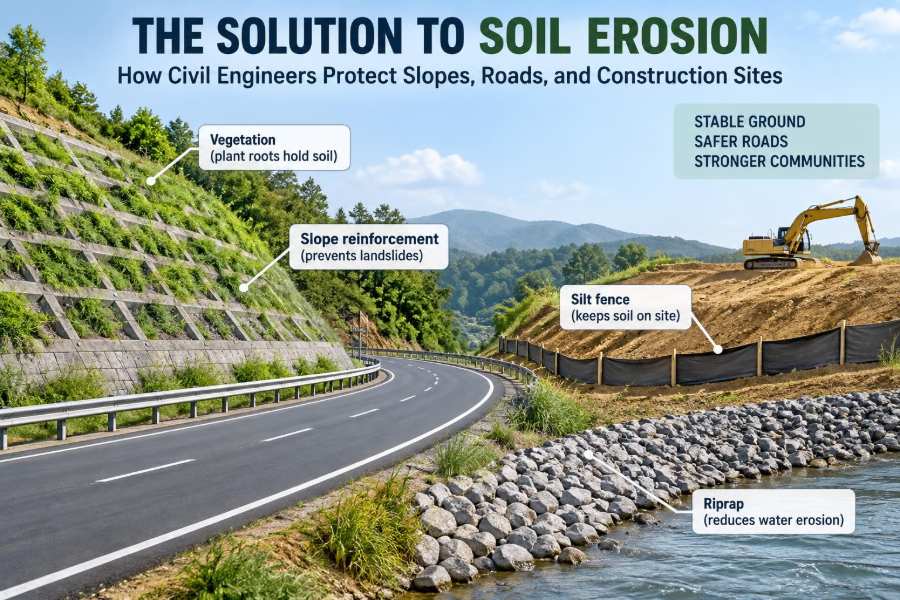

A newly cut roadside slope can look stable on the day construction ends. Then a heavy storm arrives, water finds a shallow groove, and that groove becomes a channel carrying soil toward the ditch, pavement, or nearby stream.
The same process happens on house sites, embankments, excavation edges, agricultural access roads, and large infrastructure projects. Erosion is often quiet at first, but its consequences can be expensive: blocked drains, damaged pavement, sediment-polluted water, exposed foundations, and unstable slopes.
Civil engineers do not treat soil erosion as a landscaping detail. They study how water, soil, slope shape, drainage, vegetation, and construction activity interact—then design systems that keep the ground where it belongs.
The best erosion-control solution is rarely one product or one wall. It is a coordinated approach that slows water, protects soil, safely collects runoff, and maintains the site as conditions change.
🌧️ What Soil Erosion Actually Means
Soil erosion is the detachment and transport of soil particles by water, wind, gravity, or construction activity. In civil engineering, water-driven erosion is usually the dominant concern because rainfall and runoff can act quickly on exposed ground.
Not every movement of soil is a failure. Natural erosion shapes landscapes over long periods. The engineering problem begins when soil loss threatens a structure, drainage system, property boundary, waterway, or public safety.
Erosion has two stages: particles must first be loosened, then moving water or wind must have enough energy to carry them away. Effective controls address both stages.
💧 Why Flowing Water Is So Powerful
Rainfall hits bare soil with enough force to break apart weak aggregates. This is called splash erosion. Once water begins flowing downhill, it combines into increasingly concentrated paths and gains the ability to scour the surface.
Water moving slowly across a broad, rough surface may cause little damage. The same volume forced into a narrow channel can cut deeply because velocity and shear stress increase. Shear stress is the dragging force exerted by moving water on the soil surface.
This explains a central design principle: do not allow uncontrolled water to concentrate on erodible ground.
🏔️ How Slope Geometry Changes the Risk
Steeper slopes give runoff a stronger downhill component of gravity. Long slopes are also risky because water can accumulate volume and speed as it travels.
A slope that appears acceptable when dry may erode during a storm if it is too long, too steep, or poorly drained. Engineers often divide a large slope into shorter drainage areas using benches, berms, interceptor drains, or terracing where appropriate.
Slope geometry is also tied to stability. Erosion can remove support from the toe—the lower part of a slope—and water infiltration can weaken the soil within it.
🧱 Soil Type Determines How It Responds
Soils do not erode in the same way. Loose sandy soils can detach readily, while silts may be highly erodible because their particles are fine and weakly bonded. Clay-rich soils can resist detachment when intact but may soften, crack, or disperse under changing moisture conditions.
Gravelly material is often more resistant at the surface, although fine particles between larger stones can still wash away. Organic topsoil supports vegetation, but it should not be assumed to provide immediate protection on a freshly graded slope.
Site investigation helps engineers identify soil behavior before choosing measures. A detail suited to coarse fill may be unsuitable for fine, erosion-prone silt.
🚜 Why Construction Sites Are Especially Vulnerable
Construction removes the natural cover that once absorbed rainfall and held soil together. Clearing vegetation, stripping topsoil, grading land, stockpiling material, and moving heavy equipment all expose or disturb the surface.
Compacted haul routes create another issue: they reduce infiltration, so more rain becomes runoff. Temporary excavations and unfinished drainage systems may direct that runoff toward unprotected areas.
Because a site changes week by week, erosion and sediment control must be treated as an active construction task rather than a drawing filed at project kickoff.
🌱 Vegetation Is a Living Protective Layer
Grass, shrubs, and trees protect soil in several ways. Leaves and stems intercept raindrops, roots reinforce the near-surface zone, and plant cover slows runoff enough for more water to infiltrate.
Vegetation takes time to establish, however. Seeded ground can remain vulnerable until germination and root development create reliable cover. Dry weather, poor soil preparation, steep grades, and washout can delay that process.
Engineers commonly pair seeding with temporary protection such as mulch, erosion-control blankets, or bonded fiber products. Vegetation is powerful, but it is not an instant fix.
🧭 Start With a Drainage Plan, Not a Product
A common mistake is selecting a familiar erosion-control material before understanding where water comes from and where it will go. A blanket, silt fence, or rock lining cannot compensate for a drainage path that sends too much runoff to the wrong location.
Design begins by mapping catchments, high points, low points, existing channels, proposed grades, discharge locations, and nearby sensitive areas. Engineers then estimate likely runoff using methods appropriate to the project and local requirements.
The objective is simple: separate clean upslope water from disturbed ground where possible, then convey collected water through a stable route.
🛑 Intercept Clean Water Before It Reaches the Work Area
Runoff from undisturbed ground often carries less sediment than runoff from bare construction soil. Diversion ditches, swales, berms, or lined channels can intercept that cleaner water at the top of a slope and route it around the disturbed zone.
This reduces the volume crossing exposed soil. It also makes downstream controls smaller and more manageable.
Diversions must have a stable outlet. Sending intercepted water over an unprotected slope merely transfers the erosion problem to another location.
🪨 Armoring Slopes With Rock Protection
Rock armor, commonly called riprap, protects soil where flow velocity, wave action, or concentrated discharge would overwhelm vegetation. The individual stones absorb energy and shield the underlying soil from direct scour.
A proper rock system includes more than visible stones. It may require a graded filter layer or geotextile separator beneath the armor so fine soil does not wash through gaps and undermine the protection.
Rock must be sized for the hydraulic conditions and placed with suitable thickness and edge treatment. Small decorative stone can be displaced quickly in a high-energy drainage path.
🧵 Geotextiles Keep Materials Working Together
Geotextiles are permeable synthetic fabrics used to separate, filter, reinforce, or protect materials. Under riprap, a correctly selected geotextile can prevent subsoil from migrating upward while allowing water to pass through.
Selection depends on soil particle size, expected flow, puncture resistance, installation conditions, and long-term exposure. A fabric that clogs, tears, or lacks adequate overlap can create hidden failure points.
Geotextiles are useful components, not universal solutions. They do not stabilize a poorly designed outlet or replace a drainage system.
🧺 Erosion-Control Blankets Protect New Seed
Blankets and mats are placed over seeded soil to reduce raindrop impact and hold seed, mulch, and soil in place. Many are made from biodegradable fibers; others are designed for longer service in demanding locations.
They are especially useful on moderate slopes and channel side slopes where vegetation is expected to become the long-term protection. Installation matters: the blanket must be anchored at the top, keyed into the soil where required, and laid without loose areas that can catch flowing water.
In a channel with sustained or fast flow, product selection must match the anticipated hydraulic loading. A light blanket intended for slope protection should not be assumed suitable for a drainage channel.
🌾 Mulch and Soil Cover for Broad Exposed Areas
Mulch protects large areas by cushioning rain impact, conserving moisture, and reducing surface crusting. Straw, wood fiber, compost-based products, and hydraulically applied mulch can all be used, depending on the slope, climate, seed mix, and construction sequence.
Loose mulch may blow away or wash off if it is not anchored. Hydromulch can provide more uniform coverage, but its effectiveness still depends on surface preparation and rainfall intensity.
The practical value of mulch is often greatest during the vulnerable gap between final grading and vegetation establishment.
🌊 Channels Need Special Attention
A drainage channel is designed to carry water, which makes it fundamentally different from a broad slope. Its base and side slopes must resist the expected velocity, depth, duration, and frequency of flow.
Vegetated channels work well where flows are relatively mild and maintenance is realistic. Rock-lined channels, concrete linings, articulated blocks, and reinforced turf systems may be considered where conditions are more severe.
Sharp bends, abrupt transitions, and outlets are common scour locations because flow becomes turbulent or changes direction. These points deserve careful detailing.
🔽 Check Dams Slow Water in Temporary Ditches
Check dams are small barriers placed across a temporary or low-flow channel to reduce velocity and encourage sediment to settle. They may be made from rock or other approved materials suited to the site.
They are not dams for storing large volumes of water. Their purpose is to create a series of short, slower-flowing reaches while allowing runoff to pass safely.
Poorly spaced check dams, eroded edges, or a low center that directs flow around the structure can make them ineffective. Inspection after storms is essential.
🕳️ Inlet Protection Prevents Clogged Drains
Storm-drain inlets are natural collection points for sediment-laden runoff. If sediment enters the drainage network, it can reduce pipe capacity, block structures, and later discharge pollution downstream.
Inlet protection may use gravel, fabric-supported barriers, curb-side measures, or manufactured devices. The right approach must still allow water to enter safely; a fully blocked inlet can cause flooding around roads or buildings.
Maintenance is the deciding factor. Sediment must be removed before it overwhelms or bypasses the protection.
🏞️ Sediment Basins Treat Runoff Before Discharge
A sediment basin temporarily holds runoff so suspended particles have time to settle. It is generally used where a construction area is large enough, and site conditions permit a basin with safe access for cleanout.
Basins reduce sediment leaving a site, but they do not eliminate the need for upstream erosion control. Fine particles may settle slowly, and high flows can disturb stored sediment or pass through too quickly.
Stable embankments, spillways, emergency overflow provisions, dewatering arrangements, and regular sediment removal are all part of responsible basin design.
🧱 Retaining Walls Are Not Automatically Erosion Control
A retaining wall holds back soil; it does not automatically solve water management. Water pressure behind a wall can increase loads and lead to distress if drainage is absent or clogged.
Wall systems commonly need drainage aggregate, filter material, weep outlets, or collector drains as appropriate to the design. Surface runoff also needs to be directed away from the wall crest rather than allowed to enter the backfill.
Where erosion threatens the base of a wall, toe protection and outlet control may be needed. Structural design and erosion design must work together.
🧱 Toe Protection Prevents Undercutting
The toe is often the most vulnerable part of a slope because it may receive runoff, stream flow, roadside ditch flow, or wave action. If material is removed there, the upper slope can steepen and lose support.
Toe protection can include buried rock, a keyed-in apron, a stable ditch lining, or a properly designed retaining solution. The protection should extend below the expected scour level where scour is a credible concern.
A surface layer ending exactly at grade can unravel as water attacks its lower edge. Good details account for what happens below the visible surface.
🚧 Temporary Controls and Permanent Works Have Different Jobs
Temporary measures manage risk while earthwork, utilities, and paving are incomplete. They may include diversion berms, stabilized entrances, temporary seeding, silt fences, check dams, and sediment traps.
Permanent measures must perform through the completed facility’s service life. These include final drainage systems, established vegetation, engineered channels, culverts, retaining structures, and durable slope protection.
Confusing the two creates problems. A temporary silt fence cannot serve as a permanent channel lining, and permanent drainage should not be postponed until erosion has already begun.
🧹 Stabilized Construction Entrances Reduce Track-Out
Vehicles leaving muddy work areas can deposit soil on public roads. That material can clog curb inlets, create slippery conditions, and be washed into waterways during rainfall.
A stabilized entrance usually provides a firm, rough surface that removes some soil from tires before vehicles reach the road. It works only if it is long enough for site traffic, maintained when clogged, and supported by wheel washing where conditions require it.
Street sweeping addresses material already on the road, but it does not replace controlling the source at the exit.
🧺 What Silt Fences Can and Cannot Do
Silt fences are permeable barriers installed along contours to intercept shallow sheet flow and retain sediment. They are often misunderstood as barriers capable of stopping large volumes of fast-moving water.
They are not designed for concentrated channel flow, deep ponding, or runoff from large uncontrolled catchments. Water can undercut, overtop, or flow around a poorly installed fence.
For reliable performance, the fabric must be trenched or keyed into the ground, posts must be adequately supported, and accumulated sediment must be removed before it reaches the intended storage level.
📐 Match the Measure to the Hazard
Different erosion problems need different combinations of controls. The comparison below is a starting point for thinking, not a substitute for project-specific hydraulic, geotechnical, and regulatory design.
| Site condition | Primary concern | Typical response |
|---|---|---|
| Broad freshly graded slope | Rain splash and sheet erosion | Mulch, seeding, blankets, slope breaks |
| Steep or long slope | Runoff acceleration | Diversions, benches, reinforced cover, stable outlets |
| Concentrated discharge point | Scour at outlet | Energy dissipation and rock or engineered lining |
| Temporary construction runoff | Sediment leaving site | Source controls plus traps, basins, and inlet protection |
| Streambank or roadside ditch toe | Undercutting | Toe key, rock armor, and drainage management |
⚙️ Energy Dissipation Makes Outlets Safer
Water exiting a pipe, culvert, or steep channel may have enough velocity to excavate a hole at the outlet. That hole can migrate backward, damage the pipe end, or destabilize nearby ground.
Energy dissipators reduce this erosive energy by spreading, slowing, or redirecting the flow. Rock aprons, plunge pools, baffle structures, and specially shaped outlet protection are examples.
The downstream channel must also be stable. A well-protected outlet that discharges into an unprotected ditch simply moves the damage farther downstream.
🔍 Inspection Finds Problems While They Are Small
Erosion controls are exposed to weather, traffic, settlement, and changing site grades. Inspection should be routine and intensified after significant rainfall or other events specified by the project plan.
Warning signs include muddy discharge, rills—small erosion grooves—around barriers, exposed fabric, displaced rock, standing water behind controls, sediment-filled basins, and water flowing outside a designed channel.
- Repair undermined or overtopped barriers promptly.
- Remove sediment before storage areas lose capacity.
- Regrade rills before they develop into gullies.
- Replace damaged vegetation or blankets before bare patches expand.
🧰 Maintenance Is Part of the Design
A system that cannot be accessed, cleaned, or repaired is not a practical system. Basin cleanout requires equipment access; inlet devices need a maintenance route; vegetation needs establishment care; and rock protection may need inspection after major flow events.
Designers should make maintenance responsibilities clear in project documents. Owners and contractors need to know what must be inspected, what conditions trigger action, and where sediment can be handled appropriately.
Neglected controls often fail gradually, not dramatically. That is why maintenance planning matters as much as initial installation.
⚠️ Common Mistakes That Lead to Erosion Failure
Many failures come from understandable but avoidable shortcuts. The pattern is usually a mismatch between the water behavior on site and the measure installed.
- Installing controls after grading rather than before disturbance begins.
- Allowing runoff to cross a slope without a defined route.
- Using undersized stone at pipe outlets or ditch bends.
- Relying on seed alone during a season when establishment is uncertain.
- Placing silt fence across concentrated flow paths.
- Ignoring upslope drainage while repairing only the visible gully.
- Failing to inspect controls after weather changes or grading revisions.
🗺️ Sequence Construction to Limit Exposed Soil
Phasing is one of the most effective erosion-control tools because it reduces the area left bare at any one time. Instead of clearing an entire project site, a contractor can stabilize completed portions before opening the next work area.
A typical sequence is to install perimeter and drainage controls, clear only necessary areas, rough-grade, install temporary stabilization, complete utilities and final grading, then establish permanent drainage and cover.
Actual sequencing depends on the project, weather, permits, and safety needs. The guiding idea is to minimize both exposed soil and the time it remains exposed.
🏙️ Roads Create Their Own Erosion Patterns
Road construction changes drainage by adding compacted surfaces, ditches, culverts, cuts, fills, curbs, and pavement. Water that once spread across a landscape may become concentrated at a culvert outlet or low point.
Roadside slopes need attention at cut faces, fill embankments, ditch transitions, culvert inlets, and outlets. A small blockage in a ditch can redirect water onto the pavement edge or down a fill slope.
For this reason, erosion control around roads is closely connected to drainage maintenance and safe roadway operations.
🏗️ Protecting Foundations and Building Pads
Water erosion near buildings can expose shallow services, wash soil from beneath slabs, or direct water toward foundations. The risk is often created by unfinished grading: downspouts, temporary roof drainage, and paved areas can concentrate water before final landscaping is complete.
Finished site grading should direct surface water away from structures and into an intended drainage system. During construction, temporary extensions or protected discharge routes may be needed to avoid releasing roof runoff beside a foundation.
Any settlement, cracking, or unexpected water accumulation near a structure deserves timely professional assessment rather than cosmetic repair alone.
🌍 Erosion Control Also Protects Water Quality
Soil leaving a site does not disappear. It often enters storm drains, ditches, streams, wetlands, or reservoirs. Suspended sediment can cloud water, bury habitat, transport attached pollutants, and reduce storage capacity in drainage facilities.
That is why erosion control focuses first on preventing soil detachment. Sediment traps and basins are valuable backup measures, but they are less efficient than keeping soil covered and water controlled at its source.
This source-to-receiver perspective helps engineers design beyond the property line.
🧑💼 Roles Across the Project Team
Successful erosion management requires coordination. Civil engineers establish grades, drainage routes, and control concepts. Geotechnical engineers advise on soil and slope behavior. Environmental professionals may address permit conditions and sensitive receiving waters.
Contractors translate plans into temporary works and daily site practices. Inspectors identify defects, while owners must support long-term maintenance after handover.
Clear communication matters because a small field change—such as relocating a stockpile or raising a temporary access road—can alter drainage enough to defeat the original plan.
📋 When Site-Specific Expertise Is Essential
General practices are not enough for every slope. Professional design is particularly important where there are steep or high embankments, landslide history, streams, coastal exposure, large culverts, retaining walls, weak soils, or consequences to neighboring property and public infrastructure.
Local rules may also require erosion and sediment control plans, inspections, permits, or approvals. Requirements vary by jurisdiction and project type, so they must be checked early rather than assumed.
Field conditions can differ from plans. If erosion begins unexpectedly, the response may need revised drainage, geotechnical input, or hydraulic evaluation—not simply more of the same material.
🧠 The Core Principle: Control Water, Protect Soil, Maintain the System
Reliable erosion control follows a connected chain of decisions. First, reduce exposed soil and preserve vegetation where feasible. Next, keep clean water away from disturbed areas and prevent runoff from concentrating unpredictably.
Then protect unavoidable flow paths with measures appropriate to the soil and hydraulic forces, capture sediment that remains, and inspect the system until permanent stabilization is established.
The most durable solution is not a single barrier: it is a site-wide drainage and stabilization strategy that matches real water behavior.
When engineers respect the path water wants to take, protect vulnerable soil before storms arrive, and keep controls maintained, slopes, roads, and construction sites can remain stable long after the equipment has left. 🌧️🌱🏗️