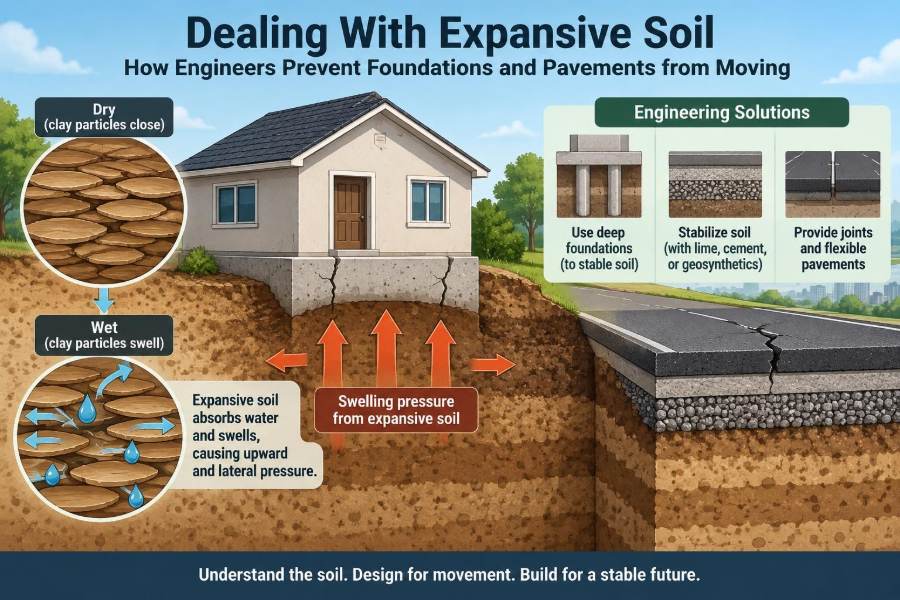

A house develops a diagonal crack near a window. A driveway that was flat a few years ago now has a raised ridge. A lightly used road shows recurring bumps after every wet season. These problems can look unrelated, but they may share a cause beneath the surface: expansive soil.
Unlike rock or clean sand, certain clay-rich soils change volume as their moisture changes. They can swell when wet and shrink when dry, slowly lifting, distorting, or removing support from structures built above them.
The challenge is not simply that the ground moves. It is that it often moves unevenly. A foundation or pavement can tolerate some uniform movement much better than one corner rising while another settles.
Engineers deal with expansive soil by understanding its behavior before construction, controlling water where practical, and choosing a foundation or pavement system that can resist, bridge, or accommodate movement. The best solution depends on the soil, climate, structure, site drainage, and long-term maintenance.
🌍 What Makes Soil Expansive?
Expansive soil is soil that undergoes significant volume change as its water content changes. It is usually associated with fine-grained clay, although not every clay soil is expansive and not every site with clay will create serious construction problems.
Its practical significance comes from the interaction of three conditions: a soil capable of swelling, a source of changing moisture, and a structure sensitive to differential movement. Remove or manage one of those conditions, and the risk may be reduced.
🧪 The Clay Minerals Behind Swell
Clay particles are extremely small, plate-like minerals. Some mineral groups have internal structures that attract water molecules between their layers or around their charged surfaces.
Smectite-rich clays, which include montmorillonite, are commonly associated with high swelling potential. Illite and kaolinite generally tend to be less expansive, but mineral type alone does not determine field performance. Density, soil fabric, stress history, chemistry, and the pattern of wetting all matter.
💧 Why Water Changes the Ground Volume
When water enters susceptible clay, the soil particles separate slightly and the soil mass expands. When water is removed, the particles move closer together and the soil shrinks. This is not the same as water freezing; it is a physicochemical response occurring within the clay fabric.
Think of a dry sponge placed in water, but with an important difference: soil wetting is rarely uniform. Moisture may arrive near a downspout, tree root zone, leaking pipe, or pavement edge while nearby soil remains comparatively dry.
📏 Swell Is Only Half of the Problem
Engineers often focus on heave, the upward movement caused by swelling. Yet shrinkage can be equally damaging. During extended drying, soil beneath part of a building may contract and lose contact with a shallow foundation, allowing that area to settle.
A site can also experience seasonal cycles of swelling and shrinkage. Repeated movement may widen cracks, misalign doors, fatigue utility connections, and create pavement roughness even where any single movement episode appears modest.
↔️ Differential Movement Causes Most Damage
Uniform upward movement is inconvenient but may produce limited distress in a stiff, continuous structure. Differential movement creates curvature, bending, and distortion because adjacent points move by different amounts.
For example, a hypothetical slab might rise near a frequently irrigated garden bed while the interior remains drier. The resulting dish- or dome-shaped distortion can crack brittle finishes, bind doors, and place stress on walls and plumbing.
🧱 Foundations Feel Soil Movement Differently
A lightweight masonry wall, a flexible timber frame, a reinforced concrete slab, and a multi-story steel structure do not respond in the same way. Structural stiffness, load distribution, joint details, and tolerance for movement all influence the selected foundation system.
More weight does not automatically solve an expansive-soil problem. A heavier building may apply greater pressure that restrains some swell, but it also requires reliable support and can suffer substantial damage if support changes unevenly.
🛣️ Why Pavements Develop Heaves and Cracks
Road and airfield pavements spread wheel loads through layers of asphalt, concrete, aggregate base, and subgrade. The subgrade is the prepared natural soil or fill beneath those layers. If it swells locally, it can push the pavement upward and create a bump or crack.
Water often enters through pavement joints, cracks, shoulders, drainage ditches, and utility trenches. Once movement begins, cracking can admit more water, creating a cycle in which drainage and maintenance become as important as the original pavement thickness.
🔎 Start With a Geotechnical Investigation
Expansive-soil design should begin before the foundation layout or pavement profile is finalized. A geotechnical investigation uses borings, test pits, sampling, groundwater observations, site history, and laboratory tests to develop a model of the subsurface.
The investigation does not predict every future crack with certainty. Its purpose is to identify relevant soil layers, their likely moisture sensitivity, the depth affected by seasonal change, and the design issues that must be addressed.
🧭 Site Reconnaissance Reveals Useful Clues
A field visit can reveal signs that guide later testing: deep desiccation cracks, sticky clay exposed in cuts, uneven older pavements, tilting fences, ponded water, mature vegetation, or nearby buildings with repair histories.
These observations are clues, not proof. A cracked building can have many causes, including settlement, poor detailing, corrosion, thermal movement, or structural overload. Engineers confirm hypotheses through measured site and laboratory information.
🧫 Laboratory Tests Characterize the Soil
Common index tests describe grain-size distribution, plasticity, water content, and density. The Atterberg limits are especially useful for fine-grained soils: the liquid limit and plastic limit help indicate the range of moisture states in which a soil behaves plastically.
More specialized swell and shrink tests can estimate how a prepared specimen responds under a specified load and wetting condition. Results must be interpreted carefully because a small laboratory sample cannot perfectly duplicate the variable moisture paths and stresses present in the field.
📊 Key Terms Engineers Use
| Term | Meaning in practice |
|---|---|
| Plasticity index | A measure derived from Atterberg limits that helps describe a fine soil’s plastic range; higher values can indicate greater concern but are not a standalone design answer. |
| Swell potential | The tendency of soil to increase in volume when wetted under stated conditions. |
| Swell pressure | The pressure that may be needed to prevent a confined specimen from expanding during a test. |
| Active zone | The near-surface depth range where seasonal or long-term moisture changes can produce meaningful volume change. |
| Heave | Upward ground or structural movement, often linked to wetting of expansive soil. |
These terms support engineering judgment; they are not interchangeable. A design should consider the actual soil profile and moisture regime rather than relying on a single classification label.
🌦️ The Active Zone Changes With Climate and Cover
The active zone is not a universal fixed depth. It depends on rainfall, evaporation, temperature, vegetation, soil permeability, groundwater conditions, drainage, and how long the site has been exposed to changing moisture.
A new building changes the moisture environment by adding roof runoff, shaded areas, landscaping, pavements, and utility services. The soil condition observed during an investigation is therefore a starting point, not necessarily the moisture condition the site will experience after occupancy.
🌳 Trees Can Dry Soil Unevenly
Tree and shrub roots remove water from soil, sometimes creating localized drying beneath or beside foundations. In expansive clay, this can lead to shrinkage and settlement, particularly where large vegetation is close to shallow footings.
Removing a mature tree can also change the problem. Soil that had been kept relatively dry by root uptake may gradually rewet and swell. Vegetation decisions should be coordinated with drainage and foundation design rather than treated as a simple landscaping issue.
🚰 Leaks and Runoff Create Local Wet Zones
A leaking water line, failed irrigation component, overflowing gutter, or poorly directed downspout can introduce water repeatedly at one location. On an expansive-soil site, a small but persistent source may be more consequential than a short, widespread rain event.
Roof drainage should carry water away in a controlled manner without discharging it against a foundation or saturating an unprotected pavement edge. Surface grading must also avoid low spots that retain water near structures.
🏠 Shallow Foundations Can Still Work
Shallow footings and slabs are often feasible when expansive behavior is limited, moisture can be managed, and the structure is detailed to tolerate expected movement. They are not automatically unsuitable simply because clay is present.
Options may include stiffened slabs, reinforced grade beams, wider footings, and carefully prepared subgrades. The selected system must match the expected movement pattern and structural load path; adding concrete without a design rationale can be expensive without solving the governing problem.
🏗️ Stiffened Raft and Mat Foundations Spread Movement
A raft or mat foundation is a reinforced concrete element supporting loads over a broad area. Stiffened versions use beams or ribs to increase bending resistance, helping the foundation bridge localized variations in support.
Such systems do not make the soil stop swelling. Instead, they aim to reduce damaging differential distortion in the supported structure. Their performance relies on reinforcement, geometry, construction quality, and assumptions about moisture and soil response.
🪜 Deep Foundations Reach More Stable Support
Piers, drilled shafts, piles, or similar deep elements can transfer structural loads below the most active near-surface soil zone to a more stable bearing layer. Grade beams may span between these supports.
Deep foundations introduce their own design questions. Expanding soil can exert uplift or side forces along a shaft, and construction must verify depth, material quality, and connection details. They are typically considered when shallow solutions cannot meet movement criteria or when a suitable deeper stratum is available.
🧰 Void Forms Allow Space for Heave
Void forms create a planned gap beneath portions of a structural element. If the soil heaves, it can expand into that space before contacting the element, reducing upward pressure during the intended service period.
Some void-form materials are designed to degrade after concrete placement, while others are permanent systems. Their use requires careful detailing: a void that becomes flooded, obstructed, or bridged by construction debris may not perform as intended.
⚙️ Overexcavation and Replacement Change the Subgrade
One strategy is to remove expansive soil within a practical depth and replace it with properly compacted, lower-expansivity engineered fill. This can reduce the magnitude of moisture-driven movement within the zone most directly supporting the structure.
The limitation is straightforward: deep expansive layers remain below. Replacement depth, transition details, borrow-material quality, and compaction control must be based on the project-specific geotechnical design, not a generic rule of thumb.
🧪 Chemical Stabilization Has Specific Uses
Lime is often used to modify suitable clay soils. It can reduce plasticity, improve workability, and, when properly designed and cured, develop cementitious reactions that improve strength. Cement or blended binders may be used in other conditions.
Stabilization is not a universal cure. Soil chemistry, sulfate content, organic material, mixing depth, curing, moisture control, and long-term exposure all affect suitability. In some sulfate-bearing soils, inappropriate lime treatment can contribute to harmful expansive reactions, so testing is essential.
🚧 Pavement Design Begins Below the Surface
A durable pavement system considers subgrade condition, drainage, traffic loading, climate, constructability, and maintenance strategy. Aggregate base layers can improve load distribution and drainage behavior, while geosynthetics may provide separation, reinforcement, filtration, or drainage depending on the product and design.
For highly expansive subgrades, engineers may use undercut-and-replace methods, stabilization, thicker structural sections, moisture barriers in appropriate details, or a combination. The objective is not merely a strong surface; it is a system that limits damaging deformation over time.
🧱 Flexible and Rigid Pavements Respond Differently
Asphalt pavement is flexible relative to concrete and can spread load through layered action, but it may reflect subgrade movement as rutting, cracking, or surface undulations. Concrete pavement has higher slab stiffness and can bridge small support variations, but localized heave can crack or fault slabs and joints.
Neither material is inherently immune to expansive soil. The appropriate choice depends on movement magnitude and pattern, traffic, drainage, jointing, maintenance capabilities, and life-cycle considerations.
💦 Drainage Is a Design System, Not an Afterthought
Drainage includes roof collection, surface grading, swales, gutters, inlets, pipes, outlet protection, subsurface systems where needed, and maintenance access. Each component should move water predictably without creating erosion, ponding, or discharge problems elsewhere.
On expansive soil, the goal is generally moisture consistency, not simply making the site as dry as possible. Aggressively drying one area while another remains wet can worsen differential movement.
🧱 Moisture Barriers Need Careful Expectations
Membranes and barriers may limit direct vapor or water movement in specific assemblies, but they rarely isolate a large foundation footprint from all long-term moisture changes. Water can move laterally through soil, enter at edges, or arrive from leaks and landscaping.
A barrier should therefore be treated as one component of a coordinated system. Its placement, continuity, puncture resistance, drainage relationship, and compatibility with the foundation detail all affect its usefulness.
📐 Joints and Details Help Structures Accommodate Movement
Movement joints, flexible utility connections, slip details, crack-control reinforcement, and separations between elements can reduce unintended stress transfer. For instance, a patio, porch, or sidewalk may be detailed to move independently from the main building rather than pushing on it.
Good detailing recognizes that not every movement can be prevented economically. Sometimes the soundest approach is to protect critical structural elements while allowing nonstructural components to move or be repaired more easily.
👷 Construction Quality Can Make or Break the Design
Even an appropriate design can underperform if subgrade preparation, moisture conditioning, compaction, reinforcement placement, drainage slopes, or curing are poorly executed. Field observation and testing provide feedback that the constructed work matches the design intent.
Common concerns include uncontrolled fill placement, soft pockets left beneath slabs, damaged membranes, blocked drains, and changes made in the field without geotechnical or structural review. Soil-related work is especially sensitive to small inconsistencies spread across a large area.
📝 Document Existing Conditions Before Work Begins
For additions, repairs, or work near existing buildings, a condition survey can distinguish old damage from later movement. Photographs, crack maps, floor-elevation readings, drainage observations, and utility records create a useful baseline.
Where movement is ongoing or its cause is uncertain, monitoring over time may be more informative than immediate major repair. Engineers may use repeated elevation measurements, crack gauges, moisture observations, or other project-appropriate methods to understand whether change is seasonal, progressive, or stable.
🔧 Repair the Moisture Cause Before Repairing the Crack
Cosmetic patching can improve appearance but will not stop a crack from reopening if the underlying moisture imbalance continues. Investigation should first consider drainage, plumbing leaks, irrigation patterns, vegetation changes, and alterations that may have redirected water.
Structural repair may involve localized foundation support, slab lifting, crack repair, drainage correction, or a combination. The appropriate approach depends on the structure and evidence of the movement mechanism; a repair method that works for settlement may not suit heave.
⚠️ Common Approaches That Often Fall Short
- Using a single soil index as the entire design: classification values are useful screening tools, not complete site models.
- Adding thickness without addressing water: a thicker slab or pavement may still distort if wetting is strongly localized.
- Ignoring landscaping and roof drainage: post-construction moisture changes can undermine otherwise sound design assumptions.
- Assuming deep foundations eliminate all risks: shaft uplift, grade-beam behavior, and utility connections still require design attention.
- Covering symptoms too quickly: crack sealing without diagnosis may obscure useful evidence while movement continues.
🧑🔧 What Owners and Facility Teams Can Maintain
Long-term performance often depends on ordinary maintenance. Keep gutters and downspouts functional, observe whether water ponds near walls or pavement edges, repair visible leaks promptly, and avoid major irrigation or planting changes without considering their effect on the site.
Maintenance does not mean trying to hold soil at one exact moisture content. It means avoiding repeated, concentrated wetting and extreme local drying that create avoidable differences across a foundation or pavement system.
📋 A Practical Project Decision Sequence
- Review site history, visible drainage patterns, vegetation, and nearby performance.
- Perform a geotechnical investigation sized to the project’s complexity and consequences.
- Define likely movement mechanisms, including wetting, drying, fill variability, and utility risks.
- Compare feasible foundation or pavement options with drainage and constructability requirements.
- Detail water management, joints, utilities, and transitions as part of the structural system.
- Verify critical construction steps and provide owners with maintenance guidance.
This sequence is more reliable than selecting a familiar foundation type first and trying to adapt the soil information afterward.
🎯 The Core Principle: Manage Movement, Water, and Expectations
Expansive soil cannot always be removed, sealed away, or forced into permanent stillness. Effective engineering instead combines a realistic soil model with a structure or pavement capable of handling expected movement and a drainage plan that limits damaging moisture variation.
The most resilient projects treat geotechnical, structural, civil, architectural, and landscaping decisions as connected. A foundation detail, a downspout outlet, a tree location, and a pavement shoulder may seem separate, yet each can influence the moisture conditions below the finished work.
When expansive soil is investigated early and managed as a whole-site water-and-movement problem, foundations and pavements can be designed for durable, predictable performance rather than surprise repairs. 🌧️🏗️🛣️