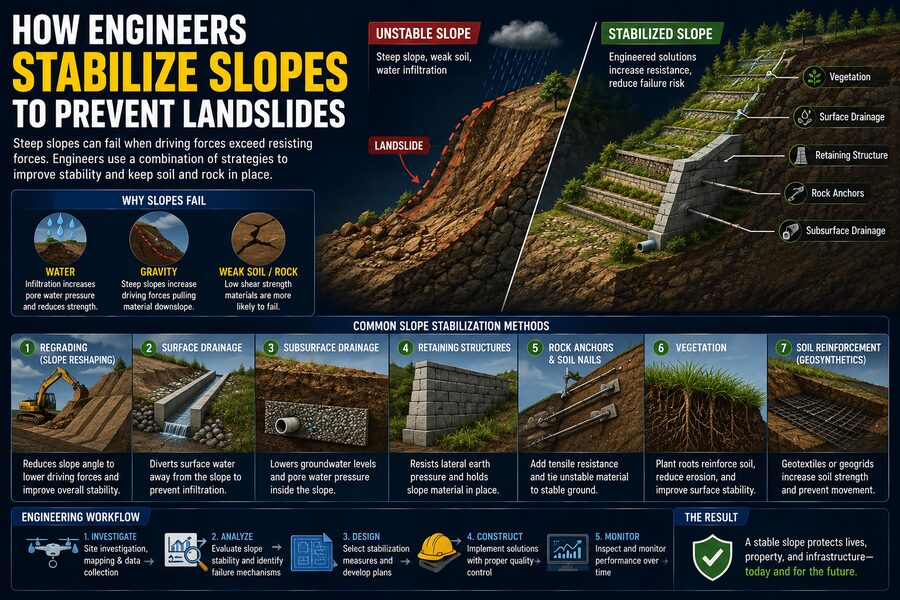

Slopes are everywhere in the built environment. Highways cut through hillsides, railways cross mountainous terrain, buildings sit above excavated embankments, mines create steep walls, and dams rely on large engineered earth slopes. Under the wrong conditions, these slopes can lose stability and move downhill in a landslide.
Landslides can damage roads, buildings, pipelines, utilities, and bridges, and they can also threaten human life. For this reason, geotechnical engineers devote considerable effort to understanding why slopes fail and how they can be stabilized. 🏗️🌧️
Slope stabilization is not based on a single technique. Engineers may improve drainage, flatten the slope, install retaining structures, reinforce the soil with anchors, add vegetation, construct rock bolts, or use combinations of these methods.
The fundamental objective is always similar:
Increase the forces resisting movement and reduce the forces driving the slope downhill.
🧠 Why Do Slopes Fail?
A soil or rock slope remains stable when its internal strength is sufficient to resist the forces trying to move material downward.
Gravity constantly pulls soil and rock toward lower elevations.
For a stable slope, resistance comes from factors such as:
- Soil friction
- Cohesion
- Rock strength
- Root reinforcement
- Retaining structures
- Effective drainage
If the driving forces become greater than the available resisting forces, the slope may begin to move.
Failure can happen gradually or suddenly.
Some slopes creep only a few millimeters each year, while others can collapse within seconds.
⚖️ Driving Forces vs. Resisting Forces
Engineers often think about slope stability in terms of two competing groups of forces.
Driving forces encourage material to move downhill.
These may include:
- Gravity
- Added weight from buildings or fill
- Water pressure
- Earthquake shaking
- Excavation at the bottom of the slope
Resisting forces prevent movement.
These include:
- Soil shear strength
- Rock strength
- Cohesion
- Friction
- Structural reinforcement
Slope stabilization works by changing this balance.
For example, drainage reduces water pressure, while soil anchors directly increase resistance.
📐 The Factor of Safety
A common measure used in slope engineering is the Factor of Safety, often abbreviated as FS.
Conceptually:
Factor of Safety = Resisting Forces ÷ Driving Forces
If the factor of safety equals 1.0, the forces resisting movement are approximately equal to the forces causing movement.
A value below 1.0 indicates instability in the simplified model.
Engineers normally design slopes for a factor of safety above 1.0, with the required value depending on the project, loading condition, uncertainty, and applicable engineering standards.
For example, long-term static slope design may require a greater safety margin than certain temporary construction conditions.
🌧️ Why Water Is So Dangerous for Slopes
Water is one of the most important causes of slope instability.
After prolonged rainfall, water can infiltrate soil and fill the pore spaces between particles.
This creates pore-water pressure.
Soil strength depends greatly on the effective pressure holding soil particles together.
A simplified relationship is:
Effective Stress = Total Stress − Pore-Water Pressure
As pore-water pressure increases, effective stress decreases.
That can reduce friction between soil particles and significantly weaken the slope.
This is why landslides frequently occur after intense or prolonged rainfall. 🌧️⚠️
💧 1. Improving Drainage
Because water is such a major destabilizing factor, drainage is often one of the first stabilization measures engineers consider.
The goal is to prevent water from accumulating inside the slope.
Drainage measures may include:
- Surface channels
- Subsurface drains
- Horizontal drains
- Drainage blankets
- Toe drains
- Perforated pipes
- Relief wells
Reducing groundwater pressure can significantly increase slope stability without changing the overall shape of the slope.
🚿 Surface Drainage
Surface drainage prevents rainfall and runoff from entering vulnerable soil.
Engineers may build channels or ditches near the top of a slope to intercept water.
Instead of allowing runoff to flow across the slope and infiltrate the ground, the drainage system carries it safely away.
Surface drainage is particularly important where cracks have developed.
Water entering cracks can travel deep into a slope and raise pore-water pressure near potential failure surfaces.
🕳️ Horizontal Drains
Horizontal drains are pipes drilled into a slope.
The pipes allow trapped groundwater to escape.
A typical horizontal drain may extend tens of meters into the hillside.
Small openings allow groundwater to enter the pipe and flow outward.
This lowers the groundwater level and reduces pore pressure.
Horizontal drains are commonly used for highway cut slopes and landslide remediation projects.
⛰️ 2. Flattening the Slope
One straightforward way to improve stability is to reduce the slope angle.
A steep slope has a larger component of gravitational force acting downhill.
By removing material and making the slope flatter, engineers reduce the driving force.
For example, instead of maintaining a very steep soil face, the slope may be reconstructed with a more gradual geometry.
This method is called slope regrading or flattening.
It can be highly effective, but it requires sufficient land.
In urban environments, there may not be enough space to create a much flatter slope.
🪨 3. Adding a Stabilizing Berm
Another technique is to place additional soil or rock near the bottom, or toe, of the slope.
This added material forms a berm or buttress.
The extra weight at the toe increases resistance against sliding.
Imagine trying to stop a stack of material from sliding by placing a heavy block against its lower edge.
A stabilizing berm works according to a similar principle, although real slope mechanics are far more complex.
Rockfill is often useful because it provides strength while also allowing drainage.
🧱 4. Retaining Walls
Where there is limited space to flatten a slope, engineers may construct a retaining wall.
Retaining walls hold soil in place and resist lateral earth pressure.
Common retaining systems include:
- Reinforced-concrete walls
- Gravity walls
- Cantilever walls
- Sheet-pile walls
- Soldier-pile walls
- Gabion walls
- Mechanically stabilized earth walls
The appropriate wall depends on soil conditions, slope height, groundwater, available space, and cost.
🪨 Gravity Retaining Walls
A gravity retaining wall relies primarily on its own weight to resist soil pressure.
These walls may be built from:
- Concrete
- Stone
- Masonry
- Gabions
The wall must be heavy enough to resist sliding and overturning.
Its foundation must also safely transfer loads into the ground.
Drainage behind the wall is extremely important because trapped water can dramatically increase lateral pressure.
🧺 Gabion Walls
Gabions are wire baskets filled with rocks.
They can be stacked to form retaining structures.
Gabion walls offer several benefits:
- They are relatively flexible.
- They allow water to drain through them.
- They can accommodate some settlement.
- They may use locally available rock.
Because they are permeable, they can be useful where groundwater drainage is an important concern.
🔩 5. Soil Nailing
Soil nailing reinforces a slope using long steel bars installed into the ground.
Engineers drill holes into the slope and insert steel reinforcement.
The holes are typically filled with grout.
A facing system may then be added to the exposed slope surface.
The nails interact with the surrounding soil and help resist deformation.
Soil nailing is commonly used for:
- Highway cuttings
- Excavation support
- Urban construction
- Existing unstable slopes
It is particularly useful where engineers need to stabilize a steep slope without taking up large amounts of additional land.
⚓ 6. Ground Anchors
Ground anchors are another reinforcement technique.
Unlike passive soil nails, anchors are often prestressed.
A hole is drilled deep into competent soil or rock.
A steel tendon is installed and bonded to the ground using grout.
The tendon is then tensioned.
This creates an active force pulling the retaining structure or slope back toward stable ground.
Anchors can provide very large resisting forces and are commonly combined with:
- Retaining walls
- Soldier piles
- Concrete facing
- Rock slopes
🪨 7. Rock Bolts
Rock slopes behave differently from soil slopes.
Failures often occur along:
- Joints
- Bedding planes
- Fractures
- Faults
A large block of rock may slide or topple if these discontinuities are unfavorably oriented.
Rock bolts can tie unstable rock blocks to stronger material deeper inside the slope.
The bolts may be tensioned or fully grouted.
This helps the fractured rock mass behave more like a connected structural system.
🕸️ 8. Rockfall Mesh and Netting
Not every slope problem involves a large landslide.
Steep rock faces may release individual stones or blocks.
Engineers can install steel wire mesh over the surface.
The mesh helps control falling rock and directs debris toward the bottom of the slope.
More advanced systems may use high-strength flexible barriers to absorb the energy of falling rocks.
These are common alongside mountain roads and railway corridors. 🚧
🧱 9. Shotcrete
Shotcrete is concrete or mortar pneumatically sprayed onto a surface.
On unstable rock or soil slopes, shotcrete can:
- Protect exposed material
- Reduce erosion
- Hold small fragments in place
- Work with soil nails or rock bolts
A typical soil-nailed wall may include reinforcing mesh and a shotcrete facing.
However, engineers must provide drainage openings so groundwater pressure does not build up behind the concrete layer.
🌱 10. Vegetation and Bioengineering
Vegetation can contribute to slope stability, particularly for shallow erosion and near-surface soil movement.
Plant roots can help bind soil particles.
Vegetation also reduces erosion caused by rainfall and surface runoff.
Slope bioengineering may use:
- Grass
- Shrubs
- Deep-rooted plants
- Live stakes
- Brush layering
Vegetation is especially useful for erosion control, but it is not a substitute for structural stabilization when a deep landslide is possible.
A major slope failure may involve thousands or millions of tonnes of material, far beyond what roots alone can resist.
🌊 Erosion Control
Erosion can gradually remove material from the toe of a slope.
Rivers, waves, stormwater, or runoff may undermine the lower portion.
Once support is removed, the upper slope can fail.
Engineers may protect slope toes using:
- Riprap
- Concrete protection
- Gabions
- Revetments
- Drainage structures
Preventing erosion can therefore be a critical part of landslide prevention.
🏗️ 11. Piles and Structural Reinforcement
For some unstable slopes, engineers install rows of deep piles.
These piles extend through the moving soil and penetrate stronger material below the potential failure surface.
As the soil attempts to slide, the piles provide resistance.
Possible systems include:
- Steel piles
- Reinforced-concrete piles
- Micropiles
- Drilled shafts
Pile stabilization can provide substantial resistance but may be expensive.
Engineers typically use detailed geotechnical analysis to determine the required spacing, depth, and structural strength.
🪵 12. Mechanically Stabilized Earth
Mechanically Stabilized Earth (MSE) uses layers of reinforcement embedded within compacted soil.
Reinforcement may include:
- Steel strips
- Geogrids
- Geotextiles
These materials interact with the soil and improve its ability to resist deformation.
MSE systems are widely used for:
- Retaining walls
- Highway embankments
- Bridge approaches
They can produce steep, stable earth structures without requiring massive conventional concrete walls.
🧵 Geotextiles and Geogrids
Geosynthetic materials play an increasingly important role in geotechnical engineering.
Geotextiles can provide separation, filtration, drainage, or reinforcement.
Geogrids are grid-shaped polymer materials designed primarily for reinforcement.
When placed in layers within soil, geogrids help distribute forces and increase stability.
These systems can also reduce the amount of high-quality natural fill required.
🧪 Soil Improvement
Sometimes the slope geometry is acceptable, but the soil itself is too weak.
Engineers can improve soil properties.
Techniques may include:
- Compaction
- Cement stabilization
- Lime stabilization
- Deep soil mixing
- Grouting
Deep soil mixing uses equipment to blend weak ground with cementitious materials.
The treated material becomes stronger and less compressible.
This can create zones of improved soil capable of resisting slope movement.
💉 Grouting
Grouting involves injecting fluid material into the ground.
Depending on the purpose, grout may:
- Fill voids
- Strengthen fractured rock
- Reduce water flow
- Improve soil properties
Cement grout is common in rock engineering.
Other specialized grouts can penetrate smaller openings.
Grouting is often used together with anchors, tunnels, dams, and rock-slope stabilization.
🌎 Earthquakes and Slope Stability
Earthquakes can destabilize slopes through rapid ground acceleration.
Shaking produces additional inertial forces inside the slope.
It may also increase pore-water pressure in saturated soils.
In loose sandy materials, extreme pressure increases can contribute to liquefaction, where soil temporarily loses much of its strength.
Engineers in seismic regions may therefore evaluate both:
Static slope stability + Seismic slope stability
A slope that is safe under normal gravity loading may require additional stabilization to resist earthquake conditions.
🧊 Freeze-Thaw Effects
Cold climates create additional challenges.
Water enters cracks in rock or soil.
When it freezes, it expands.
Repeated freezing and thawing can widen fractures and loosen material.
Rockfall barriers, scaling, drainage, and rock bolts may therefore be particularly important in mountainous cold regions.
Climate conditions must be considered throughout the design life of the slope.
🚧 Excavation Can Trigger Instability
Removing soil from the bottom of a slope can dramatically reduce stability.
The toe often provides important resistance.
A road cut, basement excavation, quarry, or construction project can remove that support.
Engineers may stabilize the slope before excavation using:
- Anchored walls
- Soldier piles
- Soil nails
- Temporary bracing
Construction sequence is critical.
A slope may be stable in its final reinforced condition but unstable temporarily before reinforcement is installed.
🏢 Adding Weight at the Top Can Be Dangerous
Placing heavy loads near the crest of a slope increases driving forces.
Examples include:
- Buildings
- Stockpiled soil
- Heavy equipment
- Water tanks
- Construction materials
Before adding such loads, engineers assess whether the slope has sufficient capacity.
Sometimes structures must be moved farther from the edge or supported on deep foundations that transfer loads below the unstable zone.
🔍 How Engineers Investigate a Slope
Successful stabilization begins with understanding the ground.
A geotechnical investigation may include:
- Boreholes
- Soil samples
- Rock cores
- Laboratory testing
- Groundwater measurements
- Geological mapping
- Geophysical surveys
Engineers need to identify:
- Soil layers
- Rock structure
- Groundwater conditions
- Weak zones
- Existing slip surfaces
Without this information, stabilization may target the wrong failure mechanism.
🧪 Laboratory Testing
Samples recovered from the site can be tested for important properties.
Common tests may evaluate:
- Moisture content
- Density
- Grain-size distribution
- Cohesion
- Friction angle
- Shear strength
These values become inputs for stability calculations.
Rock investigations may also measure joint strength, weathering, and intact rock properties.
🌀 Identifying the Failure Surface
Many landslides move along a defined underground surface.
In homogeneous soils, this surface may approximately resemble a circular arc.
In layered ground, movement may follow a weak geological layer.
Engineers analyze many potential failure surfaces to determine which one has the lowest factor of safety.
The most critical potential surface helps determine where stabilization measures should be installed.
💻 Limit Equilibrium Analysis
One widely used method is limit equilibrium analysis.
The potential sliding mass is divided into smaller sections called slices.
Engineers calculate forces acting on each slice.
Different mathematical methods are then used to estimate the factor of safety.
Software can evaluate thousands of possible slip surfaces efficiently.
This helps engineers identify the most likely critical failure mechanism.
🧮 Numerical Modeling
For complex slopes, engineers may use numerical methods such as the finite element method.
These models can simulate:
- Soil deformation
- Water flow
- Construction stages
- Structural reinforcement
- Stress redistribution
Numerical analysis can provide detailed insight into how a slope responds as excavation, rainfall, or stabilization progresses.
However, sophisticated software is only useful when the underlying geological model and material properties are realistic.
📡 Monitoring Slope Movement
Engineers often monitor slopes before, during, and after stabilization.
Instrumentation may include:
- Inclinometers
- Piezometers
- Survey monuments
- GPS sensors
- Crack gauges
- Radar
- Satellite monitoring
Each instrument provides different information.
💧 Piezometers
A piezometer measures groundwater pressure.
Because water pressure strongly affects slope stability, this information can be extremely valuable.
If pressure suddenly rises following heavy rainfall, engineers may determine that additional drainage is required.
Monitoring also allows them to verify that installed drains are working.
📏 Inclinometers
An inclinometer measures underground lateral movement.
A casing is installed vertically into a borehole.
Repeated measurements reveal whether sections of the ground are shifting sideways.
If movement is concentrated at a particular depth, this can indicate the location of an active slip surface.
That information helps engineers design targeted stabilization.
🛰️ Remote Monitoring
Modern slope monitoring increasingly uses remote-sensing technologies.
Possible systems include:
- Satellite radar
- Drones
- LiDAR
- Ground-based radar
These tools can detect small changes in ground position over large areas.
For mines and large natural slopes, continuous radar systems may provide warnings when movement begins accelerating.
🚨 Early-Warning Systems
Some landslides cannot be completely prevented economically.
In such cases, monitoring and warning systems may reduce risk.
Sensors can track:
- Rainfall
- Ground movement
- Pore pressure
- Crack opening
If measurements exceed predefined thresholds, authorities may:
- Close roads
- Stop railway traffic
- Evacuate an area
- Increase inspections
Early warnings are particularly valuable in regions with recurring rainfall-triggered landslides.
🌧️ Designing for Climate and Extreme Rainfall
Historical rainfall patterns are important in slope design, but engineers increasingly consider the possibility of changing extreme-weather patterns.
More intense rainfall can increase:
- Infiltration
- Runoff
- Groundwater pressure
- Erosion
Drainage systems therefore need adequate capacity and maintenance.
A drain clogged with sediment or vegetation may stop protecting the slope even if the original design was sound.
🔧 Maintenance Is Part of Stabilization
Slope stabilization does not end when construction finishes.
Long-term performance depends on maintenance.
Important activities include:
- Cleaning drains
- Repairing erosion
- Inspecting retaining structures
- Replacing damaged rockfall mesh
- Monitoring movement
- Checking anchor systems
- Removing unstable loose rock
A poorly maintained drainage system can gradually allow groundwater pressures to return.
For many slopes, maintenance is as important as the original stabilization work.
🏞️ Choosing the Right Stabilization Method
No single technique works for every slope.
Engineers choose methods based on:
- Failure mechanism
- Slope height
- Soil or rock type
- Groundwater
- Available space
- Nearby structures
- Construction access
- Environmental impact
- Cost
For a shallow eroding embankment, drainage and vegetation may be sufficient.
For a deep landslide threatening a highway, engineers might require:
Drainage + Toe berm + Anchors + Retaining structures
Complex slopes often require several methods working together.
💰 Balancing Safety and Cost
Slope stabilization can be expensive.
Engineers therefore evaluate different alternatives.
One option might completely rebuild a slope.
Another might lower groundwater, install anchors, and monitor movement.
The selected solution must provide an acceptable safety level while remaining practical to build and maintain.
High-consequence sites—such as slopes above densely populated areas—may justify much more extensive protection than remote low-risk slopes.
🌿 Environmental Considerations
Stabilization can affect the surrounding environment.
Large retaining walls may alter natural landscapes.
Drainage can change groundwater conditions.
Excavation can disturb habitats.
Engineers therefore increasingly consider methods that combine structural performance with environmental compatibility.
Vegetated reinforced slopes, erosion-control systems, and carefully designed drainage can sometimes provide stability while preserving a more natural appearance. 🌱
🛣️ Why Slope Stabilization Matters for Infrastructure
Modern transportation systems frequently cross difficult terrain.
Roads and railways rely on stable slopes to remain operational.
A landslide can:
- Block a highway
- Damage tracks
- Break utilities
- Isolate communities
- Cause major economic losses
Preventive stabilization can therefore be much less expensive than repairing repeated landslide damage.
✨ Conclusion
Engineers stabilize slopes by understanding the balance between the forces trying to move soil or rock downhill and the forces resisting that movement.
Water is often one of the most important factors. Rising groundwater pressure can reduce effective stress and weaken a slope, which is why surface drains, horizontal drains, and groundwater-control systems are so widely used.
Other techniques directly increase resistance.
Engineers may flatten the slope, construct stabilizing berms, build retaining walls, install soil nails, tension ground anchors, reinforce rock with bolts, or place deep piles through potential failure zones. 🏗️
For shallow problems, vegetation, geotextiles, erosion protection, and improved surface drainage may be sufficient.
For large landslides, several stabilization methods may need to work together.
Modern engineering also relies heavily on monitoring. Piezometers measure groundwater pressure, inclinometers detect underground movement, and technologies such as radar, drones, GPS, and satellite sensing can track changes across entire slopes.
The most important principle is that slope stabilization must address the actual cause of instability. Building a stronger wall will not necessarily solve a landslide caused by uncontrolled groundwater, while installing drains alone may not stop a massive rock block sliding along a weak geological plane.
By combining geology, soil mechanics, groundwater analysis, structural reinforcement, drainage, and monitoring, engineers can transform vulnerable slopes into safer and more reliable parts of the landscape. 🏔️🛡️
Ultimately, preventing landslides is not about simply holding soil in place. It is about carefully managing water, geometry, forces, materials, and movement so the resisting strength of a slope remains greater than the forces trying to pull it downhill.