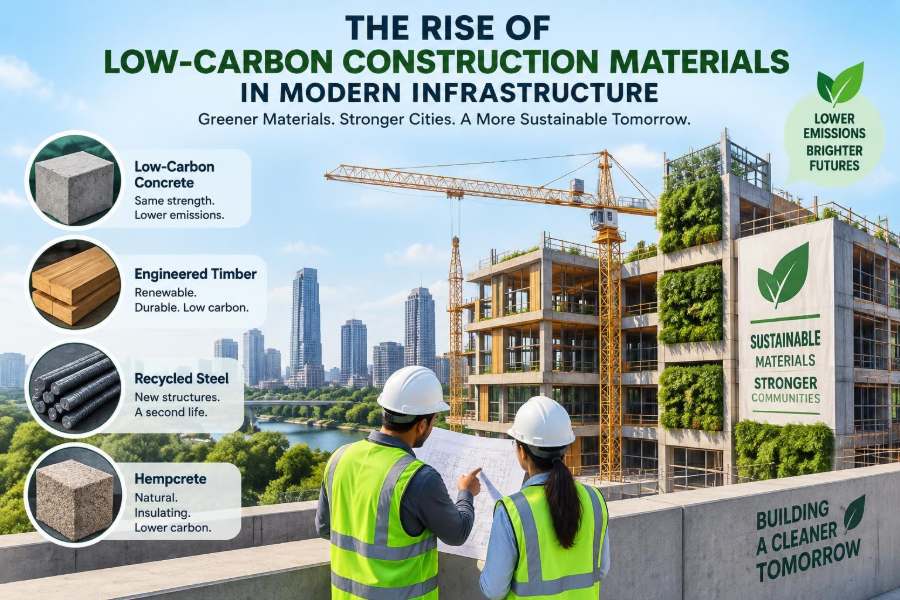

A bridge, school, water-treatment plant, or apartment block may serve a community for decades, yet a large share of its climate impact is created before anyone uses it. Quarrying aggregate, making cement, firing bricks, producing steel, transporting materials, and assembling them on site all require energy and resources.
For civil engineers, this changes a familiar design question. It is no longer enough to ask whether a material is strong, durable, available, and affordable. Project teams increasingly need to ask: what emissions are associated with this material, where do they occur, and can the same performance be achieved with less carbon?
Low-carbon construction materials are not a single product waiting to replace conventional concrete or steel. They are a growing set of materials, production methods, design choices, and procurement practices that reduce emissions while still meeting safety, service-life, and constructability requirements.
The practical challenge is to make better decisions without treating carbon as the only criterion. Infrastructure must remain safe, repairable, resilient, and suited to its location. Understanding the trade-offs is where sound engineering begins.
🌍 Why Construction Materials Matter to Climate Goals
The built environment depends on material flows at enormous scale. Roads consume aggregate and bituminous binders; buildings use concrete, steel, glass, timber, insulation, and finishes; utility networks need pipes, chambers, cables, and protective structures.
Many of these materials carry embodied carbon: greenhouse-gas emissions generated through extraction, manufacture, transport, construction, maintenance, replacement, and end-of-life treatment. Embodied carbon is different from operational carbon, which comes from energy used while an asset is in service.
As buildings become more energy efficient and electrical grids use cleaner generation, embodied emissions can represent a larger share of whole-life impact. That makes material selection a central civil engineering decision rather than a specialist concern.
🧱 Understanding Embodied Carbon
Embodied carbon is often reported as carbon dioxide equivalent, or CO₂e. This unit combines the warming effects of different greenhouse gases into a common measure, allowing materials and processes to be compared more consistently.
A useful boundary starts with the product stage: raw-material supply, transport to the factory, and manufacturing. A fuller assessment also includes delivery to site, installation, repair cycles, demolition, waste processing, and potential reuse or recycling.
Two products that look identical in a specification may have very different embodied carbon because their energy source, plant efficiency, recycled content, transport route, and factory location differ. Generic assumptions are useful early in design, but they should not replace project-specific evidence later.
🔄 The Whole-Life Carbon Perspective
A low-carbon choice at the factory gate is not automatically the lowest-carbon solution over an asset’s life. A material that needs frequent replacement, has a short service life in a marine environment, or demands more supporting structure may lose its apparent advantage.
Whole-life carbon assessment considers the emissions consequences of an asset across its expected life. It connects material decisions with durability design, maintenance access, adaptability, disassembly, and end-of-life pathways.
For example, a bridge deck design with a slightly higher initial material impact may be justified if it significantly reduces recurring closures, repair materials, and traffic disruption over a long design life. The conclusion depends on the exposure conditions and maintenance strategy, not a simple rule.
🏭 Why Ordinary Portland Cement Is a Focus
Concrete is indispensable because it is strong in compression, widely available, fire resistant, and adaptable to many forms. Its main binder, ordinary Portland cement, is emissions-intensive for two reasons: heating the kiln requires substantial energy, and limestone releases carbon dioxide during the chemical conversion to clinker.
Clinker is the reactive component that gives cement much of its binding capability. Reducing clinker content while preserving required fresh and hardened properties is therefore one of the most important routes to lower-carbon concrete.
This does not mean cement can simply be removed from every mix. Concrete performance depends on binder chemistry, water content, aggregate quality, curing, exposure class, placement method, and strength-development requirements.
🪨 Supplementary Cementitious Materials
Supplementary cementitious materials, often called SCMs, partially replace clinker-bearing cement in concrete. Common examples include ground granulated blast-furnace slag, fly ash, silica fume, calcined clay, and finely ground limestone used within suitable binder systems.
Some SCMs contribute to strength through chemical reactions; others improve particle packing or modify the pore structure. Their effect depends on dosage, fineness, curing temperature, admixtures, and the concrete’s intended performance.
- Slag can support durability and later-age strength in appropriate mixes.
- Fly ash has been widely used where available, but supply and quality can vary as power systems change.
- Calcined clay can be produced from suitable clays and offers a route less dependent on industrial by-products.
- Silica fume is often used in demanding applications, particularly where low permeability is required.
Engineers should specify performance requirements, not assume that a named SCM produces the same outcome in every mix.
🧪 Blended Cements and New Binder Systems
Blended cements combine clinker with one or more lower-carbon constituents at the cement plant or in concrete batching. This can simplify supply and quality control, although the available products differ by region and standards.
Other binders, including alkali-activated systems and certain carbonate-based or calcium-silicate systems, are being developed and used in selected applications. Their potential is real, but they require careful validation for local materials, worker handling, long-term durability, reinforcement compatibility, and code acceptance.
A new binder should be assessed as an engineering system, not marketed as a universal substitute. Test results for a precast unit made under controlled curing conditions may not transfer directly to a large, winter-poured foundation.
💧 Mix Design Often Beats Material Substitution
Reducing cement content is frequently more effective than swapping one binder for another without changing the mix design. Excess paste, unnecessary strength margins, and high water demand can all increase embodied carbon.
Well-graded aggregate, efficient particle packing, water-reducing admixtures, and realistic strength specifications can lower binder demand. The target should be the performance actually needed: workability for placement, strength at the required age, permeability resistance, shrinkage control, and durability in the expected environment.
Over-specification is a common source of avoidable emissions. Calling for a higher strength class “just in case” can increase cement use and may create shrinkage or heat-of-hydration concerns without solving a real design problem.
♻️ Recycled Aggregate in Concrete
Recycled concrete aggregate is produced by crushing and processing demolished concrete. It can reduce demand for virgin aggregate and divert mineral waste from disposal, especially when processing occurs near demolition and reconstruction sites.
Its properties vary. Recycled aggregate may retain old mortar, which can increase water absorption and affect density, workability, and stiffness. These characteristics must be measured and accounted for in mix design rather than treated as defects to be ignored.
It is often well suited to applications such as sub-base, fill, and some concrete uses when specifications permit. Higher-value structural use is possible in certain circumstances, but requires dependable processing, grading, contamination control, and appropriate testing.
🛣️ Low-Carbon Roads and Pavements
Road infrastructure offers major opportunities because pavement works involve large material volumes. Reclaimed asphalt pavement can be milled, processed, and incorporated into new asphalt mixtures, reducing demand for virgin aggregate and binder when the mix is properly designed.
Warm-mix asphalt technologies reduce mixing and compaction temperatures through additives or process changes. Lower temperatures can reduce energy demand and fumes, but the expected benefits depend on plant operation, haul distance, weather, and the selected technology.
For concrete pavements and bases, optimized binder content, local aggregate, recycled materials, and longer-life design can all matter. The best strategy depends on traffic loading, subgrade conditions, climate, maintenance access, and available plants.
🔩 Lower-Carbon Steel Pathways
Steel is essential where high tensile strength, ductility, and long spans are required. Its carbon footprint depends heavily on the production route. Steel made in electric arc furnaces can use substantial recycled scrap, while primary steel routes depend more on iron ore reduction.
The carbon intensity of electric steelmaking also depends on the electricity supply and scrap availability. Recycled content is valuable, but it should not become a substitute for verifying product data or considering the quality requirements of the intended application.
Material efficiency is equally important. Rational structural grids, optimized member sizing, standard connections, and avoiding unnecessary tonnage can reduce impact before a purchase order is placed.
🌲 Timber and Engineered Wood
Timber can offer a lower-carbon structural option when forests are responsibly managed, transport distances are reasonable, and the design protects the material from persistent moisture. Engineered wood products can provide predictable dimensions and structural capacity for floors, walls, roofs, and hybrid systems.
Biogenic carbon accounting—the treatment of carbon stored in wood—requires care. Storage in a building is meaningful, but it does not erase emissions from harvesting, processing, adhesives, transport, or end-of-life. Forest regeneration and land-management practices also matter.
Timber is not appropriate for every infrastructure application. Fire design, moisture control, biological attack, connection detailing, acoustic requirements, and local code provisions must be addressed from the outset.
🏗️ Hybrid Structures Use Each Material Well
Low-carbon design is rarely a contest between concrete, steel, and timber. Hybrid construction can place each material where its properties are most valuable: concrete for foundations and compression zones, steel for slender tension members, and timber for suitable superstructure elements.
A composite floor, for example, may reduce total material use by combining the strengths of different components. However, hybrid systems can introduce more complex interfaces, fire detailing, moisture management, and sequencing requirements.
The engineering objective is not to select the material with the best general reputation. It is to create a safe, durable load path with the least necessary material and the lowest credible whole-life impact.
🧱 Masonry, Bricks, and Local Materials
Fired clay bricks can have significant manufacturing energy because kilns operate at high temperatures. Their durability, thermal mass, and reuse potential may still make them appropriate in some designs, particularly where locally produced and carefully detailed.
Alternatives include compressed earth blocks, stabilized soil products, reclaimed brick, and lower-temperature masonry units. Their viability depends strongly on local soil characteristics, moisture exposure, workmanship, structural role, and building regulations.
Local availability is not a guarantee of low carbon, but it can reduce transport impacts and support repairable, place-appropriate construction. Engineers should distinguish between a material’s cultural appeal and its demonstrated performance.
🪟 Insulation, Envelope, and Operational Trade-Offs
Materials that reduce operational energy can have embodied impacts of their own. Insulation, glazing, air barriers, and shading systems should therefore be assessed in the context of climate, occupancy, building orientation, and expected service life.
A small additional material impact may be reasonable when it reduces heating or cooling demand for many years. Conversely, specifying complex façade systems without robust detailing can create moisture risks and premature replacement.
The right question is not whether operational or embodied carbon matters more. Both must be considered, with design assumptions made transparent.
🚚 Transport Is Important but Not Everything
Transport distance affects emissions, particularly for heavy, low-value materials such as aggregate and ready-mixed concrete. Local sourcing can be advantageous, but manufacturing emissions can still dominate the result for products like cement and steel.
Consider a hypothetical choice between a nearby conventional cement and a blended product shipped farther away. The lower-carbon option cannot be identified from distance alone; it requires a comparable assessment of production data, quantities, transport mode, and project needs.
Efficient logistics also reduce waste and delays. Coordinated deliveries, full loads, suitable storage, and realistic pour planning prevent rejected batches and unnecessary repeat trips.
📄 Environmental Product Declarations
An environmental product declaration, or EPD, presents environmental information for a product using defined assessment rules. It can help designers compare alternatives, provided the products use compatible system boundaries, functional units, and data methods.
An EPD is not a sustainability certificate or a declaration that one product is automatically suitable for every project. It is evidence that needs interpretation alongside technical performance, cost, availability, and project-specific quantities.
Teams should check whether the declaration is product-specific or industry-average, current, independently verified where required, and relevant to the region and manufacturing route being considered.
📏 Measuring Carbon at the Right Design Stage
Early estimates are valuable because most material quantities are influenced before detailed drawings are complete. At concept stage, teams can compare structural forms, spans, grids, foundation strategies, and reuse options using approximate quantities and transparent assumptions.
As the design develops, estimates should become more specific. Bills of quantities, supplier information, construction methods, and replacement assumptions allow the assessment to move from broad direction-setting to procurement decisions.
Precision should match decision maturity. A highly detailed carbon figure based on uncertain early quantities can create false confidence; a simple range with stated assumptions is often more honest and more useful.
🎯 Set a Carbon Brief Before Designing Details
A carbon brief converts ambition into decisions. It can establish a baseline, define which life-cycle stages are included, identify high-impact elements, and set reporting expectations for designers and suppliers.
Useful project questions include:
- Can an existing structure be retained, strengthened, or adapted?
- Which elements dominate material quantity and emissions?
- What performance criteria are essential, and which specifications are habitual?
- Which local materials and verified suppliers are realistically available?
- How will changes be tracked through design and construction?
Setting these questions early prevents carbon review from becoming a late-stage exercise after the structural concept and supply chain are already fixed.
🏛️ Retain Before You Replace
The lowest-carbon structure is often the one that does not need to be rebuilt. Retaining foundations, frames, pavements, retaining walls, or utility corridors can avoid large quantities of new material.
Reuse is not automatically safe or economical. Existing assets need surveys for condition, geometry, hidden defects, contamination, load capacity, and compatibility with new use. Strengthening may also require fire, seismic, drainage, or durability upgrades.
Still, demolition should be treated as a design decision rather than a default starting point. A careful appraisal can reveal opportunities for adaptation that a new-build-only brief would miss.
🧩 Design for Material Efficiency
Efficiency means providing the required performance with less material, not simply making components thinner. Optimized spans, repetitive geometry, voided slabs where appropriate, rationalized loads, and coordinated openings can reduce quantities while improving buildability.
Digital structural analysis can help engineers identify reserve capacity and avoid conservative duplication. Yet models are only as sound as their loads, restraints, connection assumptions, and detailing. Optimization must remain subject to independent checking and code compliance.
Reducing material also reduces tolerance for poor workmanship. Detailing, inspection, and construction sequencing become more—not less—important in efficient structures.
🧰 Prefabrication and Off-Site Production
Factory production can reduce cutting waste, improve repetition, and provide more controlled curing or assembly conditions. Precast concrete, modular components, and standardized steelwork may therefore support lower material losses.
Benefits are not guaranteed. Oversized modules can require special transport, lifting equipment, temporary works, and complex connections. A factory-made solution should be evaluated using the actual logistics and installation plan.
Off-site production works best when the design is coordinated early, dimensions are stable, and interfaces with foundations, services, and finishes are resolved before manufacturing begins.
🗑️ Designing Out Construction Waste
Waste is often a sign that material has been purchased, moved, and processed without becoming part of the finished asset. Accurate take-offs, standard dimensions, protected storage, and clearly separated waste streams can reduce that loss.
Designers can help by avoiding awkward cuts, specifying reusable formwork where feasible, and allowing space for material segregation on site. Contractors need practical handling plans; a recycling requirement is ineffective if materials become mixed or contaminated.
Waste reduction should be counted cautiously. A material sent for recycling does not necessarily displace an equal amount of virgin material in the same project, so claims should reflect the actual recovery pathway.
🌧️ Durability Is a Carbon Strategy
Durability design reduces the chance that components need early repair or replacement. For concrete, this may involve cover to reinforcement, crack control, permeability management, curing, and mix selection matched to chloride, sulfate, freeze-thaw, or carbonation exposure.
For steel, coatings, drainage, access for inspection, and avoiding water traps can matter as much as the initial steel grade. For timber, drainage planes, ventilation, protected end grain, and separation from wet ground are fundamental.
A durable detail may use slightly more material initially but prevent repeated interventions. The appropriate balance depends on exposure severity and the realistic quality of future maintenance.
🔧 Maintenance Access Changes the Calculation
An asset cannot be maintained effectively if critical components cannot be inspected or reached. Access platforms, replaceable bearings, removable panels, clear drainage paths, and standardized parts can extend service life and reduce disruptive repairs.
This is especially relevant to infrastructure where closures carry social and economic consequences. A repair that requires repeated lane closures may produce indirect effects beyond the materials used in the repair itself.
Designing for maintenance is not glamorous, but it supports the whole-life value of low-carbon materials by ensuring they can perform as intended.
⚠️ Avoid Green Claims Without Verification
Terms such as “eco,” “green,” “carbon neutral,” and “sustainable” are not engineering properties. They can conceal vague boundaries, reliance on offsets, or comparisons that omit durability and transport.
Ask for clear evidence: declared unit, assessment boundary, applicable standards, product composition, technical data, and limitations. Then compare like with like. A claim per kilogram may not help when alternatives provide different strength, thermal resistance, or service life.
Carbon data should inform judgment, not replace it. A product with an appealing declaration can still be unsuitable for the exposure conditions or unavailable at the required scale.
📚 Codes, Standards, and Specification Constraints
Codes protect public safety, and material innovations must meet their requirements. Some standards allow performance-based approaches that can accommodate lower-carbon mixes or recycled content; others may be more prescriptive or interpreted cautiously by clients and approving authorities.
Engineers should engage early with building-control bodies, asset owners, insurers, contractors, and material suppliers where novel materials are proposed. Early discussion can identify testing, mock-ups, trials, or additional documentation needed for approval.
Do not bypass established durability, fire, structural, or health-and-safety requirements in pursuit of carbon savings. Innovation succeeds when evidence and governance are built into the project process.
🤝 Procurement Can Unlock Better Choices
Procurement determines what suppliers are asked to provide and how alternatives are judged. If tenders reward only the lowest upfront price, suppliers have little reason to disclose emissions data, optimize mixes, or propose lower-carbon methods.
Outcome-based specifications can invite innovation while retaining essential controls. For example, a brief may require stated structural performance, exposure resistance, workability, and verified environmental reporting rather than prescribing a single conventional recipe.
Clear evaluation rules are essential. Suppliers need to know whether carbon is measured per product, per installed element, or across a defined life-cycle boundary, and how technical equivalence will be confirmed.
👷 Collaboration Across the Project Team
Architects, civil and structural engineers, geotechnical specialists, quantity surveyors, contractors, suppliers, and operators each influence carbon outcomes. A structural engineer may reduce a slab thickness, but the contractor may identify a placement constraint, while the supplier may offer a more suitable regional binder blend.
Regular design reviews should connect carbon information to decisions on form, quantity, sequencing, and maintenance. Carbon dashboards can help, but only if they lead to accountable actions rather than becoming a reporting exercise.
The most productive conversations happen early, when alternatives remain open and changes do not require extensive redesign.
🧑🎓 Skills Civil Engineers Need
Engineers do not need to become life-cycle assessment specialists to contribute effectively. They do need enough literacy to ask useful questions about system boundaries, functional units, assumptions, uncertainty, and product data.
Useful practical skills include reading EPDs, estimating quantities, recognizing carbon hotspots, understanding durability exposure, and writing performance-based specifications. Communication matters too: clients need plain-language explanations of trade-offs, risks, and benefits.
For students, material choices are an opportunity to connect structural design, construction management, geotechnics, environmental assessment, and asset management. Low-carbon infrastructure is inherently interdisciplinary.
🚀 A Practical Workflow for Material Decisions
A repeatable workflow helps teams avoid treating carbon as a last-minute substitution exercise.
- Assess retention and reuse before assuming demolition and replacement.
- Identify high-volume and high-impact elements from early quantities.
- Reduce demand through structural efficiency and realistic specifications.
- Compare credible material options using compatible, transparent data.
- Check durability, safety, buildability, availability, and maintenance implications.
- Engage suppliers and contractors early to validate the proposed solution.
- Track decisions through procurement, construction, and handover.
This sequence places the largest opportunities—avoiding work and reducing quantities—before lower-level adjustments such as changing a single product.
🌱 The Core Principle: Build Less, Build Smarter, Build to Last
The rise of low-carbon construction materials reflects a broader shift in civil engineering. The aim is not merely to swap conventional products for unfamiliar ones. It is to evaluate the full material system: whether an asset is needed, how much material it truly requires, how long it will last, and how it can be repaired or reused.
Concrete with lower clinker content, recycled aggregate, recycled steel, responsibly sourced timber, reused components, and efficient design can all contribute. None is a universal answer, and each must be matched to actual loads, exposure, supply conditions, codes, and construction capability.
The strongest projects combine verified data with engineering judgment. They reduce emissions without compromising the public value that infrastructure is meant to deliver: safety, reliability, resilience, and long service.
Low-carbon construction is most effective when material decisions are treated as whole-life engineering decisions, not as isolated product choices. That approach gives civil engineers a practical path to create infrastructure that uses resources more carefully and serves communities for longer. 🌱🏗️♻️