
A newly opened road can look nearly perfect: dark, smooth asphalt, crisp lane markings, and a ride that feels effortless. Yet a few years later, one section may begin cracking while another still performs well.
That difference is rarely explained by the surface alone. Pavement life is decided by a chain of choices and conditions, from the soil beneath the road to the trucks using it, the rain leaving it, and the maintenance it receives.
For students, this is a useful reminder that a pavement is not simply “laid” and forgotten. For working professionals, it explains why apparently similar projects can age in very different ways.
A road is best understood as a structural system that must carry repeated loads while managing water, temperature changes, and time. Its actual service life emerges after construction, not from one design value on a drawing.
🛣️ Pavement Life Means More Than Remaining in Place
A road can remain physically present long after it has stopped providing acceptable service. Engineers therefore distinguish between structural life and functional life.
Structural life concerns whether the pavement layers can continue carrying traffic without serious failure. Functional life concerns how well the road serves users: ride quality, skid resistance, noise, rutting, and visible distress all matter.
A pavement with shallow cracks may still be structurally sound, while a rough road with deep ruts can be operationally unacceptable even if it has not collapsed. The required condition depends on the road’s purpose, traffic, and agency standards.
🏗️ A Pavement Is a Layered Structural System
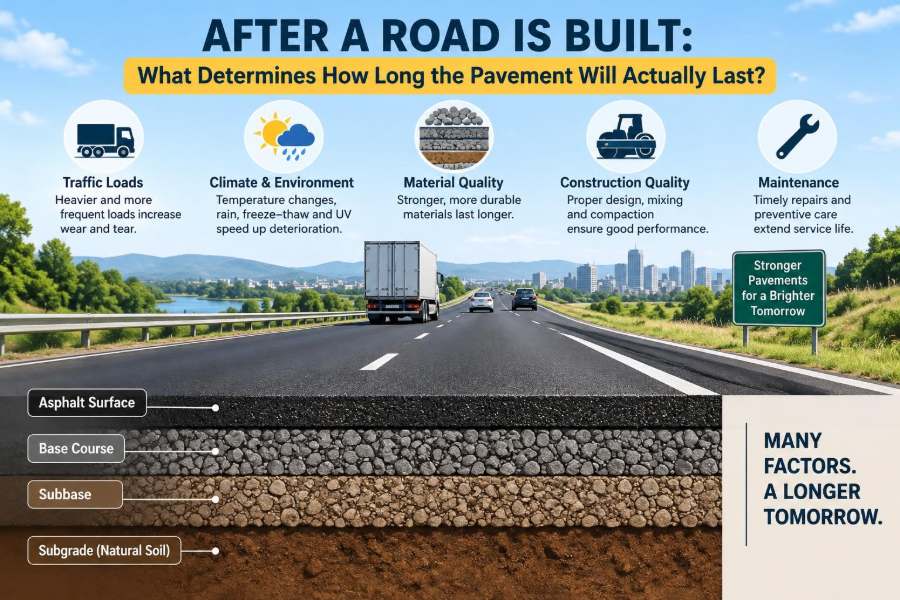
Flexible pavements, usually asphalt pavements, distribute wheel loads through several layers. The asphalt surface protects the road and provides a smooth wearing course; lower asphalt, granular base, subbase, and subgrade each have different jobs.
Rigid pavements use concrete slabs, which spread loads over a wider area. They still depend on support from the layers below, effective joints, drainage, and sound construction.
The useful analogy is a mattress on a weak floor. Adding a high-quality top layer may improve comfort temporarily, but it cannot fully compensate for poor support underneath. Pavement performance is governed by the whole system.
📐 Design Assumptions Set the Starting Point
Every pavement design begins with assumptions about traffic, material properties, climate, drainage, and the desired period before major rehabilitation. These assumptions are necessary, but they are not predictions with perfect certainty.
Traffic volumes can grow differently than forecast. Freight patterns can change after a distribution center opens. Local materials may behave differently from laboratory samples, and unusually wet seasons can expose drainage weaknesses.
A design is therefore a managed decision under uncertainty. Sensible designs account for foreseeable variability rather than treating one traffic estimate or laboratory strength value as permanent truth.
🚛 Heavy Axle Loads Cause Disproportionate Damage
Traffic does not damage pavement evenly. Heavy trucks, particularly heavily loaded axles, impose much larger stresses than passenger cars. Repeated loading gradually accumulates fatigue in bound layers and permanent deformation in weaker materials.
Axle configuration matters as well as gross vehicle weight. A load spread across multiple axles affects pavement differently from the same total load concentrated on fewer axles.
Consider two roads with similar daily traffic counts. The road serving mostly cars may remain sound for many years, while the road carrying quarry trucks or freight vehicles may deteriorate much faster. Traffic composition is often more informative than vehicle count alone.
🔁 Repetition Creates Fatigue, Even Below a Single-Load Limit
Pavement damage is commonly cumulative. A single legal truck passage may not cause visible distress, but thousands or millions of repetitions can initiate and extend cracks.
In asphalt layers, repeated bending can create fatigue cracking, often beginning near the bottom of the asphalt layer where tensile strain is greatest. Cracks may later appear at the surface as interconnected patterns sometimes called alligator cracking.
Concrete slabs can also experience repeated-load fatigue. Their response depends on slab thickness, support conditions, joint behavior, load transfer, and environmental stresses.
⚖️ Overloading Shortens Life Faster Than Many People Expect
Overloaded vehicles do not merely add a small amount of damage. Pavement response is nonlinear: greater loads produce substantially greater stresses and strains, especially where the pavement already has limited strength or moisture-damaged support.
This is why axle-load enforcement protects public infrastructure as well as road safety. A pavement designed for a defined traffic spectrum can deteriorate rapidly when regular loading exceeds that basis.
Enforcement alone is not a complete answer. Designers also need credible freight data, and road owners need to recognize routes where seasonal haulage or industrial activity creates unusual loading patterns.
🌡️ Temperature Changes Alter Pavement Behavior
Asphalt is a viscoelastic material, meaning its behavior depends partly on temperature and loading rate. In hot weather it becomes softer and more prone to deformation; in cold weather it becomes stiffer and can be more vulnerable to cracking.
Concrete expands and contracts as temperatures change. If joints, dowels, sealing, or support conditions perform poorly, this movement can contribute to cracking, faulting, or joint-related distress.
Daily temperature swings can matter near the surface, while seasonal patterns influence deeper layers and moisture conditions. Climate-aware design considers local temperature ranges rather than relying on a generic material choice.
💧 Water Is Often the Hidden Accelerator
Water is not automatically harmful; well-designed pavement systems are expected to encounter moisture. The problem arises when water remains where it reduces support, weakens bonds, or cannot drain away.
In asphalt pavement, moisture can contribute to stripping, where asphalt binder loses adhesion to aggregate. In unbound granular layers and fine-grained soils, excess water can reduce stiffness and increase susceptibility to deformation.
Once cracks admit water, deterioration can accelerate. Water enters more easily, support declines, traffic causes greater movement, and cracks widen further. This feedback loop explains why small defects deserve timely attention.
🌧️ Surface Drainage Keeps Water Moving Away
Drainage starts at the surface. Crossfall, crown shape, longitudinal grade, curb inlets, gutters, shoulders, and outlets should direct water off the pavement quickly and safely.
Ponding in wheel paths is more than a comfort issue. It raises splash and hydroplaning risks, can force water through surface defects, and may signal rutting or an inadequate surface profile.
Routine cleaning also matters. Blocked inlets, sediment-filled ditches, and vegetation at outlets can defeat an otherwise sound drainage design. A drainage feature works only when its full flow path remains open.
🕳️ Subsurface Drainage Protects the Layers Below
Surface runoff is only part of the water problem. Water may enter through cracks, joints, shoulders, utility trenches, groundwater movement, or capillary action from below.
Permeable drainage layers, edge drains, filter materials, and properly designed outlets can help remove water from vulnerable locations. These systems must resist clogging and have a realistic route for discharge.
An edge drain with no maintained outlet is not a drainage solution. It may simply collect water near the pavement edge, where support is already often weaker because traffic and environmental exposure concentrate distress there.
🪨 The Subgrade Provides the Foundation
The subgrade is the prepared natural soil or fill beneath the pavement structure. Its stiffness and moisture sensitivity strongly influence required pavement thickness and long-term performance.
Some soils maintain reasonable support across changing moisture conditions. Others, particularly certain fine-grained soils, can soften when wet, shrink and swell, or lose uniformity after disturbance.
Uniformity is crucial. A pavement may tolerate modest overall support better than highly variable support, because abrupt weak spots create localized deflection, cracking, and settlement. Investigation should seek weak zones, not merely an average soil value.
🧪 Material Quality Must Be Consistent, Not Just Compliant Once
Aggregate shape, gradation, cleanliness, durability, asphalt binder properties, concrete ingredients, and moisture content all influence performance. Meeting a specification at the source does not automatically guarantee uniform material in the finished road.
Segregation is a common concern in asphalt mixtures: coarse and fine particles separate during handling or placement, producing nonuniform texture and void structure. In concrete, inconsistent batching, finishing, or curing can create variable strength and durability.
Quality control is therefore a process, not a one-time test. Sampling, plant control, delivery practices, and field observations work together to identify variation before it becomes embedded in the roadway.
🔥 Asphalt Compaction Controls Density and Durability
Fresh asphalt must be compacted within an appropriate temperature range. Too little compaction leaves excessive air voids, allowing air and water to enter more readily and making the mix more vulnerable to oxidation and raveling.
Too much compaction or inappropriate rolling can also cause problems, including aggregate breakdown, displacement, or an unsuitable surface texture. The target is not simply “maximum rolling.”
Temperature segregation, delayed rolling, cold truck loads, and poor paver operation can create areas of lower density. These areas often become early distress locations because they age and admit moisture faster than surrounding pavement.
🧱 Concrete Curing and Joints Shape Rigid Pavement Life
Concrete needs appropriate moisture and temperature conditions during curing so that cement hydration can develop the intended properties. Premature moisture loss, inadequate curing, or poorly timed finishing can affect durability near the surface.
Joints are deliberately created to manage cracking caused by shrinkage and temperature movement. Their spacing, saw-cut timing, sealing, and load-transfer details influence whether cracks occur where intended and whether adjacent slabs move together under wheel loads.
A concrete pavement is not expected to remain crack-free indefinitely. Good design seeks controlled behavior: predictable joints, sound support, and limited water entry rather than random, widening cracks.
🚧 Construction Workmanship Is a Long-Term Design Variable
Even a well-designed pavement can underperform if constructed on a wet or disturbed subgrade, placed at incorrect thickness, compacted unevenly, or connected poorly to drainage and shoulders.
Thickness is especially significant because small reductions can materially reduce structural capacity. Weaknesses at transverse joints, paving starts and stops, utility crossings, and lane interfaces may not be obvious at opening but can become future distress points.
Inspection should focus on the work that will soon be hidden: foundation preparation, layer thickness, moisture condition, density, joint details, and drainage connections. Surface appearance alone is an incomplete indicator of quality.
📏 Thickness Is Necessary, but Thickness Alone Is Not Enough
Increasing layer thickness generally improves load-carrying capacity, but it is not a universal cure. Extra asphalt over a saturated base or unstable subgrade can still crack and deform because the underlying problem remains.
Likewise, a thin but well-supported pavement may perform acceptably on a low-volume road, while a thick pavement can fail early under unexpected heavy loading or poor drainage.
The right question is not “How thick should the asphalt be?” It is “What layered structure, materials, drainage measures, and maintenance plan suit this location and traffic?”
🛞 Rutting Reveals Where Permanent Deformation Occurs
Rutting is a longitudinal depression in wheel paths. It can originate in the asphalt layer, in unbound base or subgrade layers, or through a combination of mechanisms.
Asphalt-layer rutting is associated with mixtures that are too soft, poorly compacted, or unsuitable for high-temperature heavy traffic. Deeper rutting often suggests inadequate support or moisture-weakened granular and soil layers.
The repair must match the cause. Milling and replacing the surface may help a surface-mix problem, but it will not solve deformation continuing below the asphalt. Investigation should precede treatment selection.
🕸️ Cracking Patterns Help Diagnose Failure
Cracks are evidence, not a diagnosis by themselves. Their shape, location, width, direction, timing, and relation to traffic loading provide clues about the mechanism at work.
| Observed distress | Possible underlying mechanism | Why the distinction matters |
|---|---|---|
| Interconnected wheel-path cracks | Fatigue with inadequate structural support | May require structural repair, not simple sealing |
| Longitudinal centerline crack | Joint weakness, construction interface, or reflective cracking | Water control and localized repair may be priorities |
| Transverse crack | Thermal movement, shrinkage, or underlying crack reflection | Sealing can limit water entry if the structure remains sound |
| Edge cracking | Weak shoulder support, drainage issues, or traffic near edge | Shoulder and drainage work may be needed |
More than one mechanism can occur at once. Field inspection, records, cores, deflection testing, and drainage assessment may be needed before deciding on rehabilitation.
🧊 Freeze–Thaw Cycles Can Turn Moisture Into Damage
In cold regions, water in pores and cracks can freeze and expand. Repeated freezing and thawing can weaken materials, widen cracks, disrupt joints, and create conditions for potholes.
Frost-susceptible soils can also form ice lenses, which lift sections of pavement. When thaw arrives, the soil may temporarily lose strength under traffic, creating a particularly vulnerable period.
Not every cold climate has the same risk. Local soil type, groundwater, frost depth, drainage, and winter maintenance practices all influence how freeze–thaw mechanisms affect a road.
🧂 Deicing and Winter Operations Have Trade-Offs
Snowplowing and deicing are essential for mobility and safety in many places, but they interact with pavement condition. Plow blades can catch raised repairs or deteriorated joints, while salts and moisture can enter cracks and joints.
Concrete durability can be sensitive to repeated exposure to freezing, moisture, and deicing chemicals, particularly where surface quality or air-void systems are inadequate. The appropriate approach depends on the pavement and local winter conditions.
Winter maintenance should not be framed as the cause of all deterioration. It often reveals pre-existing weaknesses. Strong materials, sealed joints, drainage, and prompt repairs make pavements more resilient to harsh operations.
🛣️ Shoulders and Edges Are Part of the Structure
Pavement edges receive less confinement than the middle of a lane and may have weaker support. Water can enter from unpaved shoulders, and heavy vehicles may occasionally track near the edge.
Well-designed paved shoulders can improve edge support, help drainage, provide recovery space, and reduce edge cracking. Their benefit depends on proper connection to the main pavement and maintenance of the shoulder drainage path.
Road widening projects deserve special care at the longitudinal interface between old and new pavement. Without suitable bonding, support, and drainage, the joint can become a recurring crack line.
🏙️ Utilities and Trenches Create Local Weak Points
Water, sewer, gas, and communications work is necessary, but trench excavation interrupts the continuity of pavement support. Backfill that settles, remains wet, or is compacted poorly can create depressions and cracks above the trench.
Utility cuts also create many new interfaces where water may enter. In a busy street, repeated cuts can turn a once-uniform pavement into a patchwork with variable stiffness.
Coordination is the most practical defense. Utility planning before resurfacing, clear restoration requirements, appropriate backfill, and inspection of compaction reduce the chance that short-term access work destroys a recent pavement investment.
🔍 Condition Surveys Turn Visible Clues Into Decisions
Routine inspections identify changes before they become expensive failures. Agencies may document cracking, rut depth, roughness, skid resistance, drainage condition, patching, and defects at joints or edges.
Visual surveys are valuable but have limits. A smooth surface can conceal weak lower layers, while a visibly cracked surface may still have useful structural capacity. The needed level of investigation depends on the consequence and scale of the decision.
Useful records connect condition to location, traffic, maintenance history, weather exposure, and past construction. Over time, this information improves both project-level decisions and future design assumptions.
📡 Testing Helps Separate Surface Symptoms From Structural Need
Different tests answer different questions. Cores can reveal layer thickness, bonding, moisture damage, and material condition. Deflection testing estimates how the pavement responds under load and may indicate weak support zones.
Ground-penetrating radar and other non-destructive methods can help identify variation over long distances, although results require careful interpretation and often confirmation. Laboratory testing can characterize recovered materials but cannot replace field context.
No single test delivers a complete verdict. A reliable diagnosis combines observations, construction history, traffic information, drainage review, and appropriately selected testing.
🩹 Preventive Maintenance Works Before Major Failure
Preventive maintenance aims to preserve a pavement that is still fundamentally sound. Crack sealing, joint sealing, drainage cleaning, localized patching, surface treatments, and thin overlays can limit water entry and restore surface function.
Timing is critical. A crack seal applied while cracks are narrow and the surrounding pavement is stable is different from applying sealant to a road already affected by widespread structural fatigue.
Preventive work is sometimes mistaken for cosmetic work because it may not look dramatic. Its value lies in slowing damaging mechanisms while lower-cost options are still feasible.
🔨 Rehabilitation Must Fit the Failure Mechanism
When distress has progressed, rehabilitation may involve milling and overlaying, full-depth patching, base repair, slab replacement, rubblization, reconstruction, or other approaches. The suitable option depends on the extent and cause of damage.
An overlay can improve ride and add structural capacity, but reflective cracks from the old pavement may eventually reappear unless underlying movement or cracking mechanisms are addressed. Full reconstruction costs more and disrupts users, but may be justified where the foundation has failed broadly.
A balanced decision considers remaining structural capacity, drainage, future traffic, utility plans, available funding, user disruption, and the expected life of each option.
💰 Life-Cycle Thinking Changes the “Cheapest” Choice
The lowest construction bid is not necessarily the lowest long-term cost. A pavement alternative should be considered alongside future maintenance, rehabilitation timing, traffic disruption, material availability, and risk of early intervention.
This does not mean the most expensive initial design is automatically best. Overbuilding a lightly traveled road can waste resources, while underdesigning a freight route can create recurring costs and disruptions.
Life-cycle thinking asks when and why money will be spent, not only how much is spent on opening day. It supports choices that match a pavement’s function and realistic operating conditions.
🌱 Sustainability Depends on Durable, Repairable Performance
Durable pavement can reduce repeated material use, construction traffic, and user delay. Reclaimed asphalt pavement, recycled aggregates, supplementary cementitious materials, and optimized designs may lower impacts when selected and controlled appropriately.
However, sustainability is not achieved by adding recycled content in isolation. Material selection must still satisfy performance needs for climate, loading, workability, moisture resistance, and future maintenance.
A repairable pavement system with sound drainage and well-documented materials can be a practical sustainability advantage because future interventions can be targeted instead of unnecessarily extensive.
👷 Communication Across the Project Team Prevents Avoidable Failures
Pavement longevity is shared across planners, geotechnical engineers, pavement designers, drainage designers, material suppliers, contractors, inspectors, maintenance crews, and utility owners. Failure often occurs at the boundaries between these responsibilities.
For example, a pavement designer may assume an outlet will remain functional, while the maintenance team may not know it requires regular clearing. A contractor may encounter wet subgrade conditions that need prompt engineering review rather than an informal field adjustment.
Clear records, constructible details, escalation paths, and feedback from maintenance teams make future projects more realistic. The road’s behavior after opening is valuable design information.
⚠️ Common Shortcuts That Reduce Pavement Life
Many early failures are linked not to one dramatic mistake but to small compromises that interact. Recognizing them helps teams direct attention where it matters most.
- Ignoring drainage maintenance: water management can fail even when pavement materials are good.
- Resurfacing without diagnosis: a new surface may conceal, rather than solve, base or subgrade failure.
- Accepting variable compaction: isolated low-density zones can become the first weak links.
- Using average soil support alone: localized weak areas often govern distress.
- Delaying small repairs too long: cracks and failed joints create pathways for water and accelerate damage.
- Separating utility work from pavement planning: repeated cuts undermine structural continuity.
🧭 A Practical Framework for Predicting Real Service Life
When evaluating how long a pavement will last, begin with the road’s actual role. Is it a residential street, bus corridor, industrial access route, rural highway, or urban arterial? Each faces a different combination of traffic and operational demands.
Then examine five connected questions: Are loads understood? Is water controlled? Is support uniform? Are materials and construction consistent? Is there a plan to detect and repair early defects?
A hypothetical warehouse access road illustrates the framework. If truck volumes rise beyond forecasts, drainage ditches clog, and wheel-path rutting begins, a thin surface overlay alone may offer only temporary improvement. The durable response may combine traffic review, drainage restoration, localized foundation repair, and an appropriately designed rehabilitation.
🎯 The Core Principle: Pavement Life Is Managed, Not Simply Specified
A design period is a useful planning target, but it is not a promise that every meter of roadway will perform identically. Pavement life is shaped by interactions among traffic, climate, water, materials, support, construction quality, and maintenance timing.
The most resilient roads do not depend on one exceptional ingredient. They use a coherent system: credible loading assumptions, stable foundations, controlled water, consistent workmanship, regular inspection, and repairs selected for the actual mechanism of distress.
That perspective changes the question from “When will this road fail?” to “What conditions are shortening its useful life, and what action is justified now?”
A pavement lasts longest when its structure, environment, traffic, and maintenance strategy are treated as one connected system—not as separate tasks completed at different stages. 🌉🛣️💧