
A road can look perfectly sound after construction, then develop cracks, depressions, or potholes a few wet seasons later. A building may show doors that stick, uneven floors, or fine cracks in masonry long after its concrete has hardened.
In many cases, the visible defect is only the final symptom. The underlying problem is water moving into, through, or remaining trapped within the soil that supports the structure.
Roads and foundations do not rest on “ground” in a simple sense. They rely on a layered soil system whose strength changes with moisture, stress, soil type, and drainage paths.
Good drainage is therefore not an add-on at the edge of a project. It is a central part of preserving the soil conditions assumed during design.
🌍 Soil Is the Structure Beneath the Structure
Pavement, concrete, steel, and masonry transfer their loads into soil. For a road, this supporting soil is commonly called the subgrade. For a building, it is the bearing soil beneath footings, slabs, piles, or rafts.
Soil is made of particles, water, and air. Its ability to carry load depends not only on the particles themselves, but also on how tightly they are packed and how water occupies the spaces between them.
💧 Water Changes Soil Behavior
Some soils become softer as water content rises. Fine-grained soils such as silts and clays can lose useful stiffness when wet, while poorly compacted granular soil can settle as water rearranges particles.
This does not mean all water is harmful. Soil naturally contains moisture, and some clay soils need a certain moisture condition to remain stable. The concern is uncontrolled change: saturation, repeated wetting and drying, or water pressure that was not considered in design.
⚖️ Effective Stress Explains the Main Mechanism
Engineers often describe soil strength using effective stress. Total load in the ground is shared by the soil skeleton and by pore water, which is water held in soil voids.
When pore-water pressure rises, less of the load is carried through particle-to-particle contact. In simplified terms, the soil may have less resistance to shear and deformation even though the external load has not changed.
This is why a wet subgrade can support traffic poorly compared with the same material in a well-drained condition.
🫧 Pore Water Pressure Can Reduce Bearing Capacity
High pore-water pressure is especially significant where drainage is slow. Under a newly placed embankment, a loaded foundation, or repeated vehicle loads, water may not escape quickly from fine soil.
The result can be temporary or long-term weakening, depending on soil permeability and loading conditions. Bearing-capacity calculations and settlement assessments must therefore reflect groundwater conditions rather than assuming dry, idealized soil.
🪨 Different Soils Drain at Different Rates
Permeability describes how readily water passes through soil. Gravel usually drains quickly because it has larger, connected voids. Dense clay drains very slowly because its pores are extremely small.
| Soil type | Typical drainage behavior | Common engineering concern |
|---|---|---|
| Gravel | Usually rapid drainage | Migration of fine particles if filters are absent |
| Sand | Moderate to rapid drainage | Erosion, piping, or settlement if poorly compacted |
| Silt | Slow to moderate drainage | Loss of strength and frost susceptibility |
| Clay | Very slow drainage | Swelling, shrinkage, and consolidation settlement |
Actual behavior depends on grading, density, layering, fissures, and construction disturbance. A site investigation is needed before drawing conclusions from a soil name alone.
🛣️ Pavements Need a Dry, Supported Subgrade
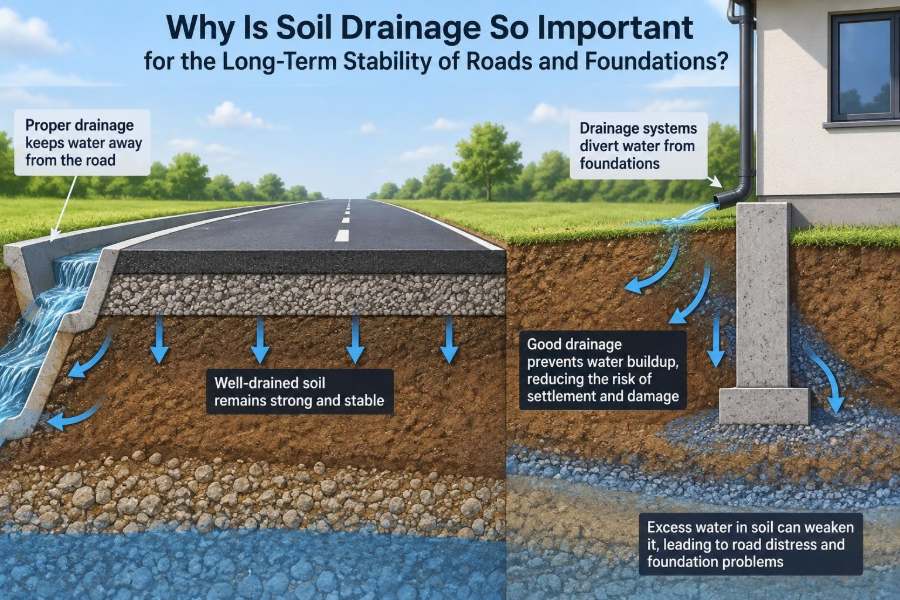
A road surface distributes wheel loads across base layers and into the subgrade. If water weakens the subgrade, the base and asphalt or concrete above it must bridge a less reliable support layer.
Repeated traffic then causes permanent deformation. Flexible pavements may rut or fatigue crack, while rigid pavements can lose uniform support and develop cracking, joint distress, or faulting.
🚚 Repeated Traffic Magnifies Small Weaknesses
One truck crossing a slightly wet road may cause no obvious damage. Thousands of axle passes can gradually compact, shear, and displace weak material beneath the wheel paths.
Water also enters through existing cracks. That creates a damaging feedback loop: cracking admits moisture, moisture weakens support, and weaker support allows more cracking.
🕳️ Potholes Often Begin Below the Surface
A pothole is rarely just a surface problem. Water can enter through a crack, joint, or failed edge; soften the underlying material; and allow traffic to break the weakened surface into pieces.
Filling the hole restores ride quality temporarily, but it may not address the wet base, blocked outlet, or damaged edge that caused the failure. Durable repair often requires removing deteriorated layers and restoring drainage as well as surfacing.
🏠 Foundations Depend on Consistent Support
Most foundation problems are not caused by water alone but by uneven changes in soil moisture or strength. If one area of soil settles, swells, erodes, or softens more than another, the building can experience differential movement.
Structures tolerate some uniform movement better than uneven movement. Differential settlement can distort frames, crack brittle finishes, strain utility lines, and affect doors and windows.
📉 Consolidation Settlement Takes Time
In saturated clay, a new load initially increases pore-water pressure. As water slowly drains from the clay, the soil particles move closer together and settlement occurs. This time-dependent process is called consolidation.
Drainage conditions affect both the rate and pattern of settlement. A foundation on compressible clay may require staged construction, preloading, vertical drains, deep foundations, or another engineered solution, depending on the project and ground investigation.
🌱 Expansive Clay Moves with Moisture Changes
Some clay-rich soils expand when wetted and shrink when dried. A leaking pipe beside one side of a house, for example, can create a localized moisture difference that causes uneven heave or settlement.
Drainage around buildings on expansive soil should manage water consistently. The goal is not necessarily to make the soil completely dry; abrupt, uneven wetting is often the greater concern.
❄️ Frost Makes Drainage a Cold-Climate Issue
Where freezing occurs, water in frost-susceptible soil can migrate toward a freezing zone and form ice lenses. These lenses lift roads, slabs, and shallow foundations.
When thaw arrives, the soil may be wet and weak, making it vulnerable to traffic damage. Appropriate granular layers, drainage, insulation where suitable, and frost-aware detailing help manage this risk.
🌧️ Surface Water Must Leave the Site
The first drainage task is simple: prevent water from lingering near the asset. Pavements need appropriate crossfall, longitudinal grade, gutters, inlets, ditches, or swales so rainfall reaches a safe outlet.
Flat areas are not automatically wrong, but they demand careful control of levels and drainage paths. Small construction errors can create persistent ponding beside a road edge, at a foundation wall, or over a pavement joint.
⬇️ Subsurface Drainage Removes Water Within Layers
Surface grading cannot control all water. Rainwater can infiltrate through pavement cracks, groundwater can rise from below, and seepage can move laterally through permeable layers.
Subsurface systems may use drainage blankets, perforated pipes, trench drains, drainage layers, or edge drains. Their job is to provide a low-resistance path for water to leave before it accumulates where strength is needed.
🧵 Filters Keep Drains from Clogging
A drain that carries water but also draws fine soil into a pipe or gravel layer can fail in two ways: the drain clogs, and the surrounding soil loses particles. That particle movement is often called internal erosion or piping, depending on the setting.
Properly designed granular filters or geotextile filters allow water through while retaining soil. Filter selection must match the adjacent soil; simply placing any fabric around any drain is not a reliable design method.
🧱 Drainage Layers Also Provide Structural Value
Well-graded aggregate base layers beneath roads can improve drainage and spread loads. Under slabs and foundations, free-draining granular layers may help limit capillary moisture and provide a workable construction platform.
However, a drainage layer needs an outlet. A highly permeable layer with no way to discharge water can become a reservoir rather than a solution.
🚧 Road Edges Are Frequent Weak Points
The pavement edge receives less confinement than the center of a lane and is often exposed to runoff from shoulders and adjacent ground. Trucks that regularly track near the edge can accelerate damage where the shoulder is saturated or poorly supported.
Sealed shoulders, stable side slopes, edge drains, and sound ditch maintenance can protect the pavement far beyond the narrow strip where they are installed.
🏞️ Ditches and Culverts Need a Real Outlet
Drainage features work as a network. A curb inlet that leads to a blocked pipe, an edge drain that discharges uphill, or a ditch with an eroded outlet does not provide dependable protection.
Design should follow water from its source to a lawful, stable receiving point. This includes considering downstream erosion, backwater during storms, sediment accumulation, and maintenance access.
🔍 Groundwater Requires Site-Specific Investigation
Groundwater depth can vary by season, rainfall, nearby water bodies, pumping, and development patterns. A borehole observed on one day gives useful information, but it may not represent the highest water level the project will encounter.
Investigations may include boreholes, trial pits, piezometers, laboratory testing, and review of geology and nearby drainage conditions. The appropriate scope depends on project scale, consequences, and uncertainty.
🏗️ Construction Can Damage the Drainage Design
Even a well-designed system can fail during construction. Heavy equipment can compact a drain blanket, soil can contaminate clean aggregate, pipes can lose their designed fall, and temporary water can soften exposed subgrade.
Good practice includes protecting formation level, inspecting pipe alignment and outlets, keeping drainage aggregate clean, and sequencing work so water is controlled throughout construction rather than only at handover.
🧭 Grading Around Buildings Deserves Attention
Finished ground should generally guide runoff away from a building rather than toward the walls. Roof downpipes should discharge to a managed drainage route, not immediately beside a footing.
Landscaping can unintentionally change drainage years later. Raised beds, impermeable patios, blocked gullies, and altered slopes can direct water toward the structure even if the original construction was sound.
🚿 Leaks Can Be as Harmful as Rain
A persistent leak from a water line, storm drain, sewer, or irrigation system may introduce water continuously in one location. It can soften susceptible soil, wash out fine particles, or trigger volume change in expansive clay.
Warning signs include unexplained wet ground, recurring local settlement, unusually vigorous vegetation, or a sudden change in drainage flow. Investigation should identify the source before cosmetic repairs are made.
🧰 Maintenance Is Part of the Engineering System
Drainage infrastructure is not “install and forget.” Leaves, sediment, vegetation, pavement debris, and damaged grates can restrict flow. Outlet headwalls and ditch linings can also erode or become blocked.
- Inspect inlets, ditches, and outlets before and during wet seasons.
- Remove sediment where it reduces capacity or blocks pipe openings.
- Seal pavement cracks before infiltration becomes widespread.
- Repair damaged slopes, channels, and erosion protection promptly.
- Check that roof and site drainage still directs water away from foundations.
⚠️ Common Drainage Mistakes
A frequent mistake is treating drainage as a finishing item after structural and architectural decisions are fixed. By then, there may be no practical fall for pipes, no route to an outlet, or no room for maintenance access.
- Relying on a drain without verifying its outlet.
- Using open-graded aggregate without a suitable filter or separator.
- Allowing fill placement on wet, pumping subgrade.
- Ignoring water from adjacent properties or upslope land.
- Sending concentrated discharge onto an unprotected soil slope.
Each mistake can be avoided more economically during planning than after movement or pavement damage appears.
🧪 Testing Helps Match Design to Ground Conditions
Field and laboratory testing can identify gradation, plasticity, moisture condition, density, permeability, strength, and compressibility. For road work, engineers may assess subgrade support and compaction quality. For foundations, they evaluate bearing behavior, settlement potential, and groundwater conditions.
No single test explains every drainage risk. Interpretation should combine test results with site topography, construction details, expected loading, and the likely movement of water through the entire site.
📐 Design Is a Balance, Not a Single Product
More drainage is not always better. Aggressive dewatering can cause settlement in some soils, affect neighboring ground, or create discharge and environmental issues. Deep drains may also be costly or difficult to maintain.
The appropriate approach balances structural performance, local soil behavior, climate, outlet availability, construction constraints, maintenance capacity, and applicable regulations. A simple swale may suit one site; another may need engineered underdrains and groundwater control.
🗺️ A Practical Design Sequence
Reliable drainage begins by asking where water comes from, where it travels, where it can safely go, and what happens if a component becomes partially blocked.
- Investigate soil layers, groundwater, slopes, and existing flow paths.
- Set road and building levels that support positive surface drainage.
- Control infiltration and collect runoff near vulnerable areas.
- Provide subsurface drainage where water can reach structural layers.
- Use compatible filters, separators, and erosion protection.
- Provide accessible, stable outlets and a maintenance plan.
- Inspect construction so the installed system matches the design intent.
🔄 Climate and Land Use Can Change Water Conditions
New paving, roof areas, upstream development, changed landscaping, and more intense rainfall patterns can alter both runoff volume and the places where water concentrates. An old ditch or culvert may no longer serve the conditions for which it was built.
Designing for inspection, adaptation, and sensible overflow paths improves resilience when future conditions differ from present assumptions.
👷 When to Seek Specialist Advice
Professional geotechnical and civil engineering input is especially valuable where there are soft or expansive soils, high groundwater, steep slopes, significant fill, recurring pavement failure, retaining walls, or signs of building movement.
Visible cracking alone does not diagnose the cause. Drainage may be involved, but movement can also arise from structural defects, tree-related moisture changes, poor fill, utility trenches, or multiple interacting factors.
✅ The Core Principle: Keep Support Conditions Predictable
The purpose of drainage is not merely to move rainwater away quickly. It is to keep the soil supporting a road or foundation within the moisture and pressure conditions anticipated by the design.
That requires a complete system: sensible grading, controlled infiltration, suitable subsurface paths, filters, protected outlets, sound construction, and routine maintenance. When one link fails, water can find its way back to the soil that matters most.
Long-term stability depends on managing water as carefully as managing loads, because the strength of soil support can change when its drainage conditions change. 🌧️🛣️🏠